
Other News
Africa Climate Adaptation Costs Could Soar to USD $350 Billion Annually by 2070
WARSAW – Africa faces huge financial challenges in adapting to climate change, according to a new report by the UN Environment Programme (UNEP) that spells out the costs faced by the continent if governments fail to close the emissions gap to keep warming below 2°C.
Adaptation costs for Africa could reach approximately USD $ 350 billion annually by 2070 should the two-degree target be significantly exceeded, while the cost would be around USD $150 billion lower per year if the target was to be met.
Africa’s Adaptation Gap, released today and endorsed by the African Ministerial Conference on the Environment (AMCEN) whose secretariat is hosted by UNEP, confirms the World Bank’s Turn Down the Heat Reports that there is a 40 per cent chance that we will inhabit a 3.5-4°C World’ if mitigation efforts are not stepped up from current levels.
Africa is already facing adaptation costs in the range of US $7-15 billion per year by 2020.
These costs will rise rapidly after 2020, since higher levels of warming will result in higher impacts.
Combining adaptation costs with residual damages, the total costs can reach 4 per cent of Africa’s Gross Domestic Product (GDP) by 2100, under a 3.5-4°C scenario.
If no adaptation measures are taken, damages are expected to cost 7 per cent of African GDP by 2100 in a 3.5-4°C World’, according to the Africa Gap report.
The report further cautions that, even if the world does manage to get on track to keep warming below 2°C, Africa’s adaptation costs will still hover around USD $35 billion per year by the 2040s and USD $200 billion per year by the 2070s with total costs reaching 1 per cent of the continent’s GDP by 2100.
Missing the 2°C window will not only cost governments billions of dollars but will risk the lives and livelihoods of hundreds of millions of people on the African continent and elsewhere, said UN Under-Secretary General and UNEP Executive Director, Achim Steiner.
Even with a warming scenario of under 2°C by 2050, Africa’s undernourished would increase 25 – 90 per cent. Crop production will be reduced across much of the continent as optimal growing temperatures are exceeded. The capacity of African communities to cope with the impacts of climate change will be significantly challenged.
I would like to welcome the decision by AMCEN to endorse the recommendations of the Africa Gap report; an important step towards strengthening political will and building resilient national policies.
Additional adaptation funding and technical know-how are imperative if Africa is to move towards a climate-resilient green future path. There is for example a need to develop drought-resistant crops, build early warning systems, invest in renewable energy sources and ensure that the catastrophic impacts of climate change are controlled or, better still, avoided ,he added.
UNEP’s Emissions Gap Report – launched days ahead of the UN Climate Conference in Warsaw analyzes in much more detail and confirms that current pledges by individual countries to limit emissions by 2020 would lead to a global temperature increase of about 3.5-4°C warming by 2100 unless emissions are reduced now and substantially reduced afterwards.
Even if nations meet their current climate pledges, greenhouse gas emissions in 2020 are likely to be 8 to 12 gigatonnes of CO2 (GtCO2e) above the level that would provide a likely chance of remaining on the least-cost pathway consistent with holding warming below 2°C.
Africa cannot risk failure of implementing serious adaptation measures, especially with Africa’s predicted population rise of 2 billion by 2050 and the current ecosystem degradation trajectory, said President of AMCEN and Minister of State for the Environment, United Republic of Tanzania, Dr. Terezya L. Huvisa.
Africa Warming
In a 3.5-4°C World’, Africa’s coastline is expected to undergo sea-level rise 10 per cent higher than the rest of the world, with several countries particularly hard hit.
In Guinea-Bissau, Mozambique, and The Gambia, up to 10 per cent of the entire population would risk flooding risks annually by 2100.
Arid areas in Africa, which already represent about half of the continent’s land area, are expected to increase by 4 per cent.
If we enter a 3°C World’, effectively all of the present maize, millet, and sorghum cropping areas across Africa would become unsustainable for current strains.
In a 4°C World’, southern Africa will likely see decreases of up to 30 per cent in rainfall each year.
At the same time, north, west, and southern Africa will also see declines of 50-70 per cent in groundwater recharge, according to the study.
The study further details how agriculture, fisheries and water access among other sectors will be impacted.
The degree to which these sectors will be impacted will depend on whether commitments are kept and whether better adaptation practices can be implemented.
The study points to a high risk of biodiversity loss, as species may be unable to migrate to suitable climates.
Up to 97 per cent of the 5,000 plant species studied could undergo range size reductions or shifts, while up to 40 per cent could experience total range elimination by 2085 in a 2°C World’ scenario.
At the same time, a 3.5-4°C’ scenario projects fish declines in freshwater lakes across places such as Chilwa, Kariba, Malawi, Tanganyika and Victoria, which would jeopardize the source of more than 60 per cent of the protein needs of the surrounding communities.
Perhaps the most drastic example of the effects of climate change in Africa is that coral reefs which are essential support systems for marine fisheries, tourism, and coastal protection against sea-level rise and storm surges are projected to be entirely extinct before we even enter a 4°C World’.
Adaptation Funding: Opportunities and Challenges
How well Africa deals with these climate impacts, now and in the future, will be co-determined by the funding it receives.
Adaptation measures such as early warning systems and coastal zone management to counter sea-level rise offer a possibility of minimizing these impacts, but Africa’s capacity to adapt depends critically on access to funding.
Traceable funding disbursed in Africa for climate change adaptation through bilateral and multilateral channels for the years 2010 and 2011 amounted to USD $743 and $454 million, respectively, although this figure does not fully account for the funding channeled through Development Finance Institutions, for example the World Bank, or national development banks.
To meet the adaptation costs estimated in the report for Africa by the 2020s, funds disbursed annually would need to grow at an average rate of 10-20 per cent a year from 2011 to the 2020s.
There is currently no clear, agreed pathway to provide these resources.
The UN Framework Convention on Climate Change’s developed country Parties have committed to provide funds rising to USD $ 100 billion annually by 2020 through the Green Climate Fund established by the 2010 Cancun Agreements from public and private sources, for both adaptation and mitigation actions in across all developing countries by 2020.
However, rules drawing up the allocation of funding for adaptation have yet to be defined and await negotiation.
At this stage, there is no clear sense of how much of these funds would benefit countries in the African region, nor of the likely allocation between adaptation and mitigation funding.
Until these issues are resolved it is not possible to assign a share of the USD $100 billion annual commitment by 2020 to Africa.
Assuming funding for adaptation efforts in Africa reached adequate levels by 2020 and assuming the world gets on track to limit warming to below 2°C, annual funding for adaptation efforts in Africa still needs to rise a further 7 per cent a year from the 2020s onwards to keep pace with continuing sea-level rise and warming peaking below 2°C after the 2050s.
This is considerably less than the funding challenge if the current mitigation efforts were not increased, and warming reached 3.5-4°C by 2100.
In this case, the scaling up of annual funds would need to be 10 per cent every year after the 2020s.
Challenged Capacity
In all scenarios, the capacity of African communities to cope with the effects of climate change on different economic sectors and human activities is expected to be significantly challenged, and potentially overwhelmed, by the magnitude and rapid onset of climate change impacts.
To reduce the magnitude of the impacts and their repercussions for African livelihoods, adaptation measures at different levels, from households to national and regional levels, are being planned and implemented and need to be further supported and strengthened.
These measures include:
The development of early-warning systems for floods, droughts or fires to help populations anticipate and prepare for the occurrence of extreme events;
Irrigation, improvement in water storage capacity, reforestation to protect surface water systems, sustainable use of groundwater resources, desalinization of seawater, and rainwater catchments and storage to maintain sufficient and reliable access to freshwater for human and agricultural needs;
City infrastructure protection measures such as seawalls, dykes, wave breakers and other elements of coastal zone management, as well as city-level food storage capacity and urban agriculture to enhance food security;
Improving design and drainage technology of sanitation facilities to reduce the risk of water-borne diseases in the aftermath of extreme weather events.
The majority of these and other adaptation measures require an anticipatory and planned approach, as well as large investments. The need for planned capital-intensive adaptation is greater at high than low warming levels.


WARSAW – Africa faces huge financial challenges in adapting to climate change, according to a new report by the UN Environment Programme (UNEP) that spells out the costs faced by the continent if governments fail to close the “emissions gap” to keep warming below 2°C.
Adaptation costs for Africa could reach approximately USD $ 350 billion annually by 2070 should the two-degree target be significantly exceeded, while the cost would be around USD $150 billion lower per year if the target was to be met.
 Africa’s Adaptation Gap, released today and endorsed by the African Ministerial Conference on the Environment (AMCEN) whose secretariat is hosted by UNEP, confirms the World Bank’s Turn Down the Heat Reports that there is a 40 per cent chance that we will inhabit a ‘3.5-4°C World’ if mitigation efforts are not stepped up from current levels.
• Africa is already facing adaptation costs in the range of US $7-15 billion per year by 2020.
•These costs will rise rapidly after 2020, since higher levels of warming will result in higher impacts.
•Combining adaptation costs with “residual” damages, the total costs can reach 4 per cent of Africa’s Gross Domestic Product (GDP) by 2100, under a 3.5-4°C scenario.
•If no adaptation measures are taken, damages are expected to cost 7 per cent of African GDP by 2100 in a ‘3.5-4°C World’, according to the Africa Gap report.
The report further cautions that, even if the world does manage to get on track to keep warming below 2°C, Africa’s adaptation costs will still hover around USD $35 billion per year by the 2040s and USD $200 billion per year by the 2070s —with total costs reaching 1 per cent of the continent’s GDP by 2100.
“Missing the 2°C window will not only cost governments billions of dollars but will risk the lives and livelihoods of hundreds of millions of people on the African continent and elsewhere,” said UN Under-Secretary General and UNEP Executive Director, Achim Steiner.
“Even with a warming scenario of under 2°C by 2050, Africa’s undernourished would increase 25 – 90 per cent. Crop production will be reduced across much of the continent as optimal growing temperatures are exceeded. The capacity of African communities to cope with the impacts of climate change will be significantly challenged.”
“I would like to welcome the decision by AMCEN to endorse the recommendations of the Africa Gap report; an important step towards strengthening political will and building resilient national policies.”
“Additional adaptation funding and technical know-how are imperative if Africa is to move towards a climate-resilient green future path. There is for example a need to develop drought-resistant crops, build early warning systems, invest in renewable energy sources and ensure that the catastrophic impacts of climate change are controlled or, better still, avoided ,” he added.
UNEP’s Emissions Gap Report – launched days ahead of the UN Climate Conference in Warsaw – analyzes in much more detail and confirms that current pledges by individual countries to limit emissions by 2020 would lead to a global temperature increase of about 3.5-4°C warming by 2100 – unless emissions are reduced now and substantially reduced afterwards.
Even if nations meet their current climate pledges, greenhouse gas emissions in 2020 are likely to be 8 to 12 gigatonnes of CO2 (GtCO2e) above the level that would provide a likely chance of remaining on the least-cost pathway consistent with holding warming below 2°C.
“ Africa cannot risk failure of implementing serious adaptation measures, especially with Africa’s predicted population rise of 2 billion by 2050 and the current ecosystem degradation trajectory,” said President of AMCEN and Minister of State for the Environment, United Republic of Tanzania, Dr. Terezya L. Huvisa.
Africa Warming
In a ‘3.5-4°C World’, Africa’s coastline is expected to undergo sea-level rise 10 per cent higher than the rest of the world, with several countries particularly hard hit.
In Guinea-Bissau, Mozambique, and The Gambia, up to 10 per cent of the entire population would risk flooding risks annually by 2100.
Arid areas in Africa, which already represent about half of the continent’s land area, are expected to increase by 4 per cent.
If we enter a ‘3°C World’, effectively all of the present maize, millet, and sorghum cropping areas across Africa would become unsustainable for current strains.
In a ‘4°C World’, southern Africa will likely see decreases of up to 30 per cent in rainfall each year.
At the same time, north, west, and southern Africa will also see declines of 50-70 per cent in groundwater recharge, according to the study.
The study further details how agriculture, fisheries and water access—among other sectors—will be impacted.
The degree to which these sectors will be impacted will depend on whether commitments are kept and whether better adaptation practices can be implemented.
The study points to a high risk of biodiversity loss, as species may be unable to migrate to suitable climates.
Up to 97 per cent of the 5,000 plant species studied could undergo range size reductions or shifts, while up to 40 per cent could experience total range elimination by 2085 in a ‘2°C World’ scenario.
At the same time, a ‘3.5-4°C’ scenario projects fish declines in freshwater lakes across places such as Chilwa, Kariba, Malawi, Tanganyika and Victoria, which would jeopardize the source of more than 60 per cent of the protein needs of the surrounding communities.
Perhaps the most drastic example of the effects of climate change in Africa is that coral reefs—which are essential support systems for marine fisheries, tourism, and coastal protection against sea-level rise and storm surges—are projected to be entirely extinct before we even enter a ‘4°C World’.
Adaptation Funding: Opportunities and Challenges
How well Africa deals with these climate impacts, now and in the future, will be co-determined by the funding it receives.
Adaptation measures such as early warning systems and coastal zone management to counter sea-level rise offer a possibility of minimizing these impacts, but Africa’s capacity to adapt depends critically on access to funding.
Traceable funding disbursed in Africa for climate change adaptation through bilateral and multilateral channels for the years 2010 and 2011 amounted to USD $743 and $454 million, respectively, although this figure does not fully account for the funding channeled through Development Finance Institutions, for example the World Bank, or national development banks.
To meet the adaptation costs estimated in the report for Africa by the 2020s, funds disbursed annually would need to grow at an average rate of 10-20 per cent a year from 2011 to the 2020s.
There is currently no clear, agreed pathway to provide these resources.
The UN Framework Convention on Climate Change’s developed country Parties have committed to provide funds rising to USD $ 100 billion annually by 2020 through the “Green Climate Fund”—established by the 2010 Cancun Agreements—from public and private sources, for both adaptation and mitigation actions in across all developing countries by 2020.
However, rules drawing up the allocation of funding for adaptation have yet to be defined and await negotiation.
At this stage, there is no clear sense of how much of these funds would benefit countries in the African region, nor of the likely allocation between adaptation and mitigation funding.
Until these issues are resolved it is not possible to assign a share of the USD $100 billion annual commitment by 2020 to Africa.
Assuming funding for adaptation efforts in Africa reached adequate levels by 2020 and assuming the world gets on track to limit warming to below 2°C, annual funding for adaptation efforts in Africa still needs to rise a further 7 per cent a year from the 2020s onwards to keep pace with continuing sea-level rise and warming peaking below 2°C after the 2050s.
This is considerably less than the funding challenge if the current mitigation efforts were not increased, and warming reached 3.5-4°C by 2100.
In this case, the scaling up of annual funds would need to be 10 per cent every year after the 2020s.
Challenged Capacity
In all scenarios, the capacity of African communities to cope with the effects of climate change on different economic sectors and human activities is expected to be significantly challenged, and potentially overwhelmed, by the magnitude and rapid onset of climate change impacts.
To reduce the magnitude of the impacts and their repercussions for African livelihoods, adaptation measures at different levels, from households to national and regional levels, are being planned and implemented and need to be further supported and strengthened.
These measures include:
• The development of early-warning systems for floods, droughts or fires to help populations anticipate and prepare for the occurrence of extreme events;
•Irrigation, improvement in water storage capacity, reforestation to protect surface water systems, sustainable use of groundwater resources, desalinization of seawater, and rainwater catchments and storage to maintain sufficient and reliable access to freshwater for human and agricultural needs;
•City infrastructure protection measures such as seawalls, dykes, wave breakers and other elements of coastal zone management, as well as city-level food storage capacity and urban agriculture to enhance food security;
•Improving design and drainage technology of sanitation facilities to reduce the risk of water-borne diseases in the aftermath of extreme weather events.
The majority of these and other adaptation measures require an anticipatory and planned approach, as well as large investments. The need for planned capital-intensive adaptation is greater at high than low warming levels.

The Economic and Financial Crimes Commission (EFCC) and the National Judicial Institute (NJI) have called for specialised judges, improved digital evidence management and legal reforms to accelerate the prosecution of corruption and other financial crime cases in Nigeria.
The recommendations were contained in a communiqué issued at the end of the 8th Capacity Building Workshop for Justices and Judges, held in Abuja from October 13 to 15, 2026.
The workshop, organised by the EFCC in collaboration with the NJI, was themed “Investigation and Prosecution of Economic and Financial Crimes in a Digital Age.”
SEE MORE: EFCC Arrests Enugu Estate MD Over Alleged N128m Land Scam
According to a statement signed by the EFCC’s Head of Media and Publicity, Dele Oyewale, the workshop brought together justices and judges from across the country, alongside EFCC investigators and prosecutors, for three days of lectures and deliberations.
Participants resolved that designating specialised judges and court staff to handle corruption cases, alongside targeted training, would help address delays in the administration of justice.
According to the communiqué, delays in resolving corruption cases “will be greatly reduced by designating specialised judges and court staff to handle such cases as well as equipping such judges and courts with necessary skills through training to ensure efficient, certain and consistent application of existing laws in the administration of justice.”
The participants also called for a balance between protecting the rights of defendants and ensuring the speedy administration of justice.
They said the criminal justice system “must strike the proper balance between fairness, efficiency and legal certainty in the protection of individual rights on one hand and the speedy administration of justice, on the other hand.”
To achieve this, they recommended reviewing relevant provisions of the Administration of Criminal Justice Act where necessary.
EFCC, NJI Seek Better Digital Evidence Management
The participants called for stronger investigation standards, including improved digital management protocols, to ensure that prosecutions rely on credible and admissible evidence.
They also recommended a more coordinated approach to obtaining confessional statements, stressing that institutionalising video recording and other necessary safeguards would protect suspects’ rights and preserve the integrity of investigations.
On asset recovery, the communiqué described Non-Conviction Based Asset Forfeiture proceedings as “an effective tool for recovery of stolen assets.”
However, participants stressed that its use “must follow extant legal protocols, adherence to human rights standards and strong institutional oversight.”
They also called for procedural reforms to allow extensions of time for freezing suspected proceeds of financial crimes.
Participants Recommend AI Guidelines for Judiciary
The communiqué further called on Ministries, Departments and Agencies in the anti-corruption sector to work with the National Assembly and the Judiciary to develop governance protocols and policy guidelines for adopting and deploying artificial intelligence in the administration of justice.
Participants also urged stakeholders to familiarise themselves with existing laws and regulations governing the investigation, prosecution and adjudication of financial crime cases involving virtual assets.
These include the Investment and Securities Act (2025), the Executive Order on Virtual Assets Coordination (2026), the Rules on Digital and Virtual Assets Operations (2026) and the Proceeds of Crime Act (2022).
The workshop also highlighted the need for increased investment in digital forensic laboratories, technology infrastructure and specialised training for investigators, prosecutors and judicial officers.
Participants called for continuous training to equip judicial officers and anti-corruption agencies with the skills required to address evolving economic and financial crimes in line with global best practices.
On the use of open-source intelligence, they said investigators, prosecutors and judicial officers should treat it primarily as a source of investigative leads and corroboration, while ensuring that evidence relied upon in court complies with applicable evidential rules.
NJI, NJC Urged to Develop Certification Courses
The communiqué recommended that the NJI, working with the National Judicial Council (NJC), develop accredited certificate and diploma courses to equip judges and other relevant stakeholders with the skills required to improve justice delivery, subject to any necessary legislative review.
Participants also called for sustained coordination among stakeholders in the administration of criminal justice, particularly in sharing information on emerging trends in the investigation and prosecution of economic and financial crimes in the digital age.
They urged heads of courts to use insights from the workshop to develop policies clarifying judicial practice on the technical issues discussed.
The workshop featured nine interactive sessions covering the admissibility of confessional statements, garnishee proceedings, abuse of court processes, asset forfeiture, artificial intelligence in investigations and prosecutions, virtual asset recovery and digital forensics.
Attendees included justices of the Supreme Court and Court of Appeal, judges of the Federal High Court, State High Courts and the High Court of the Federal Capital Territory, alongside other stakeholders in the judiciary and anti-corruption sector.
Participants expressed appreciation to President Bola Ahmed Tinubu, who was represented at the workshop by Vice-President Kashim Shettima, as well as other stakeholders and organisers who contributed to its success.

The Lagos State Traffic Management Authority (LASTMA) has alerted motorists to traffic delays along Ogunnusi Road towards Ojodu-Berger due to ongoing rehabilitation work.
LASTMA disclosed this in a post on its official X account on Sunday, stating that the road rehabilitation was being carried out by the Lagos State Public Works Corporation (LSPWC).
According to the agency, “The ongoing work is affecting traffic flow, with vehicles moving at a slower pace in both directions.”
ALSO READ: Chaos On Lagos-Ibadan Expressway As LASTMA Shuts Otedola Bridge
To ease the situation, LASTMA said a contraflow arrangement had been introduced for motorists travelling from Omole Junction towards Vis Junction.
“A contraflow arrangement is in place for vehicles coming from Omole Junction towards Vis Junction to facilitate the movement of traffic,” the agency stated.
LASTMA added that its personnel had been deployed to manage traffic and ensure the continuous movement of vehicles around the affected area.
“Our personnel are on ground managing the traffic situation and ensuring the continuous flow of vehicular movement,” the agency said.
The traffic management authority advised motorists to remain patient and exercise caution while the rehabilitation work continues.
“Motorists are advised to exercise patience and drive with caution while the rehabilitation work continues,” LASTMA stated.

Leading economists, financial experts and industry stakeholders have described the Dangote Group’s investments as major drivers of industrialisation and economic transformation across Nigeria and Africa.
The experts cited the Group’s impact on job creation, import substitution, foreign exchange conservation and economic competitiveness.
They voiced their thoughts at the Lagos Economic Summit themed “The Real Deal: Africa’s Greatest Investment Opportunity,” where they urged governments to implement policies that strengthen local industries and accelerate economic diversification.
President and Chief Executive Officer of the Africa Finance Corporation (AFC), Samaila Zubairu, commended the Dangote Group’s sustained investments across Africa, describing them as critical to unlocking the continent’s economic potential.
He noted that while recent economic reforms have improved foreign exchange stability, strengthened reserves and eased inflationary pressures, the focus must now shift to growth in industry, productivity and employment.
READ ALSO: NMDPRA Shares July Domestic Cooking Gas Supply Details
Also speaking, Chief Executive Officer of the Centre for the Promotion of Private Enterprise (CPPE), Muda Yusuf, said industrialisation remains the most effective path to sustainable economic development.
He called for better alignment of trade and industrial policies, stressing that local manufacturers require strategic support to compete effectively and drive broader economic benefits.
Founder and CEO of Nairametrics, Ugodre Obi-Chukwu, said Africa’s growing population presents a significant industrial opportunity, noting that investments such as the Dangote Refinery are helping to retain capital within the continent while strengthening local production capacity.
In his keynote address, Managing Director of Financial Derivatives Company Limited, Bismarck Rewane, said Nigeria is gradually transitioning from a consumption-led economy to one driven by investment and production.
He added that sustained investments in productive sectors will continue to stimulate growth, create jobs and improve living standards.
Participants at the summit also advocated stronger credit infrastructure, improved national identification systems and increased investment in skills development to enhance the productivity and global competitiveness of Africa’s growing youth population.
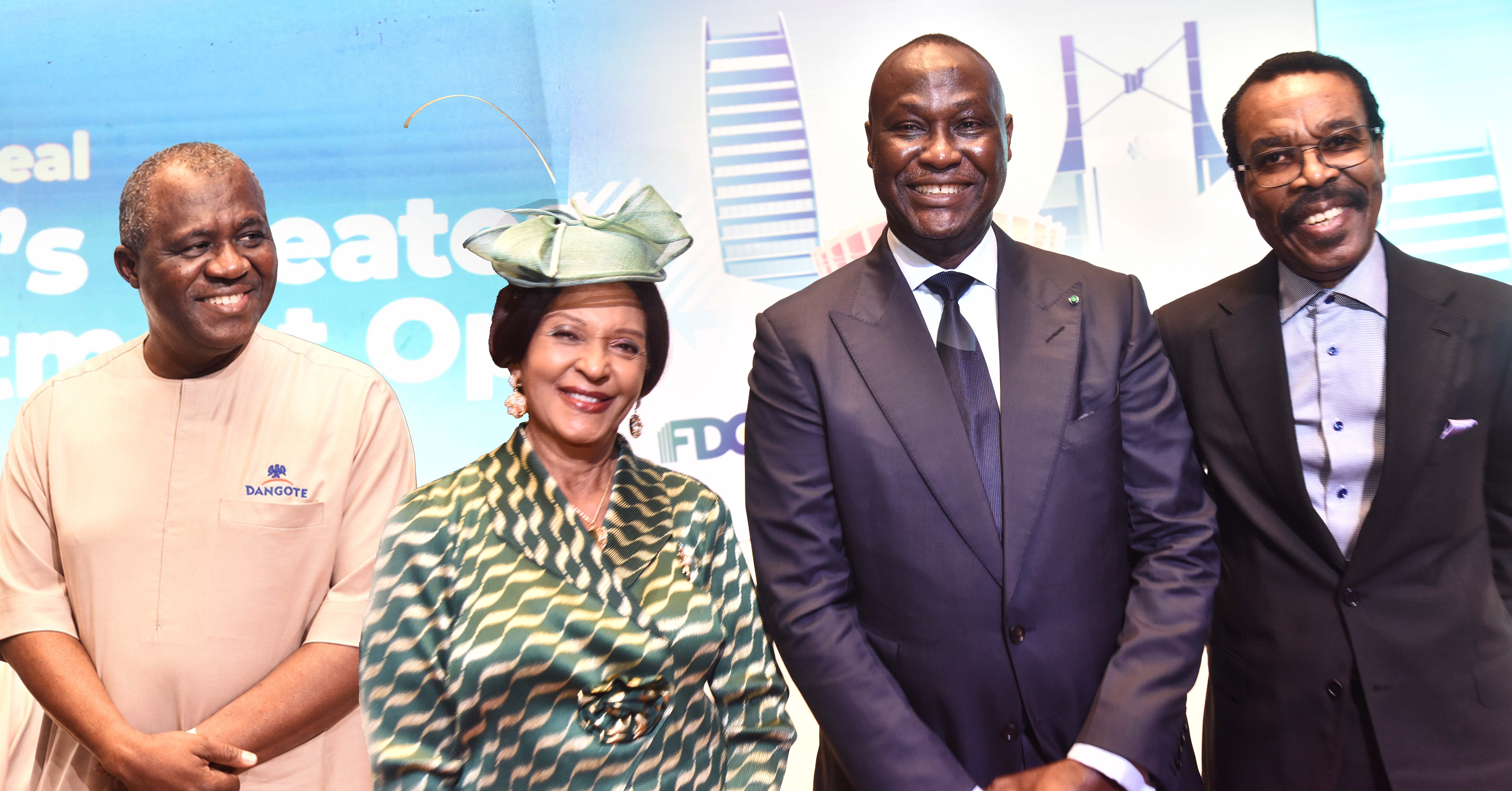
Photo Caption: From Left – Chief Economist, Dangote Industries Limited, Dr. Hassan Mahmud; Lady Maiden Alex-Ibru; Chairman of Occasion/Special Guest of Honour, Samaila Zubairu; Key Note Speaker Session 1, Bismarck Rewane; during the Real Deal: Africa’s Greatest Investment Opportunity, Sponsored by Dangote Industry Limited in Lagos on Thursday 3, September 2026.






INEC Opens Online Access to Voters’ Register After Public Outcry

ADC Replies Alake, Says APC’s ‘Falsehood’ Cannot Hide Tinubu’s Failures

‘How Did Tinubu Graduate Before School Existed?’ – ADC Challenges Shettima Over Atiku

Tinubu Congratulates Lula on Re-Election, Seeks Stronger Nigeria-Brazil Ties

Ebola: IGP Warns Nigerians Against Contact With Suspected Patients’ Body Fluids
‘Nigeria Cannot Do What China Did’ – Oxford Economist Warns

Trump’s Family Unveils New Cryptocurrency Platform

Senate Denies Receiving Petitions Against Tinubu’s Ambassadorial Nominees

Dangote Cement Lights Up Benue Host Communities With CSR Initiatives

Reps Recommend 3-year Jail Term For Aviation minister

Tems Sets New Record On Billboard Hot 100 Chart
