
Politics
Aiyedatiwa Wins Ondo APC’s Governorship Ticket

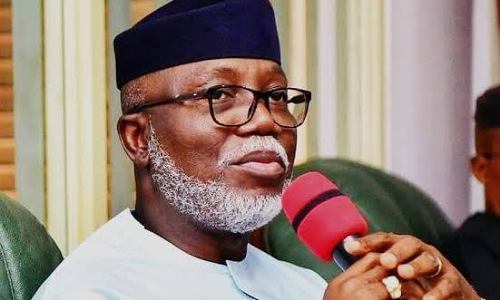
Ondo State Governor, Mr. Lucky Aiyedatiwa, clinches victory in the highly contested governorship primary of the ruling All Progressives Congress.
With a commanding total of 48,460 votes from across the 18 local government areas, Aiyedatiwa emerges as the frontrunner.
The announcement was made on Sunday by the Primary Election Committee led by Kogi State Governor, Mr. Usman Ododo, following a closely watched electoral process held across 203 wards amidst protests by several governorship aspirants.
A robust lineup of 16 party members fiercely contested the party’s ticket in Saturday’s primary election.
Notable contenders included Aiyedatiwa, Chief Olusola Oke, SAN, Wale Akinterinwa, Prince Diran Iyantan, Prof Dayo Faduyile, Mr. Gbenga Edema, Mr. Jimi Odimayo, and Dr. Jimoh Ibrahim.
Also in the fray were Brig. Gen. Olamide Ohunyeye (retd), Mr. Diran Iyantan, Ife Oyedele, Mr. Soji Ehinlawo, Mrs. Funmilayo Waheed-Adekojo, Mr. Morayo Lebi, and Mrs. Funke Omogoroye.
The national leadership of the party established a nine-man committee chaired by Ododo, with Senator Ovie Omo-Agege serving as the secretary.
Ododo, who arrived in the state on Saturday morning, engaged with some of the disgruntled stakeholders at the distribution center, located at a hotel in the Ijapo area of Akure.
He assured them that the electoral materials had been dispatched to the Ondo South and Ondo North senatorial districts, with only the materials for the Ondo Central district pending (as of 10:30 a.m.).
The committee chairman said “There was no issue, I just came this (Saturday) morning, and I was told that the election materials have been taken to Ondo South and Ondo North Senatorial Districts.”
However, one of the aspirants, Gbenga Edema, contested the governor’s assertion, claiming that election materials had not been relocated. He stated, “I have been here since 6.30am and I didn’t see any material taken out of this place.
“The returning officers and electoral officers of my ward, Mahin Ward 2 in Ilaje Local Government are here and unable to collect any materials.
“What we are asking for is a credible election. So, we are asking the leadership of the party to look into this. If they’re not ready for this election, they should postpone it and the right thing should be done.”
Likewise, Sola Arowosafe, the Programme Officer of the Wale Akinterinwa Campaign Organization, called for the annulment of the entire process, alleging that the primary election committee had not conducted the process fairly.







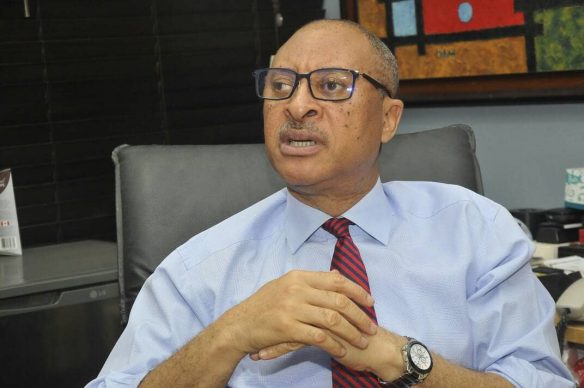
Political economist and former presidential candidate, Pat Utomi, has blamed election-related judicial decisions for the declining public perception of Nigeria’s judiciary, saying rulings on electoral disputes have contributed significantly to the loss of confidence in the institution.
Utomi said the impact of such decisions was evident in the questions ordinary Nigerians were asking about the judiciary, particularly when court judgments produce electoral outcomes that appear inconsistent with the results initially announced by the Independent National Electoral Commission (INEC).
Speaking in a video, he described election rulings as a major source of the judiciary’s diminishing public standing.
SEE ALSO: 2027: Sowore Disowns Involvement in Utomi-Led Single-Candidate Talks
“Elections and rulings on matters of elections have been the biggest source of the diminishing of the judiciary in Nigeria,” he said.
Utomi recalled visiting a rural community where residents questioned the logic behind judicial decisions determining electoral outcomes.
He cited the 2020 Imo State governorship election, in which the Supreme Court overturned the declaration of Emeka Ihedioha as governor and declared Hope Uzodimma the winner.
According to Utomi, the judgment had become an example cited by citizens questioning the credibility of the judicial process.
“They say to you, this kind of judiciary we have, when you have election, and number four suddenly becomes the winner. Is there any logic in this, your judiciary functions?” he said, recounting the concerns expressed by the residents.
The Supreme Court delivered the judgment on January 14, 2020, declaring Uzodimma of the All Progressives Congress (APC) the winner of the Imo State governorship election and removing Ihedioha of the Peoples Democratic Party (PDP) from office.
The decision generated considerable debate about the role of the judiciary in resolving electoral disputes and its implications for public confidence in Nigeria’s democratic institutions.
Utomi also questioned whether members of the legal profession were concerned about the effect of public perceptions on the dignity of the judiciary.
He challenged lawyers and judges to reflect on the declining respect for the profession and consider what could be done to restore public confidence in the courts.
“Is the legal profession, the bar, the bench, not concerned with the diminishing of… you know, used to be, somebody’s a lawyer in the nineteen fifties, people would say, ‘Wow, lawyer.’ But today people are saying judge,” he said.
He further questioned whether legal practitioners recognised the need to rebuild the judiciary’s reputation.
“Is there no professional sense of a need to reestablish dignity behind the bench?” Utomi asked.
His comments highlight concerns about the relationship between judicial decisions, electoral credibility and public trust in democratic institutions.
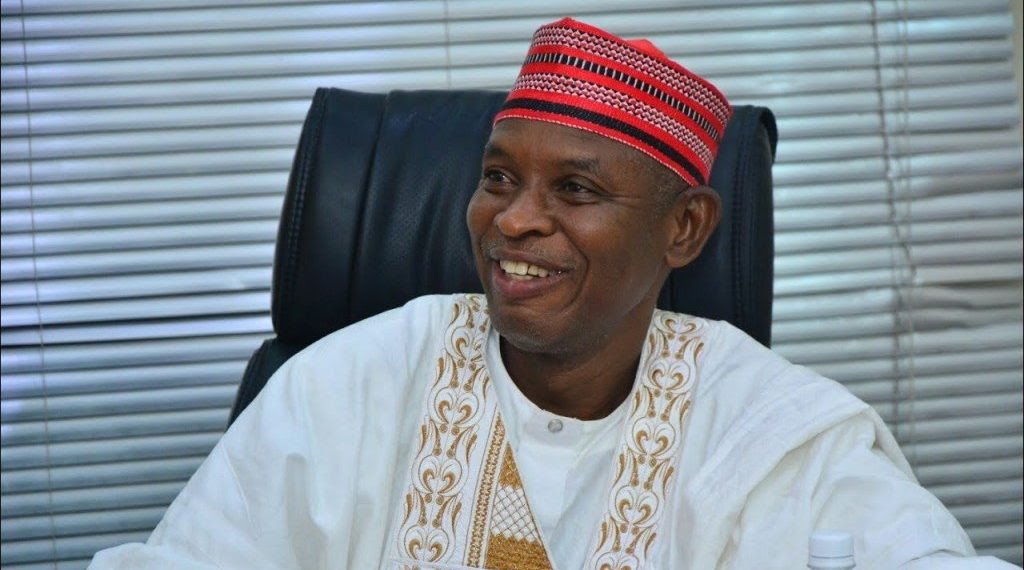
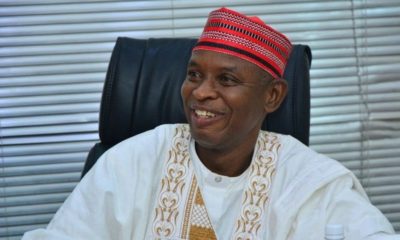
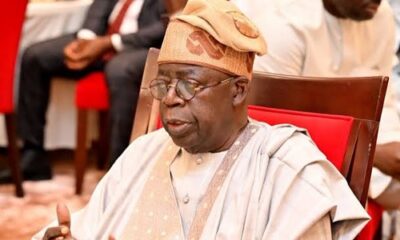
Kano State Governor Abba Kabir Yusuf has declared his support for President Bola Tinubu’s re-election bid in 2027, arguing that the North should respect an alleged power-sharing agreement between northern and southern political leaders.
Yusuf made the declaration at the unveiling of the Arewa for Asiwaju (A4A) National Headquarters in Abuja, where he pledged 100 per cent Northern support for Tinubu in the next presidential election.
SEE ALSO: DPRP’s Free Fuel Delivery Expands to Kano, Imo, Nearly 10 More States
The governor cited an alleged agreement reached in 1999 under which the North and South would take turns to produce Nigeria’s president, with the North allowed to serve two consecutive terms.
He referenced the eight years served by former President Muhammadu Buhari, who governed Nigeria for two consecutive terms before Tinubu assumed office in 2023.
According to Yusuf, the North should respect the arrangement rather than seek to produce another presidential candidate in 2027.
“For me, and for every right-thinking Nigerian, especially for us here in the North, we don’t have any reason, we don’t have any cause to now contribute on that premise, even though not constitutionally,” he said.
“Common sense dictates that we have to respect this mutual agreement.”
Yusuf subsequently declared his support for Tinubu on behalf of the northern states and what he described as patriotic Northerners.
“I therefore, on behalf of all the northern states, on behalf of all Democrats, on behalf of all patriotic northern states, indigenous, we want to assure His Excellency Bola Ahmed Tinubu of our full support one hundred percent,” the governor said.
He also urged members of the All Progressives Congress (APC) to openly support the president and work together towards victory in the 2027 election.
“We have all agreed we are members of the APC, and therefore we must work together to ensure that President Bola Ahmed Tinubu and his vice president emerge victorious,” Yusuf said.
The governor further called on party members to extend similar support to members of the National Assembly, state governors and members of state assemblies.
He congratulated the organisers of the event and wished participants well.
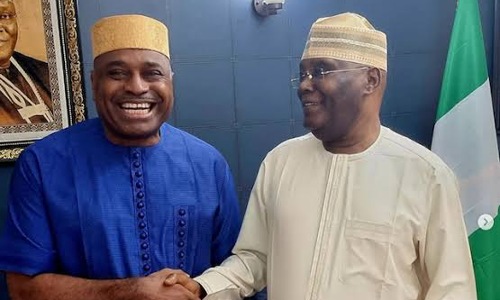
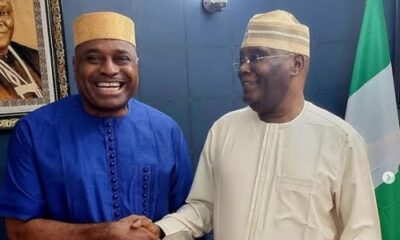
Kenneth Okonkwo has declared that Nigeria is “doomed under Tinubu” while urging Nigerians to support former Vice President Atiku Abubakar in the 2027 presidential election.
Okonkwo made the remarks in a statement shared on X on Saturday, October 17, in which he criticised President Bola Tinubu’s performance, citing the proposed 12-state presidential campaign tour, the country’s corruption ranking and the Federal Government’s debt-servicing costs.
He described Tinubu’s planned campaign coverage as an “F” performance, noting that the President would campaign in only 12 of Nigeria’s 36 states and the Federal Capital Territory.
SEE ALSO: 2027: ADC Chieftain Warns Kenneth Okonkwo Against ‘Insulting’ Remarks on Amaechi
“This is about 30% coverage of the entire Nigeria. This is an ‘F’ performance by Tinubu,” he said.
Okonkwo also criticised Tinubu for allegedly failing to grant regular interviews to independent media organisations or participate in a national debate with opposition candidates.
He argued that the President had not adequately engaged Nigerians directly to explain his plans and policies, describing him as an “absentee President” and questioning his suitability for re-election.
The former spokesperson for the Labour Party presidential campaign also cited Nigeria’s position in Transparency International’s Corruption Perceptions Index, stating that the country ranked 142nd out of 182 countries, with a score of 26 out of 100.
He described the ranking as another “F” performance under Tinubu’s administration.
On the economy, Okonkwo claimed that Nigeria was “technically bankrupt,” citing figures he said showed that the Federal Government spent ₦7.7 trillion on interest payments in the first half of 2026, compared with total revenue of ₦6.2 trillion.
According to him, interest payments exceeded government revenue by ₦1.5 trillion during the period.
Okonkwo further accused Tinubu of failing to achieve 30 per cent in his administration’s undertakings, describing the government as an “F” government.
He urged Nigerians to support Atiku in the 2027 presidential election, crediting the former vice president’s time in office with helping Nigeria exit its international debt through what he described as prudent management of national resources.
Okonkwo also defended Atiku’s position on fuel subsidies, arguing that the former vice president’s government had maintained fuel subsidies that made life more affordable for Nigerians.
He said Atiku had promised to restore a production-based petroleum subsidy to reduce the cost of refining fuel and make refined petroleum products more affordable.
The statement comes amid preparations for the 2027 presidential election, with political parties and opposition figures intensifying their criticism of the Tinubu administration.





‘World Bank’s 124% Debt Interest Figure Misleading’ – Finance Ministry Insists

‘Election Rulings Have Diminished Nigeria’s Judiciary’ – Utomi

NDLEA Arrests 85-Year-Old Woman With 179kg of Cannabis in Edo

Ambakederimo Questions NNPC Over Crude Oil Sales, Upfront Payments
South-South Group Opposes Coastal Road Alignment With East-West Road

Zamfara: Farmer rescued as search for 10 others continues

Trump’s Family Unveils New Cryptocurrency Platform

Senate Denies Receiving Petitions Against Tinubu’s Ambassadorial Nominees

Dangote Cement Lights Up Benue Host Communities With CSR Initiatives

Reps Recommend 3-year Jail Term For Aviation minister

Tems Sets New Record On Billboard Hot 100 Chart
