
Business
China rises as Euro zone stumbles


LONDON – Signs of an economic revival in China have raised hopes that Beijing’s targeted measures to bolster growth are having an impact but a slowdown in the euro zone will increase expectations of policy easing there.
Chinese factory activity expanded at the fastest pace in five months in May but euro zone manufacturing growth slowed more than initially thought, fuelling expectations that the European Central Bank will ease policy this week.
“The Chinese numbers were fractionally higher. We are beginning to make some progress but it is consistent with this story that the Chinese economy is not going to grow as fast as it has in the past,” said Peter Dixon at Commerzbank.
“The European numbers were in and around the ballpark. It’s not the kind of data the ECB is going to react to instantly but it is part of a bigger puzzle that says we need more growth in Europe.”
U.S. manufacturing growth probably accelerated in May, a report from the Institute for Supply Management (ISM) is expected to show later on Monday.
Markit’s final Manufacturing Purchasing Managers’ Index (PMI) for the euro zone slipped to a six-month low of 52.2 in May from April’s 53.4 as strong figures from Germany failed to offset a contraction in activity in France.
The final number was below the initial reading of 52.5 but held above the 50 mark that separates growth from contraction for the 11th straight month. A subindex measuring output sank to 54.3 from 56.5, weaker than the initial reading of 54.7.
“The slowdown in euro zone manufacturing activity in May reinforces belief that the ECB will deliver a package of measures at its 5 June policy meeting,” said Howard Archer at IHS Global Insight.
To spur growth, boost lending and drive up inflation the ECB is widely expected to cut its deposit rate to below zero, reduce its main borrowing rate and launch a refinancing operation aimed at businesses when it meets on Thursday.
Inflation in the 18 nations using the euro is predicted to have held steady at just 0.7 percent in May, well within the ECB’s “danger zone” of below 1 percent and also below its preferred 2 percent ceiling.
A key measure of German inflation, due later on Monday, is expected to have fallen in May.
Germany is Europe’s largest economy and again supported the tepid overall growth but in France, the bloc’s second-largest, the PMI sank back below the 50 mark after just two months of expansion.
In non-euro using Britain manufacturing activity kept expanding at a rapid pace in May, suggesting the economic recovery has lost little of its shine this quarter.
The reassuring Chinese factory data and another record high for Wall Street lifted world stocks and commodities on Monday, although markets are waiting to see how far the ECB will go with policy easing plans.
STRONGER CHINA
China’s official PMI, which is geared towards bigger, state-owned firms, rose to 50.8 in May, from April’s 50.4, the National Bureau of Statistics said on Sunday, beating market expectations of 50.6.
“Recent pro-growth measures, which were stepped-up further last Friday, may have lent a helping hand here,” said Nikolaus Keis at UniCredit.
China’s manufacturing data bolstered market expectations that the world’s second-largest economy is regaining strength as the government’s pro-growth measures kick in.
Beijing stepped up policy fine-tuning in recent weeks and has unveiled a slew of measures this year to help shore up the economy, which dipped to an 18-month low in the first quarter and is on track to post the weakest annual showing in 24 years.
China’s cabinet announced new easing measures on Friday to help lower funding costs and reduce operating burdens for companies to give more support for the real economy, adding to moves that included hastening construction of railways and public housing.
In South Korea, Asia’s fourth-largest economy and one of the leading manufacturing and export powerhouses, the HSBC/Markit manufacturing gauge slid below 50 while trade data showed exports fell.
In India, the manufacturing PMI edged up but came in slightly below the median forecast in a Reuters poll. Indonesia’s PMI surged to a record high but hopes were tempered after its trade balance slipped back into deficit in April after two consecutive months of surpluses.
– REUTERS

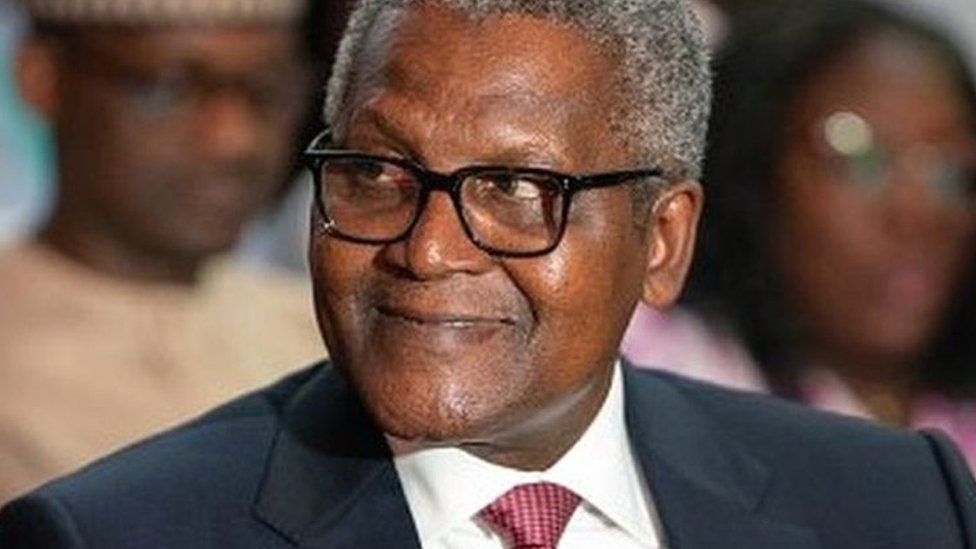
President/Chief Executive, Dangote Industries Limited, Aliko Dangote, has disclosed plans to increase the group’s investment programme in Africa from $50 billion to about $70 billion under its Vision 2030.
Biztellers reports that this strategy would witness a major intervention in electricity generation to support industrial growth, to the tune of 10,000-megawatt.
Addressing creative industry stakeholders from Northern Nigeria, including content creators, journalists, bloggers, entertainers and Kannywood stars, Dangote said expanding production, creating jobs and providing reliable electricity were essential to unlocking Nigeria’s economic potential.
He identified inadequate power supply as a major obstacle to the survival of small and medium-sized enterprises, warning that businesses dependent on petrol and diesel generators would struggle to remain profitable. Dangote said the group was considering a 10,000-megawatt power programme across Africa, potentially including Nigeria, alongside an expansion of the generating capacity dedicated to its own operations.
“We initially planned to invest $50 billion. We are now looking at increasing that to about $70 billion in Africa,” he said.
Explaining the ambition behind Vision 2030, Dangote said African businesses must take greater responsibility for investing in the continent and addressing the infrastructure constraints that discourage other investors.
READ ALSO: Chevron Nigeria Emerges Second-best Exhibitor at NAPE 2026
According to him, inconsistent government policies and unreliable electricity remain significant barriers to investment. He said the group had largely addressed the power challenge within its operations by generating its own electricity.
“Across the group, we currently have almost 1,500 megawatts. By the time we complete Vision 2030, that could rise to between 4,500 and 5,000 megawatts,” he said. “That is captive power—electricity for our own operations. Separately, part of the vision is to intervene in power generation with 10,000 megawatts across Africa, potentially including Nigeria.”
Responding to a question about the economic decision that would most improve the lives of ordinary Nigerians, Dangote placed electricity at the centre of the country’s development needs.
He argued that individual households and companies installing alternative power systems would not, by itself, resolve the wider economic problem.
“Installing solar power for yourself does not mean the wider problem has been solved. Other people may not have that option,” he said. “A vibrant economy is driven by small and medium-sized enterprises. Large companies such as ours help sustain those businesses, but SMEs are essential to economic activity. When you generate electricity using diesel or petrol, it becomes very difficult to make money.”
Dangote expressed confidence in Nigeria’s entrepreneurial strength, saying the country had yet to realise the full benefits of its large and dynamic economy. He said businesses had a responsibility to invest and create opportunities, while the government should concentrate on providing policies and conditions that allow enterprises to grow.
“The government’s principal responsibility is to create an enabling environment through good policies. With the right policies, businesses can invest and create jobs,” he said.
The industrialist identified agriculture and solid minerals as areas with substantial potential, particularly in Northern Nigeria, but stressed that the country must move beyond exporting unprocessed resources. He said investment in infrastructure, including ports, could open markets for other producers and make it easier for businesses to develop and export their products.
“It is not only about us; it is about Nigeria and the African continent,” he said. “We should not simply export raw materials and then buy back the processed products at many times the price. That is the pattern we want to change. Without production, we will continue to face economic difficulties. We must build a productive economy.”
Sharing lessons from his business career, Dangote attributed the group’s expansion to focus, financial discipline and the consistent reinvestment of earnings. He said the transition from trading to manufacturing was built around products the group already understood, supported by established customers, distribution networks and market knowledge.
“The logical next step was backward integration: producing the things we were already importing,” he said.
Dangote also urged entrepreneurs to avoid spending anticipated profits and to recognise when a venture was no longer commercially viable.
“Give it your best effort, but when you do the numbers and they are not adding up, you must be willing to leave,” he said.
Despite the challenges facing businesses, he maintained that the group would continue investing and encouraged smaller enterprises to build opportunities around major industrial projects.
“People like us will continue investing. People like you can build businesses around those investments—as suppliers, producers and service providers,” he said.
Chevron Nigeria won the second-best exhibitor award at the just-concluded 2026 Nigerian Association of Petroleum Explorationists (NAPE) conference and exhibition at Eko Hotels and Suites, Victoria Island, Lagos.
Biztellers reports that Olajumoke Cecilia Ajayi, FNAPE, NAPE President (2025–2026) and Managing Director/CEO of Ingentia Energies Limited, presented the award to Chevron, during the awards dinner on November 12, 2026.
The award is in recognition of Chevron’s outstanding exhibition, where visitors to its booth, particularly students, took part in Geology/Geophysics presentations and quizzes, word games, and Human Resources/Nigerian Content presentations and quizzes, with gifts for winners and participants.
Commenting on the award, the leader of the Chevron’s exhibition team, Dr. Victor Anyaegbudike, Manager Communications, Chevron companies in Nigeria and the Mid Africa Region, commended NAPE for its commitment to hosting the annual conference and exhibition. He noted that Chevron has operated in Nigeria for over 60 years, contributing to the country’s growth and development and making human investments that yield long-term, transformative returns.
READ ALSO: Tinubu, Shettima Head to Jos for APC Presidential Campaign Rally
“At Chevron Nigeria, we drive innovation and investment to open up opportunities for growth, jobs, productivity and lasting value. Forums like the NAPE conference and exhibition matter because they bring government, academia, students and industry together around shared goals and a better understanding of one another,” he remarked.
Victor noted that Chevron is committed to building productive, collaborative and mutually beneficial relationships, grounded in trust, with governments, partners, customers, communities and employees. “We believe that affordable, reliable and ever-cleaner energy is vital to a more prosperous and sustainable world,” he said.
Attendees at the NAPE conference and exhibition included representatives of the Federal Government of Nigeria, industry regulators, industry leaders, academics, and students from tertiary institutions across the country.


The Nigerian Exchange Limited (NGX) recorded a 1.36 per cent weekly gain as its market capitalisation increased to ₦163.80 trillion at the close of trading on Friday, November 13, 2026.
The NGX All-Share Index (ASI) rose to 252,269.16 points, pushing the market’s year-to-date return to 62.11 per cent.
The performance reflected a positive trading week for the equities market, with 43 listed companies recording price appreciation, compared with 29 in the previous week.
SEE MORE:NGX Market Cap Falls to ₦163.65trn As All-Share Index Drops
According to the Exchange’s weekly market report, investors traded 8.03 billion shares valued at ₦185.36 billion in 160,836 deals during the week.
This represented a significant increase in trading volume from the 2.83 billion shares exchanged in 192,158 deals in the preceding week, although the total value of transactions declined from ₦208.41 billion.
The Financial Services Industry dominated trading activities, accounting for 4.85 billion shares worth ₦95.79 billion. This represented 60.45 per cent of the total equity turnover volume and 51.68 per cent of turnover value.
The Agriculture Industry followed with 2.24 billion shares valued at ₦22.78 billion, while the Consumer Goods Industry recorded 260.99 million shares worth ₦11.89 billion.
Further details of the market performance showed that 39 equities declined during the week, compared with 57 in the previous week, while 64 equities closed unchanged against 60 recorded in the preceding period.
On the gainers’ chart, Champion Breweries Plc emerged as the best-performing stock, appreciating by 27.27 per cent, while LivingTrust Mortgage Bank Plc recorded the biggest loss, declining by 18.53 per cent.
Meanwhile, trading in Exchange-Traded Products (ETPs) stood at 1.21 million units valued at ₦278.97 million in 3,351 deals, compared with 1.46 million units worth ₦381.82 million in 4,085 deals in the previous week.
The fixed-income segment recorded 156,612 units valued at ₦177.88 million in 41 deals, against 21.99 million units worth ₦20.60 billion in 48 deals recorded in the preceding week.
The Exchange also recorded the listing of two commercial paper instruments issued by Thrive Agric Limited.
The instruments comprised ₦3.17 billion Series 1 (Tranche A) and ₦2.09 billion Series 1 (Tranche B) Commercial Papers, with a combined value of approximately ₦5.26 billion.






Dangote Plans 10,000MW Power Intervention, Raises Africa Investment Ambition to $70bn

40% of Breadmakers Shut Down as Atiku Accuses Tinubu of Economic Failure

ADC Fires Back at NBA Over Kalu, Says ‘No Respectful Way to Address Evil’

INEC Debunks Amupitan Resignation Rumour After London Protest, Voter Register Controversy

Chevron Nigeria Emerges Second-best Exhibitor at NAPE 2026
NGX Gains 1.36% as Market Capitalisation Climbs to ₦163.80trn

Trump’s Family Unveils New Cryptocurrency Platform

Senate Denies Receiving Petitions Against Tinubu’s Ambassadorial Nominees

Dangote Cement Lights Up Benue Host Communities With CSR Initiatives

Reps Recommend 3-year Jail Term For Aviation minister

Tems Sets New Record On Billboard Hot 100 Chart
