
Crime
Court Dismisses Lawsuit Against DSS By Alleged Boko Haram Financier


In a case involving Abba Maina, a suspect connected to allegations of supporting Boko Haram, a Federal High Court in Abuja rejected a lawsuit against the Department of State Services (DSS) over claims of unlawful detention.
The court dismissed the lawsuit on Tuesday.
Maina was apprehended by the DSS at an Abuja bank in September 2022, following investigations tying him to financing terrorism, dealing in terrorist assets, and facilitating the movement of terrorists within Nigeria.
In the initial motion filed on November 22, 2022, Abba Maina took legal action against the Department of State Services (DSS) and its Director-General. He requested an order compelling the respondents to present him in court to investigate the reasons for his detention since September 19, 2022.
Additionally, Maina sought a bail order in accordance with Sections 32(3), 32(1) and (2), and 158 of the Administration of Criminal Justice Act, 2015, Article 36(4) of the 1999 Constitution (as amended), and other relevant laws.
Identifying himself as a ‘law-abiding Nigerian citizen,’ Maina revealed that he was arrested on September 19, 2022, at a branch of Guarantee Trust Bank (GTB) in Abuja by DSS personnel. According to him, the arrest was linked to undisclosed accusations.
He further stated that the respondents, in violation of constitutional provisions mandating law enforcement agencies to present a suspect in court within 24 or 48 hours, kept him in detention.
The security agency contended that the lawsuit was an abuse of the legal system, citing a previous similar lawsuit filed in another court.
Justice Inyang Ekwo, in his Tuesday ruling, sided with the Department of State Services (DSS), acknowledging that the suit aiming for Maina’s release constituted an abuse of court processes.
He highlighted that initiating separate legal actions involving the same parties across different courts, even if on different grounds, amounted to an abuse of the judicial system.
Hence, the judge concurred with the Department of State Services (DSS) and its Director-General regarding the similarity between the fundamental rights suit labeled CV270/2022 before Justice A.Y. Shafa of the FCT High Court, filed on November 4, 2022, and the ongoing case labeled FHC/ABJ/CS/2090/2022.
This is clearly a situation where the applicant has fallen into the temptation of instituting different actions between the same parties simultaneously in different courts, even though on different grounds.
“The applicant could have clearly avoided this situation by taking one of the options available to him by law, exhausting one remedy before going for another, assuming that the next action would not be caught by the principle of res judicata.
“Consequently, nothing else is worthy of any consideration where a suit is found to be an abuse of process of the court.
The Department of State Services (DSS) had submitted court documents alleging that on September 12, they received intelligence from their Borno Command about plans to transfer N10 million to aid the relocation of certain Jama’atu Ahlus-Sunnah Lid-Dawa’awati wal Jihad, also known as Boko Haram, members from Borno to a camp in Kaduna State.
This transfer was reportedly organized by an individual identified as Kaura (FNU), who is purportedly the armor-bearer for the terrorist group.
Further investigation by the DSS revealed that Kaura (FNU) sought bank account numbers from individuals named Baba Guraba and Bayero (FNU), identified as Boko Haram commanders stationed around Bama Local Government Area (LGA) in Borno.
Their involvement was allegedly to facilitate the transfer of the funds.
The agency stated that Bayero (FNU) provided a United Bank for Africa (UBA) account number, 2196498467, registered under Basiru Hassan’s name, and a GTB account number, 025264587, linked to Maina.
They alleged that while Hassan’s account received N6 million, Maina’s account received N4 million. According to their intelligence efforts, Kaura (FNU) instructed that transfers and withdrawals should be managed through Point of Sale (POS) operators.
“Kaura (FNU) initially deposited N2 million into the applicant’s GTB account number 0025264587 as the first payment.”
“Based on this intelligence gathering efforts, the Borno State Command of the 1st respondent sought and obtained the orders of the court to flag the said account numbers by placing a Post-No-Debit (PND) order and requesting that the account holders be apprehended whenever sighted,” it said.
The DSS reported that on September 19th, 2022, Maina was arrested at a GTB branch near the National Mosque in Abuja while attempting to inquire about the funds deposited into his account.
The agency claimed Maina was promptly detained due to suspected involvement in facilitating terrorist activities, financing terrorism, dealing in terrorist assets, and alleged roles in aiding the movement of terrorists within Nigeria.
Their investigation purportedly revealed that Maina, contrary to being a law-abiding citizen, acted as a courier and facilitator for the Boko Haram terrorist group.











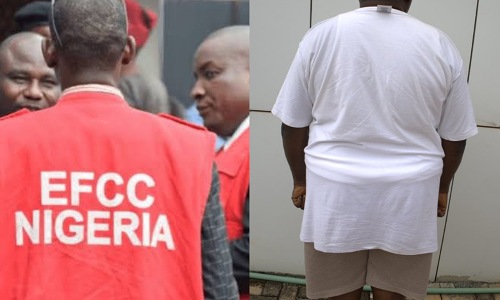
Operatives of the Enugu Zonal Directorate of the Economic and Financial Crimes Commission (EFCC) have arrested Basil Iwoba Ochili, Managing Director of Debasilio Construction and Estate Development Limited, over alleged fraudulent activities involving N128 million.
The EFCC disclosed this in a statement posted on its official X account on Wednesday.
According to the commission, Ochili was arrested for allegedly using his company for fraudulent activities, including “obtaining by false pretence to the tune of N128,000,000.00 (One Hundred and Twenty-eight Million Naira).”
SEE ALSO: EFCC Warns Lawyers Against Charging Clients in Foreign Currencies
The EFCC said Ochili was arrested based on a claim by a petitioner who alleged that sometime in September 2022, the suspect falsely presented himself as the owner of five plots of land situated beside Anambra State Secretariat by Stamford Hotel, Aroma Junction, Awka, Anambra State, and falsely offered the property for sale.
“Relying on the suspect’s representation, the petitioner purchased the said plots in the sum of N128,000,000.00 (One Hundred and Twenty-Eight Million Naira), which was paid into the suspect’s company account,” the EFCC said.
However, the commission said the petitioner was unable to take possession of the land.
Preliminary investigations, according to the EFCC, showed that the suspect knew that the land “encroached on Anambra State Government Secretariat’s land” but allegedly went ahead to sell it to the petitioner.
The commission further said that instead of refunding the petitioner’s money, Ochili “offered him two dud cheques.”
“Further preliminary investigations showed that the suspect used part of the money to settle his debts,” the EFCC said.
The commission also stated that Ochili’s company, Debasilio Construction and Estate Development Limited, “has never been tax compliant.”
The EFCC said the suspect will be charged to court after investigations are concluded.
“The suspect will be charged to court as soon as investigations are concluded,” the commission stated.

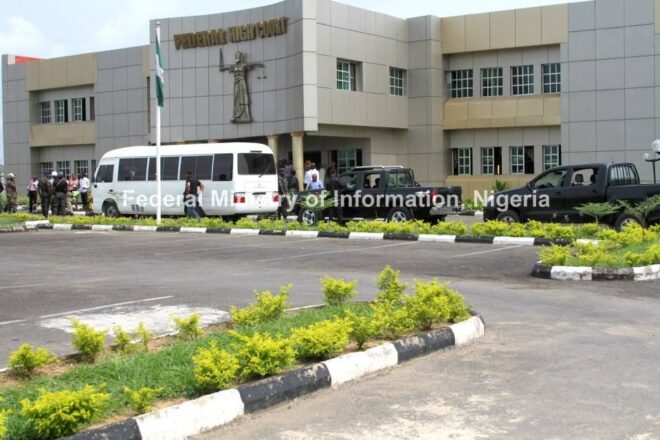
The Federal High Court (FHC) sitting in Uyo, Akwa Ibom State, has sentenced nine convicted crude oil thieves to 10 years in prison without an option of fine following a joint intelligence-led operation by the Department of State Services (DSS) and the Nigerian Navy (NN).
The convicts were among 19 suspects arrested earlier this year after security operatives caught them allegedly stealing crude oil from an oil well head identified as Asabo-D in Ibeno Local Council of the state.
READ ALSO: DPRP to Favour Small Investors in Event of IPO Oversubscription
Delivering judgment on Monday, Justice Joy Ikpeme found the nine men guilty on a two-count charge of conspiracy and tampering with an oil pipeline, contrary to Section 1(7) of the Miscellaneous Offences Act.
The judge sentenced each of them to five years’ imprisonment on the first count and 10 years on the second count, with no option of fine. The sentences are to run concurrently.
The remaining 10 suspects arrested during the operation are expected to face further legal proceedings.
The arrests followed an intelligence-led operation conducted by the DSS in collaboration with the NN as part of efforts to disrupt crude oil theft and illegal bunkering activities in the oil-producing communities of Akwa Ibom.
The conviction was described by a security source as another significant step in the sustained campaign against oil theft, particularly along Nigeria’s maritime and riverine areas.
According to the source, crude oil theft and illegal bunkering have continued to deprive the country of vital oil revenue while inflicting serious environmental damage on host communities.
The source said the latest conviction underscored the determination of security agencies to ensure that those involved in the theft of the nation’s crude resources are brought to justice.
The Economic and Financial Crimes Commission (EFCC) has called on legal practitioners in the country to desist from the illegal and unethical practice of charging clients in foreign currencies.
The Commission disclosed this in a post on its official X account on Monday.
SEE ALSO: Expose Stolen Nigerian Assets Abroad, Get Up to 5% Reward — EFCC
The call was made on Friday, September 11, 2026, in Lagos by the Acting Zonal Director of the Lagos Zonal Directorate 2 of the EFCC, ACE I Bawa Usman Kaltungo, when he received a delegation of the Nigerian Bar Association (NBA) Lagos Task Force on Illegal Practice of Law, led by its Head, Moshood Abiola.
Speaking during the interactive session, Kaltungo expressed concern over the activities of lawyers who engage in “illegal and unethical practices,” stressing that the Commission would not hesitate to prosecute anyone found culpable.
He also urged legal practitioners to desist from charging their clients in foreign currencies, warning that such practice could attract regulatory action.






Mambilla: ICC Orders Sunrise Power to Pay Nigeria $11.8m After 9-Year Battle

How Nigeria’s Foreign Reserves Rose to $54.61bn in 2026

Terror Threats: Osun Establishes Joint Security Task Force

Shettima Arrives Yola to Condole With Bamanga Tukur’s Family

Middle East Crises Pump Fuel Prices Upwards with Attacks on Iran, Saudi Arabia

NCDMB Book Reading Features Nwabuikwu

Trump’s Family Unveils New Cryptocurrency Platform

Senate Denies Receiving Petitions Against Tinubu’s Ambassadorial Nominees

Dangote Cement Lights Up Benue Host Communities With CSR Initiatives

Reps Recommend 3-year Jail Term For Aviation minister

Tems Sets New Record On Billboard Hot 100 Chart