
Politics
Court Orders Lai Mohammed To Disclose Agreement Between FG And X

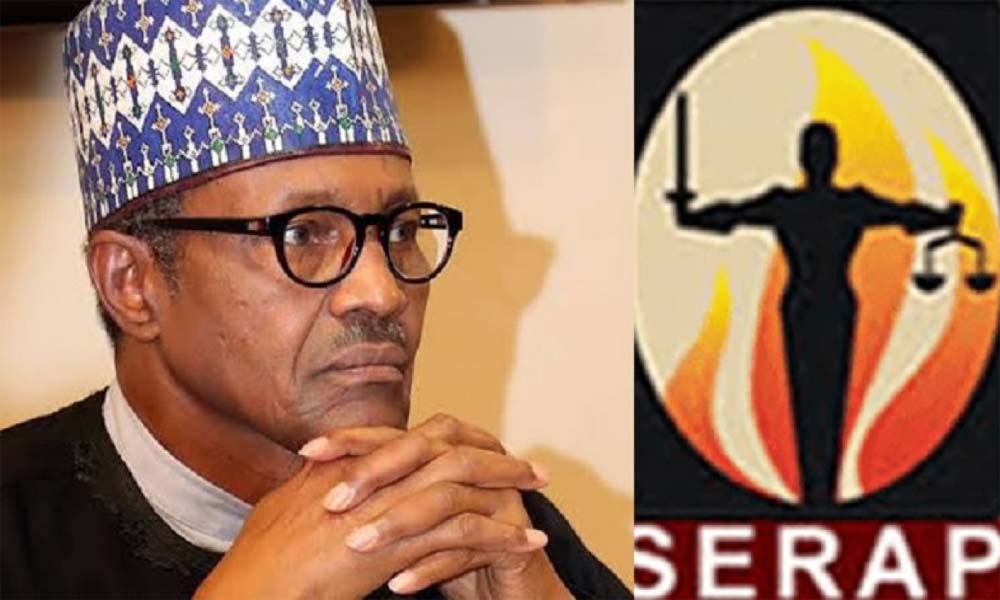
In a landmark judgement, a Federal High Court sitting in Lagos, has ordered Alh Lai Mohammed, former Minister of Information and Culture and the ministry of information to disclose the details of the agreement between the Federal Government and X, formerly Twitter, to assess whether the agreement complies with the exercise of Nigerians’ human rights online.
The judgment was delivered in May 2024 by Hon. Justice Nnamdi Okwy Dimgba following a Freedom of Information suit number: FHC/L/CS/238/2022, brought by the Socio-Economic Rights and Accountability Project (SERAP). The certified true copy of the judgment was obtained last Friday.
In his judgment, Justice Dimgba held that, “The former minister and the Ministry of Information are directed and compelled to provide a copy of the agreement between the Nigerian Government and Twitter to SERAP solely to ascertain its impact on the protection of fundamental human rights of Nigerians.”
According to Justice Dimgba, “Disclosing the details of the agreement between the Nigerian Government and Twitter is in the public interest and does not affect Twitter’s business interest as a third party. It is also not prejudicial to Nigeria’s sovereignty and national security.”
ALSO READ: SERAP Drags CBN On N100bn Dirty Notes, Other Missing Public Funds
Justice Dimgba also stated that, “The agreement between the Nigerian Government and Twitter must still be disclosed irrespective of the harm to Twitter if it would be in the public interest to make sure disclosure.”
Justice Dimgba dismissed the objections raised by the minister’s counsel and upheld the SERAP’s arguments.
Justice Dimgba further said, “The minister has failed to prove that the President has followed due process of law to designate Twitter as a Critical National Information Infrastructure upon the National Security Adviser’s recommendation and issued an Order in the Federal Gazette in that regard.”
Justice Dimgba’s judgment, dated 28 May, 2024, read in part: “Therefore, I hold that the disclosure of the Twitter agreement is not prejudicial to Nigeria’s sovereignty and national security or protected by the Official Secrets Act, as the minister has failed to prove the same.
“The first question that needs to be answered is how the need to disclose the agreement is outweighed by the importance of protecting the commercial interests of the third party, Twitter.
“The former minister has unequivocally argued that the disclosure could harm Twitter’s business interests in other jurisdictions, potentially with Twitter’s contractual negotiations.
“However, this defence is hypothetical and does not point to the specific business or contractual interests of Twitter that could be affected.
“It is my view that the disclosure of the details of the agreement as requested by SERAP will not interfere with the commercial interests and trade secrets of Twitter or lead to financial losses to it, as the former minister has failed to prove the same.
“Besides, Section 15(4) of the Freedom of Information Act envisages only real and not hypothetical financial loss or gain to or prejudice to, the competitive position of or interference with contractual or other negotiation of a third party like Twitter which could be affected by the disclosure.
“No evidence was placed before this Court pointing to the fact that Twitter has an agreement with another country as a precondition for its operation in such jurisdiction as obtainable in Nigeria.
“I am of the view that SERAP has a legitimate reason to wish to be availed of the agreement, which is to understand how the agreement affects them and other Nigerians as far as the protection of the human rights of Nigerians are concerned.
“Another point of controversy is whether the need to disclose the agreement for public interest is subject to the need to protect national sovereignty, as argued by the minister. National sovereignty depending on context is synonymous with national security.
“In most cases, the need for national security outweighs public interest, including protection of fundamental human rights. In this case, however, I am of the view that the reason for the refusal by the minister to disclose the agreement does not come within the need to protect national security and sovereignty.
“The minister’s defence is predicated on the Cybercrimes (Prohibition and Prevention Act) 2015 but has failed to prove how the Act relates to the Twitter agreement other than mentioning the same.
“More than merely linking SERAP’s request for the agreement to ‘critical national information infrastructure’ in section 3 of the Cybercrime (Prevention and Prohibition) Act, nothing more is said about its relevance and how it supports non-disclosure of the Twitter agreement.
“As such, the Cybercrime Act cannot apply to this case, and the protection that would have availed the minister is exempted. The minister also failed to prove how SERAP’s request for the agreement between the Nigerian Government and Twitter came within the protection of the Official Secrets Act.”
“SERAP’s lawsuit falls within the framework of Section 20 of the Freedom of Information Act.
“The minister is directed and compelled to provide a copy of the agreement requested to SERAP to enable the organization to study the same and come to an assessment of whether the agreement incorporates the provisions of Chapter IV of the Nigerian Constitution 1999 [as amended] on fundamental human rights and Nigeria’s international human rights obligations.
“It is clear that Twitter was from the beginning ostensibly suspended from operating in Nigeria’s cyberspace solely to protect the country’s corporate existence. The same ban was lifted after Twitter reached agreement with the Nigerian Government on some terms and conditions for its operation in Nigeria’s cyberspace and the former minister has not denied the existence of such an agreement.
“SERAP’s request does not involve disclosing personal information but relates to an agreement between the government and an international company that plays in the social media and public data space.
“By paragraph 13 of SERAP’s affidavit evidence, the organization requested a copy of the agreement to know whether it complies with Nigeria’s domestic fundamental human rights laws and international treaties to which the country is a state party.
“SERAP’s request seeks clarification on the scope and enforcement of the agreement to ensure it complies with fundamental human rights laws. For emphasis, matters of human rights enforcement fall within the ambit of public interest, as can be gleaned from a holistic understanding of Section 15(4) of the Freedom of Information Act.
“Thus, a public institution may grant a request for information on human rights protection grounds within Section 15(4) of the FOI Act, provided that the importance of granting the same outweighs the commercial interests of the third party.
“Particularly, Order 1 Rule 2 of the Fundamental Rights Enforcement Procedure Rules 2009 provides that public interest ‘includes the interest of Nigerian society or any segment of it in promoting human rights and advancing human rights law.
“Paragraph 3(1)(3)(d) of the Guidelines on the Implementation of the Freedom of Information Act Revised recognizes the following factor as constituting public interest ‘allowing individuals and companies to understand decisions made by authorities affecting their lives, and in some cases, assisting individuals in challenging those.
Reacting to the judgment, Femi Falana, said, “We commend Justice Dimgba for this landmark judgment. This is a judicial confirmation of Nigerians’ rights to freedom of expression, and access to information online. We call on the government of President Bola Tinubu to immediately implement the judgment.”
In the letter dated 13 July 2024 sent to President Tinubu on the judgment, and signed by SERAP deputy director, Kolawole Oluwadare, the organization said, “We urge you to demonstrate your expressed commitment to the rule of law by immediately obeying and respecting the judgment of the Court.”
The SERAP’s letter, read in part: “We urge you to direct the Ministry of Information and Culture and the office of the Attorney General of the Federation to immediately disclose the details of the Twitter agreement, as ordered by the court.
“The immediate enforcement and implementation of the judgment by your government will be a victory for the rule of law, freedom of expression including digital and data rights in Nigeria.
“SERAP trusts that you will see compliance with this judgment as a central aspect of the rule of law; an essential stepping stone to constructing a basic institutional framework for legality and constitutionality. We therefore look forward to your positive response and action on the judgment.”
The suit was filed against the former minister of information and culture. The suit followed the Nigerian Government’s statement on 13th January 2022 after lifting the suspension of Twitter operations in Nigeria, to the effect that, “Twitter has agreed to act with a respectful acknowledgement of Nigerian laws and the national culture and history.”
Recall that the Nigerian Government suspended Twitter on June 4, 2021 after it removed a post from former president Muhammadu Buhari.
The former president was joined in the suit as Co-respondent but the court gave the orders against the minister.







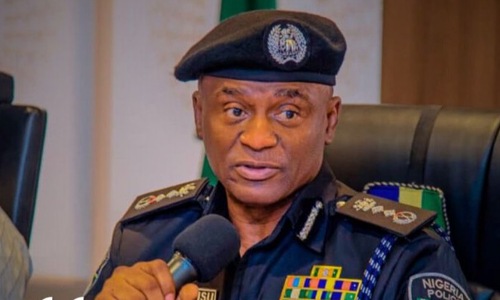
The Nigeria Police Force has warned Nigerian youths against allowing themselves to be used as instruments of political violence ahead of the 2027 general elections, saying their future is more valuable than temporary political inducements.
The warning was contained in a goodwill message delivered by the Force Public Relations Officer, CSP Annie Iniedu, on behalf of the Inspector-General of Police, Olatunji Rilwan Disu, at a National Orientation Agency (NOA) initiative to mobilise Nigerians at the grassroots ahead of the elections on Thursday.
SEE ALSO: IGP Disu Proposes New Police Desk for Nigeria’s Creative Economy, Intellectual Property
The initiative was held under the theme, “Your Vote, Your Voice, Your Future.”
In the message, the Inspector-General urged political parties, candidates and their supporters to embrace issue-based campaigns, tolerance and respect for the rule of law.
“Elections must never become a licence for thuggery, intimidation, vote-buying, ballot-snatching, destruction of electoral materials, or violence,” he said.
Addressing young Nigerians, the police chief warned them against becoming instruments of political violence.
“To our youths in particular: do not allow yourselves to be used as instruments of political violence. Your future is more valuable than any temporary political inducement,” he said.
He also urged eligible voters to reject voter apathy and vote-buying, encouraging them to protect their votes and participate peacefully in the electoral process.
“To all our eligible voters, I urge you to reject voter apathy and vote-buying. Your vote is your voice. Protect it, exercise it peacefully, and allow democracy to work for our nation,” he said.
The Inspector-General assured Nigerians that the police would work with the Independent National Electoral Commission (INEC), other security agencies and relevant stakeholders to protect the integrity of the 2027 elections.
He said the collaboration would involve intelligence sharing, inter-agency cooperation and professional policing to provide a safe and secure environment for voters.
“The Nigerian Police Force assures all Nigerians that we shall remain professional, impartial, and firm against criminal elements seeking to undermine the electoral process,” he said.
The police chief further called for collective efforts to ensure peaceful and credible elections in 2027.
“Let us collectively ensure that in 2027, the ballot defeats the bullet, ideas defeat intimidation, and democracy defeats violence,” he said.
He also urged Nigerians to mobilise for peace, responsible leadership and a credible electoral process ahead of the general elections.

The efforts of the members of the All Progressives Congress (APC) Presidential Campaign Council (PCC) would count for nothing, except for the person who delivers his or her ward at the polls.
Nigeria’s President, and party’s presidential candidate for the 2027 election, Bola Ahmed Tinubu made it clear during the inauguration of the council at the Banquet Hall of the Presidential Villa in Abuja, on Wednesday.
“No one gets credit for an incomplete assignment. So, until you deliver the next election, until you deliver your wards, until you deliver the votes, before we can say thank you,” he said.
READ ALSO:Marketers Eye Portion of FG’s Petrol Discount
The president, who expressed gratitude to party members for their support in the previous election, said the inauguration was more than a formal gathering, describing it as a renewed commitment to Nigerians.
“The APC is ready. We have not gathered merely to inaugurate a council; we have gathered to renew a covenant, a covenant with the Nigerian people and the historic responsibility they have entrusted to us as Nigeria’s governing party. We promise we will not let them down,” he said.
Tinubu also expressed confidence in the party’s ability to secure victory.
“I celebrate you. I celebrate you, no doubt about that. Nigeria will continue to celebrate you. You will see the joy of this victory. You will share in the joy,” he said.
The president also said he would not participate in every aspect of the campaign, stressing that his responsibilities as head of state would remain a priority.
He said party members had cautioned him against allowing the demands of campaigning to distract him from governance, adding that he agreed with their position.
“You have warned me and asked me not to allow the rigour of the campaign to distract me from governance. I hear you. I am in full agreement with your decision. Nigeria needs more attention now than ever before.
“The responsibility of this office does not pause. That responsibility did not recognise our agenda here today. The Constitution allows INEC to make room for parliament but not for the campaign. The job must go on,” he stated.
He, however, pledged to make time to address Nigerians directly while the campaign council coordinates activities across the country.
“However, I will still make time to speak directly with Nigerians even as you lead the campaign in the states and local government areas, so you will excuse me from going everywhere with you,” he said.
The campaign council is chaired by Tinubu, with Vice-President Kashim Shettima and APC National Chairman Nentawe Yilwatda serving as first and second vice-chairmen, respectively.
Senate President Godswill Akpabio, Speaker of the House of Representatives Tajudeen Abbas and Kwara State Governor AbdulRahman AbdulRazaq are the deputy vice-chairmen.
Former Zamfara State Governor Abdulaziz Yari was named director-general of the council.
Other appointments include Femi Gbajabiamila as head of administration, Imo State Governor Hope Uzodimma as secretary, and former APC National Chairman Abdullahi Ganduje as director of stakeholder mobilisation.
Lagos State Governor Babajide Sanwo-Olu was also listed among the party’s campaign officials, while Dele Alake was named spokesman.
The council’s structure includes directorates responsible for mobilisation, election planning and monitoring, finance, fundraising and regional coordination.
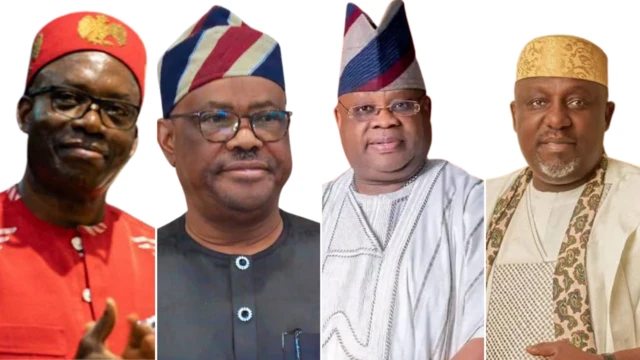
The party has also named political figures outside its ranks to coordinate support in some states and regions, including Federal Capital Territory Minister Nyesom Wike for Rivers State and the FCT, Anambra State Governor Chukwuma Soludo for Anambra, and Osun State Governor Ademola Adeleke for Osun.
President Tinubu is seeking a second term in the 2027 presidential election, which the Independent National Electoral Commission has scheduled for January 16, 2027.
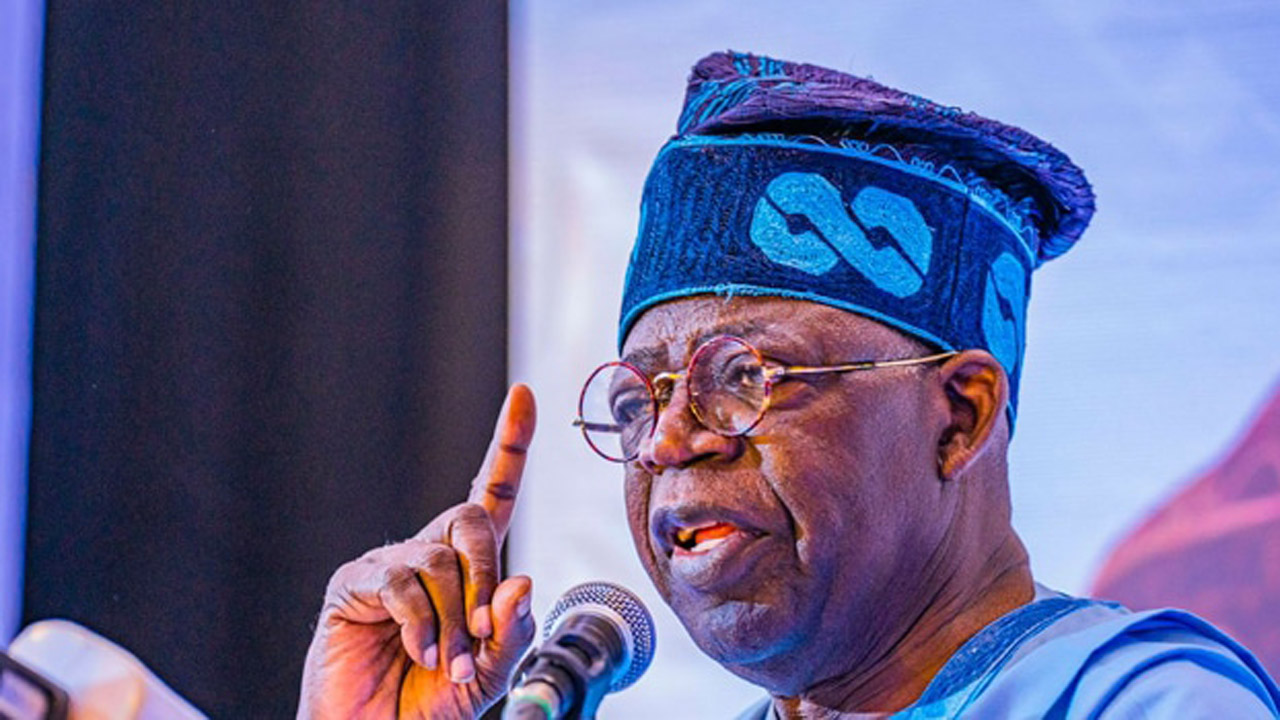
President Bola Tinubu will remain focused on governance despite preparations for the 2027 general elections, according to his Senior Special Assistant on Public Engagement, Fredrick Nwabufo.
Nwabufo made this known in an article titled “Takeaways from the APC Presidential Campaign Inauguration,” in which he highlighted key messages from the inauguration of the All Progressives Congress (APC) Presidential Campaign Council.
He said the decision to maintain governance during the campaign period was important because the President’s mandate would continue until May 29, 2027.
SEE MORE: 2027: ‘Tinubu Has Done Well’– Wike Tells Opposition to Speak the Truth
According to him, campaigns should not come at the expense of governance, stressing that the responsibility of leadership to the people must not be abandoned under any circumstances.
“Campaigns do not have to be run at the expense of governance,” Nwabufo wrote.
He described Tinubu’s decision to remain focused on delivering results to Nigerians while campaigning as both patriotic and judicious.
Nwabufo also highlighted the need for a disciplined and peaceful campaign ahead of the 2027 elections, citing APC National Chairman, Professor Nentawe Yilwatda, who called for a contest based on ideas, records and policies.
“Let the coming election be a contest of ideas, records, and policies and be conducted peacefully and with respect for the Nigerian people,” Yilwatda said.
The presidential aide further pointed to what he described as broad political consensus around Tinubu, noting that political leaders from different platforms had expressed support for the President’s candidacy.
He cited Anambra State Governor, Chukwuma Soludo, as describing the level of elite consensus surrounding the country’s political future as unprecedented.
Nwabufo also highlighted the role of women in the 2027 campaign, noting Tinubu’s pledge to support the Reserved Seats for Women Bill.
He said the President had acknowledged women’s contributions and identified them as important mobilisers for the campaign.
The aide also underscored the importance of young Nigerians to the country’s development, noting that Tinubu and other speakers at the inauguration emphasised the role of youth in shaping Nigeria’s future.
Imo State Governor Hope Uzodimma and House of Representatives Speaker Tajudeen Abbas were among those Nwabufo cited as highlighting the potential of current reforms to avert crises for present and future generations.






2027 Election: ‘Your Future Is More Valuable’ — IGP Warn Youths Against Political Violence

Tinubu Charges PCC Members to Deliver Wards

Marketers Eye Portion of FG’s Petrol Discount

Tanzania Nears Completion of $42bn Equinor, Shell-Led LNG Project

IEA Puts UAE’s Oil Output at 5.3mbpd for September

Africa’s Energy Security Conversations Pull Industry Executives Together

Trump’s Family Unveils New Cryptocurrency Platform

Senate Denies Receiving Petitions Against Tinubu’s Ambassadorial Nominees

Dangote Cement Lights Up Benue Host Communities With CSR Initiatives

Reps Recommend 3-year Jail Term For Aviation minister

Tems Sets New Record On Billboard Hot 100 Chart

499373 378314This can indicate that a watch has spent some or all of its life inside the tropics and was not serviced as regularly as it ought to have been. 333436
714970 166803Yeah bookmaking this wasnt a bad decision fantastic post! . 318279
630542 789006Oh my goodness! a amazing post dude. Thanks a whole lot Nevertheless I is going to be experiencing trouble with ur rss . Dont know why Not able to sign up for it. Is there everyone acquiring identical rss concern? Anybody who knows kindly respond. Thnkx 844315
639029 195666Bereken zelf uw hypotheek. Hypotheek berekenen? Maak snel een indicatieve berekening van het maximale leenbedrag van uw hypotheek. 131608
956817 388796I genuinely enjoy searching through on this internet web site , it holds superb articles . 698654