
NEWS
Does INEC have the capacity to let people decide?

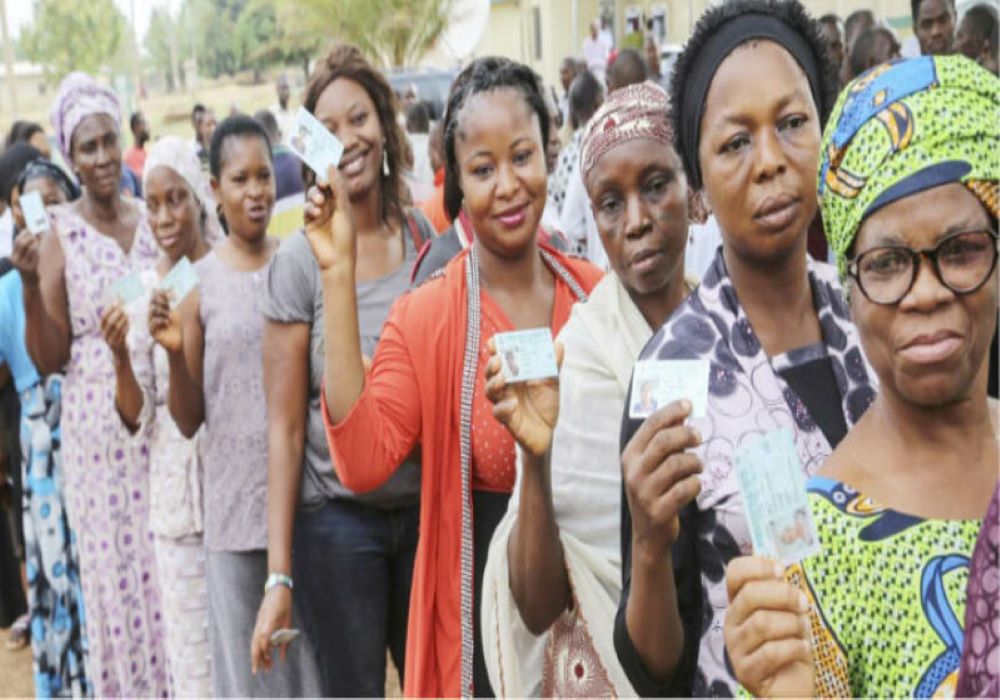
By Elsie Godwin
Three days ago, I was in an uber taxi from Eleganza in Lekki, going home. Ordinarily, using the services of a ride-hailing platform in Lagos Nigeria, should not be worthy of mention, however, the conversation I had with my uber driver made the ride a memorable yet thought-provoking one.
The ride was without drama until we got to the traffic light at Jakande. As we tried turning into Osapa London on our right, a white minibus blocked our entrance as it waited for the traffic light to turn green. There is an unholy alliance between disorderliness and public transport drivers in my state.
My Uber driver, who seemed to be a middle-aged, educated man, got out of the car to have a word with the driver. I was almost embarrassed because such a ‘necessary’ act will only serve as an attention-drawing tool toward the red Toyota Camry and the person sitting behind. And if you know me, I don’t like attention, I enjoy being in my own bubble and getting the job — whatever it may be per time, done.
When he got back into the car, I was of the opinion (which I shared with him) that he shouldn’t have gone down to have a conversation (read as ‘exchange words in a heated manner’) with the minibus driver.
“Why not?” he asked.
“It won’t make any difference”, I replied. “He will do the same thing at the next traffic junction without a care about the results of his actions to others and himself.”
“So, do we just let people do whatever they want without making an effort? This is exactly how Nigeria has become what it is today. Everybody does things just as they want, whether right or wrong without consequences and no one to guide or caution them as the case may be,” he said.
The above was the beginning of a very meaningful rant from a concerned, passionate, and frustrated Nigerian. He spoke about what Nigeria used to be and what it is now, which he described as a shadow of itself.
“Do you have a PVC (Permanent Voters Card)?” I asked.
Read Also >> NEMA Recovers 13 More Bodies From Lagos Boat Accident
“I have never voted in my life,” he responded. “But this time, something in me wanted to vote and play my part. To be part of this movement led by the youths. Maybe there might be hope for the country,” he continued.
“But my sister, I am discouraged. These people are not ready to give us our PVC and I am not ready to leave my daily bread for days just because of a PVC. Man must work if man go chop,” he added.
In his opinion, there seems to be a deliberate attempt to disenfranchise voters. And if I am completely honest, the same thought has crossed my mind. To get an idea of where his sentiments came from, I asked him why his new found urge to exercise his democratic right was fast waning.
He described how he once dedicated a day to register for a voter’s card. According to him, he got to the Independent National Electoral Commission (INEC) registration point by 7 am and was told to write his name on a list with a couple of other people he met.
The list was to be the order in which they would be attended to. But he spent the whole day at the registration unit without being attended to. He also noticed that a few people who were familiar with the INEC agents came in later on and were attended to. People like himself who didn’t know anyone waited in vain. He said as he walked out of the INEC registration unit at about 5 pm, he vowed never to waste his time trying to get a voters card, again.
I heard and understood him. He typifies the average Nigerian. We are a resilient people and over the years, have put so much effort into work and productivity which has inadvertently made the idea of work and the workplace a trench of suffocation to prove relevance.
Like clockwork, you have to be busy, or no one will see you as being productive. So, when a Nigerian tells you they do not have time, they really do not. So, our faulty system thrives on the idea of Nigerians not having time to live or to pursue any civic activity including getting their voter’s card
Although, some non-governmental organizations are organizing conferences and concerts to encourage voter registration, and estates and communities are collaborating with INEC officials to register residents on weekends, the spotlight is still on INEC, whether it has the capacity to let people decide? Whether it will allow as many Nigerians as possible to vote, and choose the set of leaders who will steer the Nigerian ship for the next 4 – 8 years?
Are we really taking back power in 2023 or should these efforts be seen as a long game for the time that we can truly take back power? Are we playing the right cards and do we have the right incentives for the desired result?
Ultimately, like my uber driver, the onus is on us as Nigerians to be ready to play our part in removing reckless minibus drivers trying to obstruct Nigeria’s path to progress.
Godwin is a Media Personality and a Marketing & Communications professional





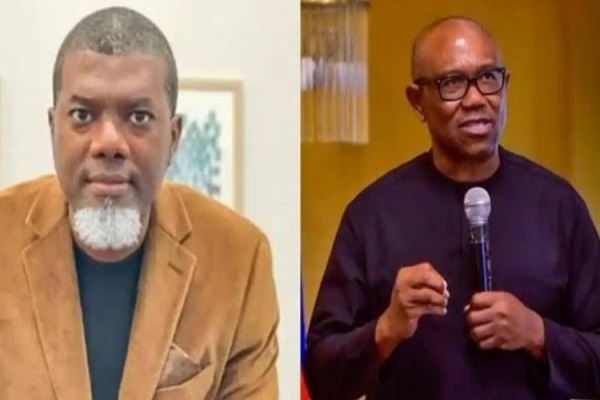
Former presidential aide Reno Omokri has criticised Afrobeats singer Peter Okoye over his call for Nigerians to retire older politicians and support former Anambra State Governor Peter Obi.
Okoye, popularly known as Mr P, made the remarks in a video that went viral on social media, urging Nigerians to move away from older politicians and support Obi.
“Let’s leave these old guys, dem done try. Let’s retire them,” Okoye said in the video, according to Omokri’s account.
SEE MORE: Reno Omokri Praises Tinubu’s Independence Day Address, Says Nigeria Is in ‘Sound Hands’
Reacting to the singer’s position in a post on Sunday, Omokri argued that age alone should not determine Nigerians’ choice of presidential candidates, insisting that a comparison of the ages of the leading presidential tickets does not support Okoye’s argument.
Omokri noted that Obi is 65 years old, while his proposed running mate, Rabiu Musa Kwankwaso, is 70. He put President Bola Tinubu’s age at 74 and Vice President Kashim Shettima’s at 60.
According to Omokri, the Obi-Kwankwaso ticket has a combined age of 135 years, compared with 134 years for the Tinubu-Shettima ticket.
He argued that, based on the average ages of the two tickets, the incumbent president and his deputy are marginally younger as a pair.
Omokri also compared the figures with those of Atiku Abubakar and Rotimi Amaechi, whose combined ages he put at 140 years.
Beyond the age argument, Omokri questioned Obi’s record as Anambra governor, contrasting it with Tinubu’s administration in Lagos State.
He listed schools and independent power projects he attributed to Tinubu’s tenure as Lagos governor, challenging Okoye to identify comparable projects initiated, completed and commissioned with government funds during Obi’s time in office.
Omokri further argued that Nigerians should consider candidates’ records in public office rather than relying primarily on their ages.
He also defended the Tinubu administration by citing the absence of a nationwide strike by the Academic Staff Union of Universities (ASUU) during its tenure and the federal government’s Nigerian Education Loan Fund (NELFUND) programme.
The Federal Ministry of Finance has challenged reports that Federal Government interest payments reached 124 per cent of revenue in the first half of 2026, describing the figure as misleading because it does not fully account for the scope of government debt obligations and revenue.
The ministry’s position comes in response to recent analysis citing the World Bank’s October 2026 Nigeria Development Update, which reported that interest payments exceeded federal revenue during the first six months of the year.
In a press release on Sunday and dated October 18, 2026, the ministry argued that the calculation compared interest payments that included obligations serviced on behalf of other tiers of government with federal revenue alone.
SEE ALSO: Nigeria Lands Fresh $1.25bn World Bank Loan to Drive Jobs, Reforms
According to the ministry, this approach overstates the ratio because the debt obligations and revenue used in the calculation should cover the same level of government.
“The interest figure includes debt the Federal Government services on behalf of other tiers of government, including external loans to states,” the ministry said.
It added that the revenue figure used in the calculation was incomplete because it excluded independent revenue earned by government agencies and enterprises but not yet remitted to the Treasury.
The ministry also explained that government revenue typically increases in the second half of the year because of the statutory timing of certain tax payments.
Citing the 2025 figures, it said the debt-service-to-revenue ratio stood at 156 per cent in the first half of the year but fell below 60 per cent on a full-year basis.
The ministry said the ratio had declined from 97 per cent before the current administration’s reforms, describing the figures as evidence of progress in the government’s fiscal position.
Revenue Growth Outpaces Interest Payments
The ministry also highlighted the changes in federal revenue and interest payments between the first halves of 2025 and 2026.
According to the statement, federal revenue increased by 72 per cent, rising from ₦3.6 trillion in the first half of 2025 to ₦6.2 trillion in the corresponding period of 2026.
Interest payments, meanwhile, rose by 38 per cent, from ₦5.6 trillion to ₦7.7 trillion over the same period.
“Revenue is therefore growing almost twice as fast as interest costs,” the ministry said.
It added that the interest-to-revenue ratio fell by 32 percentage points, from 156 per cent to 124 per cent, while the gap between interest payments and revenue narrowed from ₦2 trillion to ₦1.5 trillion.
The ministry maintained that the figures reflected the impact of the government’s reforms rather than evidence of fiscal distress.
Ministry Cites Full-Year Debt Projection
On debt sustainability, the ministry argued that a six-month snapshot should not be used as the sole measure of the country’s debt position.
It said the World Bank’s report projected Nigeria’s full-year 2026 debt service, covering both interest and principal payments, at 46 per cent of revenue.
“Debt sustainability is assessed on a full-year basis, not over six months,” the ministry stated.
It described the projected full-year figure as the appropriate benchmark for assessing the country’s debt-service position.
Finance Ministry Defends Government Borrowing
The ministry also defended the legality of the Federal Government’s borrowing, stating that all borrowing fell within the limits approved by the National Assembly under the 2026 Appropriation Act and the approved borrowing plan.
According to the statement, borrowing activities comply with the Fiscal Responsibility Act 2007 and the Debt Management Office (Establishment) Act 2003.
It added that borrowing information is published regularly by the Debt Management Office.
The ministry said it welcomed scrutiny of public finances but urged analysts and commentators to ensure that figures were compared on a consistent basis.
“We encourage analysts and commentators to apply the same rigour they seek to hold the government to: compare like with like, read figures in context, and seek clarification where the data is unclear,” the statement said.
The South-South Reawakening Group has opposed plans to align the proposed coastal road with the East-West Road, insisting that both projects should be constructed side by side.
The group’s convener, Joseph Ambakederimo, stated this during an interview on Arise TV on Sunday, arguing that the coastal road should be delivered as a separate infrastructure project rather than diverted to the existing East-West Road.
Ambakederimo said the coastal road had remained on the drawing board for many years and questioned why the project was now being considered for alignment with the East-West Road.
SEE ALSO: BREAKING: Joseph Boakai Takes Oath As Liberia’s President
“I posted on my LinkedIn handle when somebody posted the minister’s briefing. I said no. Mr. Minister, we want to see the coastal road side by side the East-West Road,” he said.
“We want to see that happen, not to do any alignment. Alignment of what? To where? We need that coastal road, and that road has been on the drawing board for so many years. So many, many years.”
He urged engineers to revisit their plans and address potential environmental challenges associated with constructing the road through the South-South region.
“I believe the feasibility of that road has been done. We know the processes of building roads, infrastructure all over the world. Pure and concrete feasibility would have been done. So let the engineers go back to the drawing board,” Ambakederimo said.
His comments come amid concerns over the proposed route of the coastal road and calls for the Federal Government to reconsider its approach to the project.
Ambakederimo maintained that the coastal road should be constructed alongside the East-West Road rather than aligned with it, stressing the importance of delivering the long-awaited infrastructure project to the South-South region.






Tinubu vs Obi: Omokri Fires Back at Peter Okoye Over Call to Retire Older Politicians
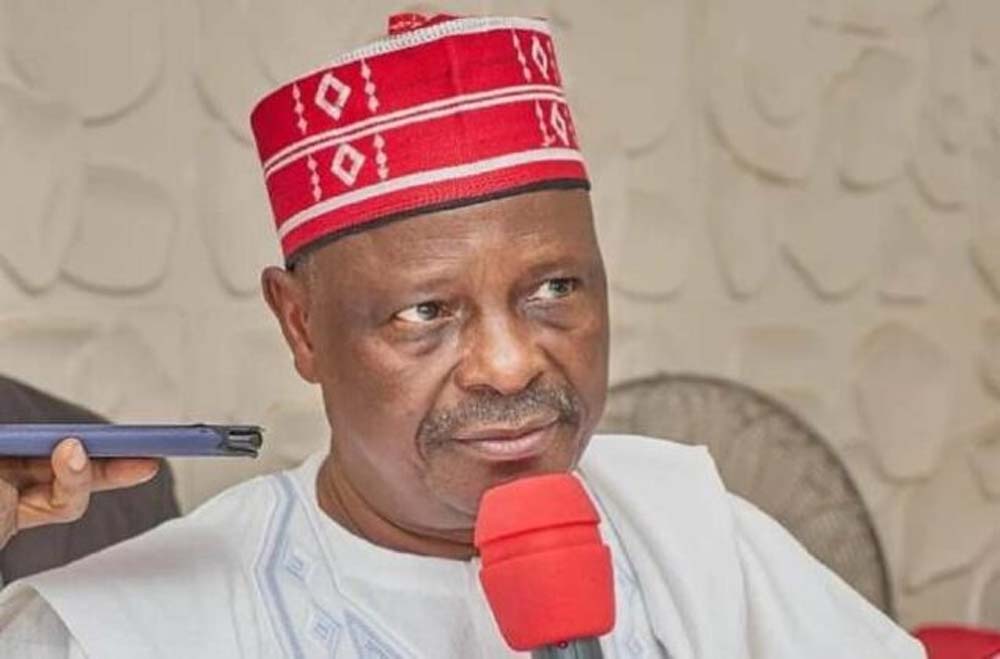
Kwankwaso Rejects ADC Claims, Says NDC Won’t Withdraw From 2027 Race
‘World Bank’s 124% Debt Interest Figure Misleading’ – Finance Ministry Insists

‘Election Rulings Have Diminished Nigeria’s Judiciary’ – Utomi

NDLEA Arrests 85-Year-Old Woman With 179kg of Cannabis in Edo

Ambakederimo Questions NNPC Over Crude Oil Sales, Upfront Payments

Trump’s Family Unveils New Cryptocurrency Platform

Senate Denies Receiving Petitions Against Tinubu’s Ambassadorial Nominees

Dangote Cement Lights Up Benue Host Communities With CSR Initiatives

Reps Recommend 3-year Jail Term For Aviation minister

Tems Sets New Record On Billboard Hot 100 Chart

400317 546587Excellent weblog here! Also your site loads up very rapidly! What host are you making use of? Can I get your affiliate link to your host? I wish my internet site loaded up as quickly as yours lol xrumer 664914
958724 581030Id forever want to be update on new posts on this web site , bookmarked ! . 82785