
Maritime
EU to Probe Shipping Companies


NEW YORK – European anti-competition regulators said they are probing possible price fixing by a number of container-line shipping companies, saying they may have illegally colluded to boost prices along certain global trade routes.
The EU executive, the European Commission, said Friday that investigators were probing the way these companies announce price increases and whether those announcements were, in essence, a veiled effort to coordinate price hikes. The executive declined to name the firms involved in the probe, but two shipping companies, Denmark’s A.P. Moller-Maersk A/S and France’s CMA CMG said Friday that they had either been informed they were part of the probe or intended to cooperate. Both said they have acted legally in their pricing practices.
 A person familiar with the probe said it will focus on 14 firms, among them the world’s major container-shipping companies from Europe and Asia, though this person declined to name any of them. The commission said it would probe whether what appeared to be a standard and transparent way of announcing price increases was, in reality, an illicit way by which big shippers signaled to each other their price intentions.
It is unclear how specifically EU investigators believe shippers may have used these announcements to fix prices, and the commission didn’t provide examples. Since 2009, the commission said, companies have been making regular public announcements of price-increase intentions through news releases on their websites and in the trade press. The announcements are usually made successively, a few weeks before the price hikes are set to go into place, the commission said.
“This practice may allow the companies to signal future price intentions to each other and may harm competition and customers,” the commission said in its statement.
Maersk, CMA CGM and Switzerland-based Mediterranean Shipping Co., the world’s top three container shipping firms by capacity, have announced prices increases, roughly simultaneously, three times so far this year, with a fourth hike planned for December. But those attempts have all been undercut by smaller container companies offering cheaper pricing, and the hikes didn’t stick. Freight rates are still lower now than they were at the beginning of the year.
The EU didn’t name these three as specific targets of the probe. Maersk, however, said in a statement that it had been informed “it will be part of the investigation.” It said the company has “no reason to believe that Maersk Line has behaved in a manner not in accordance with EU competition law.”
CMA CGM said it was subject to inspections by the commission in May 2011, adding that it will “cooperate fully” with investigators and “is strongly of the view that its practices regarding price announcement are fully compliant with the EU law.” A representative for MSC wasn’t immediately available for comment.
The container-shipping industry is going through one of its toughest cyclical downturns, marred by overcapacity and weak global economic growth. Analysts estimate that the industry needs to take out about 25% of total fleet capacity before supply and demand and prices stabilize.
The EU probe could result in steep fines if investigators find evidence of collusion. But it also puts a fresh cloud over a separate effort by Maersk, MSC and CMA CGM to bolster their business. The three earlier this year announced a broad alliance in which they would share capacity on certain, heavily trafficked trade routes. The EU is currently weighing whether to approve that deal–set to go into effect sometime next year, pending green lights from regulators in Europe, the U.S. and China.
The alliance would give the three shippers joint control of over 40% of total sea-cargo capacity along some of the world’s busiest routes, and a number of smaller firms have criticized the proposed tie-up. U.S. and EU regulators have said they plan to meet, along with Chinese counterparts, to scrutinize the deal amid the criticism.
– NASDAQ

The Nigerian Maritime Administration and Safety Agency (NIMASA) and the Nigerian Navy have renewed their strategic partnership with the endorsement of a Memorandum of Understanding (MoU) to strengthen maritime security, enhance safety and deepen coordinated enforcement across Nigeria’s maritime domain.
The MoU was signed at the Nigerian Navy Headquarters, Abuja, by the Director General of NIMASA, Dr Dayo Mobereola, and the Chief of the Naval Staff, Vice Admiral Idi Abbas.
The renewed agreement marks a significant milestone in the longstanding relationship between both institutions and represents the first formal renewal of their partnership since the original MoU was signed in 2007.
The agreement provides a framework for enhanced collaboration in the promotion and maintenance of maritime security and the effective implementation of the Suppression of Piracy and Other Maritime Offences (SPOMO) Act, the International Ship and Port Facility Security (ISPS) Code and other relevant maritime laws and regulations within NIMASA’s mandate.
READ ALSO: NNPC/Shell Vision First Initiative Impact over 10,000
Speaking at the signing ceremony, the NIMASA Director General, Dr Dayo Mobereola, commended the commitment of the Honourable Minister of Marine and Blue Economy, Adegboyega Oyetola, to strengthening inter-agency collaboration as a key driver of maritime security and the development of Nigeria’s Blue Economy.
He said the renewed MoU would provide a stronger institutional framework for both organisations to discharge their respective statutory mandates while consolidating the gains already recorded in securing Nigeria’s maritime domain. This he said will enhance achieving the goals of President Bola Tinubu GCFR for the Blue Economy.
According to him, the agreement is also designed to address emerging maritime security challenges through improved coordination, information sharing and operational cooperation.
“As we renew this partnership today, I urge our respective teams to ensure that the spirit of this agreement translates into practical and measurable outcomes,” Dr Mobereola said.
Dr Mobereola also expressed appreciation to the Chief of the Naval Staff and the Nigerian Navy for their continued support and commitment to the renewal of the partnership.
In his remarks, the Chief of the Naval Staff, Vice Admiral Idi Abbas, described the signing as a milestone in the enduring relationship between the Nigerian Navy and NIMASA.
He noted that the renewed MoU contained important additions aimed at strengthening the response to the evolving nature of maritime security challenges.
One of the key provisions, he said, is the integration of the Deep Blue Project into the collaborative framework, providing a stronger basis for cooperation between the Nigerian Navy’s Maritime Guard Command and the project.
He also highlighted the introduction of a joint reporting protocol for communication and information sharing during operations, which he said would facilitate timely decision-making and a more coordinated response to maritime incidents.
Vice Admiral Abbas further welcomed provisions for greater institutional engagement, including an annual conference to enhance collaboration, review progress and address emerging challenges.
“Whether we like it or not, the water is where we get whatever we are getting—our revenue, everything and even the trade we engage in, in large percentages, is done through the water. So this institution has to be very strong,” he said.
The renewed MoU is expected to deepen operational cooperation between NIMASA and the Nigerian Navy, particularly in maritime security, information sharing, coordinated responses to maritime incidents, enforcement of applicable maritime laws amongst others.
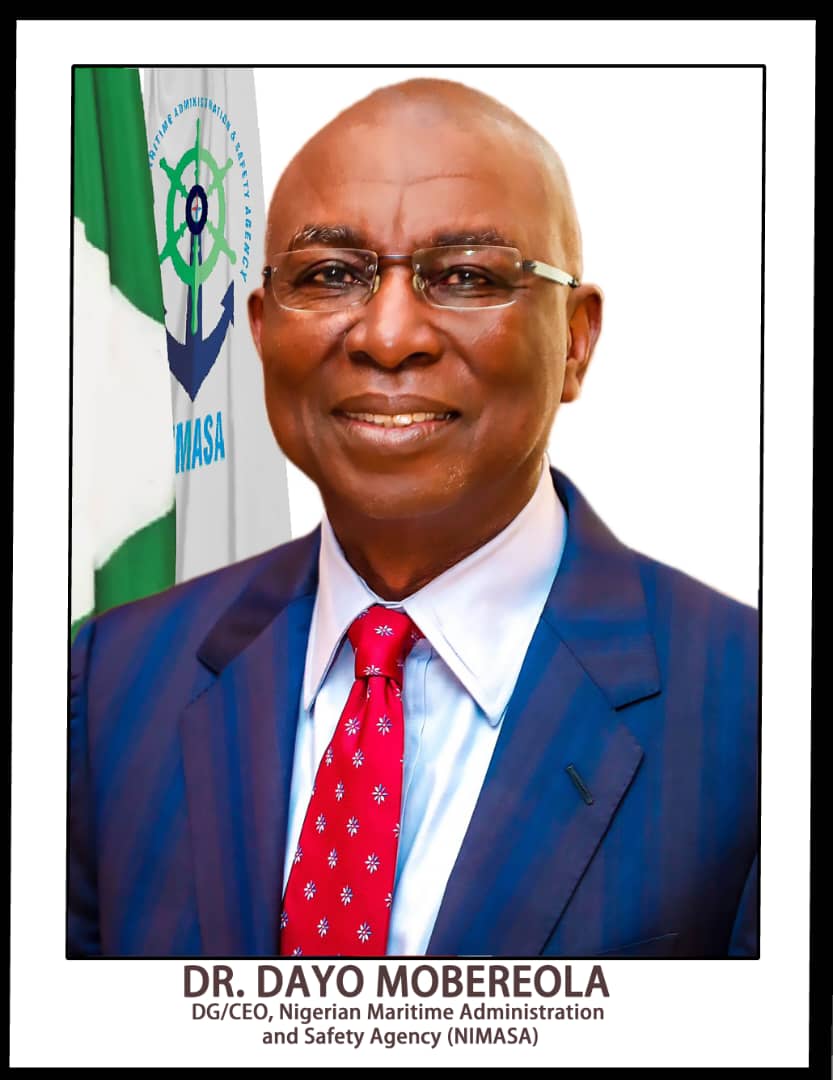
The Director General of the Nigerian Maritime Administration and Safety Agency (NIMASA), Dr. Dayo Mobereola, has reaffirmed the Agency’s commitment to advancing regional maritime integration, cooperation and capacity development across Africa.
Mobereola made this known when he received the Honorary Consul of the Republic of Liberia in Lagos, Dapo Akinosun, at the Agency’s headquarters in Lagos.
The NIMASA DG described the meeting as a reflection of the longstanding and mutually beneficial relationship between Nigeria and Liberia, particularly within the maritime sector.
According to him, stronger collaboration among African nations remains critical to unlocking the continent’s maritime potential, strengthening the Blue Economy, and promoting sustainable regional growth of the continent.
On the significance of maritime cooperation, Mobereola said: “The time has come for African nations to upscale maritime collaboration. The partnership between Nigeria and Liberia will help us build capacity, strengthen regional cooperation, and create opportunities for African youths within the global maritime industry.
“We must collectively build maritime capacity beyond borders. Sea-time training and practical exposure will position Nigerian and African youths to compete effectively in the international maritime space.”
ALSO READ: Workers Suspend Strike at NUPRC
He also appreciated the Liberian Government for supporting Nigeria’s successful bid for the Category C seat of the International Maritime Organization (IMO), noting that both countries have sustained productive maritime relations over the years.
In his address, Akinosun stated that the visit was aimed at reinforcing the enduring relationship between Nigeria and Liberia while promoting stronger maritime cooperation between both countries.
The Envoy described the maritime sector as a key driver of economic growth, regional integration, and Blue Economy development, while commending the management of NIMASA for efforts towards repositioning Nigeria’s maritime industry for sustainable growth and investment.
“Nigeria has demonstrated genuine commitment to maritime partnership and regional growth. Liberia looks forward to deeper collaboration with NIMASA in maritime administration, safety, capacity development, and trade promotion for the advancement of Africa’s Blue Economy,” Akinosun said.
Modupe Asudo
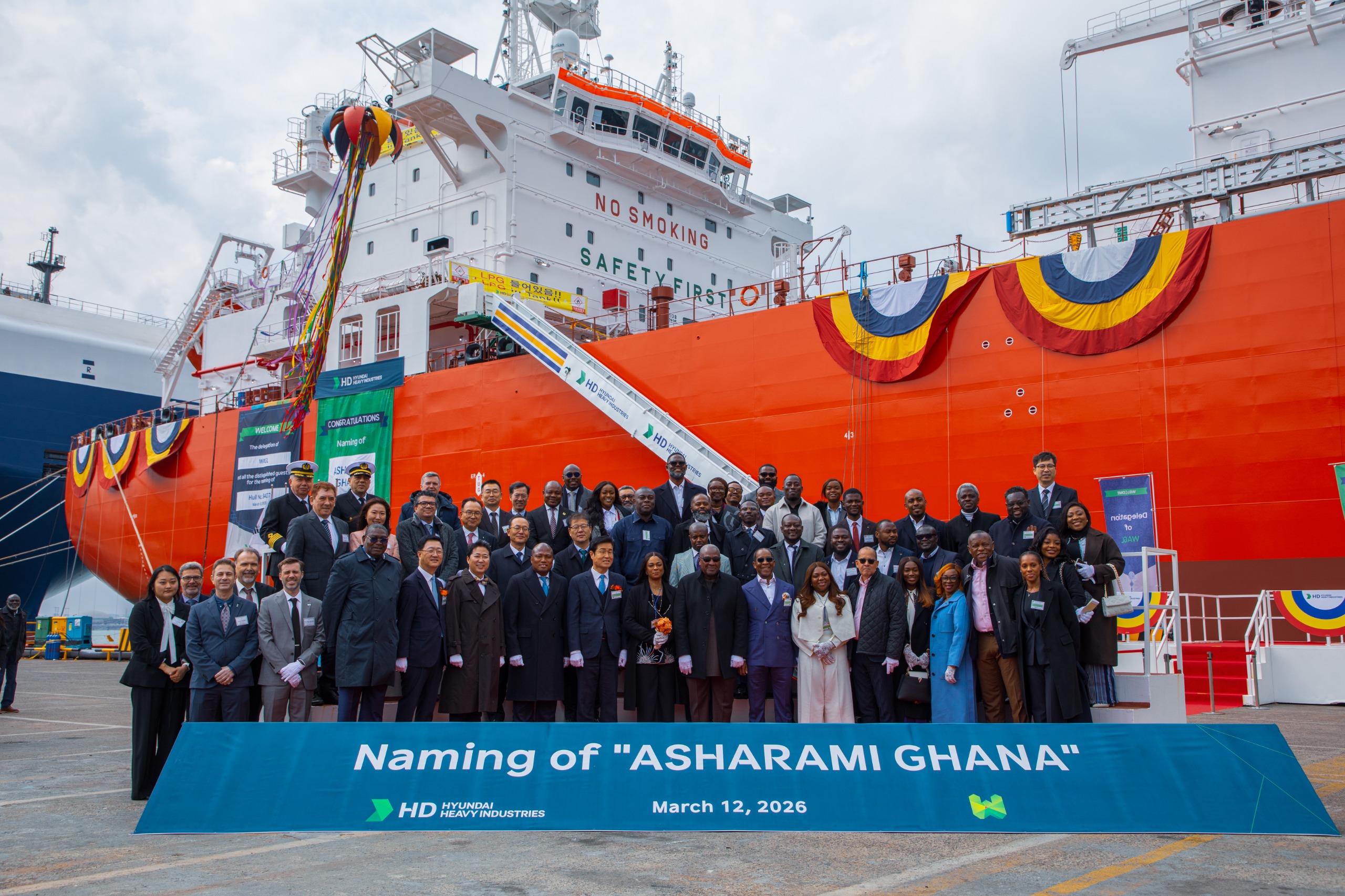
Sahara Group, a leading global energy and infrastructure conglomerate, has commissioned MT Asharami Ghana, a 40,000‑cubic‑metre Liquefied Petroleum Gas (LPG) carrier, expanding its fleet capacity, while strengthening Ghana’s clean energy supply chain and LPG distribution network.
The dual‑fuel vessel improves operational efficiency, enhances supply reliability, and supports lower‑emission LPG logistics as consumption grows across Ghana and the wider sub‑region.
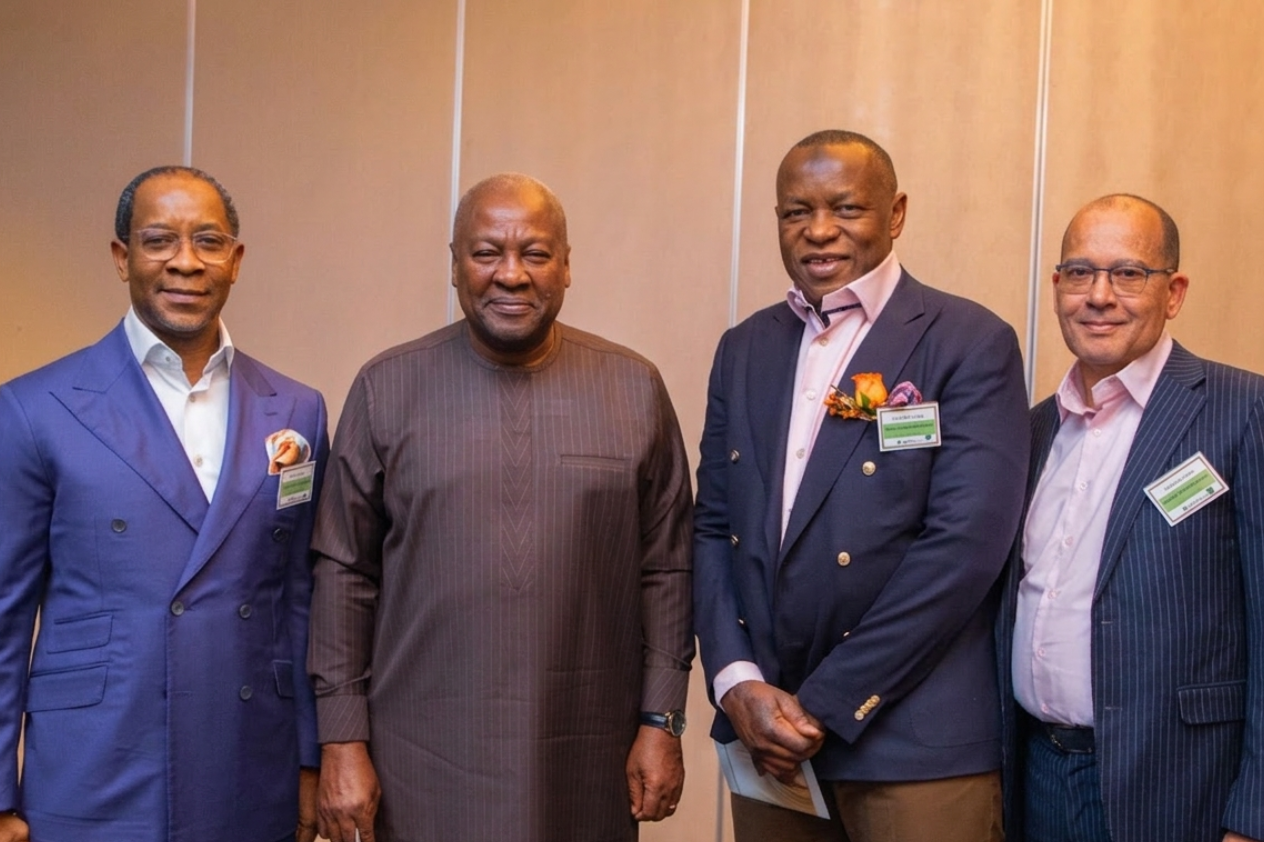
Ghanaian President Mahama and Sahara Executive Directors
Speaking at the commissioning in Ulsan, South Korea, President John Dramani Mahama described the vessel as “a significant milestone in strengthening the infrastructure that underpins the global LPG supply chain,” noting that expanded shipping capacity is critical to improving supply security, reliability and efficiency for countries that rely partly on LPG imports.
He commended Sahara Group, WAGL Energy and all partners involved for their “leadership, technical expertise and strategic foresight,” adding that the project reflects “the power of partnership” in advancing safe, efficient, and responsible energy distribution.
President Mahama wished the MT Asharami Ghana safe sails, expressing confidence that the vessel would inspire further investment and collaboration across Africa’s energy value chain.
According to Wale Ajibade, Executive Director, Sahara Group, the vessel supports Ghana’s clean energy ambitions through integrated infrastructure.
“MT Asharami Ghana is more than a vessel; it is part of a deliberate strategy to strengthen LPG supply security and support Ghana’s clean energy ambitions. It secures an additional 25,000-Metric-tonne stock security for the Ghana economy, alongside the soon to be commissioned 6000-metric-tonee of 12.000-metric-tonne land storage in Tema,” he said.
With the addition of Asharami Ghana, Sahara Group’s LPG carrier fleet now comprises six delivered vessels with a combined capacity of 202,000 cubic metres. Supported by partnerships with WAGL Energy, NNPC Limited and other stakeholders, an additional 270,000 cubic metres of capacity is under construction and due for delivery by September 2028.
Temitope Shonubi, Executive Director, Sahara Group, said Asharami Ghana is part of Sahara’s integrated LPG infrastructure strategy spanning shipping, storage, and downstream distribution globally, including the development of a 12,000‑metric‑tonne land‑based LPG storage terminal in Tema, with a 6,000‑metric‑tonne first phase scheduled for completion in May 2026.
He thanked Yaa Serwaa Alifo, MD of Asharami Ghana, for her resilience and insistence to dedicate a ship of “this magnitude solely to the Ghana Market and its landlocked neighbours.”
Ghana is targeting LPG adoption of 50 per cent of households by 2030, up from about 30 per cent today. Sahara’s investments will support clean energy access for more than 35 million people, while strengthening Ghana’s role in regional LPG trade to neighbouring and landlocked West African markets.
The commissioning comes in Sahara Group’s 30th anniversary year, guided by the Sahara Beyond XXX milestone, underscoring Sahara’s focus on building an enduring enterprise that delivers responsible growth, shared prosperity and long‑term impact across its markets.





Yenagoa Hosts NCDMB 2026 Content Forum

IPO: ADF Opens Wealth Creation Pathway for 2m Vulnerable Nigerian Women

2027: Tinubu Will Beat Atiku, Obi by Wide Margin, Says Bwala

‘Dem Dey Use Stick Dey Flog Women’ — Nigerians in India Camp Cry Out

2027: I’ll Bring Petrol Price Down to ₦300, Says Donald Duke
2027: INEC Must Prove Nigerians Wrong on Election Credibility — Donald Duke

Trump’s Family Unveils New Cryptocurrency Platform

Senate Denies Receiving Petitions Against Tinubu’s Ambassadorial Nominees

Dangote Cement Lights Up Benue Host Communities With CSR Initiatives

Reps Recommend 3-year Jail Term For Aviation minister

Tems Sets New Record On Billboard Hot 100 Chart
