
Business
Euro zone business starts 2014 on a high, China falters


LONDON – The global economy started 2014 on a disjointed note with the euro zone’s private sector in better shape than expected and China’s vast manufacturing industry contracting for the first time in six months.
Surveys on Thursday showed stronger growth across the now 18-member euro zone was marred only by an ongoing contraction in France, although the pace of that slowed. Apart from that, the upturn appeared broad-based with decent growth in both the services and manufacturing industries.
But in the first indication of sentiment for the new year in China’s 56.9 trillion yuan ($9.4 trillion) economy – the world’s second-largest – factories were hit by weaker domestic and export demand.
 “Overall, the message from the euro zone PMIs (purchasing managers’ indexes) were a good, positive surprise. It gives some support to the idea that we are going to get stronger activity growth in the earlier months of this year,” said Peter Dixon at Commerzbank.
“(The Chinese PMI) is consistent with the idea that China has shifted to a lower growth path, which is exactly in line with what the government is calling for. Is it a concern? Not at this stage. It’s a bit of a warning signal but that’s it.”
Markit’s Flash Euro zone Composite Purchasing Managers’ Index (PMI), which gauges business activity across thousands of companies and is seen as a good guide to economic health, jumped to 53.2 in January from 52.1 last month.
That was well above the 50 mark that denotes growth and was its highest since mid-2011, beating all forecasts in a Reuters poll of 25 economists.
An earlier composite PMI from France, the bloc’s second-biggest economy, showed activity contracted for the third month running in January, although the downturn was less pronounced with both services and factory PMIs beating expectations.
In neighboring Germany, the composite PMI rose to a 31-month high.
“The euro zone economy started 2014 on a positive footing, which is encouraging news and will reinforce hopes of a sustained recovery this year,” said Martin van Vliet at ING.
Markit said if the data held near current levels, the bloc’s economy would grow around 0.3-0.4 percent in the first quarter, stronger than the 0.2 percent suggested in a Reuters poll last week.
New orders rose for the sixth month, indicating the PMIs might rise higher next month. That comes after Ireland and Spain drew strong demand for bonds in auctions this month, while European shares climbed to fresh 5-1/2 year peaks on Tuesday as investors become increasingly bullish.
A Markit manufacturing survey for the United States, comparable with the euro zone and Chinese ones, is due later on Thursday and is expected to show sustained growth.
NOT SO HAPPY NEW YEAR
A Reuters visit to southern China’s manufacturing heartlands this month showed many factories have closed earlier than usual for the upcoming Lunar New Year, the nation’s biggest holiday, discouraged by weak orders and rising costs.
China’s Flash Markit/HSBC PMI fell to 49.6 in January from December’s 50.5, showing a faster rate of decrease in new export orders and employment.
“Such a reading highlights the deteriorating growth outlook as policymakers are tightening their monetary stance, pushing through with an austerity campaign, and withdrawing stimulus measures,” said Dariusz Kowalczyk, a senior economist and strategist for Credit Agricole CIB in Hong Kong.
Leaders in Beijing have pledged to push reforms to unleash new growth drivers as the economy loses steam, burdened by industrial overcapacity, piles of debt and soaring home prices.
China’s annual economic expansion slowed to 7.7 percent in the fourth quarter of 2013 from 7.8 percent in the previous quarter, putting full-year growth at 7.7 percent, slightly ahead of the government’s target of 7.5 percent.
While the economy narrowly missed expectations for full-year growth to fall to a 14-year low in 2013, some economists say a further cooling will be inevitable this year as officials hunker down for difficult reforms.
“Today’s PMI figure reinforces our expectation of growth momentum easing further this year. We expect GDP growth to progressively slow towards the pain threshold of 7 percent later this year,” said Nikolaus Keis at UniCredit.
– REUTERS
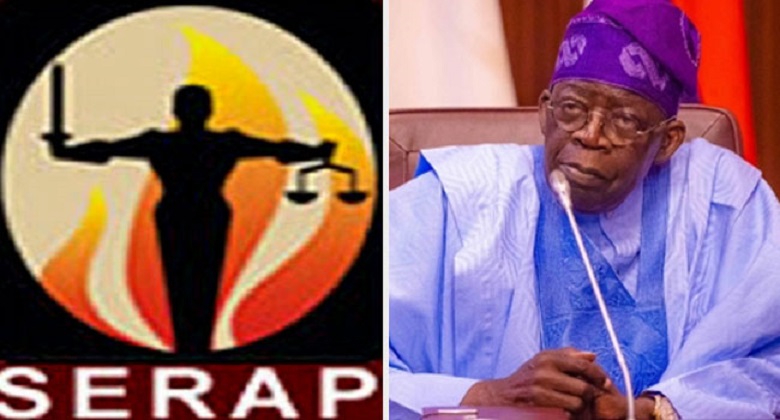
The Socio-Economic Rights and Accountability Project (SERAP) has called on President Bola Ahmed Tinubu to immediately instruct the Attorney General of the Federation and Minister of Justice, Lateef Fagbemi, along with relevant anti-corruption agencies, to investigate the reported spending of about N5.9 billion on the rebranding of the Nigerian National Petroleum Corporation (NNPC) to the Nigerian National Petroleum Company Limited (NNPCL).
According to SERAP, the probe should be carried out promptly to determine how the funds were used and whether the expenditure followed due process.
SERAP urged him to direct the Economic and Financial Crimes Commission (EFCC) and the Independent Corrupt Practices and other related offences Commission (ICPC) to identify the officials who approved and paid the amount, and the contractor(s) who collected the money, and to invite them for questioning.
READ ALSO NLNG Change YourStory: Backs Digital Storytelling’s New Era
SERAP also urged him to direct the EFCC and ICPC to promptly investigate the procurement process for the rebranding project, including whether the contract was awarded in compliance with the procurement laws and financial regulations.
SERAP further asked him to direct Fagbemi and the EFCC and ICPC to ensure that those suspected to be responsible for any wrongdoing are brought to justice if there is sufficient admissible evidence, and that any public funds that may have been misused or mismanaged are recovered and returned to the national treasury.
The NNPC reportedly paid N2.9 billion for incorporation expenses from petroleum product proceeds, while the National Petroleum Investment Management Services (NAPIMS) also charged N2.9 billion against crude oil revenue for the same purpose. In total, about N5.9 billion was spent by the NNPCL for the rebranding.
In the open letter dated March 14, 2026, and signed by SERAP deputy director Kolawole Oluwadare, the organisation said: “There ought to be full transparency and accountability regarding the reported N5.9 billion spent on rebranding NNPC to NNPCL.” SERAP said, “Nigerians have the right to know who approved the expenditure, who received the money, and whether due
The letter, also reads in part: “Any investigation into the rebranding project should determine whether the N5.9 billion represents value for money, lawful spending of public funds, and compliance with transparency and accountability requirements.
“Investigating the alleged spending of the N5.9 billion would help promote transparency and accountability in the management of public funds and strengthen public confidence in government institutions.
“Investigating the spending of the N5.9 billion would also demonstrate your government’s commitment to transparency, accountability and the fight against corruption in the oil sector.
“Your government has a legal obligation to investigate credible allegations of corruption, prosecute those suspected to be responsible, and recover any misused or mismanaged public funds.
“Given the size of the reported expenditure and the importance of transparency in the management of public resources in the petroleum sector, there is an urgent need for a prompt, thorough, independent, transparent and effective investigation into the spending. The findings of any such investigation should be made public.
“We would be grateful if the recommended measures are taken within 7 days of the receipt and/or publication of this letter. If we have not heard from you by then, SERAP shall consider appropriate legal actions to compel your government and the NNPCL to comply with our request in the public interest.”
Modupe Asudo
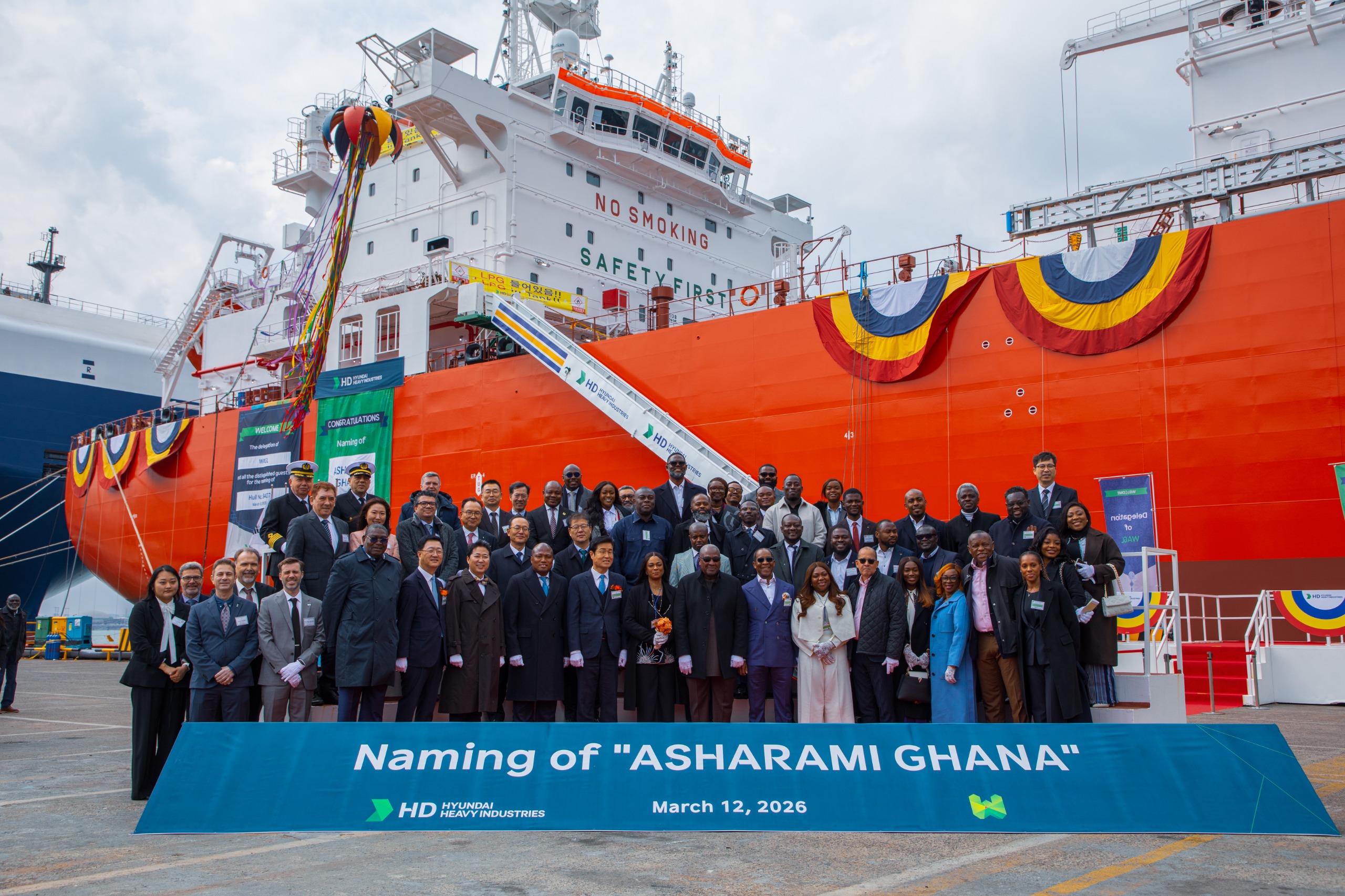
Sahara Group, a leading global energy and infrastructure conglomerate, has commissioned MT Asharami Ghana, a 40,000‑cubic‑metre Liquefied Petroleum Gas (LPG) carrier, expanding its fleet capacity, while strengthening Ghana’s clean energy supply chain and LPG distribution network.
The dual‑fuel vessel improves operational efficiency, enhances supply reliability, and supports lower‑emission LPG logistics as consumption grows across Ghana and the wider sub‑region.
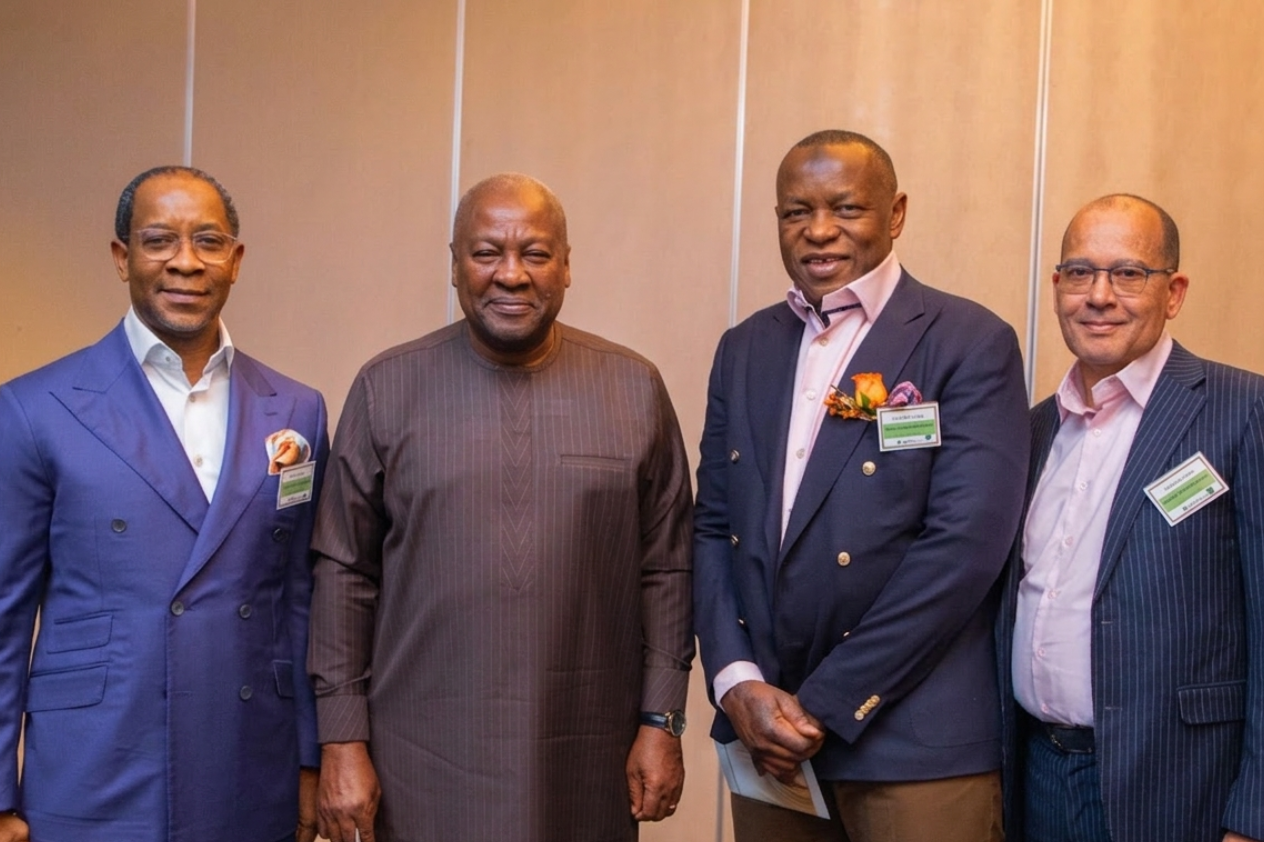
Ghanaian President Mahama and Sahara Executive Directors
Speaking at the commissioning in Ulsan, South Korea, President John Dramani Mahama described the vessel as “a significant milestone in strengthening the infrastructure that underpins the global LPG supply chain,” noting that expanded shipping capacity is critical to improving supply security, reliability and efficiency for countries that rely partly on LPG imports.
He commended Sahara Group, WAGL Energy and all partners involved for their “leadership, technical expertise and strategic foresight,” adding that the project reflects “the power of partnership” in advancing safe, efficient, and responsible energy distribution.
President Mahama wished the MT Asharami Ghana safe sails, expressing confidence that the vessel would inspire further investment and collaboration across Africa’s energy value chain.
According to Wale Ajibade, Executive Director, Sahara Group, the vessel supports Ghana’s clean energy ambitions through integrated infrastructure.
“MT Asharami Ghana is more than a vessel; it is part of a deliberate strategy to strengthen LPG supply security and support Ghana’s clean energy ambitions. It secures an additional 25,000-Metric-tonne stock security for the Ghana economy, alongside the soon to be commissioned 6000-metric-tonee of 12.000-metric-tonne land storage in Tema,” he said.
With the addition of Asharami Ghana, Sahara Group’s LPG carrier fleet now comprises six delivered vessels with a combined capacity of 202,000 cubic metres. Supported by partnerships with WAGL Energy, NNPC Limited and other stakeholders, an additional 270,000 cubic metres of capacity is under construction and due for delivery by September 2028.
Temitope Shonubi, Executive Director, Sahara Group, said Asharami Ghana is part of Sahara’s integrated LPG infrastructure strategy spanning shipping, storage, and downstream distribution globally, including the development of a 12,000‑metric‑tonne land‑based LPG storage terminal in Tema, with a 6,000‑metric‑tonne first phase scheduled for completion in May 2026.
He thanked Yaa Serwaa Alifo, MD of Asharami Ghana, for her resilience and insistence to dedicate a ship of “this magnitude solely to the Ghana Market and its landlocked neighbours.”
Ghana is targeting LPG adoption of 50 per cent of households by 2030, up from about 30 per cent today. Sahara’s investments will support clean energy access for more than 35 million people, while strengthening Ghana’s role in regional LPG trade to neighbouring and landlocked West African markets.
The commissioning comes in Sahara Group’s 30th anniversary year, guided by the Sahara Beyond XXX milestone, underscoring Sahara’s focus on building an enduring enterprise that delivers responsible growth, shared prosperity and long‑term impact across its markets.
Business
NGX Group, IFC, CSCS and WIMBIZ Convene Leaders to Advance Gender Equality at 2026 Ring the Bell Ceremony

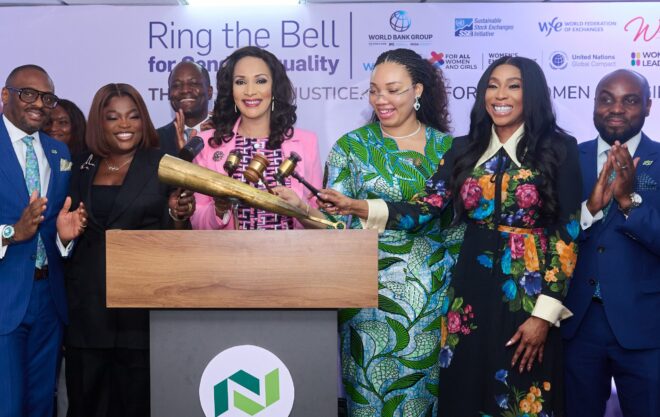
The Nigerian Exchange Group Plc (NGX Group), in collaboration with Central Securities Clearing System Plc (CSCS) and Women in Management, Business and Public Service (WIMBIZ), convened leaders from across the public and private sectors to commemorate International Women’s Day 2026 through the global Ring the Bell for Gender Equality initiative.
Aligned with the UN Women theme “Rights, Justice, Action – For All Women and Girls,” the event, held during the Nigerian Exchange Closing Gong Ceremony, served as a call for sustained action to advance gender equality and expand women’s participation in economic leadership.
ALSO READ: Dangote Refinery Cuts Petrol, Diesel Prices
Delivering the welcome address, Temi Popoola, Group Managing Director/Chief Executive Officer of NGX Group, emphasized the critical role capital markets must play in shaping inclusive economic growth. “Capital markets are powerful engines for economic transformation. When women participate fully as leaders, entrepreneurs, and investors, markets become stronger, deeper, and more resilient. At NGX Group, we remain committed to advancing policies, partnerships, and platforms that expand opportunities for women and accelerate inclusive prosperity,” he said.
Delivering special remarks, Honourable Bianca Odumegwu-Ojukwu, Minister of State for Foreign Affairs, commended NGX Group and its partners for advancing gender inclusion through the initiative. “I congratulate NGX Group and its partners for sustaining this important global movement and for championing gender equality within our financial ecosystem. Together, let us continue to open the doors of opportunity so the next generation of women can lead with confidence and help transform our world,” she said.
Chioma Uzodimma, First Lady of Imo State, called for collective action to expand opportunities for women and girls. “As we sound the NGX Gong today, let it symbolize our shared pledge to protect every girl child, expand opportunities for every woman, and build an inclusive economy where every woman and girl can flourish,” she said.
Jude Chiemeka, Chief Executive Officer of Nigerian Exchange, emphasized the importance of broadening women’s participation in the capital market ecosystem. “When more women participate in the market as investors and professionals, we deepen the market and strengthen the foundation for sustainable growth,” he said.
Speaking on the role of development finance institutions in advancing gender inclusion, Claude Owona, Regional Industry Manager for Financial Institutions at the International Finance Corporation (IFC) for Central Africa and Anglophone West Africa, emphasized the economic benefits of gender equality. “When women and men participate equally in the economy, our societies function better and our economies become more prosperous,” she said.
Media entrepreneur and founder of EbonyLife Media, Mo Abudu, encouraged women to pursue their ambitions with clarity and confidence. “For me, it comes down to four things, purpose, passion, progress, and power. Find your purpose, let passion fuel your journey, stay consistent even when challenges arise, and most importantly, stand firmly in your power. Do not shrink,” she said.
Award-winning actor and filmmaker Funke Akindele urged women to pursue their ambitions with discipline and courage. “To every woman out there, you can do it. But beyond the words, we must put in the hard work, build structure into our businesses, and do things the right way. It takes courage to take the first step even when you’re not ready, courage to stay consistent when no one is clapping, and courage to hold firmly to your vision,” she said.
The Ring the Bell for Gender Equality ceremony celebrated the contributions of women to Nigeria’s capital markets and the broader economy while reinforcing the need for sustained action to close gender gaps in leadership, finance, and opportunity.
The 2026 edition was organized in collaboration with global partners including the International Finance Corporation (IFC), UN Women, the World Federation of Exchanges (WFE), the United Nations Global Compact, and the Sustainable Stock Exchanges Initiative (SSEI).
The event also featured the participation of female board members of NGX Group of companies, Ojinika Olaghere, Fatima Wali-Abdulrahman, Lilian Olubi, Ummahani Ahmad Amin, Amina Mohammed, and Fiona Ahime, alongside key ecosystem leaders including Onome Komolafe, Divisional Head, Business Services and Client Experience, CSCS Plc; Jumoke Olaniyan, Group Chief Strategy Officer, NGX Group; Uto Ukpanah, Chairperson, UN Global Compact Network Nigeria; and Mrs. Omowumi Akingbohungbe, Executive Director, WIMBIZ.
As the closing gong sounded, stakeholders echoed a common message: advancing gender equality requires more than dialogue. It requires sustained collaboration, deliberate action, and a collective commitment across governments, institutions, and markets to expand opportunities for women and girls.
Through initiatives such as Ring the Bell for Gender Equality, NGX Group and its partners continue to champion inclusive markets, recognizing that empowering women is essential to building stronger capital markets and a more resilient economy.





NCDMB, Renaissance Africa Train Pipeline Engineers

NLNG Inducts 103 Trainees Into Empowerment Scheme
NCDMB Sponsored Oracle Primavera P6 Training Underway In Rivers State

Senate Approves Abe as Chairman, NUPRC Board

Tinubu Swears in Taiwo Oyedele as Finance Minister

Burna Boy Breaks Record as Africa’s Top-Grossing Concert Artist

Trump’s Family Unveils New Cryptocurrency Platform

Reps Recommend 3-year Jail Term For Aviation minister

Dangote Cement Lights Up Benue Host Communities With CSR Initiatives

Senate Denies Receiving Petitions Against Tinubu’s Ambassadorial Nominees

Tems Sets New Record On Billboard Hot 100 Chart
