
Business
FG’s Q1 2024 Revenue Hits ₦9.1 Trillion, Doubles 2023 Figure


Minister of Finance Wale Edun has announced that the Federal Government’s revenue for the first quarter of 2024 has increased to ₦9.1 trillion.
This represents more than double the revenue for the same period in 2023.
Edun made this statement at the 17th Annual Banking and Finance Conference organized by the Chartered Institute of Bankers of Nigeria (CIBN) in Abuja on Tuesday.
Read Also: DJ Neptune Denies Fraud Allegations By Laycon
He was represented by Dr. Armstrong Takang, the Managing Director of the Ministry of Finance, Incorporated.
The minister attributed the increase in revenue to the success of the government’s revenue collection policies and the effective deployment of technology.
He assured that the government is committed to ensuring that revenue generation meets or exceeds the set target. Edun also emphasized that the government has not increased taxes.
He said, “Such progress will enable us to essentially make social and capital investments that positively impact both the economy and its citizens.
“Despite this progress, our primary challenge remains addressing the sharp increases in food prices. Several initiatives are on their way to boost food supply and curb food inflation.”
In his remarks, the Governor of the Central Bank of Nigeria (CBN), Dr. Olayemi Cardoso, said that the bank looks forward to actionable solutions from the conference. These solutions will aid in achieving a one trillion-dollar economy. Cardoso was represented by Dr. Blaise Ijabor, the Director of the Risk Management Department of CBN.
Cardoso emphasized the critical role of bankers in the growth and development of the economy. He noted that bankers are essential stakeholders in this process.
Bello Hassan, the Managing Director of the Nigeria Deposit Insurance Corporation (NDIC), congratulated the CIBN for organizing the conference.
He reaffirmed the Corporation’s commitment to working towards engendering confidence in the banking system.








In the bid to transform Tanzania into the East African regional energy hub, the country is on the verge of concluding an agreement with a consortium of energy companies, including a $42 billion LNG project.
It was gathered that the project is designed to tap the 47.13 tcf of gas discovered in Tanzania’s deep offshore fields, part of the country’s estimated 57.54 tcf in total discovered reserves, the sixth-largest in Africa, behind Nigeria, Algeria, Senegal, Mozambique and Egypt.
READ ALSO: Shell Identifies Keys to Nigeria’s Energy Future
Equinor and Shell would be the lead operators, alongside involvement from ExxonMobil Pavilion Energy and Medco Energi, while state oil major, the Tanzania Petroleum Development Corporation (TPDC), would also hold an equity stake in the project.
“It’s almost there,” Khamis Mussa Omar, Tanzania’s finance minister, told Reuters.
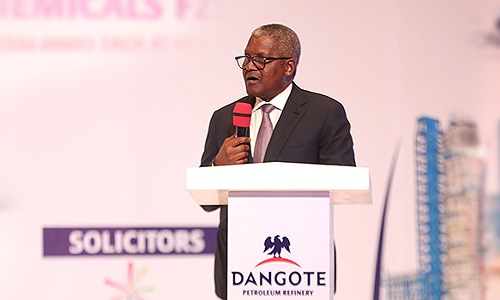
President of Dangote Group, Aliko Dangote, has reaffirmed his commitment to ensuring broad-based participation in the Dangote Refinery’s Initial Public Offering (IPO).
In a statement, the industrialist announced that investors applying with ₦50,000 and below will receive priority consideration as the company seeks to democratize ownership of one of Africa’s most significant industrial assets.
Dangote made the declaration during the final leg of the nationwide IPO roadshow held in Port Harcourt, Rivers State, where investors, financial market experts, business leaders and other stakeholders gathered to discuss the investment opportunity and its implications for Nigeria’s economic transformation.
READ ALSO: Sahara Champions Global Shipping Collaboration for $20m Mercy Ships Healthcare Impact
Speaking at the event, Dangote emphasised that the IPO should be viewed not merely as an investment opportunity, but as a chance for Nigerians to become shareholders in a landmark enterprise that is reshaping the country’s industrial landscape.
“We will prioritise people with ₦50,000 and below,” Dangote stated, underscoring the Group’s determination to make the offering accessible to small and medium-scale investors across the country.
He noted that while international and African investors had already committed substantial capital to the refinery, the IPO now offers Nigerians a rare opportunity to participate directly in the ownership of a world-class industrial project built on Nigerian soil.
According to him, investing in the refinery goes beyond financial returns, representing a vote of confidence in Nigeria’s future, institutional development, corporate governance standards and industrial capacity.
“African investors have invested in this refinery. Now it is time for Nigerians to invest in themselves and participate in a project that is creating value, jobs and opportunities for generations to come,” he said.
Dangote also encouraged prospective shareholders to adopt a long-term investment perspective, noting that participation in the IPO presents a pathway to wealth creation, portfolio diversification and increased public engagement with the capital market.
He added that wider participation in the stock market would deepen financial literacy, promote a savings and investment culture, and enable more Nigerians to better understand how businesses create value and contribute to economic growth.
The roadshow also featured insightful presentations from leading economists and market analysts on the refinery’s economic significance and the broader opportunities associated with the public offering.
Renowned economist Bismarck Rewane highlighted the enormous economic potential of the South-South region and stressed the need to convert the area’s resource endowment into sustainable prosperity, infrastructure development and improved living standards. He also noted that the IPO presents an opportunity to deepen Nigeria’s capital market by encouraging citizens to participate actively in wealth creation.
Similarly, economist Dr. Muda Yusuf outlined the refinery’s far-reaching impact on economic diversification, domestic value addition, energy security, capital formation and employment generation.
According to Yusuf, the refinery represents far more than a petroleum-processing facility, serving as a catalyst for growth across multiple sectors including petrochemicals, packaging, manufacturing, logistics and other downstream industries.
He further emphasized that policy consistency, regulatory stability and sustained stakeholder engagement remain critical to maintaining investor confidence and attracting long-term capital into Nigeria’s industrial sector.
Speaking on the investment outlook, stakeholders urged prospective investors to consider the company’s operational performance, valuation metrics and long-term fundamentals when evaluating the offer.
Yusuf also described the refinery as a major example of domestic value addition, noting that its extensive local content and industrial linkages would significantly amplify its contribution to the Nigerian economy.
Discussions at the event further highlighted the importance of sound monetary policy, affordable financing and a predictable business environment in supporting investment-led growth and industrial expansion.
The Port Harcourt engagement was particularly significant for the South-South region, with legal luminary and business leader Paul Usoro expressing satisfaction at the level of participation from investors across the region.
“My joy is to see the South-South well represented,” Usoro said, stressing the importance of ensuring that investors from the region take advantage of the opportunity presented by the IPO.
The Port Harcourt event marked the final stop of the nationwide IPO roadshow, concluding a series of engagements designed to deepen public awareness and expand participation in what is widely regarded as one of the most significant capital market offerings in Nigeria’s history.
For Dangote Group, the objective remains clear: to provide Nigerians from all backgrounds with an opportunity to participate in the ownership of a transformative industrial enterprise while contributing to economic growth, employment generation and national development.
Sahara Energy Geneva has highlighted the power of business collaboration to deliver lasting impact, with Mercy Ships Cargo Day celebrating more than $20 million raised over the past decade to support healthcare interventions in Africa.
More than 500 guests from over 150 shipping and trading companies gathered in Geneva recently for the 10th anniversary Gala of Mercy Ships Cargo Day, celebrating a decade of industry support for the international charity.
David Walker, Head of Chartering at Sahara Energy Geneva and Chairman of the Cargo Day Geneva Committee, joined industry leaders at the event, where he thanked the global shipping community, sponsors, media partners and Cargo Day committees in Geneva, London, Houston, Dubai and Singapore for supporting the initiative.
Cargo Day brings together charterers, shipowners, shipbrokers, and other shipping professionals who contribute through pledges, cargo commissions, and address commissions to support the work of Mercy Ships.
READ ALSO: 30 Nigerians Bag Postgraduate Scholarship from NNPC Ltd, Eni
Kola Motajo, Director, Sahara Geneva said Sahara’s involvement reflects the company’s belief in the ability of enterprise and partnerships to deliver impact beyond business.
“At Sahara, our focus is always on impact and lives transformed. Cargo Day demonstrates what is possible when businesses and individuals unite around a shared purpose. The $20 million milestone reflects the collective commitment of the global shipping community to improving healthcare in Africa. As Sahara looks Beyond XXX, we remain committed to building connections that create lasting value and possibilities for generations to come,” Motajo said.
Reflecting on Cargo Day’s growth, Walker said: “Ten years ago, we raised $300,000 and there were 70 people at the Gala. Today, we have more than 500 people coming from around the world to support such a great cause.”
Cargo Day 2025 raised more than $2.5 million, with 93 companies participating, including charterers, brokers, shipowners, and other partners.
Mercy Ships operates two hospital ships supporting patients in Africa with free life-changing surgeries, while also providing training and mentoring for local healthcare professionals. Cargo Day funding contributes to expenses associated with operating the hospital ships.
The 2026 Cargo Day campaign begins November 4 and will run through November and December, with companies participating through Mercy Cargoes, address commissions and pledges.






Tanzania Nears Completion of $42bn Equinor, Shell-Led LNG Project

IEA Puts UAE’s Oil Output at 5.3mbpd for September

Africa’s Energy Security Conversations Pull Industry Executives Together
‘Oseni Rufai Helped Me, Not NiDCOM’ — Ekene Chukwuma on Return to Nigeria

‘Who Owns NNPC?’ Rufai Grills Olabode Sowunmi Over Fuel Subsidy

JUST IN: Amnesty Volunteer Lawrence Zongo Regains Freedom After 10 Days In Custody

Trump’s Family Unveils New Cryptocurrency Platform

Senate Denies Receiving Petitions Against Tinubu’s Ambassadorial Nominees

Dangote Cement Lights Up Benue Host Communities With CSR Initiatives

Reps Recommend 3-year Jail Term For Aviation minister

Tems Sets New Record On Billboard Hot 100 Chart
