
Business
Global Stocks put aside U.S. growth setback


SYDNEY – Stock markets in Europe and Asia looked past gains by Iraqi militants and poor first-quarter growth in the United States on Thursday, with some investors raising their forecasts for a U.S. economic bounce in coming months.
A Sunni insurgency in Iraq has driven oil prices as high as $115 a barrel, threatening to raise costs for businesses around the world. Prices eased on Thursday LCOc1 but remain close to levels not seen since the start of 2013.
The surge in oil prices is the latest setback for a global economy still trying to get back on its feet. In that light, Wednesday’s final estimate of U.S. gross domestic product in the first quarter was only the latest argument that the Federal Reserve will keep interest rates at record lows into next year.
Most investment houses are also much more optimistic about the future. Some responded to the U.S. figures by raising their estimates of second-quarter growth.
“There’s a storm in the rear-view mirror, but much brighter sunshine ahead,” said Kit Juckes, a strategist with French bank Societe Generale in London. “The storm does matter, though. There is every reason to be optimistic about upcoming U.S. data, and equally, every reason to expect policy to remain easy.”
European stock markets had retreated after the U.S. figures on Wednesday, then rebounded .EU. Shares in Barclays BARC.L sank 3 percent, though, after New York’s attorney general filed a lawsuit against the UK lender.
Longer-dated bond yields fell and the dollar suffered as funds were forced to move out the yield curve. Investors were willing to accept just 1.26 percent to lend to Germany for 10 years.
U.S. crude CLc1 added 4 cents to $106.54 a barrel, while Brent LCOc1 was unchanged at $114.00. O/R
STABILITY COUNTS
Top of the bill in Europe was the British pound and the impact on it of a Bank of England report on financial stability.
The report is expected to provide the bank’s newly founded Financial Policy Committee with a vehicle to announce more measures to curb a booming British housing market, which some worry may be overheating again, six years after the 2008 crash.
Such “macroprudential” steps, particularly if aggressive, might push back expectations of a rise in interest rates that have driven sterling 10 percent higher in a year.
“There’s quite a lot of uncertainty because this is all quite new for UK assets,” said Paul Robson, a currency strategist with RBS in London.
“The devil will be in the detail, but the rule of thumb is that the tighter macroprudential policy becomes, the looser conventional monetary policy can be – i.e., interest rates might not have to be raised quite as early or aggressively as they would have otherwise been.”
The prospect of the Fed keeping rates low for longer encouraged equity investors, though some were cautious in case a key measure of U.S. inflation due later Thursday surprised on the high side.
The price index for personal consumption expenditures is the Fed’s favoured measure of inflation and looks likely to have reached its highest since late 2012 in May. ECONUS
Most Asian markets ended in the black with MSCI’s broadest index of Asia-Pacific shares outside Japan .MIAPJ0000PUS up 1.08 percent. Japan’s Nikkei .N225 gained 0.3 percent and Australia .AXJO 1.15 percent.
“You can make the argument that the weaker the number for Q1, the more that Q2 is going to pay back in terms of growth,” said Alessandro Tentori, global head of rates strategy at Citi.
“This is on the assumption that Q1 has been influenced by emerging markets weakness and weather related factors.”
– REUTERS


Leading investment research firm Renaissance Capital Africa (RCA) has upgraded its valuation of Dangote Petroleum Refinery and Petrochemicals (DPRP) to N700.41 per share, implying a 33.4 percent upside from the refinery’s IPO offer price of N525 per share.
According to RCA, the valuation increase reflects the refinery’s exceptional earnings performance in the first nine months of 2026, driven by stronger refining margins and better-than-anticipated operational results. Revenue, EBITDA and net profit all exceeded the firm’s expectations during the period.
READ ALSO: Dangote Refinery IPO Elicits Participation in 90 Countries Globally
In its October 16, 2026, update, titled “Stronger Refining Margins Drive Earnings Outperformance,” the investment firm cited robust refining margins and stronger operating results as key drivers of the enhanced valuation.
The remarkable investor interest comes against the backdrop of the refinery’s strong operational and financial performance. For the nine months ended September 30, 2026, the DPRP reported revenue of US22.5 billion and net profit of US4.7 billion, representing one of the strongest financial performances recorded by an African industrial enterprise in recent years.
The results marked a significant turnaround from the corresponding period in 2025, when the company recorded a loss of US117.2 million. Revenue grew by 144 percent from US9.2 billion, while EBITDA increased nearly nine-fold to US5.5billionfromUS627.6 million. Operating cash flow rose more than ten-fold to US$3.68 billion, underscoring the refinery’s growing ability to generate substantial earnings and cash flow from its operations.
The company also strengthened its balance sheet considerably, moving from a net debt position of US1.73 billion as of September 2025 to a net cash position of US651 million by September 2026, reflecting improved liquidity and financial resilience.
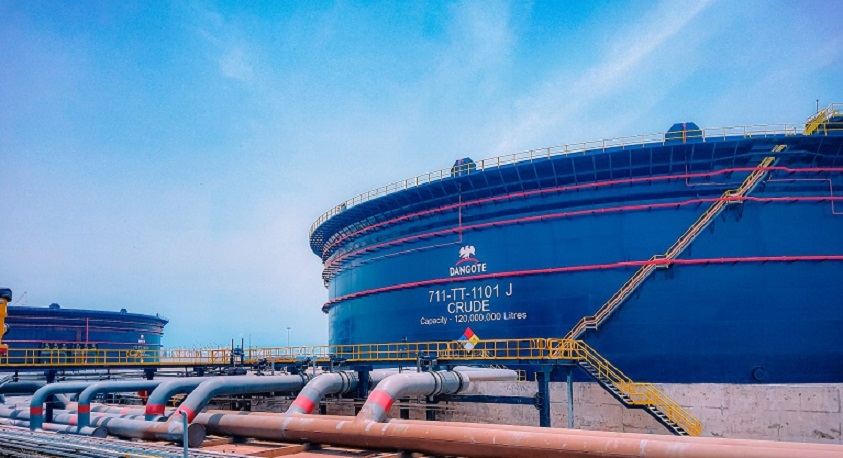
The Dangote Petroleum Refinery & Petrochemicals (DPDP) has revealed that its ongoing Initial Public Offering (IPO) has attracted exceptional participation from investors across Africa and around the world, with subscriptions received from more than 90 countries, including investors from 51 of Africa’s 54 nations.
The unprecedented level of participation positions the transaction as Africa’s first truly pan-African public offering, reflecting strong investor confidence in African-led industrialization and a growing desire among Africans to own strategic assets built on the continent.
The company noted that the IPO has already set new benchmarks in the capital markets, breaking the Nigerian market record on its opening day and surpassing the previous African record within its first ten days, driven by robust demand from retail investors, pension funds, institutional investors, asset managers, and members of the investing public.
On the milestone, Chief Financial Officer of Dangote Group, Murat Erden, said: “This offering represents far more than a capital-raising exercise. It is a landmark opportunity for Africans and global investors alike to participate in the ownership of one of the continent’s most transformative industrial assets. The extraordinary participation from individuals and institutions across Africa demonstrates a shared conviction that Africans should not only benefit from industrial development but also own and create wealth from it.”
The remarkable investor interest comes against the backdrop of the refinery’s strong operational and financial performance. For the nine months ended September 30, 2026, the DPRP reported revenue of US22.5billion and net profit of US4.7 billion, representing one of the strongest financial performances recorded by an African industrial enterprise in recent years.
READ ALSO: Makinde Fires Back at Presidency, Insists on ₦9tn NLNG Dividend Shortfall
The results marked a significant turnaround from the corresponding period in 2025, when the company recorded a loss of US117.2 million. Revenue grew by 144 percent from US9.2 billion, while EBITDA increased nearly nine-fold to US5.5 billion from US627.6 million. Operating cash flow rose more than ten-fold to US$3.68 billion, underscoring the refinery’s growing ability to generate substantial earnings and cash flow from its operations.
The company also strengthened its balance sheet considerably, moving from a net debt position of US1.73 billion as of September 2025 to a net cash position of US651 million by September 2026, reflecting improved liquidity and financial resilience.
According to Erden, the refinery’s current performance significantly exceeds the assumptions underpinning the IPO valuation. “Our financial performance has already advanced well beyond the baseline assumptions used in determining the IPO valuation. The refinery’s operational momentum, scale and efficiency continue to create substantial shareholder value and reinforce our confidence in its long-term growth prospects.”
In a major boost to African capital-market integration, the transaction has also benefited from pioneering cross-border market collaborations involving Botswana, Egypt, Ethiopia and Kenya, helping to broaden access and reduce barriers to participation for investors across the continent.
The DPDP described the IPO as a powerful demonstration of the increasing sophistication, depth and interconnectedness of African financial markets, providing a blueprint for future continent-wide investment offerings.
The company reiterated that the IPO provides a unique opportunity for investors to become shareholders in one of Africa’s largest and fastest-growing industrial enterprises, with the potential for USD-linked dividends, subject to the company’s dividend policy and applicable regulatory approvals.
With the offer scheduled to close on 27 October 2026, the company has intensified investor education and engagement activities across key markets to ensure broader inclusion and participation. The refinery emphasized that no further extension of the offer period is currently planned.
On the significance of the transaction, Erden added: “We are witnessing the emergence of a new chapter in African industrial ownership and capital-market development. The overwhelming response from investors across 51 African countries and more than 90 countries globally is a resounding vote of confidence in Africa’s future and in the ability of world-class African enterprises to deliver sustainable value for shareholders.”
The company expressed appreciation to regulators, stockbrokers, issuing houses, financial institutions, fintech partners, community leaders, investor associations and the investing public for their support and participation throughout the offer period.

Tesla has set a 2028 commercial production date for its new Roadster sports car that can briefly rise into the air using rocket technology.
According to CNN, the date was revealed when the manufacturers demonstrated its functionality on Thursday at a SpaceX testing facility in Texas, United States, where the two-seater vehicle performed a series of manoeuvres, including driving upside down before making a short airborne movement.
The prototype was operated without a driver during the test, with Musk saying the decision was taken “to make sure we don’t kill anyone.”
“Success is not guaranteed. I mean that. It’ll probably work, but if it doesn’t work, we’re at a safe distance,” he said.
READ ALSO: 2027 Election: ‘Your Future Is More Valuable’ — IGP Warn Youths Against Political Violence
CNN reported that the vehicle uses 10 nozzles and high-pressure air tanks to generate thrust, with Musk claiming it could accelerate from zero to 60 miles per hour in less than a second.
The Tesla boss attributed the development to cooperation between the electric vehicle manufacturer and SpaceX, the rocket company he also leads.
He described the project as “the results of what happens when you have a collaboration with the world’s best car company and the world’s best rocket company.”
Musk also sought to assure spectators that the demonstration was genuine, saying, “We need an audience to prove that it’s not AI or SI. So you guys can tell people you saw it with your eyes, because what you see with your eyes, you will not believe.”
Despite the display, questions remain about whether the vehicle can achieve sustained flight and how practical it would be for everyday transportation.
Roger Conner, curator for vertical flight at the Smithsonian’s National Air and Space Museum, told CNN that combining the requirements of road vehicles and aircraft presented significant engineering challenges.
“Aircraft are extremely sensitive to weight, whereas with ground vehicles you want them to have bumpers and crumple zones and all that,” he said.
“Inevitably, something that is a hybrid between the two is going to be a poor performing aircraft and a poor performing vehicle, and also quite expensive,” he added.
Conner questioned whether the demonstration amounted to flying in the conventional sense.
“We’re not talking about sustained flight. We are literally talking about hopping,” he said.
However, Jim Dukhovny, chief executive of flying car startup Alef, said the technology was achievable, while pointing to the difficulties involved in making such vehicles transition safely from vertical take-off to forward flight.
“It absolutely is 100% feasible,” he told CNN.
“That being said, the hardest part on all eVTOLs, and for us, it’s a transition from (rising) vertical to (moving) forward. It needs to be extremely careful, making sure you do not lose lift, and making sure it’s very stable,” he added.
CNN also reported that Alef’s prototype weighs about 254 pounds, uses eight propellers and is designed to carry one person.
Musk said Tesla intended to begin production of the new Roadster in 2028.
CNN reported that the latest display adds to Musk’s ambitions to push Tesla’s vehicle technology beyond conventional electric cars, although the prototype’s ability to operate as a practical flying vehicle has yet to be established.






APC Campaign Council Sets Inaugural Meeting for Tuesday Ahead of Kaduna Flag-Off

Renaissance Capital Sees Significant Upside in Dangote Refinery, Lifts Valuation by 33.4%

Dangote Refinery IPO Elicits Participation in 90 Countries Globally

Makinde Fires Back at Presidency, Insists on ₦9tn NLNG Dividend Shortfall

‘NELFUND Is Not an Excuse for School Fees Hikes’ – NANS Warns Universities

NANS Threatens to Shut Down AE-FUNAI Over School Fees Hike

Trump’s Family Unveils New Cryptocurrency Platform

Senate Denies Receiving Petitions Against Tinubu’s Ambassadorial Nominees

Dangote Cement Lights Up Benue Host Communities With CSR Initiatives

Reps Recommend 3-year Jail Term For Aviation minister

Tems Sets New Record On Billboard Hot 100 Chart
