Finance
How Nigeria can get out of economic crisis – IMF boss

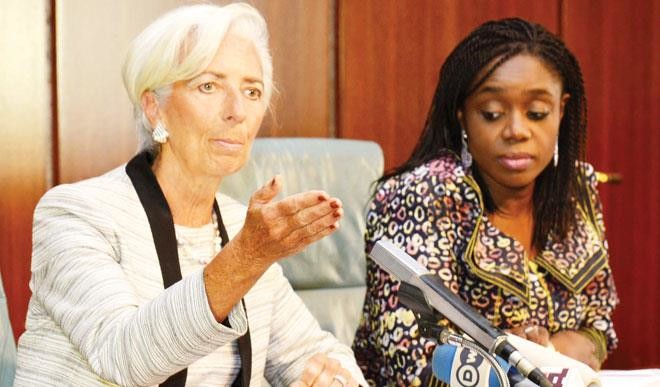
ABUJA – MANAGING Director, International Monetary Fund, IMF, Christine Lagarde has asked Nigeria and Nigerians to brace up for harder times, following the massive fall in the price of oil globally, just as she said that the country since inception recorded the slowest pace of growth in the year 2015.
Lagarde, who called for increase in Value Added Tax, VAT, stressed that it has become imperative for the federal government to broaden the country’s tax base against the backdrop that Nigeria has the lowest VAT rate in the African continent. According to her, “the current VAT rate is among the lowest in the world and well below the rates in other ECOWAS members—so some increase should be considered.”
IMF chief, Christine Largarde speaking in Abuja
Although the IMF Managing Director was careful not to endorse the devaluation of naira against major international currencies, she, however, urged the federal government to adopt a flexible monetary policy that will better serve the interest of Nigerians.
Speaking, yesterday, at the National Assembly complex in Abuja during a meeting with Senate President Bukola Saraki and other senators, the IMF boss who called on the federal government to reduce cost of governance, said that the contentious fuel subsidy must be removed to allow government spend on infrastructure, housing, education, health, among others.
She, however, cautioned Nigeria against obtaining loans, noting that it was at the moment affecting the country and subsequent borrowing could hurt the nation’s economy in the long run.
She said: “On recurrent expenditure, efforts should be made to streamline the cost of government and improve efficiency of public service delivery across the federal and sub-national governments. Transfers and tax expenditures should also be addressed. For example, continuing the move already begun by the government in the 2016 budget to eliminate resources allocated to fuel subsidies would allow more targeted spending, including on innovative social programmes for the most needy.”
Fuel subsidies hard to defend
She continued: “Indeed fuel subsidies are hard to defend.“Not only do they harm the planet, but they rarely help the poor. IMF research shows that more than 40 per cent of fuel price subsidies in developing countries accrue to the richest 20 per cent of households, while only 7 per cent of the benefits go to the poorest 20 per cent.
“The move by the government to remove fuel subsidy is good. Those people who need the subsidy can receive cash transfer. Fuel subsidies are hard to defend. Subsidies are no longer good. But I hear that it will hurt the poor. Forty per cent of fuel subsidies in rich countries go to rich families. The people do not really need the subsidy. Look at the number of people who stay in stations trying to buy fuel.
“There is a small acceleration expected in 2016. Growth in the last 10 years has slowed down in Sub-Saharan African countries. Oil prices will remain low and low for a long time. Oil producing countries must factor this in and model their economic policies towards this direction. Nigeria is facing mounting pressure. There will continue to be abundant supply of oil, but low demands. It is very unlikely that we will see any rise anytime soon.
“Private sector investments will be affected. Higher interest rate will continue to rise. Sub-Saharan African countries are facing immense pressure as a result of this. I can feel the hardship and pains as a result of activities of Boko Haram. The resources spent in trying to fight insurgency are supposed to be spent on infrastructure.
“Whatever happens in Nigeria will affect our neighbours because of the trading relationship. There must be a fundamental change in the way government operates. It is not about how to divide proceeds from oil wealth. It is about how to deliver to Nigerians the basic services they deserve. Hard decisions must be made. As the National Assembly considers the 2016 budget, these are the issues they consider.
“Moreover, the experience here in Nigeria of administering fuel subsidies suggests that it is time for a change—think of the regular accusations of corruption, and think of the many Nigerians who spend hours in queues trying to get gas (fuel) so that they can go about their everyday business.
“At the same time, we should not forget the huge challenges facing Nigeria’s state and local governments. These sub-national governments—which account for the bulk of social spending—have only limited tools to manage the impact of declining oil revenues. My message here is to manage better the smaller purse, while building capacity to increase internally generated revenue.”
Nigeria and West Africa
Lagarde then urged Nigeria as a country to build regional cooperation among West African countries because whatever affects Nigeria directly or indirectly affects other countries within the sub region. According to her, “This is always a moment I cherish. My first visit to Nigeria was in late 2011. At that time, Nigeria was emerging from the global economic crisis. Nigeria is the prime destination in Africa. Nigeria has gone through democratic transition which is a good thing. When investors know that transitions can happen successfully, they have more confidence.
“The richness of Nigeria has to do with the population. Nigeria is a huge market and people who are prepared to put their money here look at the population. Oil prices have fallen sharply. The geopolitical tensions have increased. These things are happening at a time the country needed to lift the standard of living of Nigerians. Nigerians are known for their courage and doggedness. Nigeria cannot waste time. There is no time at all.
“Government must step up revenue mobilization and reduce leakages. Every 50 kobo collected from 30 per cent of the country’s revenue goes into the servicing of local and foreign debts. The government must focus on power, transportation and housing. These three areas will create wealth.
They are critically important. Efforts should be made to reduce the cost of governance.
“As I am told, Nollywood currently employs over one million Nigerians. Poverty and inequality still remain high in many parts of the country. Mortality rate is still high.”
Speaking on the need to strengthen institutions of government empowered to tackle corruption-related issues, Ms Lagarde revealed that over $1 trillion was given and received as bribes globally every year. She equally revealed that corruption makes up five per cent of global Gross Domestic Product (GDP).
The IMF boss who urged the National Assembly to come up with laws that will address corruption and block leakages in the system, said: “Corruption is touted to be five per cent of the global GDP and over $1 trillion is said to be given as bribes globally every year. Today, Nigeria is looking ahead. The future is greater than the past in Nigeria. But the sooner the government delivers, the better it will be for Nigeria and Nigerians.”
Nigerian financial sector’s strong, solid, but needs to support real economy
Meanwhile, speaking earlier during a meeting with officials of the Central Bank of Nigeria (CBN) and chief executives of financial institutions in Abuja, Lagarde emphasized the need for the financial sector to support the real sector and also contribute to the growth and development of the Nigerian economy.
She said: “We had a productive meeting with representatives of the banking industry and we had the chance to discuss the stability and the sustainability of that particular sector. We also had the chance to debate together how the financial sector can better contribute to financing the economy and supporting the business and the development of growth in Nigeria.
“From my perspective, it was a very productive meeting, very open; we had the chance to really exchange and consider how the system can improve further.
“The financial sector of Nigeria is strong, solid and needs to continue to be so, but it also needs to lend to the real economy and to provide good terms of business.”
Also, Governor of the CBN, Mr. Godwin Emefiele, stated that banks in the country promised to increase their support of the real sector and also play a major role in Nigeria’s economic development.
He said: “On behalf of the people of Nigeria and the bankers, I would like to thank the IMF and Lagarde. We had very fruitful discussions and she gave support to the efforts of the CBN by also trying to encourage Nigerian banks to continue to support the real sector, support SME in Nigeria and indeed, also try as much as possible to boost lending at very concessionary pricing, just as we are doing.
“And the banks themselves have given their words that they would do their best to support, notwithstanding the risk as well as some of the challenges we had witnessed in the past.”
After the meeting at the CBN, Lagarde, who was accompanied by her husband, Xavier Giocanti, also visited Mother Theresa Children Home, Gwarimpa, Abuja, where she made a donation of $7,500, about N1.5 million, to the orphanage on behalf of the IMF.
Speaking at the orphanage, Lagarde congratulated the management of the orphanage for their efforts at caring for the children.
She said this was her second visit to Nigeria as IMF president, but nothing was as touching as whenever she visits orphanage of the likes of Mother Theresa Children Home.
She said: “This is my second visit to Nigeria as head of the IMF and on every occasion I have visited, presidents, governor of the CBN and legislators, but nothing is as touching as a visit like this one.
“And as you say, the future of Nigeria is bigger than its past. But the future is built investing in youth and education. And that future is built one child at a time; and that is what this orphanage demonstrates. No child is left behind and you care about those who are left by the society. And for that, I really want to thank you.






Business
Nigeria pays US$4.9 billion on petrol subsidy in 2024- NNPCL
It was however noted by Biztellers.com.ng, that although subsidy is back in effect, the main reason for that is the increasingly weak state of the Naira and the country’s extreme dependence on products importation. Also unlike the previous subsidy era, where several oil marketers were getting free subsidy refunds for unverified product importation, this subsidy era is witnessing only one importer, the NNPCL, which in effect is the sole receiver of government subsidies.
Yemie ADEOYE
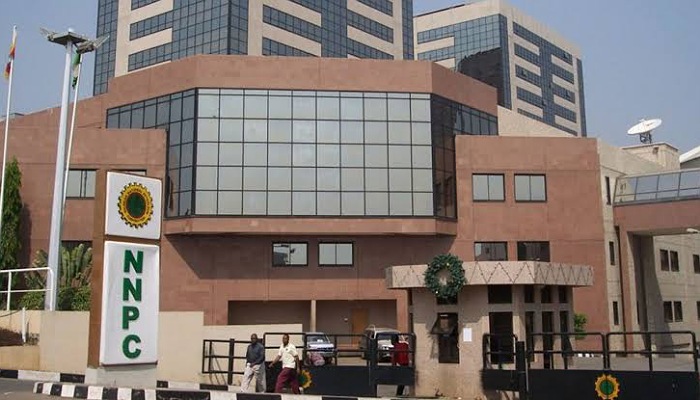
INSPITE of the official position of the Nigerian government that the controversial petrol subsidy is gone for good as announced by the President on assumption of office, the state owned Nigerian National Petroleum Corporation Limited, NNPCL has disclosed that petrol subsidy is still fully operational in Nigeria, although, under a different identity.
Umar Ajiya, Chief Financial Officer at the NNPCL, disclosed that it cost the company a staggering N7.8 trillion (US$4.9) to cover this price gap in the first seven months of 2024.
Rather than simply referring to these claims as subsidies, he stated that the company is merely managing the price difference in petrol imports on behalf of the federation, stressing that this should not be misconstrued as a return to subsidy payments.
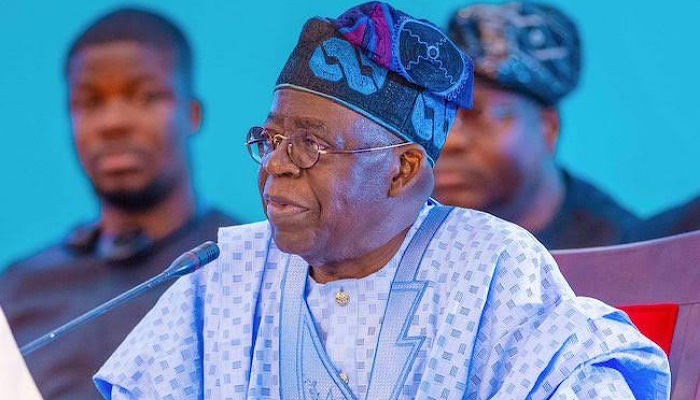 This revelation has reignited discussions on whether the NNPC is indirectly offering subsidies, a concept typically defined as selling a product below its cost price.
Documents reviewed by Biztellers.com.ng showed that the term “subsidy” was used extensively in official correspondence between the NNPCL and the presidency, particularly in reference to the “shortfall.”
Recall that President Bola Tinubu reportedly approved NNPC’s request to utilize the 2023 final dividends due to the federation to offset these costs.
However, during a media briefing on Monday about the company’s 2023 audited financial statements, Ajiya refuted claims that the NNPC is involved in any subsidy scheme.
Ajiya further disclosed that the Nigerian government owes the NNPC N7.8 trillion ($4.9 billion) in subsidy-related debts for the period from January to July 2024.
In furtherance of his clarification to the News Agency of Nigeria (NAN), Ajiya insisted that no subsidy payments have been made to any marketer in the last nine years, citing the NNPC’s role as the sole importer of petrol under supply contracts.
He said, “In the last eight to nine years, NNPC Ltd. has not paid anyone a dime as a subsidy; no kobo has been disbursed by NNPC Ltd. in the name of subsidy. No marketer has received any payment from us for subsidy.”
“What has been happening is that we have been importing PMS, which has been landing at a specific cost price, and the government tells us to sell it at half price. So the difference between the landing price and that half price is a shortfall.
“And the deal is between the Federation and NNPC Ltd., to reconcile, sometimes they give us money, so there is no money exchanging hands with any marketer in the name of subsidy.”
Ajiya remained silent on how much of the $4.9 billion could have been remitted to the federation account if the NNPC had not been covering the “shortfall.”
It was however noted by Biztellers.com.ng, that although subsidy is back in effect, the main reason for that is the increasingly weak state of the Naira and the country’s extreme dependence on products importation. Also unlike the previous subsidy era, where several oil marketers were getting free subsidy refunds for unverified product importation, this subsidy era is witnessing only one importer, the NNPCL, which in effect is the sole receiver of government subsidies.

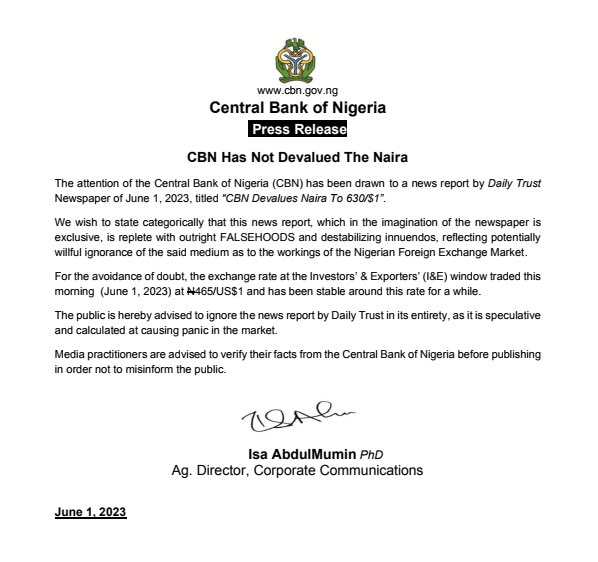
The Central Bank of Nigeria (CBN) has refuted claims of devaluing the.
Earlier reports suggested that the CBN had devalued the Naira, lowering its exchange rate from N631 to the dollar, compared to the previous day’s rate of N461.60 at the Importers and Exporters (I&E) window.
However, the Central Bank of Nigeria (CBN) released a statement on Thursday through its Acting Head of Corporate Communications, Dr. Isa Abdulmumin, categorizing the report as false information.
In the statement titled ‘CBN Has Not Devalued The Naira’, he said the attention of the apex bank was drawn to the news report by an Abuja based newspaper edition of June 1, 2023, titled “CB Devalues Naira To 630/51”.
However, the CBN stated categorically that the news report was replete with outright FALSEHOODS and destabilizing innuendos, ‘reflecting potentially willful ignorance of the said medium as to the workings of the Nigerian Foreign Exchange Market.’
“For the avoidance of doubt, the exchange rate at the Investors’ & Exporters (I&E) window traded this morning (June 1, 2023) at N465/USS1 and has been stable around this rate for a while.
“The public is hereby advised to ignore the news report by Daily Trust in its entirety, as it is speculative and calculated at causing panic in the market,” the CBN spokesman added.
He, therefore, advised media practitioners to verify their facts from the Central Bank of Nigeria before publishing in order not to misinform the public.

The interest rate in Nigeria has been raised to 18.5 percent, up by 0.5 percent, from 18 percent where it was pegged in March 2023.
The Central Banks of Nigeria’s (CBN) Monetary Policy Committee (MPC) resolved to this effect at its third meeting of 2023 in Abuja, on Wednesday.
Governor, CBN, Godwin Emefiele, made the disclosure in the communiqué of the MPC’s meeting, thereafter.
While engaging the media at the end of the two-day meeting, Emefiele, said the committee voted to keep the asymmetric corridor at +100 and -700 basis points around the MPR.
In the view of the MPC, rising inflation rate is traceable to the high energy cost and challenges around the supply chain, among others, which lie outside the corridors of the CBN.
Emefiele said, “The current trend in price development would continue to be monitored by the bank with greater collaboration with fiscal authority to address the drivers of inflation.”
Biztellers reports that the CBN had effected six consecutive interest rate increases, which has seen the rate move from 11.5 percent in March 2022 to 18.5 percent in May 2023.






Kano Police Warn Residents Of Imminent Terror Attack Threats
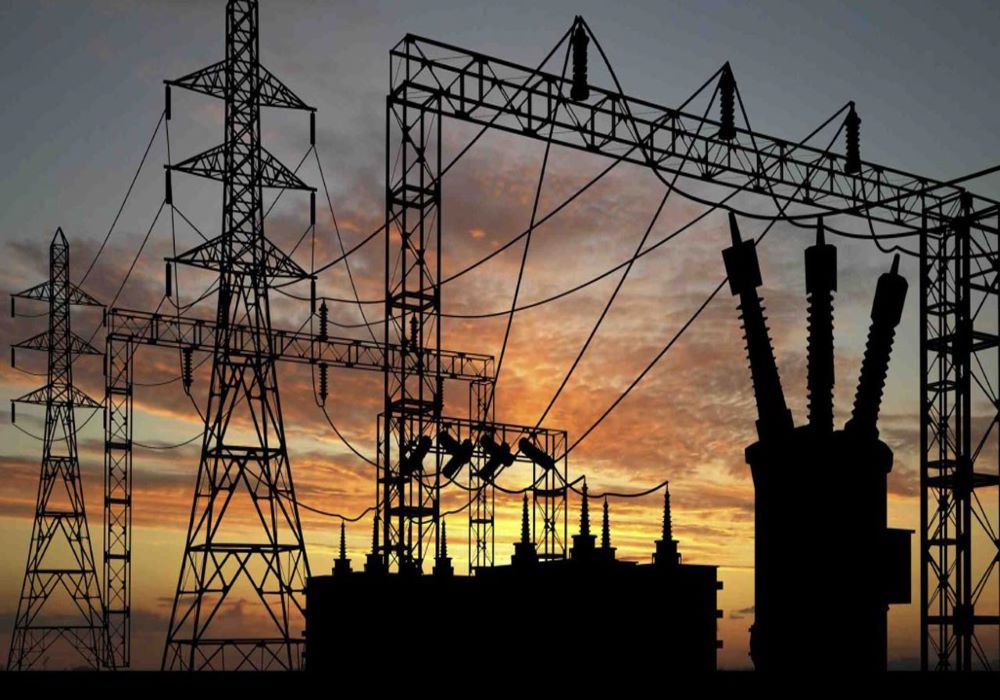
TCN Completes Relocation Of 8 Towers, Ends Power Rationing In Abuja

Ifon-Ilobu-Erin Osun Land Disputes: Osun Constitutes A 100-Member Boundary Resolution Committee
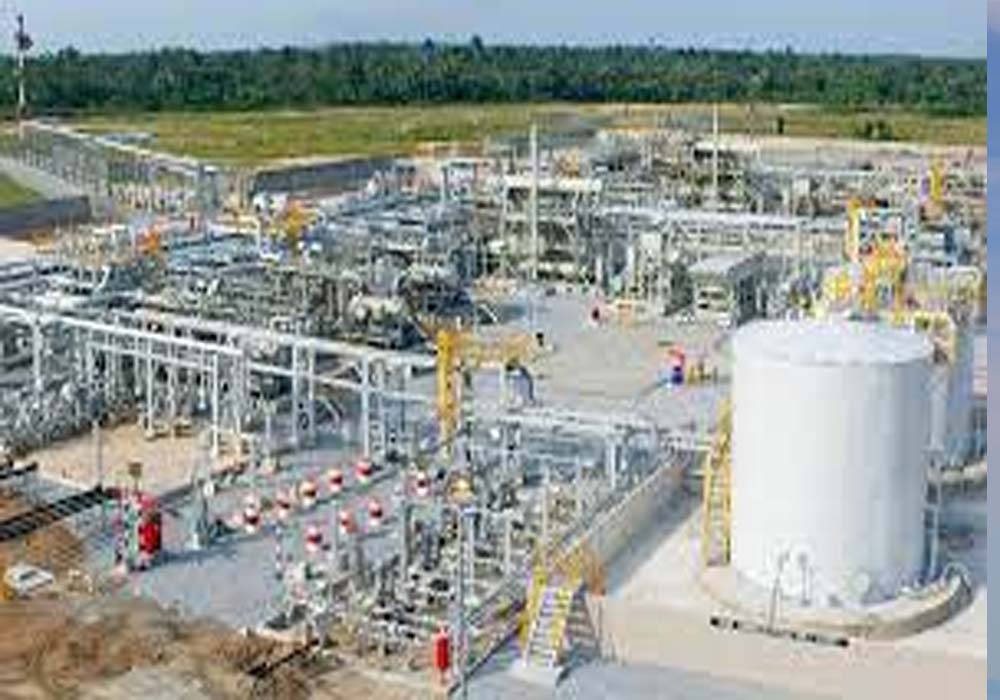
Savannah Energy Provides Unaudited FY 2024 Trading Updates

Okpebholo Moves To End Indiscriminate Parking, Gridlock In Edo State
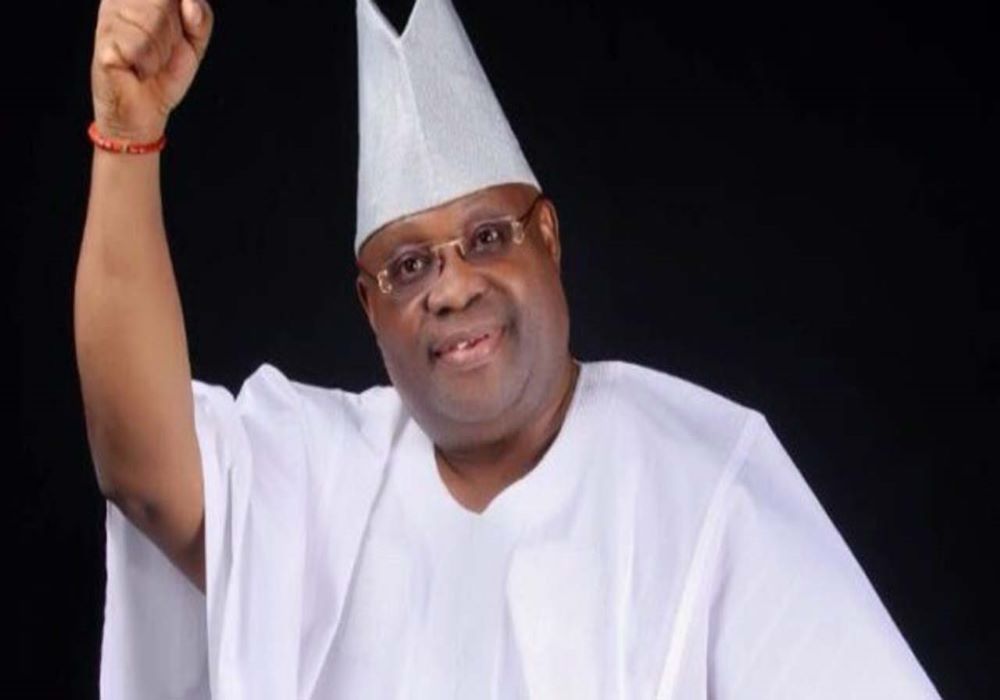
Leadership Newspaper Backs Adeleke For Second Tenure, Names Him ‘Gov Of The Year’
OSSG Raises Alarm Over Murder Plot By APC Chieftain
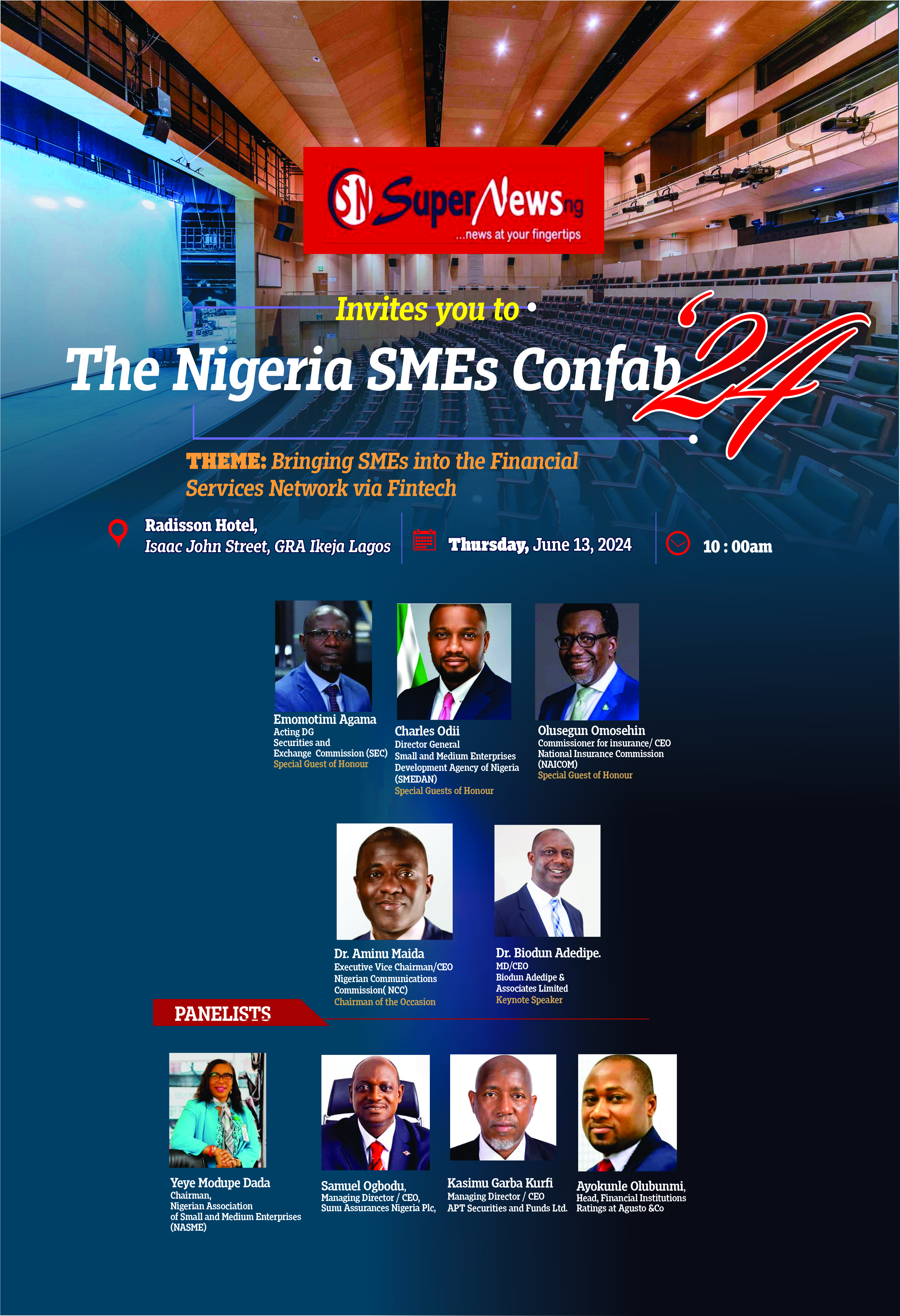
NCC, SMEDAN, NAICOM, SEC, Others Set for SUPERNEWS SMEs Conf June 13
Sahara’s Tonye Cole resigns from GPHCDA
Niger Delta Avengers: President Buhari Reads riot Act …considers the carrot and stick option

Oando opens ultra-modern petrol station in Lagos