
NEWS
NCDMB Holds Retreat With Senate Committee On Local Content

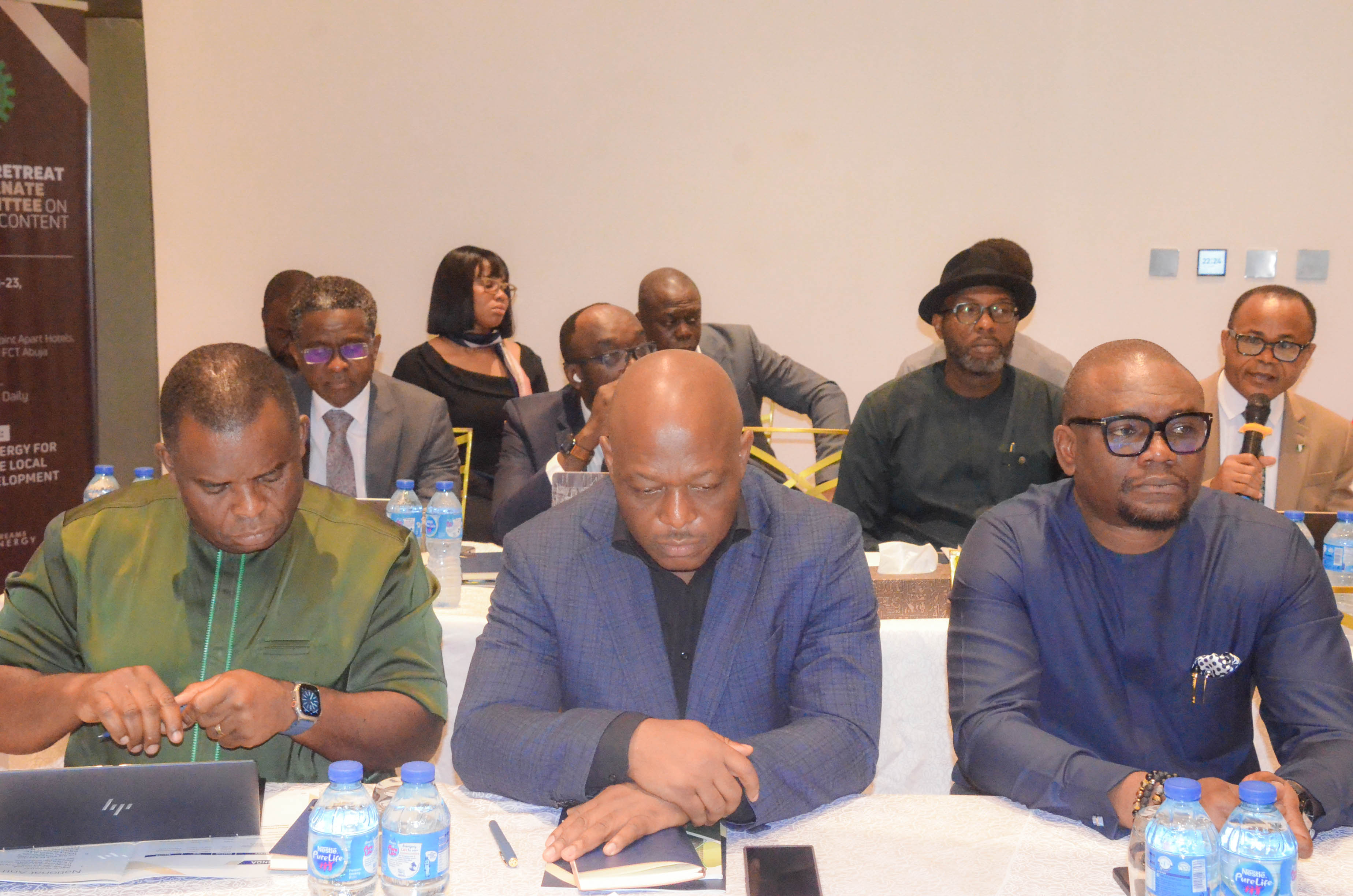
The Nigerian Content Development and Monitoring Board (NCDMB) and the Senate Committee on Local Content on Sunday began a 3-day retreat at Abuja.
Biztellers reports that the retreat is aimed at forging closer collaboration between the two entities, to achieve improved implementation of the Nigerian Oil and Gas Industry Content Development (NOGICD) Act.
The theme of the retreat is creating synergy for sustainable local content development and was attended by members of the committee and some senior management of the NCDMB.
Speaking at the opening ceremony on Monday, the Executive Secretary NCDMB, Engr. Felix Omatsola Ogbe underscored the importance of collaboration with relevant stakeholders in managing and growing Nigerian Content in the oil and gas industry.
READ ALSO: Minister Hails NCDMB, Nedogas Strategic Partnership
He stated that the retreat is a key platform for actualising the needed collaboration, describing the National Assembly as one of the most important stakeholders to collaborate with.
He reiterated that the Board was focused on fulfilling the mandate set out by the NOGICD Act, which is basically to build the capacity of Nigerian companies and people to participate in the oil and gas industry and to monitor the compliance of oil and gas companies. He stressed that the mandate has not changed with the change of leadership in the Board.
Speaking further, Engr Ogbe maintained that his major objective in the current role is how to sustain the growth of Nigerian Content in the oil and gas industry.
On the performance of the Board, the Executive Secretary indicated that the NCDMB operates as a business enabler and supports the value chain efficiency and project delivery.
He added that “consistent with the recent Presidential Directives on Local Content and in line with our Service Level Agreement (SLA) with the oil and gas industry, we are simplifying our processes and accelerating our approval timeline to enable business delivery.”
He also announced that the Board was coming up with a programme where it would upgrade the quality of some primary and secondary schools in the hinterlands, as a strategy to develop competent manpower for the oil and gas industry in years to come.
In her remarks, the Chairman of the Senate Committee on Local Content, Senator Natasha Akpoti-Uduaghan lauded the successes that have been recorded with the implementation of the NOGICD Act, especially in the development of critical assets and the emergence of Nigerians with the requisite skills to deliver complex projects and lead operations of the oil and gas industry.
She, however, identified huge gaps for improvements, noting that the retreat provided the opportunity to create the needed interface with key stakeholders.
She emphasized that close collaborations lead to higher productivity and impact, which would benefit members of the public.
She also canvassed that trainees of the Board’s on-the-job training and direct training programmes should be engaged by the oil and gas industry, otherwise, the resources committed to their training would have been wasted.
The retreat featured presentations from key directorates of the Board, including the Director, Monitoring and Evaluation, Abdulmalik Halilu, who discussed how monitoring activities are carried out by the Board, to ensure that operating and service companies comply with the provisions of the NOGICD Act.
He explained that the Nigerian Content Compliance Certificate (NCCC) which is the outcome of the Board’s Projects Certification and Authorization process is converted into the monitoring template and used to monitor the operations of oil and gas firms.
Also speaking, the Director, Projects Certification and Authorization Division (PCAD), Engr. Abayomi Bamidele suggested that players of the Nigerian oil and gas industry must ensure that at least one final investment decision (FID) is taken every year, to keep oil and gas service facilities, investments and employees engaged.



Human rights defender and Amnesty International volunteer, Lawrence Zongo, has been released from the custody of the Nigerian Army in Jos, Plateau State, after spending 10 days in detention.
His release comes after Amnesty International and the Take-It-Back (TIB) Movement demanded his immediate release, raising concerns over his alleged incommunicado detention at the Nigerian Army’s 3 Division headquarters in Jos.
ALSO READ: How Troops Forced Kidnappers to Abandon Abducted Army Lieutenant Colonel in Enugu
“Zongo is out,” a source privy to the information said on Thursday.
Zongo was arrested on October 5 while visiting relatives receiving treatment at a military hospital within Maxwell Khobe Cantonment, Rukuba Barracks, the headquarters of the Army’s 3 Division.
He had reportedly gone to the facility to assist family members who were attacked by gunmen in Meyango, Bassa Local Government Area of Plateau State, on Sunday night.
Sources familiar with the incident said one of Zongo’s first cousins died from injuries sustained in the attack before he arrived at the hospital late Monday morning.
Following his arrest, sources alleged that Zongo was held without charge and denied access to his lawyers and family members.
Sources also claimed that he was wearing Ray-Ban Meta smart glasses when he visited the military facility, suggesting that this might have contributed to the soldiers’ decision to detain him. However, the claim had not been independently verified.
On October 8, Amnesty International raised the alarm over what it described as the arbitrary and incommunicado detention of its member, demanding that the military either release him immediately or hand him over to the appropriate civilian authorities.
The organisation said efforts to gain access to Zongo had been unsuccessful and called on the Army to clarify the circumstances surrounding his arrest and detention.
On October 13, the Take-It-Back Movement’s Plateau State chapter also demanded his release, alleging that he remained in military custody without a clear explanation.
The movement said its members and executive committee representatives had discussed the matter during an appearance on JayFM Jos, insisting that the military should disclose the offence Zongo was suspected of committing and provide evidence justifying his continued detention.
The group also called for respect for Zongo’s fundamental rights and urged the Army to follow established legal procedures if there were allegations against him.
His release comes after days of pressure from rights advocates and activists over the circumstances surrounding his arrest and detention.
The Nigerian Army’s reasons for detaining Zongo and the circumstances surrounding his release were not immediately available.
The Secretary to the Adamawa State Government, Awwal D. Tukur, has identified intelligence gathering, timely information sharing and proactive security strategies as key priorities for tackling Nigeria’s evolving security challenges.
Tukur stated this while delivering a welcome address on behalf of Governor Ahmadu Umaru Fintiri at the opening ceremony of the Federal and State Security Administrators’ Meeting in Yola, Adamawa State on Thursday.
Welcoming delegates to the state, he said, “It is my honor and privilege to welcome you all on behalf of the government and the good people of Adamawa State to the capital city of Yola for this federal and state security administrators’ meeting.”
He described the gathering as an important platform for collaboration between federal intelligence institutions and state and local government administrations.
ALSO READ: ASUU strike: We are losing students to incessant killings — Students union
“As a premier security engagement forum, the FSSAM plays an indispensable role. It provides a unique, highly collaborative platform where federal intelligence frameworks meet the practical day-to-day realities of state and local government administration,” Tukur said.
The Adamawa SSG noted that Nigeria faces evolving security challenges, including insurgency, cross-border criminality and internal civil cleavages.
“No doubt, our nation is facing evolving and fast-moving security challenges, ranging from complex insurgency and cross-border criminality to internal civil cleavages. The mandate of this initiative is therefore, the more pressing,” he said.
Tukur outlined three key tasks for participants during the two-day meeting, stressing the need to identify emerging threats, improve intelligence sharing and develop practical strategies to address security challenges.
“To my mind, the collective task of this forum over the next two days is clear,” he said.
He listed the priorities as identifying and evaluating emerging security indicators; reviewing methods for generating actionable intelligence and sharing it with relevant authorities in a clear, precise and timely manner; and proposing practical strategies to anticipate and contain present and future security threats within communities.
Tukur also highlighted Adamawa State’s efforts to prioritise intelligence gathering under Governor Fintiri’s leadership.
“Under the dynamic and visionary leadership of His Excellency, Governor Ahmadu Umaru Fintiri, Adamawa State has consistently prioritized intelligence in the sector. Community-centered intelligence networks and robust logistical support for our security formation,” he said.
He added that hosting the meeting reflected the state’s commitment to supporting national security efforts.
“Host of this meeting reflects the test part of the commitments on unwavering commitment to contributing meaningfully to the national security architecture,” Tukur said.
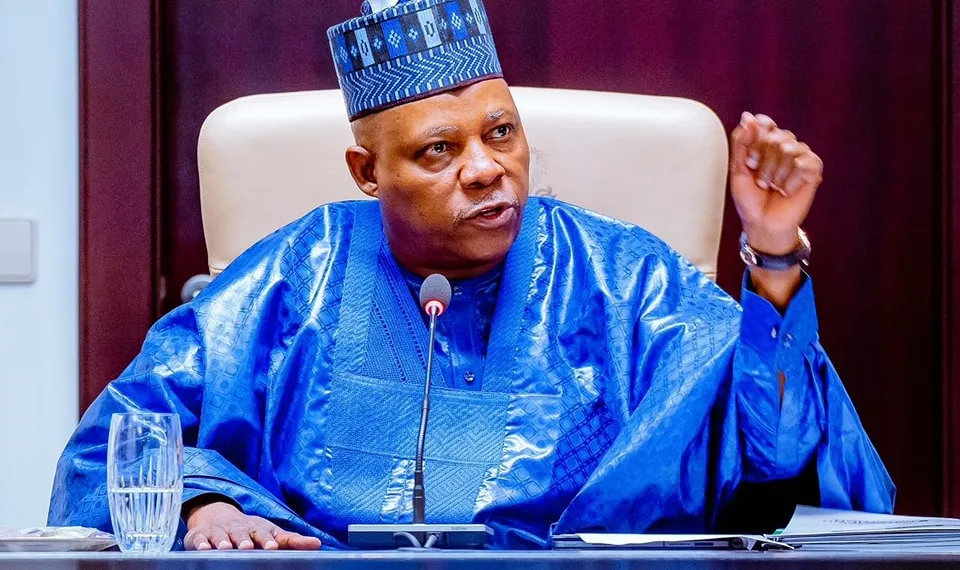
Vice President Kashim Shettima has urged Nigerians to celebrate President Bola Tinubu, saying his leadership saved the country from a potential implosion.
Shettima said Nigeria’s economy had been teetering on the edge of collapse before Tinubu’s intervention, adding that the country could have faced a different situation.
“The economy was teetering on the edge of collapse, we were on a cliff edge,” the Vice President said.
ALSO READ: Subsidy Removal, FX Reforms Driving Fresh Oil Sector Investment – Shettima
“So he literally saved the nation from an implosion. That could have been the scenario. So, instead of demonizing him, Nigerians ought to celebrate this poor man.”
Shettima also called for a return to the drawing board, expressing confidence in the leadership’s commitment and the prospects for the 2027 elections.
“I believe on the bottom of my heart that with this presentation I have seen, and with the commitment of our leadership, by the grace of God, we are going to win,” he said.
Speaking about the 2027 elections, the Vice President reminded his audience that social media platforms should not be mistaken for actual polling stations.
“There are no polling stations on Facebook or Instagram,” he said.
Shettima also expressed gratitude for the efforts made towards promoting the cause of the 2027 elections.





JUST IN: Amnesty Volunteer Lawrence Zongo Regains Freedom After 10 Days In Custody

2027: Tinubu Won’t Abandon Governance for Campaigns, Says Aide

Atiku Launches ‘Ask AA’ Portal, Invites Nigerians to Question His Record
Adamawa SSG Identifies Three Priorities for Tackling Nigeria’s Security Challenges

Ebonyi 2027: Gov Nwifuru Jittery Over My Candidacy, Violating Constitution — Odii

Small Investors Take Centre Stage as Dangote IPO Nears Close

Trump’s Family Unveils New Cryptocurrency Platform

Senate Denies Receiving Petitions Against Tinubu’s Ambassadorial Nominees

Dangote Cement Lights Up Benue Host Communities With CSR Initiatives

Reps Recommend 3-year Jail Term For Aviation minister

Tems Sets New Record On Billboard Hot 100 Chart
