
Business
Nigeria’s External Reserves Rise 2.83% Amid Foreign Inflows


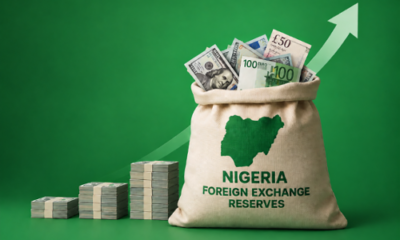
In a testament to Nigeria’s economic strength, the country’s external reserves have surged by 2.83% year-to-date, propelled by increased foreign capital and remittances.
Recent data from the Central Bank of Nigeria (CBN) reveals a noteworthy uptick, with foreign currency reserves reaching $34.11 billion as of March 7, 2024—up from $33.17 billion at the beginning of the year.
This boost in reserves, comprising foreign currencies, gold, and other international assets, reflects Nigeria’s ability to navigate and thrive amid global economic currents.
Recall that on Wednesday, the CBN unveiled a striking surge in Diaspora remittances.
February witnessed an extraordinary spike, with remittances skyrocketing by an astounding 433%, surging to $1.3 billion compared to the $300 million reported in January.
It said “We saw a 1.0 percent week-on-week (w/w) accretion in the foreign reserves to $34.02bn as of March 6th, 2024, owing to foreign capital inflow (evident in the year-to-date (YTD) foreign net inflows of $822.6m through the NAFEM window) following CBN’s drive to attract FX, analysts at Afrinvest Securities Limited.”
On Friday, the Naira experienced a 1.55% depreciation, with the dollar quoted at N1,627.40, marking a decline from Thursday’s N1,602.17, as reported by the FMDQ Securities Exchange.
The intraday high also weakened to N1,640 per dollar on Friday, compared to N1,635 on Thursday.
However, the intraday low showed improvement, reaching N1,413/$1 on Friday, stronger than Thursday’s N1,470/$1.
Notably, there was a substantial increase in dollar supply, rising by 63.48% to $269.35 million on Friday, up from $164.76 million recorded on Thursday.
In the parallel market, commonly referred to as the black market, the Naira remained stable at N1,620 per dollar.
Governor Olayemi Cardoso of the Central Bank of Nigeria (CBN) announced, following the Monetary Policy Committee (MPC) meeting on February 27, 2024, that the country’s external reserves had increased to $34 billion from the initial $33 billion at the beginning of the year.
Moreover, on February 5, 2024, the CBN reported a reduction in the inherited $7 billion FX backlog to $2.2 billion.
The CBN expressed its commitment to resolving the outstanding balance, demonstrating efforts to address foreign exchange challenges.
According to a weekly report by Afrinvest, the Naira maintained stability across the FX market, trading within a similar band as the preceding week.
The report highlighted a 41.4% improvement in activity at the NAFEM Window, totaling $421.6 million, a notable increase from the previous week’s $473.1 million.
Furthermore, the report indicated a 4.9% week-on-week depreciation of the Naira against the dollar at the NAFEM Window, with the exchange rate falling to N1,627.40/$1.00.
Additionally, the parallel market witnessed a 5.3% week-on-week dip in the Naira against the dollar, settling at N1,600.00/$1.00.
It said “We note that the spread between the NAFEM and parallel rates sustained its streak for the second week though the weekly average declined 98.8 percent to N27.40.
“In the week ahead, the Naira is likely to trade within a similar band across FX segments, supported by intensified regulatory spotlight, the analysts.”
In a press briefing held in Abuja, Hakama Sidi Ali, the acting director of corporate communications at the Central Bank of Nigeria (CBN), underscored a substantial increase in overseas remittances, surpassing four times the figures from the preceding month.
Ali emphasized the heightened interest of foreign investors in Nigerian assets, revealing investments exceeding $1 billion in February alone.
Additionally, she highlighted a positive trajectory in total portfolio flows for 2024, reaching $2.3 billion, showcasing promise compared to the $3.9 billion recorded for the entire previous year.
In addition, Ali highlighted that the momentum of increased foreign exchange inflows continued into March 2024.
This surge was attributed to a heightened investor appetite for short-term sovereign debt following adjustments to benchmark interest rates.
A significant development was observed in government securities issuances, with substantial oversubscription.
Foreign investors took a leading role, contributing to over 75 percent of the total bids received during auctions conducted on March 1 and 6, 2024.










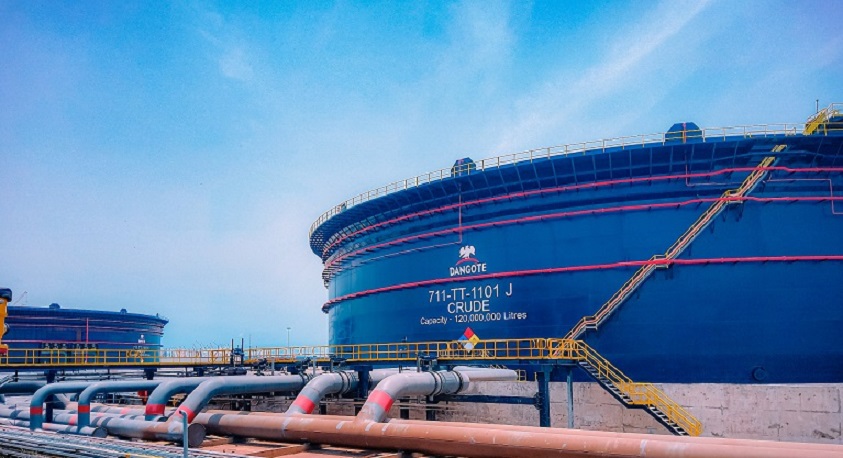
The Aliko Dangote Foundation (ADF) has unveiled the Women’s Share Subscription Grant Initiative (WSSGI), a pioneering financial inclusion programme aimed at increasing women’s participation in Nigeria’s capital market through the ongoing Initial Public Offering (IPO) of Dangote Petroleum Refinery and Petrochemicals FZE (DPRP).
The nationwide initiative is designed to support up to two million Nigerian women, with a special focus on low- and middle-income earners, as well as vulnerable women. Through the programme, ADF seeks to expand access to equity ownership, promote a culture of savings and long-term investing, and empower women with greater opportunities for wealth creation through responsible participation in the capital market.
The initiative is open to several categories of beneficiaries, including independent applicants earning ₦100,000 or less per month, verified participants in designated ADF programmes such as CRoWN, ADFIN, and Mu Shuka Iri, eligible non-commissioned servicewomen and service spouses, as well as verified service widows.
To accommodate different categories of participants, the initiative provides two pathways for entry: Matching Grant Track: Eligible independent applicants who subscribe to a minimum of 10 shares will receive an ADF-funded application for an additional 10 shares in their name.
Unconditional Grant Track
The ADF will fund an application for 20 shares on behalf of eligible beneficiaries who satisfy programme eligibility, investor identification, and Know Your Customer (KYC) requirements.
This category covers verified beneficiaries from designated ADF programmes and verified service widows.
Under both tracks, grant funds will be applied directly through the designated issuing house. No cash payments will be made to beneficiaries, government agencies, or sponsors. Any shares successfully allotted will be credited solely to the beneficiary and held in her name.
Eligibility Requirements
Applicants must be Nigerian women aged 18 years and above; resident in Nigeria; meet the eligibility requirements of their respective participation category; successfully complete all required identity verification and KYC processes; and receive no more than one ADF share grant across all Foundation share grant schemes.
The ADF is implementing the initiative in partnership with Vetiva Capital Management and the Nigerian Exchange Group (NGX) through the Securities and Exchange Commission (SEC)-approved IPO subscription infrastructure.
The Foundation will not receive, collect, or hold applicants’ or sponsors’ subscription funds. All applications, payments, allotments, and refunds will be handled in accordance with the IPO Prospectus, applicable regulatory requirements, and the approved basis of allotment.
Participation in the programme is entirely voluntary. Prospective investors should note that share prices may fluctuate, dividends are only payable when declared, and neither allotment nor investment returns are guaranteed.
To facilitate broad participation, applicants are not required to have an existing Central Securities Clearing System (CSCS) account. Where necessary, accounts will be created through Vetiva upon successful completion of the IPO’s KYC requirements.
Eligible independent applicants may submit their applications exclusively through the official ADF portal at ipo.alikodangotefoundation.org.
READ ALSO: 40 Oil Blocks up for Grabs as NUPRC Opens 2026 Bid Round
Beneficiaries affiliated with the ADF programmes and verified service widows will receive application guidance through approved Foundation channels.
The offer closes on 13 October 2026.
The ADF urges prospective participants to remain vigilant against fraud. Applicants should not make payments to agents, individuals, or personal bank accounts in exchange for grants or promises of guaranteed allotment. Passwords, PINs, and one-time passwords (OTPs) should never be shared, and any unexpected payment request or online link should be verified through official channels before action is taken.
Through this initiative, the ADF is reinforcing its commitment to inclusive economic empowerment, broadening access to investment opportunities, and enabling more Nigerian women to participate meaningfully in the nation’s wealth creation journey.
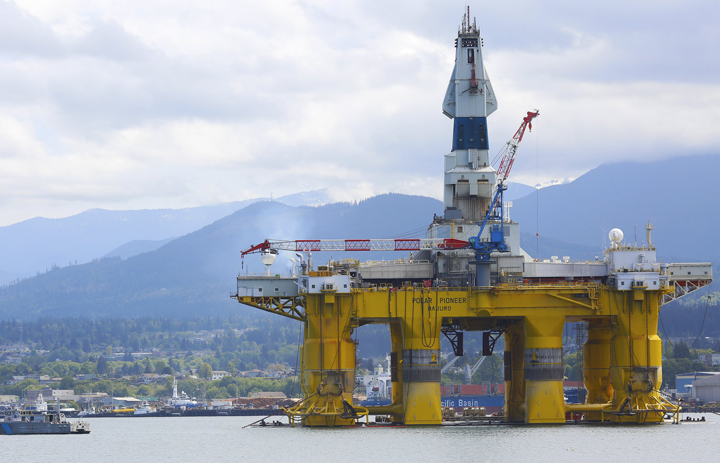
The Nigerian Upstream Petroleum Regulatory Commission (NUPRC) has unveiled a pipeline of major offshore projects with the potential to attract significant new investment into Nigeria’s upstream petroleum sector.
This is as the commission has intensified efforts to convert the country’s substantial hydrocarbon resources into producing assets and sustainable economic value, the NUPRC said in a statement.
According to the statement, Nigeria’s upstream investment outlook was presented at the Nigeria Investment Forum 2026 in New York by the Commission Chief Executive (CCE), Oritsemeyiwa Eyesan.
Eyesan, who was represented by the Executive Commissioner, Corporate Services and Administration, Dr. Kelechi Ofoegbu, highlighted the emerging investment opportunities across Nigeria’s offshore, gas and brownfield assets, noting that the combination of regulatory reforms, improved project economics and a growing pipeline of development-ready assets is creating new opportunities for investors and industry partners.
READ ALSO: NCDMB, Zeconia Global Train 50 on Digital Oilfield Operations
A key feature of the presentation, it said, was the identification of 22 major offshore projects, comprising 12 deepwater and 10 shallow-water developments, as part of the pipeline capable of driving substantial new capital into the sector.
According to the commission, the projects include major developments such as Bonga Southwest, Aparo, Zaba Zaba, Owowo, Bosi and Egina South.
The NUPRC also highlighted recent capital commitments across projects including Bonga North, Obeta Gas Development, HIN Associated Gas Development and Iseni Gas Development, demonstrating the movement of investment interest towards actual project development.

The average prices of petrol and diesel have risen by 86 percent in 2026, with the two products reaching their highest average price levels for the year by September 22, according to the latest fuel price trend report by priceandpromo.
The report stated that the average price of Premium Motor Spirit, popularly known as petrol, rose to N1,378 per litre by September 22, while automotive gas oil, commonly known as diesel, increased to N1,899/litre.
It puts the increase in the price of petrol at 80.8 percent from the January 13 base, while diesel recorded a 91.8 percent rise over the same period. The average increase of the two products is 86.3 percent, which rounds to 86 percent.
The report stated, “The latest priceandpromo fuel price trend shows renewed upward movement following the relative stability observed between April and July.
“Petrol rose to an average of N1,378 per litre by 22 September, while diesel increased to an average N1,899 per litre, the highest average price levels recorded for both products in the displayed 2026 series.”
READ ALSO: NNPC Ltd Celebrates Second Year of Zero Voluntary Resignations
According to the report, petrol prices had increased sharply in March before remaining relatively stable at elevated levels between April and July. “After the sharp March increase, fuel prices stabilised at higher levels through July before rising again in August and September,” it added.
The renewed increase came amid heightened volatility in the international energy market, according to the report, which noted that the domestic market remained exposed to movements in global energy costs.
“The renewed increase comes amid heightened global energy-market volatility, highlighting the domestic market’s continued exposure to shifts in international energy costs,” the report added.
The report indicated that the latest movement in fuel prices could have wider implications for transportation, logistics and the cost of distributing goods, given the importance of petrol and diesel to economic activities.
The report noted that fuel prices remained an important channel through which changes in energy costs could feed into transportation and other consumer costs.
The report further warned that the renewed increase in both products is a development to monitor because of its potential implications for the movement of people and goods.
It said, “The renewed increase in both petrol and diesel is therefore an important market signal to watch, particularly for its potential implications for mobility, logistics costs and the wider cost of moving goods through the market.”
The report’s figures show that the increase in diesel prices has outpaced that of petrol, with AGO rising by 91.8 percent compared with PMS’s 80.8 percent increase.
Courtesy – The PUNCH






IPO: ADF Opens Wealth Creation Pathway for 2m Vulnerable Nigerian Women

2027: Tinubu Will Beat Atiku, Obi by Wide Margin, Says Bwala

‘Dem Dey Use Stick Dey Flog Women’ — Nigerians in India Camp Cry Out

2027: I’ll Bring Petrol Price Down to ₦300, Says Donald Duke
2027: INEC Must Prove Nigerians Wrong on Election Credibility — Donald Duke

‘Military Gets Huge Budgets, Yet Air Crashes Persist’ — Shehu Muhammad

Trump’s Family Unveils New Cryptocurrency Platform

Senate Denies Receiving Petitions Against Tinubu’s Ambassadorial Nominees

Dangote Cement Lights Up Benue Host Communities With CSR Initiatives

Reps Recommend 3-year Jail Term For Aviation minister

Tems Sets New Record On Billboard Hot 100 Chart
