
NEWS
PwC Recommends Nigeria’s Oil Sector to South African Investors

A call has gone to South African investors, banks, and policymakers to take direct stakes in Nigeria’s upstream oil sector to guarantee crude supply for their domestic refineries, adopting the same playbook European and American majors used to build energy security for their countries.
The PricewaterhouseCoopers (PwC) took the stance, even as the Nigerian Upstream Petroleum Regulatory Commission (NUPRC) urged members of the Crude Oil Refinery Owners Association of Nigeria (CORAN) to consider acquiring oil blocks in upcoming licensing rounds as a long-term solution to crude supply challenges.
The appeal by PwC was made by its Partner and Africa Oil and Gas Leader, Pedro Omontuemhen.
Omontuemhen spoke in Lagos during the Fourth South Africa Week, with the theme, “Repositioning and Promoting Energy Investments between South Africa and Nigeria.”
He stated that the two economies had complementary strengths across oil, gas, renewables, and enabling infrastructure that could create scalable, cross-border energy investment opportunities.
“Let me start from South Africa. If I were a South African, I would ask myself, where are the investment opportunities in Nigeria?” Omontuemhen said, referencing the Dangote Refinery’s plan to supply petroleum products across Africa.
ALSO READ: Salvation for All Souls Global Outreach Provides Free Medicals at Osun
He stated that South Africa had little or no oil, despite ongoing exploration in the Orange Basin.
Omontuemhen said nearby Namibia, which had the same sedimentary basin, had found oil, an indication that South Africa should also find but had not been able to do so at the moment.
Omontuemhen urged South African firms to replicate the model of the international oil companies (IOCs) by investing in the oil exploration and production space in Nigeria and securing crude for their home countries’ refineries.
He stated, “If I was South African, I would take the examples of the Americans or the British who came to Nigeria and invested in oil in Nigeria, and they took the oil back home to refine. Because South Africa at the moment is importing a lot of the oil they are refining.
“Why can’t the South African businessman or the South African bank, the DBSA, invest in oil in Nigeria and then take the oil? Because that’s your share of the crude, you take it back to South Africa, so that way, you’re also securing your supply, which is what the British and Americans did.”
He added, “ExxonMobil, Total, the French, they came here, invested in oil, and they took the oil back to their country to refine.”
Omontuemhen encouraged participation by South Africans in Nigeria’s ongoing oil bid round, where 50 oil blocks spanning onshore, swamp, shallow water and deep-water were being auctioned.
He stated, “Look for credible businessmen in the room here who you can invest in the oil. You take the crude oil and take it back to South Africa, that way, you’re actually securing your supply. And I think you should also do the same thing when you come to Namibia.”
Omontuemhen, who further spoke on the opportunities in the upstream oil and gas sectors in Nigeria and South Africa, cited joint exploration, production sharing, and technology transfer.
He stressed that Nigeria’s deep-water assets offered premium opportunities for South Africa technical partners.
For gas, Omontuemhen said there was huge value in monetising Nigeria’s gas flares, supplying South Africa’s energy transition, adding that a combined liquefied natural gas (LNG) value chain creates significant multi-billion-dollar potential.
In renewables, he said “SA’s solar and wind expertise meets Nigeria’s abundance of solar irradiation,” opening room for “utility-scaled projects and distributed energy solutions”.
He made a strong push for dual listings for both countries, highlighting access to multiple capital markets through listings on two exchanges, enhancing liquidity, visibility, and investor participation.
Pointing to Seplat’s Nigeria-London listing, Omontuemhen asked, “Why are we not listed in South Africa? What should we do in South Africa to make the dual listing more attractive to the Nigeria oil and gas fields?”
He recalled Oando’s earlier failed Johannesburg listing, saying other Nigerian firms can try it again and learn from the mistakes of others.
Omontuemhen pointed out that South African technology remained underutilised.
According to him, “Sasol developed a technology that Chevron copied and it’s all over the world. Why are more companies in Nigeria not using the Sasol technology? To take your stranded gas and make it more valuable, so you can have your naphtha and your diesel.”
He described South Africa’s financial sector as a source of cheap capital, explaining that the banks in South Africa have what he called ancient capital that have been there for years and well-established.
He explained, “So we can tap on that resource as Nigerians to produce here in Nigeria. Can you guys come and invest and participate in what we are doing?
“Nigeria has huge resources, huge population. South Africa, good technology, well-structured, and systems that work. So we can collaborate as two giants of Africa to make our country even much better and to make the continent much, much better.”
Omontuemhen stated, “Private investors play a critical role in mobilising capital, accelerating delivery, and improving operational performance across the energy value chain. Working with governments, the private sector can mobilise capital, de-risk investment, enable growth, improve education and efficiency, and ensure both countries benefit.”
Referring to South Africa and Nigeria as the biggest countries in Sub-Saharan Africa, the PwC energy expert said South Africa stood at 19 per cent and Nigeria at 40 per cent in the continental Gross Domestic Product (GDP) but their power profiles differed sharply.
He said South Africa had 55.4 gigawatts of installed power capacity while Nigeria had 14GW for a far larger population.
According to him, “They actually have more power per person than we do in Nigeria. If you’re talking about energy security, which we call energy poverty, there’s more energy poverty in Nigeria than in South Africa.”
Omonfoman stated that recent mergers and acquisitions (M&A) in Nigeria showed momentum, citing the Seplat-ExxonMobil deal, Renaissance acquisition of Shell Petroleum Development Company (SPDC), Oando’s purchase of Eni, and Axxela-Blue Coal.
He stated, “So there are deals going on, so even in the midst of all of these issues we’re talking about, there are still huge opportunities to make money.
“If you look at the acquisition that happened in the oil and gas field, for example, most of those monies have either come from locally or from other African countries. The rest of the world is not as interested in investing in us. So the need for what I call South-South collaboration, Africa collaboration is much stronger.”
He admitted that private sector interest was rising, alongside policy reforms, and tweaking with the policy to ensure a better outcome.
Omontuemhen mentioned the Electricity Act, tariff rebalancing, and other policies that were unlocking potential.
He added, “The market potential is huge. I think that kind of gives me joy that, even though in the midst of darkness, in Nigeria, light will come.
“So Nigeria and South Africa, if it’s going to be, it’s up to us. We have a role to play to ensure that our country gets better. Why, we’re not talking to each other, why, we’re not doing projects jointly, and then this will lead to local capacity development, job creation, and long-term sustainability.”
Meanwhile, amid complaints of crude supply deprivation, NUPRC urged members of CORAN to consider acquiring oil blocks in upcoming licensing rounds as a long-term solution to crude supply challenges.
Chief Executive of NUPRC, Oritsemeyiwa Eyesan, made the call during a courtesy visit by CORAN members to the commission’s headquarters in Abuja, where both parties discussed ways to strengthen domestic refining capacity and ensure sustainable crude supply.
A statement by CORAN spokesperson, Eche Idoko, quoted Eyesan as, “Encouraging indigenous refiners to participate in upstream asset ownership would create more stable and commercially viable crude supply arrangements while also deepening local participation across the petroleum value chain.”
She assured the refiners that Nigeria had adequate crude resources to meet domestic refining needs, and reiterated the commission’s commitment to policies that promoted in-country value addition.
The NUPRC boss also advised refinery operators to adopt long-term crude supply contracts with producers as a practical approach to guaranteeing feedstock availability, improving operational planning, and achieving pricing stability.
However, she stated that infrastructure gaps remained a major hurdle to seamless crude delivery, citing inadequate pipeline networks, evacuation bottlenecks, storage constraints, marine logistics, and other supply chain challenges as areas requiring urgent investment and coordinated efforts.
Members of CORAN commended the commission’s ongoing regulatory reforms and its support for domestic refining, while stressing the need for effective implementation of frameworks that ensure consistent crude supply to local refineries.
Stakeholders had always emphasised that improved access to crude feedstock was critical to reducing Nigeria’s dependence on imported petroleum products, enhancing energy security, conserving foreign exchange, and creating jobs through the growth of local refining capacity.
Idoko said the meeting was part of ongoing engagements between regulators and private refinery operators aimed at unlocking the full potential of Nigeria’s downstream petroleum sector.









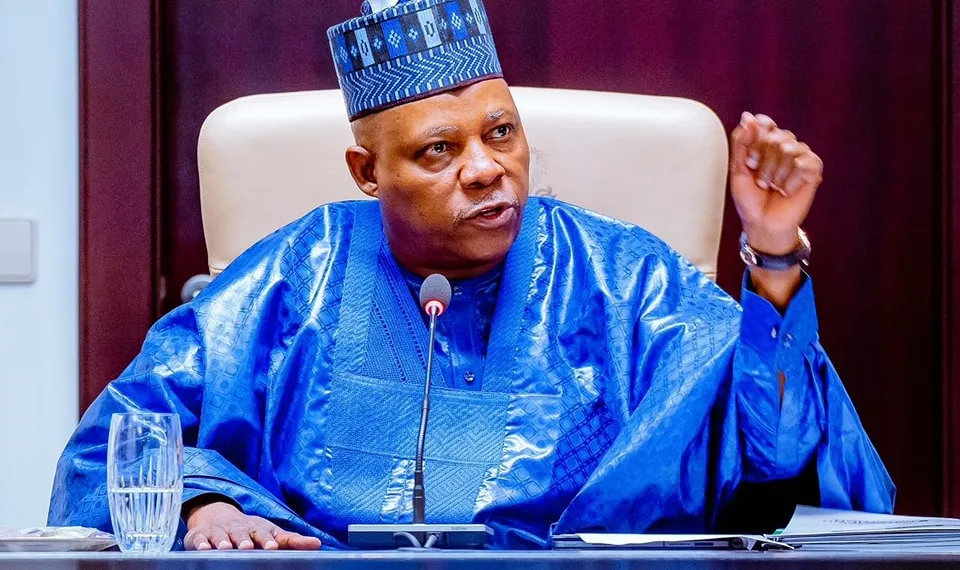
Vice President Kashim Shettima has urged Nigerians to celebrate President Bola Tinubu, saying his leadership saved the country from a potential implosion.
Shettima said Nigeria’s economy had been teetering on the edge of collapse before Tinubu’s intervention, adding that the country could have faced a different situation.
“The economy was teetering on the edge of collapse, we were on a cliff edge,” the Vice President said.
ALSO READ: Subsidy Removal, FX Reforms Driving Fresh Oil Sector Investment – Shettima
“So he literally saved the nation from an implosion. That could have been the scenario. So, instead of demonizing him, Nigerians ought to celebrate this poor man.”
Shettima also called for a return to the drawing board, expressing confidence in the leadership’s commitment and the prospects for the 2027 elections.
“I believe on the bottom of my heart that with this presentation I have seen, and with the commitment of our leadership, by the grace of God, we are going to win,” he said.
Speaking about the 2027 elections, the Vice President reminded his audience that social media platforms should not be mistaken for actual polling stations.
“There are no polling stations on Facebook or Instagram,” he said.
Shettima also expressed gratitude for the efforts made towards promoting the cause of the 2027 elections.
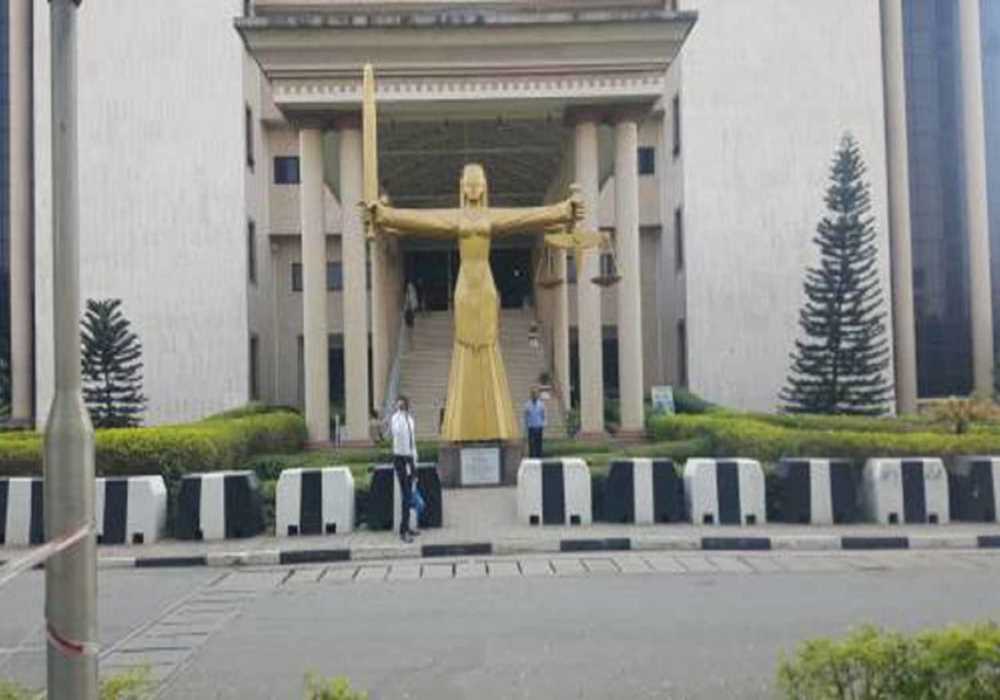
Following observed mis-steps, the Federal Government of Nigeria has withdrawn the eight-count criminal charge brought against the alleged fake Director General (DG) of the Presidential Foreign Intervention Promotion Council (PFIPC), Adeniyi Adeyemi.
Biztellers reports that the matter, in accordance with the counsel of the Attorney General of the Federation (AGF) and Minister of Justice, Prince Lateef Olasunkanmi Fagbemi, (SAN), the matter will be filed at the High Court of the Federal Capital Territory (FCT), instead of the Federal High Court (FHC).
Consequently, upon an unopposed application for termination by the prosecution counsel and Director of the Public Prosecution of the Federation (DPPF), Rotimi Oyedepo (SAN), on Monday, Justice Mohammed Umar of a Federal High Court, Abuja on Monday, struck out the matter.
READ ALSO: Shell Identifies Keys to Nigeria’s Energy Future
In a motion for the termination of the charges, Oyedepo informed the court that the Attorney General of the Federation (AGF) and Minister of Justice has carried out a review of the case file of Adeyemi and the charge filed by the Inspector General of Police (IGP) and found some loopholes.
The DPPF added that the documents allegedly forged by Adeyemi during his operations of the fake agency are those that can be prosecuted by the High Court of the Federal Capital Territory (FCT).
He also informed the court that a new charge has been filed at the High Court of the FCT and that Adeyemi would be expeditiously arraigned afresh.
He therefore urged the judge to strike out the charge as required by law.
Following no objections from Ibrahim Angulu (SAN), who stood in for Adeyemi, Justice Umar subsequently terminated the charge.
Adeniyi, 38, was being tried alongside two others whose whereabouts are unknown, on charges bordering on conspiracy and forgery.
The two others said to be at large were identified as Femi (surname unknown) and Anu (surname unknown).
The charge marked: FHC/ABJ/CR/25/2025, was entered against the defendant by the DPPF.

To secure a bright energy for her teeming population, Nigeria must sustain the momentum of reform, accelerate investment, and deepen partnerships.
This view was expressed by Managing Director, Shell Nigeria Exploration and Production Company of Nigeria Limited (SNEPCo) Ronald Adams in Lagos at the weekend.
Delivering a keynote address at the Africa Energy Conference (AEC) of the Lagos Business School (LBS), Adams called for regulatory certainty through efficient execution of reforms, sustained investment appeal to enable projects to move more swiftly from opportunity to production and partnership by operators, regulators, NNPC Limited and communities to unlock the full value of Nigeria’s resources.
Adams cited Nigeria’s huge oil and gas resources as an advantage but pointed out: “Resources alone do not guarantee prosperity. Prosperity comes when resources are matched with investment, technology, sound policy and disciplined execution. Success will be determined not by the size of our resources, but by our ability to convert them into investment and economic growth.”
Adams pledged the support of Shell towards a bright energy future of Nigerians. He said: “For more than six decades, Shell has been part of Nigeria’s energy journey. Together with our partners, we have helped develop major energy infrastructure, supported Nigerian businesses, invested in talent, and contributed to economic development. Bonga remains a powerful example of what technology, partnership and Nigerian capability can achieve in deepwater operations. Today, that story continues through Bonga North.”
READ ALSO: ADF Targets 5 Million Students, 2 Million Vulnerable Women
Issuing a clarion call for action by all stakeholders, he added: “The world is not standing still. Capital is moving, technology is advancing and competition is intensifying. The countries that attract investment tomorrow are those that improve competitiveness today. Nigeria has begun that journey. Our task is to sustain the momentum and translate reform into projects, projects into growth, and growth into shared prosperity.”
The conference, the 4th in the series had at its theme; “Securing Nigeria’s Energy Future: Policy Reform, Capital Mobilisation, and Pathways to a Sustainable Power and Energy Market” and was attended by top government officials, industry captains, energy professionals, and students.
Lagos State Deputy Governor Obafemi Hamzat represented Lagos State Governor Babajide Sanwo-Olu as the guest of honour. SNEPCo was a principal sponsor of the Africa Energy Conference (AEC) and mounted a well-received exhibition on its deepwater operations and social investments across Nigeria.






State Govs, Wike Endorse One-Party State, Join APC Campaign Council

2027: ‘Tinubu Has Done Well’ – Wike Tells Opposition to Speak the Truth

‘Celebrate This Poor Man’ – Shettima Defends Tinubu Over Economic Crisis
FG Withdraws Charges Against ‘Fake Agency’ DG, Adeniyi Adeyemi

Shell Identifies Keys to Nigeria’s Energy Future

Nigeria Records Biggest Rise in Multidimensional Poverty Among Five Countries – UN

Trump’s Family Unveils New Cryptocurrency Platform

Senate Denies Receiving Petitions Against Tinubu’s Ambassadorial Nominees

Dangote Cement Lights Up Benue Host Communities With CSR Initiatives

Reps Recommend 3-year Jail Term For Aviation minister

Tems Sets New Record On Billboard Hot 100 Chart
