
Politics
Release, compensate Nnamdi Kanu now, UN tells Nigerian govt

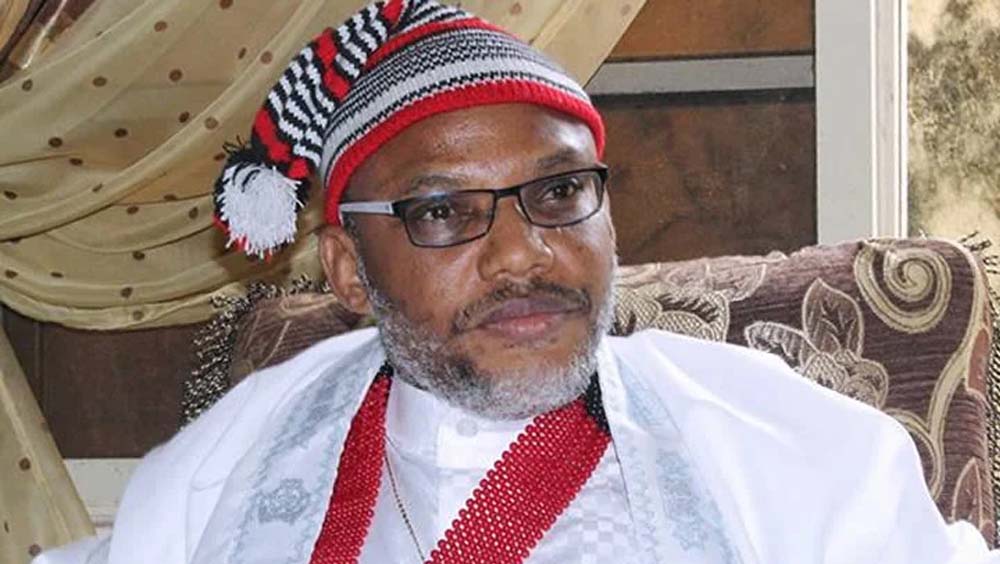
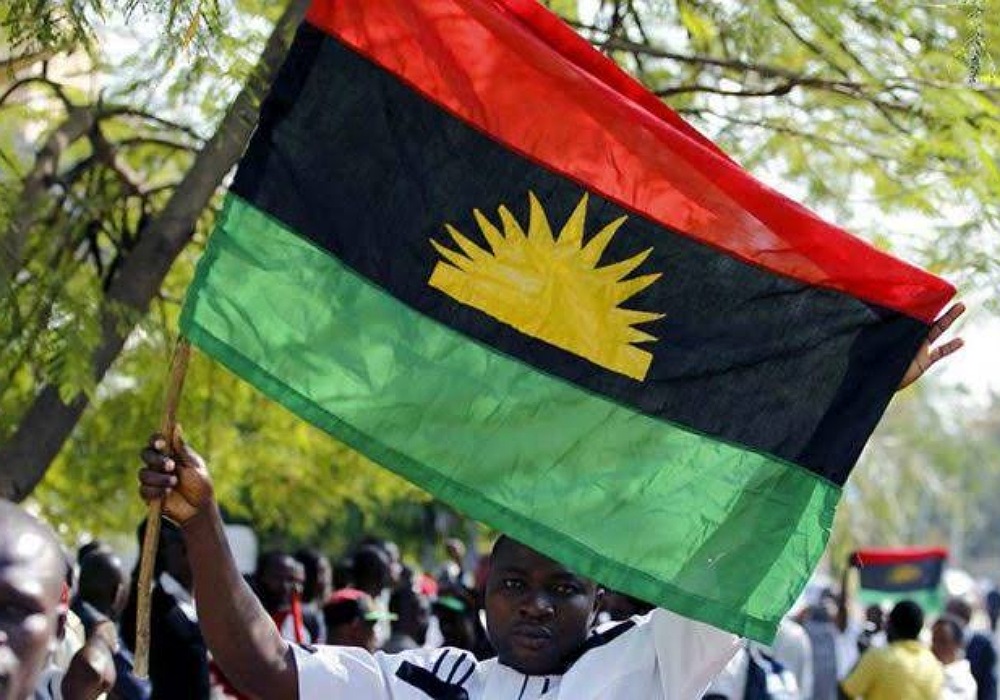
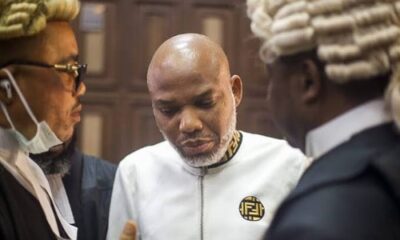
The United Nations, UN Human Rights Council Working Group on Arbitrary Detention, has indicted both Nigeria and Kenya Governments for the arrest and extraordinary rendition, torture and continued detention of the Leader of the Indigenous People of Biafra, IPOB, Mazi Nnamdi Kanu, without due process.
UN therefore, asked Nigerian Government to, “immediate release Kanu unconditionally” and pay him adequate compensations for the arbitrary violation of his fundamental human rights.
It also recommended that Government officials responsible for the torture meted to the IPOB Leader be investigated and punished.
The UN body further directed Nigeria to report back within six months of the transmission of its opinions on Kanu’s matter, steps taken to comply with all the recommendations thereof.
It referred the case of Kanu’s torture to Special Rapporteur on torture and other cruel, inhuman or degrading treatment or punishment for further consideration
The UN Working Group also threatened to take further action to ensure the recommendations are complied with, noting that both Nigeria and Kenya are signatories to the Convention and should comply.
The 16-page report dated July 20, 2022 was adopted on April 4 by the Working Group on Arbitrary Detention at its 93rd session, held between March 30 – April 8, 2022.
The unedited version of the document sighted by Vanguard, was marked:”Opinion No. 25/2022 concerning Mr. Nwannekaenyi Nnamdi Kenny Okwu-Kanu (Nigeria and Kenya).
The Working Group on Arbitrary Detention was established in resolution 1991/42 of the UN Commission on Human Rights.
In accordance with its methods of work, the Working Group, on December 30, 2021, transmitted to the Nigeria and Kenya Governments, a communication concerning
Mr. Nwannekaenyi Nnamdi Kenny Okwu-Kanu.
According to the report, Nigeria replied to the communication on 25 January 2022 while the Government of Kenya did not reply.
Both countries are parties to the International Covenant on Civil and Political Rights.
The Working Group said in the report that Kanu was a victim of State persecution as Nigeria failed to provide convincing explanations with proof that he is guilty of treason and other criminal allegations levelled against him.
“Noting the failure of the Government to explain what actions of Mr. Kanu amounted
to such criminal acts and how, and observing the lack of any evidence that any of his actions may in fact amount to such crimes, the Working Group concludes that Mr. Kanu is in fact being persecuted for the peaceful exercise of his rights, most notably his freedom of opinion and expression.
“In the present case, the Government of Nigeria has presented no exceptions permitted under article 19 (3) of the Covenant nor is there any evidence to suggest that Mr. Kanu’s exercise of his right to freedom of opinion and expression was anything but peaceful.
” In fact, the Government has chosen not to provide any explanation for the arrest, detention and subsequent proceedings against Mr. Kanu. In these circumstances, the Working Group concludes that Mr. Kanu’s detention is thus arbitrary under category II”, UN Working Group said.
The Working Group also said there was no evidence that International laws were observed in the arrest and rendition of Kanu from Kenya.
The 16-page dossier read in part: “In the present case, Mr. Kanu was not furnished with an arrest warrant by Nigerian
authorities nor was he promptly informed of the grounds for his arrest in Nigeria.
Consequently, the Working Group finds that Mr. Kanu’s continued deprivation of liberty
violates his rights under articles 3 and 9 of the Universal Declaration of Human Rights, article
9 of the Covenant, and principles 2, 4, and 10 of the Body of Principles and constitutes
arbitrary detention under category I.”
“Turning to the uncontested allegations that following his rendition to Nigeria,
Mr. Kanu remained in pre-trial detention with his trial having been scheduled to commence
in January 2022, the Working Group recalls that it is a well-established norm of international law that pre-trial detention should be the exception rather than the rule, and should be ordered for the shortest time possible. Put differently, liberty is recognised under article 9 (3) of the Covenant as the core consideration with detention merely as an exception.
“Therefore, detention pending trial must be based on an individualised determination that it is reasonable and necessary for such purposes as to prevent flight, interference with evidence or the recurrence of crime. Such determination was not carried out in the present case, in violation of Mr. Kanu’s rights under article 9 (3) of the Covenant.
“Further, in accordance with article 9 (3) of the Covenant, an arrested person is to be
brought before a judge within 48 hours.27 This was not satisfied in the case of Mr. Kanu and
the Working Group therefore finds a violation of articles 3 and 9 of the Universal Declaration
of Human Rights, article 9 (3) of the Covenant and principles 11, 37 and 38 of the Body of
Principles.
“Furthermore, in order to establish that a detention is indeed legal, anyone detained has
the right to challenge the legality of his or her detention before a court, as guaranteed by
article 9 (4) of the Covenant. The Working Group wishes to recall that according to the UN Basic Principles and Guidelines on Remedies and Procedures on the Rights of Anyone Deprived of their Liberty to Bring Proceedings before a Court, the right to challenge the lawfulness of detention before a court is a self-standing human right, which is essential to preserve legality in a democratic society.
“This right, which is in fact a peremptory norm of international law, applies to all forms of deprivation of liberty, 29 to “all situations of
deprivation of liberty, including not only to detention for purposes of criminal proceedings but also to situations of detention under administrative and other fields of law, including military detention, security detention, detention under counter-terrorism measures”.
“Moreover, it also applies “irrespective of the place of detention or the legal terminology used in the legislation. Any form of deprivation of liberty on any ground must be subject to
effective oversight and control by the judiciary. This was also denied to Mr. Kanu, thus, violating his right under article 9 (4) of the Covenant.
“Finally, turning to Mr. Kanu’s pre-trial detention in Nigeria, the Working Group
recalls that according to international human rights law, in particular article 9 (3) of the
Covenant, any person detained while awaiting trial is entitled to trial within a reasonable
time, or otherwise shall be released. Article 14 (3) (c) of the Covenant also guarantees the
right of anyone charged with a criminal offence to be tried without undue delay. In the
absence of a substantive response from the Government of Nigeria, the Working Group finds no legitimate grounds for the delays in the trials against Mr. Kanu.
“Consequently, the Working Group finds that the Government of Nigeria failed to
establish a legal basis for the detention of Mr. Kanu. His detention is thus arbitrary under
category I.”
The UN Working Group said that both the Nigerian and Kenyan Governments should take responsibility for Kanu’s rights violations.
“The Working Group wishes once again to underscore the collusion between the
Governments of Kenya and Nigeria in the rendition of Mr. Kanu and reiterates that both
Governments bear joint responsibility for any violations of Mr. Kanu’s rights in Kenya and
Nigeria.
“The Working Group has already established in its discussion of the detention of Mr. Kanu in Kenya that he was arrested and detained due to the peaceful exercise of his rights (see paras 52-54 above). The Working Group notes that the source has argued the same in relation to Mr. Kanu’s arrest, detention and trial proceedings in Nigeria. Notably, the
Government of Nigeria has chosen not to address the substance of these allegations.
“The Working Group notes that it is not contested that Mr. Kanu is accused of the crime of conspiracy to commit a treasonable felony through an agreement with others to be broadcast from London, in view of the establishment of a Biafran sovereignty. The source notes that, while treason consists of “levying war” against Nigeria under Nigerian law, the Federal Government of Nigeria does not allege any action implicating Mr. Kanu in the contemplation, planning, or incitement of war against Nigeria. The source argues that
Mr. Kanu was in fact advocating for a peaceful referendum for the establishment of a Biafran
sovereignty, in conformity with international and other relevant laws.
“The Working Group recalls that freedom of opinion and expression, as expressed in article 19 of the Covenant, is an indispensable condition for the full development of the person. It is essential for any society and constitutes the foundation stone for every free and democratic society. It also recalls that freedom of expression includes the right to seek, receive and impart information and ideas of all kinds, regardless of frontiers, and that this right includes the expression and receipt of communications of every form of idea and opinion capable of transmission to others, including political
opinions.
“Similarly, in Resolution 12/16, the Human Rights Council called on States to refrain
from imposing restrictions which are not consistent with article 19 (3), including on the
discussion of government policies and political debate; reporting on human rights; engaging in peaceful demonstrations or political activities, including for peace or democracy; and expression of opinion and dissent, religion or belief.”
The UN Working Group further said that the Nigeria Government could not disprove claims by Kanu that he was denied effective lagal representation including access to his US lawyer.
“The source has submitted, and the Government did not address, that Mr. Kanu was denied effective legal representation. The Working Group considers legal representation as being a core facet of the right to a fair trial. Legal assistance should be available at all stages of criminal proceedings, namely, pre-trial, trial, and appellate stages, to ensure compliance with fair trial guarantees. Any denial of access to lawyers substantially undermines and compromises an accused individual’s capacity to defend him or herself in any judicial proceedings.
“As the Working Group has stated in principle 9 and guideline 8 of its Basic Principles,
persons deprived of their liberty have the right to legal assistance by counsel of their choice,
at any time during their detention, including immediately after the moment of apprehension, and must be promptly informed of this right upon apprehension. Access to legal counsel should not be unlawfully or unreasonably restricted.
“Article 14 (3) (b) of the Covenant entitles defendants to adequate time and facilities
for the preparation of their defence and to communicate with counsel of their own choosing. Defendants must have access to documents and other evidence, including “all materials that the prosecution plans to offer in court against the accused or that could assist the defence.
“Recalling general comment No. 32, a detainee has the right to have “prompt access” to legal counsel, meaning that a lawyer must be able to have private communications and
meetings with the detainee and be able to attend all the investigations without interference or restrictions. A detainee also ought to have access to “effective counsel.”
“All of this was denied to Mr. Kanu. In the Working Group’s view, by failing to allow
Mr. Kanu to be represented by lawyers of his choice, including an international counsel,
the Government denied Mr. Kanu’s right to legal assistance at all times, which is inherent in the right to liberty and security of the person as well as the right to a fair and public hearing
by a competent, independent and impartial tribunal established by law, in accordance with articles 3, 9, 10 and 11 (1) of the Universal Declaration of Human Rights, article 14 of the
Covenant, articles 37 (b) and (d) and 40 (2) (b) (ii) and principles 15, 17 and 18 of the Body
of Principles and principles 1, 5, 7, 8, 21 and 22 of the Basic Principles on the Role of
Lawyers.
“The Working Group is also disturbed by the source’s report of the treatment of
Mr. Kanus’s lawyers and recalls its jurisprudence highlighting that such treatment of lawyers is entirely unacceptable and violates articles 10 and 11 of the Universal Declaration of Human Rights as well as article 14 (3) (b) of the Covenant.41 It is the legal and positive duty of the State to protect everyone on its territory or under its jurisdiction against any human rights violation and to provide remedy whenever a violation still occurs.
“The Working Group also considers that Mr. Kanu’s presumption of innocence was
violated as the Department surrounded the court complex with an array of armed forces,
creating an atmosphere of intimidation and danger (see para. 9), a submission which the
Government has chosen not to contest. The Working Group recalls that defendants should
not be presented to the court in a manner indicating that they may be dangerous criminals, as this also undermines the presumption of innocence.The Working Group finds a breach of article 14 (2) of the Covenant.
“Further, according to the source and uncontested by the Government, following his
rendition to Nigeria, Mr. Kanu was detained in solitary confinement within the headquarters
of the Department in Abuja, Nigeria. He is reportedly currently still held in a very small cell where he is exposed to daily psychological and mental torture without access to other inmates or any other person except for the Department officers. Mr. Kanu is also allegedly denied access to reading or writing materials and has been refused access to professional medical care despite a serious heart ailment.
“The source reports that Mr. Kanu’s life is in jeopardy and that he suffers from a medical condition occasioned by gradual depletion of potassium in his system, which has defied any medical solution given to him within the Department facilities.
“The Working Group is seriously concerned about the treatment to which Mr. Kanu
has been subjected. Especially noting its finding that Mr. Kanu was subjected to
extraordinary rendition as well as his treatment prior to that, the Working Group considers it unlikely that Mr. Kanu would have been able to effectively assist with and participate in his own defence during the proceedings against him, and that such treatment roceedings against him, rendering them inherently unfair and unjust, in violation of article 14 of the Covenant. For all the reasons above, the Working Group finds that the fair trial rights and procedural guarantees of Mr. Kanu under the Universal Declaration of Human Rights, the Covenant and other relevant human rights standards, were not observed and that such violations are of such gravity as to render Mr. Kanu’s detention arbitrary under category III.”
The UN Working Group said Nigeria also failed to disprove that Kanu was a victim of political persecution.
“Mr. Kanu is an activist and the leader of the organisation Indigenous People of Biafra,
which he founded in 2012. The source alleges that the Government of Nigeria is targeting
Mr. Kanu due to his political expression, in particular, due to his membership in a group
politically opposed to the Nigerian Government on the question of Biafra, his widely published criticism of the Government, and his work with and advocacy for the Indigenous People of Biafra. The Government has chosen not to address these allegations.
“The Working Group finds that Mr. Kanu has indeed been targeted by the Government
as a human rights defender on account of his freedom of opinion and expression as well as
his position regarding the sovereignty of Biafra. As Mr. Kanu has been targeted on account of his activism in galvanising momentum for a referendum on the sovereignty of Biafra, the Working Group considers that his detention violates articles 2 and 7 of the Universal Declaration of Human Rights and articles 2 (1) and 26 of the Covenant, and is arbitrary under category V.
Concluding remarks:
“The Working Group wishes to record its very serious concern for the well-being of
Mr. Kanu, who, according to the source and uncontested by the Government of Nigeria,
remains in solitary confinement since his arbitrary detention in Nigeria on 29 June 2021. He has been denied medical treatment and medication for his heart condition. The Working Group recalls that prolonged solitary confinement in excess of 15 consecutive days is prohibited under rules 43(1)(b) and 44 of the Mandela Rules.
“The Working Group is also
obliged to remind the Government of Nigeria that in accordance with article 10 of the
Covenant, all persons deprived of their liberty must be treated with humanity and with respect to the inherent dignity of the human person and that denial of medical assistance constitutes a violation of the Nelson Mandela Rules, rules 24, 25, 27 and 30 in particular.
” According to the source, throughout Mr. Kanu’s detention in Kenya and transfer to
Nigeria, no family members knew about his location or could access him, and Mr. Kanu was not permitted to contact his family during this detention. These allegations have not been contested by either Governments. The Working Group stresses that, under international human rights law, all detained and imprisoned individuals have the right to communicate and be visited by their families.
“The right to receive visits applies to all detainees, “regardless of the offence of which they are suspected or accused.” Under Principle 19 of the Body of
Principles, this right could be subject only to conditions and restrictions that are appropriate to a legitimate aim. Neither Governments have argued that the restrictions placed on Mr. Kanu’s contact with his family conformed with this requirement. As a result, the Working Group finds that the restrictions placed on Mr. Kanu’s contact with his family violated his right to contact with the outside world under rules 43 (3) and 58 (1) of the Nelson Mandela Rules and principles 15 and 19 of the Body of Principles.
“Noting the treatment to which Mr. Kanu has been subjected at the hands of both
Kenyan and Nigerian authorities as well as his continued solitary confinement, the Working
Group refers this case to the Special Rapporteur on torture and other cruel, inhuman or degrading treatment or punishment for further consideration.
“The Working Group also wishes to reemphasize its very serious concern over the
apparent collusion between the Governments of Kenya and Nigeria in this case and reiterates its findings that both Governments are jointly responsible for the violations of Mr. Kanu’s rights in both jurisdictions. The present Opinion concerns solely the treatment and rights of Mr. Kanu and is sposition
“In the light of the foregoing, the Working Group renders the following opinion:
In relation to Kenya and Nigeria
The deprivation of liberty of Nwannekaenyi Nnamdi Kenny Okwu-Kanu, being in
contravention of articles 2, 3, 6, 7, 8, 9, 10, 11 and 19 of the Universal Declaration of
Human Rights and articles 2, 9, 13, 14, 16, 19 and 26 of the International Covenant
on Civil and Political Rights, is arbitrary and falls within Categories I, II, III and V.
“The Working Group requests the Governments of Kenya and Nigeria to take the steps necessary to remedy the situation of Mr. Kanu without delay and bring it into conformity with the relevant international norms, including those set out in the Universal Declaration of Human Rights and the International Covenant on Civil and Political Rights.
” The Working Group considers that, taking into account all the circumstances of the
case, the appropriate remedy would be for the Government of Nigeria to release Mr. Kanu
immediately and for both Governments to accord him an enforceable right to compensation and other reparations, in accordance with international law.
READ ALSO: Judge Reiterates Order to DSS to Treat Nnamdi Kanu Fairly
” In the current context of the
global coronavirus disease (COVID-19) pandemic and the threat that it poses in places of detention, the Working Group calls upon the Government of Nigeria to take urgent action to ensure the immediate unconditional release of Mr. Kanu.
” The Working Group urges the two Governments to ensure a full and independent
investigation of the circumstances surrounding the arbitrary deprivation of liberty of Mr. Kanu and to take appropriate measures against those responsible for the violation of hisrights.
” In accordance with paragraph 33 (a) of its methods of work, the Working Group refers
the present case to the Special Rapporteur on torture and other cruel, inhuman or degrading
treatment or punishment, for appropriate action.
“The Working Group requests the Governments to disseminate the present opinion through all available means and as widely as possible.
Follow-up procedure:
“In accordance with paragraph 20 of its methods of work, the Working Group requests
the source and the Governments to provide it with information on action taken in follow-up
to the recommendations made in the present opinion, including: (a) Whether Mr. Kanu has been released and, if so, on what date;
(b) Whether compensation or other reparations have been made to Mr. Kanu;
(c) Whether an investigation has been conducted into the violation of Mr. Kanu
rights and, if so, the outcome of the investigation; (d) Whether any legislative amendments or changes in practice have been made to harmonize the laws and practices of Kenya and Nigeria with its international obligations in line with the present opinion;
(e) Whether any other action has been taken to implement the present opinion.
“The Government is invited to inform the Working Group of any difficulties it may
have encountered in implementing the recommendations made in the present opinion and whether further technical assistance is required, for example through a visit by the Working Group.
“The Working Group requests the source and the Government to provide the abovementioned information within six months of the date of transmission of the present opinion.
“However, the Working Group reserves the right to take its own action in follow-up to the
opinion if new concerns in relation to the case are brought to its attention. Such action would enable the Working Group to inform the Human Rights Council of progress made in
implementing its recommendations, as well as any failure to take action.
” The Working Group recalls that the Human Rights Council has encouraged all States
to cooperate with the Working Group and has requested them to take account of its views
and, where necessary, to take appropriate steps to remedy the situation of persons arbitrarily deprived of their liberty, and to inform the Working Group of the steps they have taken”
Victory for freedom fighters – Kanu’s family
Meanwhile, Kanu’s family has expressed delight over the UN recommendations, describing the report as victory for freedom fighters.
Kanu’s younger brother, Prince Emmanuel Kanu, who conveyed the position of the family in an exclusive interview with Vanguard, said that Nigeria must comply with the UN recommendations.
“In as much as they are lawless, they must obey. After now they must still face the music because Internationally they must be held accountable.”







The Nigeria Police Force has warned Nigerian youths against allowing themselves to be used as instruments of political violence ahead of the 2027 general elections, saying their future is more valuable than temporary political inducements.
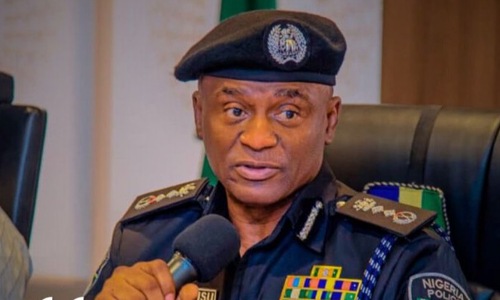
The warning was contained in a goodwill message delivered by the Force Public Relations Officer, CSP Annie Iniedu, on behalf of the Inspector-General of Police, Olatunji Rilwan Disu, at a National Orientation Agency (NOA) initiative to mobilise Nigerians at the grassroots ahead of the elections on Thursday.
SEE ALSO: IGP Disu Proposes New Police Desk for Nigeria’s Creative Economy, Intellectual Property
The initiative was held under the theme, “Your Vote, Your Voice, Your Future.”
In the message, the Inspector-General urged political parties, candidates and their supporters to embrace issue-based campaigns, tolerance and respect for the rule of law.
“Elections must never become a licence for thuggery, intimidation, vote-buying, ballot-snatching, destruction of electoral materials, or violence,” he said.
Addressing young Nigerians, the police chief warned them against becoming instruments of political violence.
“To our youths in particular: do not allow yourselves to be used as instruments of political violence. Your future is more valuable than any temporary political inducement,” he said.
He also urged eligible voters to reject voter apathy and vote-buying, encouraging them to protect their votes and participate peacefully in the electoral process.
“To all our eligible voters, I urge you to reject voter apathy and vote-buying. Your vote is your voice. Protect it, exercise it peacefully, and allow democracy to work for our nation,” he said.
The Inspector-General assured Nigerians that the police would work with the Independent National Electoral Commission (INEC), other security agencies and relevant stakeholders to protect the integrity of the 2027 elections.
He said the collaboration would involve intelligence sharing, inter-agency cooperation and professional policing to provide a safe and secure environment for voters.
“The Nigerian Police Force assures all Nigerians that we shall remain professional, impartial, and firm against criminal elements seeking to undermine the electoral process,” he said.
The police chief further called for collective efforts to ensure peaceful and credible elections in 2027.
“Let us collectively ensure that in 2027, the ballot defeats the bullet, ideas defeat intimidation, and democracy defeats violence,” he said.
He also urged Nigerians to mobilise for peace, responsible leadership and a credible electoral process ahead of the general elections.

The efforts of the members of the All Progressives Congress (APC) Presidential Campaign Council (PCC) would count for nothing, except for the person who delivers his or her ward at the polls.
Nigeria’s President, and party’s presidential candidate for the 2027 election, Bola Ahmed Tinubu made it clear during the inauguration of the council at the Banquet Hall of the Presidential Villa in Abuja, on Wednesday.
“No one gets credit for an incomplete assignment. So, until you deliver the next election, until you deliver your wards, until you deliver the votes, before we can say thank you,” he said.
READ ALSO:Marketers Eye Portion of FG’s Petrol Discount
The president, who expressed gratitude to party members for their support in the previous election, said the inauguration was more than a formal gathering, describing it as a renewed commitment to Nigerians.
“The APC is ready. We have not gathered merely to inaugurate a council; we have gathered to renew a covenant, a covenant with the Nigerian people and the historic responsibility they have entrusted to us as Nigeria’s governing party. We promise we will not let them down,” he said.
Tinubu also expressed confidence in the party’s ability to secure victory.
“I celebrate you. I celebrate you, no doubt about that. Nigeria will continue to celebrate you. You will see the joy of this victory. You will share in the joy,” he said.
The president also said he would not participate in every aspect of the campaign, stressing that his responsibilities as head of state would remain a priority.
He said party members had cautioned him against allowing the demands of campaigning to distract him from governance, adding that he agreed with their position.
“You have warned me and asked me not to allow the rigour of the campaign to distract me from governance. I hear you. I am in full agreement with your decision. Nigeria needs more attention now than ever before.
“The responsibility of this office does not pause. That responsibility did not recognise our agenda here today. The Constitution allows INEC to make room for parliament but not for the campaign. The job must go on,” he stated.
He, however, pledged to make time to address Nigerians directly while the campaign council coordinates activities across the country.
“However, I will still make time to speak directly with Nigerians even as you lead the campaign in the states and local government areas, so you will excuse me from going everywhere with you,” he said.
The campaign council is chaired by Tinubu, with Vice-President Kashim Shettima and APC National Chairman Nentawe Yilwatda serving as first and second vice-chairmen, respectively.
Senate President Godswill Akpabio, Speaker of the House of Representatives Tajudeen Abbas and Kwara State Governor AbdulRahman AbdulRazaq are the deputy vice-chairmen.
Former Zamfara State Governor Abdulaziz Yari was named director-general of the council.
Other appointments include Femi Gbajabiamila as head of administration, Imo State Governor Hope Uzodimma as secretary, and former APC National Chairman Abdullahi Ganduje as director of stakeholder mobilisation.
Lagos State Governor Babajide Sanwo-Olu was also listed among the party’s campaign officials, while Dele Alake was named spokesman.
The council’s structure includes directorates responsible for mobilisation, election planning and monitoring, finance, fundraising and regional coordination.
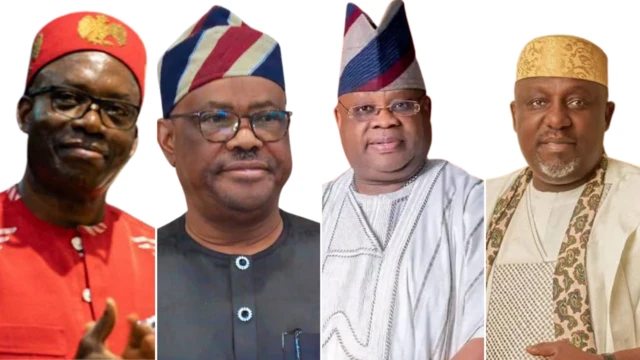
The party has also named political figures outside its ranks to coordinate support in some states and regions, including Federal Capital Territory Minister Nyesom Wike for Rivers State and the FCT, Anambra State Governor Chukwuma Soludo for Anambra, and Osun State Governor Ademola Adeleke for Osun.
President Tinubu is seeking a second term in the 2027 presidential election, which the Independent National Electoral Commission has scheduled for January 16, 2027.
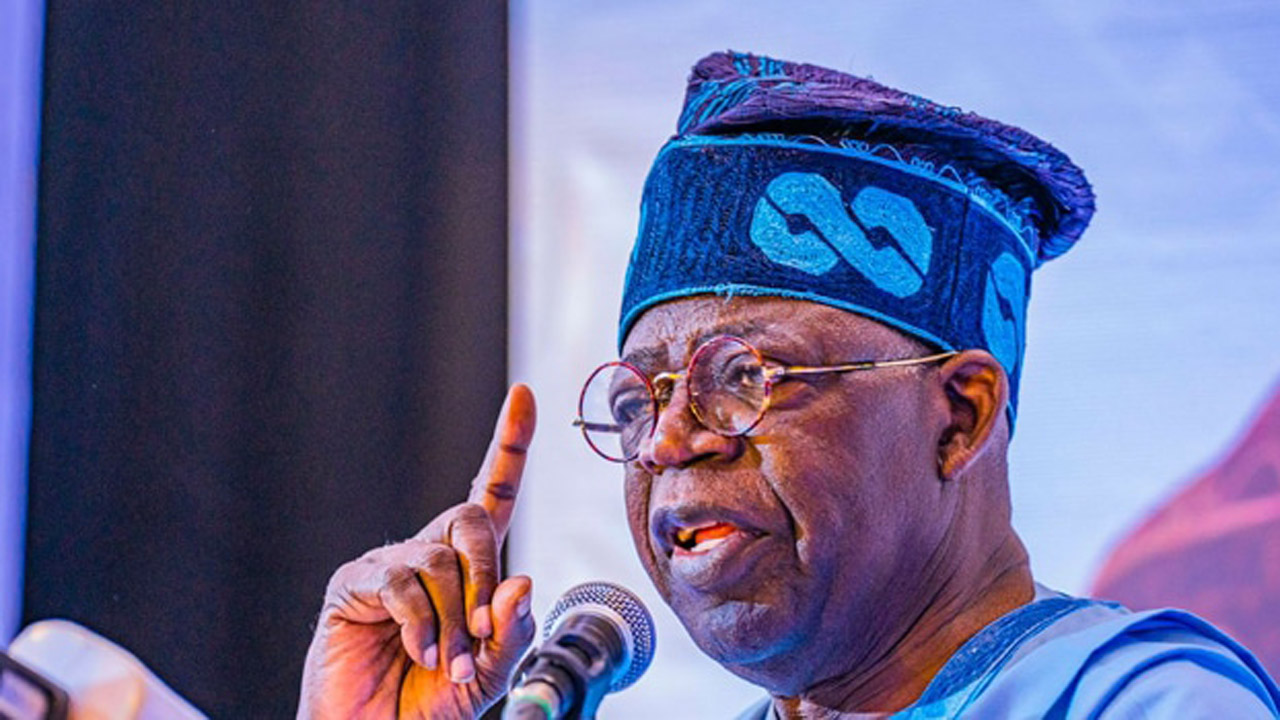
President Bola Tinubu will remain focused on governance despite preparations for the 2027 general elections, according to his Senior Special Assistant on Public Engagement, Fredrick Nwabufo.
Nwabufo made this known in an article titled “Takeaways from the APC Presidential Campaign Inauguration,” in which he highlighted key messages from the inauguration of the All Progressives Congress (APC) Presidential Campaign Council.
He said the decision to maintain governance during the campaign period was important because the President’s mandate would continue until May 29, 2027.
SEE MORE: 2027: ‘Tinubu Has Done Well’– Wike Tells Opposition to Speak the Truth
According to him, campaigns should not come at the expense of governance, stressing that the responsibility of leadership to the people must not be abandoned under any circumstances.
“Campaigns do not have to be run at the expense of governance,” Nwabufo wrote.
He described Tinubu’s decision to remain focused on delivering results to Nigerians while campaigning as both patriotic and judicious.
Nwabufo also highlighted the need for a disciplined and peaceful campaign ahead of the 2027 elections, citing APC National Chairman, Professor Nentawe Yilwatda, who called for a contest based on ideas, records and policies.
“Let the coming election be a contest of ideas, records, and policies and be conducted peacefully and with respect for the Nigerian people,” Yilwatda said.
The presidential aide further pointed to what he described as broad political consensus around Tinubu, noting that political leaders from different platforms had expressed support for the President’s candidacy.
He cited Anambra State Governor, Chukwuma Soludo, as describing the level of elite consensus surrounding the country’s political future as unprecedented.
Nwabufo also highlighted the role of women in the 2027 campaign, noting Tinubu’s pledge to support the Reserved Seats for Women Bill.
He said the President had acknowledged women’s contributions and identified them as important mobilisers for the campaign.
The aide also underscored the importance of young Nigerians to the country’s development, noting that Tinubu and other speakers at the inauguration emphasised the role of youth in shaping Nigeria’s future.
Imo State Governor Hope Uzodimma and House of Representatives Speaker Tajudeen Abbas were among those Nwabufo cited as highlighting the potential of current reforms to avert crises for present and future generations.






2027 Election: ‘Your Future Is More Valuable’ — IGP Warn Youths Against Political Violence

Tinubu Charges PCC Members to Deliver Wards

Marketers Eye Portion of FG’s Petrol Discount

Tanzania Nears Completion of $42bn Equinor, Shell-Led LNG Project

IEA Puts UAE’s Oil Output at 5.3mbpd for September

Africa’s Energy Security Conversations Pull Industry Executives Together

Trump’s Family Unveils New Cryptocurrency Platform

Senate Denies Receiving Petitions Against Tinubu’s Ambassadorial Nominees

Dangote Cement Lights Up Benue Host Communities With CSR Initiatives

Reps Recommend 3-year Jail Term For Aviation minister

Tems Sets New Record On Billboard Hot 100 Chart
