
Politics
State Of Emergency In Rivers Necessary – NNPP

The New Nigeria Peoples Party (NNPP) has thrown its weight behind President Bola Tinubu’s declaration of a state of emergency in Rivers State, arguing that decisive action was necessary to prevent further deterioration of the crisis.
Speaking in an interview with the News Agency of Nigeria (NAN) on Saturday in Lagos, NNPP National Chairman, Dr. Agbo Major, stressed that no responsible government would sit back and allow instability to escalate unchecked.
“President Tinubu is the Chief Security Officer of Nigeria. The information available to him as president from intelligence sources may not be in public purview,” Major said.
READ MORE: NNPP Has Failed Kano, APC Will Reclaim Power Ganduje
He added that the decision to suspend the state government was based on the severity of the crisis, which could have worsened without swift intervention.
“The government in Rivers was suspended, and no one can actually say what would have happened by now, judging from the deepening crisis.
“The crisis was further compounded by some leaders who, instead of offering advice or promoting peace during the turmoil, allowed it to escalate before later stepping in to criticize,” he stated.
Major described the security situation in Rivers State as unacceptable, warning that it posed a threat to lives and property.
He defended President Tinubu’s leadership style, noting that making tough decisions, even when unpopular, was a mark of true governance.
“It was a difficult decision to remove the oil subsidy; one that no previous administration was willing to make, whether right or wrong. Tinubu took that step, and we are gradually emerging from the crisis, moving forward for the better,” he explained.
According to him, the government must have had access to intelligence beyond what was available in the public domain before making its decision.
“Six months or less of the emergency rule is in the interest of Rivers residents, democracy, and Nigeria. It is our hope that indigenes of the state shall be streetwise and disregard those with personal interests, who are crying foul,” Major added.
The NNPP chairman urged Nigerian leaders to be mindful of their statements, warning that inflammatory remarks could worsen tensions in Rivers State and affect national stability.
“The Renewed Hope Agenda for a greater Nigeria should be our focus. It is centered on hard work, trust, science and technology, agriculture, education, the rule of law, and more. Focus should be on constructive criticism that will make for greater performance,” he advised.
Addressing concerns about Federal Capital Territory (FCT) Minister Nyesom Wike’s involvement in Rivers politics, Major argued that Wike, as a former governor and indigene, naturally has interests in the state.
“Wike as a minister is neither the Inspector General of Police, Chairman of EFCC, Attorney General of the Federation, Chief Judge of the Federation, nor President of Nigeria. If our institutions are not compliant with their statutory functions, why can’t we leave Wike alone to live his life?”
He also emphasized that while opposition to government is vital for democracy, it must be constructive and aimed at fostering good governance.
“Opposition to the government at the center is the lifeblood of democracy and a catalyst for good governance when it is constructive and aimed at enhancing productivity.
“However, if opposition simply means dismissing everything the government does as wrong, then something is definitely amiss,” Major concluded.




The House of Representatives Committee on Petroleum Resources (Downstream) has launched investigations into petitions seeking the cancellation of gas distribution licences held by NIPCO Plc in five locations.
This is as the Committee accused the Executive Vice President (Downstream) of the Nigerian National Petroleum Company Limited (NNPC Ltd), Dr Mumuni Dagazu, of money laundering and abuse of office.
The Committee also constituted two sub-committees to conduct preliminary investigations into the petitions, which its Chairman, Ikenga Ugochinyere, described as serious complaints requiring urgent attention.
READ MORE: UNDC Assures on Readiness to Protect Oil, Gas Pipelines
The decision was announced on Monday in Abuja at the technical briefing marking the end of Downstream Week 2026.
The Sub-Committee investigating the allegations against Dagazau will be chaired by Aliyu Al-Mustapha, with Amobi Ogah as Deputy Chairman. It has seven days to conduct a preliminary investigation and report its findings to the main Committee.
The Sub-Committee examining the NIPCO petition will be chaired by Peter Aniekwe, while Shehu Dalhatu would serve as Deputy Chairman.
The petition against NIPCO calls for the investigation, suspension and cancellation of gas distribution licences issued by the Nigerian Midstream and Downstream Petroleum Regulatory Authority (NMDPRA) to the company for Lagos, Ogun, Oyo and Osun states, as well as the Lagos and Lekki Free Trade Zones.
In the second petition, the complainants accused Dagazau of money laundering and abuse of office. The Committee, however, stressed that the allegations had not been established and that the investigation would determine the merits of the complaints.
Addressing journalists at the event, Ugochinyere said the Committee had not reached any conclusion on either matter, assuring all parties of a fair hearing.
“These are allegations, and the Committee has reached no conclusion on them. All parties will be given a full and fair opportunity to be heard,” he said.
He added that the Committee would not ignore complaints touching on the integrity of the downstream petroleum sector and promised that Nigerians would be informed of the outcome of the investigations.
Neither NIPCO Plc nor Dagazau had publicly responded to the petitions as of the time of the briefing.
The investigations formed part of the Committee’s wider review of developments in the downstream petroleum sector during Downstream Week 2026, at which it also passed votes of confidence in President Bola Tinubu, the leadership of the NMDPRA and Alhaji Aliko Dangote.
The Committee said reforms in the sector were yielding results but identified pipeline security, reliable crude supply to domestic refineries and a properly regulated import market as areas requiring sustained government attention.
Ugochinyere praised the NMDPRA’s Chief Executive, Rabiu Umar, and the authority’s Executive Directors, saying their work had helped stabilise the sector.
Figures presented at the briefing indicated that “domestic refineries increased their contribution to national petrol supply by more than 75 per cent, with no supply shortfalls recorded and more than 25 days of national sufficiency maintained.”
The committee also cited “the commissioning of the Port Harcourt Petroleum Product Laboratory, the licensing of a petroleum liquid trading exchange and the finalisation of a framework for a national strategic stock of up to 20 days,” adding that, “plans are in place to raise the reserve to 90 days in 2027.”
Despite the progress, Ugochinyere insisted that energy security depended on effective pipeline protection and adequate crude supply to local refineries.
“There is no supply security without pipeline security,” he said, adding that importation should supplement verified shortfalls rather than become a permanent substitute for domestic production.
He also called for strict enforcement of the Domestic Crude Supply Obligation, saying local refineries must have reliable access to feedstock to remain viable.
The Committee disclosed that it had opened an inquiry into alleged underpayment for crude oil by some companies and questioned NNPCL over legacy transactions and refinery rehabilitation.
“We will not accept silence as an answer,” Ugochinyere warned.
The committee further urged the Federal Government to increase funding for pipeline surveillance and ensure timely provision of logistics to operators, arguing that improved security had contributed to the rise in crude oil production.
It expressed confidence that Nigeria could achieve its target of producing three million barrels of crude oil per day with sustained government support.
The committee also said it would continue to pursue amendments to the Petroleum Industry Act to strengthen provisions on crude supply to domestic refineries, licensing and protection of local refining investments, while maintaining a regulated import market.
Ugochinyere said the objective was to balance immediate security of supply with the long-term development of Nigeria’s domestic refining capacity.
“Our goal is balance: security of supply today, and a strong domestic refining industry for tomorrow,” he stressed.

The All Progressives Congress (APC) Presidential Campaign Council is scheduled to hold its inaugural meeting on Tuesday, October 20, 2026, to consider its campaign calendar and preparations for the campaign flag-off in Kaduna.
The meeting, according to an internal memorandum released on Sunday and signed by Imo State Governor Hope Uzodimma, Secretary of the Presidential Campaign Council, will take place at 2 p.m. at the council’s headquarters, Plot 781, Herbert Macaulay Way, Central Business District, Abuja.
SEE ALSO: ‘The Entire North Has Made Up Its Mind for Tinubu’ — APC Chieftain
The notice states that attendance is “strictly by invitation” and restricted to the 134 members of the Presidential Campaign Council listed in the distribution list.
It explains that the meeting will formally commence the council’s collective assignment and provide an opportunity for members to consider and adopt the campaign calendar.
“The meeting will formally commence the collective assignment of the Council and provide an opportunity to consider and adopt the Campaign Calendar,” the memorandum stated.
It added that members would also deliberate on other related matters, including preparations for the campaign flag-off scheduled to take place in Kaduna on Saturday, October 24, 2026.
Governors, National Assembly Leaders Listed
The distribution list includes state governors, National Assembly leaders and officials assigned to various campaign directorates.
Among those listed as state coordinators are Imo State Governor Hope Uzodimma, Lagos State Governor Babajide Sanwo-Olu, Kaduna State Governor Uba Sani, Enugu State Governor Peter Mbah, Borno State Governor Babagana Zulum and Rivers State Governor Nyesom Wike.
Others include Akwa Ibom State Governor Umo Eno, Anambra State Governor Charles Soludo, Delta State Governor Sheriff Oborevwori, Ogun State Governor Dapo Abiodun and Osun State Governor Ademola Adeleke.
Senate President Godswill Akpabio and House of Representatives Speaker Tajudeen Abbas are also listed among the council’s leadership.
Campaign Directorates
The memorandum identifies officials responsible for coordinating different aspects of the campaign, including media and strategic communications, new media, finance and treasury, fundraising, policy and manifesto development, legal affairs, security and intelligence, data management, and contact and mobilisation.
The Directorate of Media and Strategic Communications lists Mohammed Idris Malagi as Coordinating Director I and Abdulaziz Abdulaziz as Coordinating Secretary I.
Segun Dada and Solomon Arowolo are listed as director and secretary, respectively, of the Directorate of New Media.
Other directorates listed include infrastructure mobilisation and sensitisation, creative sector mobilisation, artisan mobilisation, diaspora mobilisation, women mobilisation, sport sector mobilisation and mobilisation of people living with disabilities.
The document also identifies a Parliamentary Mobilisation Directorate for State Assemblies.
In the memorandum, Uzodimma thanked members for their cooperation and commitment to the assignment.
“Thank you for your usual cooperation and dedication to the success of this important assignment,” he stated.
The meeting is scheduled to hold four days before the campaign flag-off in Kaduna, which the memorandum identifies as a key item for discussion.
The Nigeria Democratic Congress (NDC) has withdrawn recognition of its diaspora chapters, citing a subsisting court judgment that reportedly restricts Nigerian political parties from establishing, operating or supervising chapters outside the country’s territorial boundaries.
The party announced the decision in a press statement released on Sunday October 18, 2026, signed by its National Publicity Secretary, Osa Director, Esq.
The statement followed a review of the party’s relationship with its foreign chapters operating across different countries, with the NDC explaining that its decision was informed by a court judgment concerning the legality of diaspora chapters belonging to Nigerian political parties.
SEE ALSO: Kwankwaso Rejects ADC Claims, Says NDC Won’t Withdraw From 2027 Race
The party referenced the case of Prof. Ali Alao v. All Progressives Congress (APC) & Anor, Suit No. CV/187/2025, decided by Justice Peter Kekemeke of the Federal Capital Territory High Court in Maitama.
According to the NDC, the court held that “no political party registered in Nigeria has the legal authority to establish, operate or supervise chapters outside the country’s territorial boundaries.”
The statement further quoted the court as ruling that “diaspora chapters of Nigerian political parties were illegal, unconstitutional, and unknown to the laws of the Federal Republic of Nigeria.”
Explaining its decision to comply with the reported judgment, the party said it was withdrawing all previous recognition granted to its foreign chapters.
“Therefore, the NDC, in deference to the said judgment, is halting recognition of foreign chapters of the party and all earlier recognitions are hereby withdrawn,” the statement read.
NDC Appreciates Diaspora Supporters
Despite the withdrawal of recognition, the party expressed appreciation to its diaspora supporters, acknowledging their contributions, loyalty, guidance and continued commitment to its activities.
The NDC said it remained grateful for the support it had received from the various foreign chapters, even as it moved to address the legal implications of the court judgment.
“We are deeply appreciative of the immense support of various foreign chapters in the diaspora. We are grateful for their unwavering loyalty, guidance, and contributions to the party,” the statement said.
The party also disclosed that a harmonisation process had been initiated in jurisdictions where more than one group existed, with the aim of bringing the different groups under a single umbrella.
It added that the judgment was still under review and had been referred to its Legal Department for further advice and guidance.
“The party is currently studying the judgment and has referred same to its Legal Department for further advice and guidance,” the statement added.
NDC Addresses Peter Obi’s Diaspora Supporters
The NDC also acknowledged the significant interest Nigerians living abroad have shown in its candidates, particularly its presidential candidate, Peter Obi.
The party encouraged diaspora supporters to sustain their interest and continue supporting its political activities despite the withdrawal of formal recognition from its foreign chapters.
“The party is aware of the tremendous interest that Nigerians in the diaspora have in our candidates, especially our presidential candidate, Mr Peter Obi and we thank them and encourage them to sustain such interest with more vigour,” the statement read.
The party further clarified that the withdrawal of recognition did not mean diaspora supporters should stop meeting or interacting with one another.
Instead, it encouraged them to maintain their engagements, assuring them that the party would continue to communicate with them through appropriate and lawful channels.
“We encourage our supporters in the diaspora to continue to meet and interact, and we shall remain in touch with them through appropriate and legal channels,” the statement said.
NDC Criticises APC, Calls for a New Nigeria
The party also used the statement to urge its supporters to remain committed to its political objectives, calling for collective efforts to address what it described as Nigeria’s present state of drift and hopelessness under the ruling All Progressives Congress (APC).
“Collectively, we must work hard to build a Nigeria of our dreams. We must rescue Nigeria from its present state of drift and hopelessness foisted on it by the rudderless APC,” the statement read.






Renaissance, Sterling Bank Back Indigenous Oil and Gas Contractors Financially
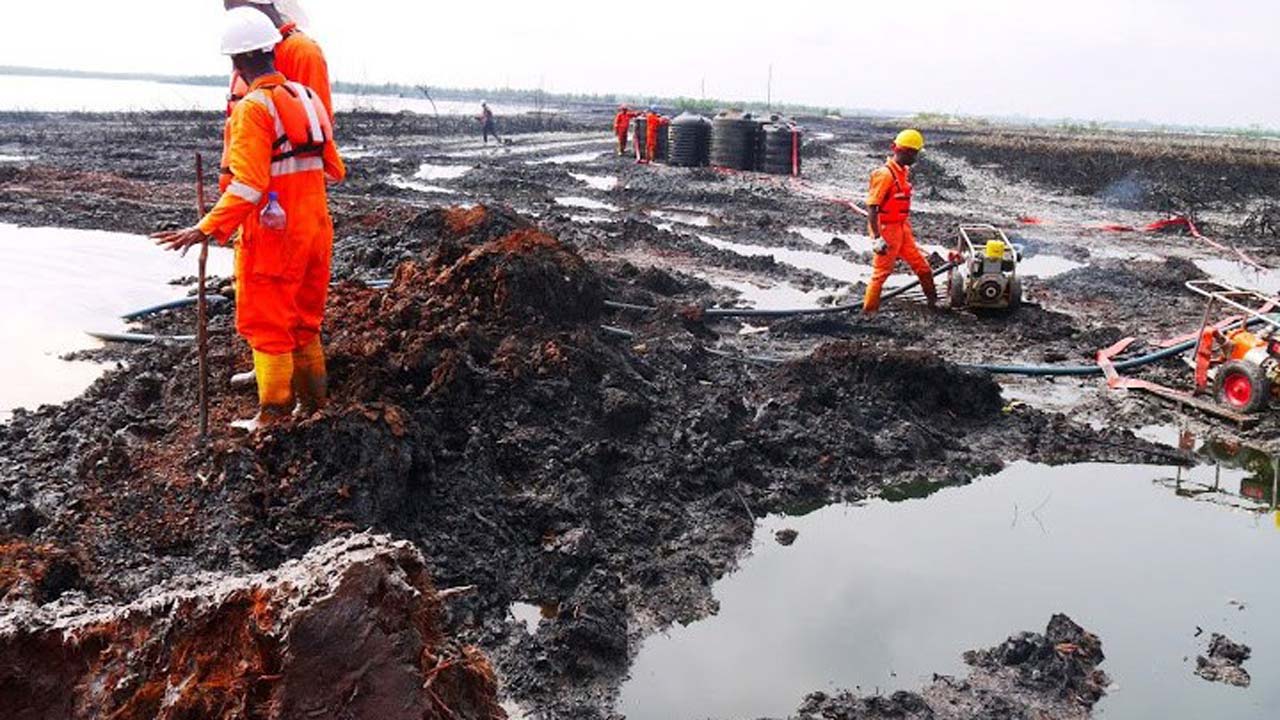
Group Demands Fair Share of NNPC Jobs for Ogoni Oil Exploration

NNPC Ltd Exploration Spending Down 87%
200 Imo Teachers Benefit from NCDMB’s Effective Curriculum Training
FG to Launch National Lead Poisoning Prevention Plan Wednesday

EndSARS Memorial: ‘Nigerians Still Deserve Answers’ – Atiku

Trump’s Family Unveils New Cryptocurrency Platform

Senate Denies Receiving Petitions Against Tinubu’s Ambassadorial Nominees

Dangote Cement Lights Up Benue Host Communities With CSR Initiatives

Reps Recommend 3-year Jail Term For Aviation minister

Tems Sets New Record On Billboard Hot 100 Chart
