
Business
U.S. Stock Futures Hold Gains after Data


WASHINGTON – U.S. stock futures held their gains after data showed personal income and spending data increased mostly in line with expectations.
About 55 minutes ahead of the open, Dow Jones Industrial Average futures gained 32 points, or 0.2%, to 16214. Just before the release of the data, Dow futures were up 32 points.
S&P 500 index futures added five points, or 0.3%, to 1845 and Nasdaq-100 futures advanced 14 points, or 0.4%, to 3567. Changes in stock futures don’t always accurately predict stock moves after the opening bell.
Personal income for February rose 0.3% on the month and consumer spending increased 0.3%, compared with expectations of increases of 0.2% and 0.3%, respectively. Personal-consumption expenditures, a measure of inflation, rose 0.1%, matching forecasts.
After the open, the final reading of the Thomson-Reuters/University of Michigan consumer sentiment index for March, due at 9:55 a.m., is expected to be revised to 80.5, up from a preliminary reading of 79.9, but below February’s 81.6.
The yield on the 10-year Treasury note ticked up to 2.692% from 2.668% late Thursday. Helping lend early support to stock futures, European markets were broadly higher, with the Stoxx Europe 600 headed for a fourth-straight gain.
The S&P 500 closed Thursday down 0.9% on the week, after rising 1.4% the week before. Although investors are mostly optimistic about the outlook for U.S. stocks, the market has struggled to sustain gains in recent weeks. The S&P 500 has declined 1.5% since hitting a record high on March 7, as investors have seen little reason to chase the market higher.
After running up 30% in 2013, the S&P 500 heads into the next-to-last session of the first quarter up less than 0.1% on the year. Meanwhile, the Dow has lost 1.9% year to date.
Robert Pavlik, chief market strategist at wealth management firm Banyan Partners, which oversees $4.5 billion, said the market could continue to struggle into next week, and into earnings season, which starts in mid-April, as investors look for more fundamental news for guidance.
He said he wouldn’t be surprised if stocks pull back in the coming weeks, but he would view that as a buying opportunity.“I’ve been taking some profits in some stocks that have done very well for me,” Mr. Pavlik said. “I’m just making sure that my cash levels are where I’m comfortable, to have a little extra money available, so I can buy” if there is a pullback in the coming weeks.
Asian markets were mostly higher. Japan’s Nikkei Stock Average gained 0.5% for a third-straight gain, while China’s Shanghai Composite bucked the regional trend by slipping 0.2% to suffer a third-straight loss.
In corporate news, Amazon.com rose 0.6% in premarket trading after The Wall Street Journal reported late Thursday that the company is considering an ad-supported streaming content service that would be free to watch. Shares of Internet-video service provider Netflix fell 1.3% following the report.
BlackBerry climbed 7.6% after the mobile phone maker reported a fiscal fourth-quarter loss that was much smaller than expected, offsetting a bigger-than-expected drop in revenue and a decline in the company’s cash position.
Zynga rallied 3.6% after SAC Capital Advisors disclosed late Thursday that it increased its stake in the game maker to more than 5% of outstanding shares.
– WALLSTREET JOURNAL

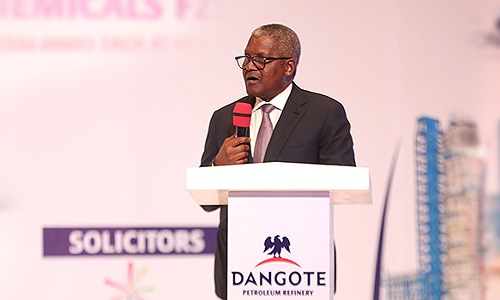
President of Dangote Group, Aliko Dangote, has reaffirmed his commitment to ensuring broad-based participation in the Dangote Refinery’s Initial Public Offering (IPO).
In a statement, the industrialist announced that investors applying with ₦50,000 and below will receive priority consideration as the company seeks to democratize ownership of one of Africa’s most significant industrial assets.
Dangote made the declaration during the final leg of the nationwide IPO roadshow held in Port Harcourt, Rivers State, where investors, financial market experts, business leaders and other stakeholders gathered to discuss the investment opportunity and its implications for Nigeria’s economic transformation.
READ ALSO: Sahara Champions Global Shipping Collaboration for $20m Mercy Ships Healthcare Impact
Speaking at the event, Dangote emphasised that the IPO should be viewed not merely as an investment opportunity, but as a chance for Nigerians to become shareholders in a landmark enterprise that is reshaping the country’s industrial landscape.
“We will prioritise people with ₦50,000 and below,” Dangote stated, underscoring the Group’s determination to make the offering accessible to small and medium-scale investors across the country.
He noted that while international and African investors had already committed substantial capital to the refinery, the IPO now offers Nigerians a rare opportunity to participate directly in the ownership of a world-class industrial project built on Nigerian soil.
According to him, investing in the refinery goes beyond financial returns, representing a vote of confidence in Nigeria’s future, institutional development, corporate governance standards and industrial capacity.
“African investors have invested in this refinery. Now it is time for Nigerians to invest in themselves and participate in a project that is creating value, jobs and opportunities for generations to come,” he said.
Dangote also encouraged prospective shareholders to adopt a long-term investment perspective, noting that participation in the IPO presents a pathway to wealth creation, portfolio diversification and increased public engagement with the capital market.
He added that wider participation in the stock market would deepen financial literacy, promote a savings and investment culture, and enable more Nigerians to better understand how businesses create value and contribute to economic growth.
The roadshow also featured insightful presentations from leading economists and market analysts on the refinery’s economic significance and the broader opportunities associated with the public offering.
Renowned economist Bismarck Rewane highlighted the enormous economic potential of the South-South region and stressed the need to convert the area’s resource endowment into sustainable prosperity, infrastructure development and improved living standards. He also noted that the IPO presents an opportunity to deepen Nigeria’s capital market by encouraging citizens to participate actively in wealth creation.
Similarly, economist Dr. Muda Yusuf outlined the refinery’s far-reaching impact on economic diversification, domestic value addition, energy security, capital formation and employment generation.
According to Yusuf, the refinery represents far more than a petroleum-processing facility, serving as a catalyst for growth across multiple sectors including petrochemicals, packaging, manufacturing, logistics and other downstream industries.
He further emphasized that policy consistency, regulatory stability and sustained stakeholder engagement remain critical to maintaining investor confidence and attracting long-term capital into Nigeria’s industrial sector.
Speaking on the investment outlook, stakeholders urged prospective investors to consider the company’s operational performance, valuation metrics and long-term fundamentals when evaluating the offer.
Yusuf also described the refinery as a major example of domestic value addition, noting that its extensive local content and industrial linkages would significantly amplify its contribution to the Nigerian economy.
Discussions at the event further highlighted the importance of sound monetary policy, affordable financing and a predictable business environment in supporting investment-led growth and industrial expansion.
The Port Harcourt engagement was particularly significant for the South-South region, with legal luminary and business leader Paul Usoro expressing satisfaction at the level of participation from investors across the region.
“My joy is to see the South-South well represented,” Usoro said, stressing the importance of ensuring that investors from the region take advantage of the opportunity presented by the IPO.
The Port Harcourt event marked the final stop of the nationwide IPO roadshow, concluding a series of engagements designed to deepen public awareness and expand participation in what is widely regarded as one of the most significant capital market offerings in Nigeria’s history.
For Dangote Group, the objective remains clear: to provide Nigerians from all backgrounds with an opportunity to participate in the ownership of a transformative industrial enterprise while contributing to economic growth, employment generation and national development.
Sahara Energy Geneva has highlighted the power of business collaboration to deliver lasting impact, with Mercy Ships Cargo Day celebrating more than $20 million raised over the past decade to support healthcare interventions in Africa.
More than 500 guests from over 150 shipping and trading companies gathered in Geneva recently for the 10th anniversary Gala of Mercy Ships Cargo Day, celebrating a decade of industry support for the international charity.
David Walker, Head of Chartering at Sahara Energy Geneva and Chairman of the Cargo Day Geneva Committee, joined industry leaders at the event, where he thanked the global shipping community, sponsors, media partners and Cargo Day committees in Geneva, London, Houston, Dubai and Singapore for supporting the initiative.
Cargo Day brings together charterers, shipowners, shipbrokers, and other shipping professionals who contribute through pledges, cargo commissions, and address commissions to support the work of Mercy Ships.
READ ALSO: 30 Nigerians Bag Postgraduate Scholarship from NNPC Ltd, Eni
Kola Motajo, Director, Sahara Geneva said Sahara’s involvement reflects the company’s belief in the ability of enterprise and partnerships to deliver impact beyond business.
“At Sahara, our focus is always on impact and lives transformed. Cargo Day demonstrates what is possible when businesses and individuals unite around a shared purpose. The $20 million milestone reflects the collective commitment of the global shipping community to improving healthcare in Africa. As Sahara looks Beyond XXX, we remain committed to building connections that create lasting value and possibilities for generations to come,” Motajo said.
Reflecting on Cargo Day’s growth, Walker said: “Ten years ago, we raised $300,000 and there were 70 people at the Gala. Today, we have more than 500 people coming from around the world to support such a great cause.”
Cargo Day 2025 raised more than $2.5 million, with 93 companies participating, including charterers, brokers, shipowners, and other partners.
Mercy Ships operates two hospital ships supporting patients in Africa with free life-changing surgeries, while also providing training and mentoring for local healthcare professionals. Cargo Day funding contributes to expenses associated with operating the hospital ships.
The 2026 Cargo Day campaign begins November 4 and will run through November and December, with companies participating through Mercy Cargoes, address commissions and pledges.

Up to 30 Nigerian graduates have bagged postgraduate scholarships to pursue further studies both locally and in the Diaspora.
According to the Nigerian National Petroleum Company Limited (NNPC Ltd) and Italian energy company, Eni have awarded postgraduate scholarships
The beneficiaries emerged from more than 3,000 applicants following assessments of their academic records and performances in a recently conducted computer-based test (CBT).
The awards are under the 2026/2027 Postgraduate Scholarship Scheme of Nigerian Agip Exploration Limited (NAE), an Eni subsidiary, on behalf of the NNPC-NAE Production Sharing Contract (PSC) partners.
In a statement, NAE’s Vice Chairman and Managing Director, Maurizio Pinna, said the initiative was designed to develop local talent and equip young Nigerians with skills relevant to the oil and gas industry. Pinna congratulated the beneficiaries, noting that the scholarships would enable them to pursue their academic ambitions and achieve their career goals.
According to NAE, the programme reflects its commitment to education, innovation and capacity building in Nigeria.
The company urged the beneficiaries to make good use of the opportunity by acquiring valuable knowledge and skills that would contribute to national development, particularly in the energy sector.
Ten of the awardees will undertake postgraduate studies in universities abroad, including Imperial College London, Robert Gordon University in Aberdeen, Newcastle University, the University of Aberdeen and the University of Hull in the United Kingdom.
READ ALSO: Navy Recovers 98,000 Litres of Suspected Stolen Crude in Rivers
The remaining 20 beneficiaries will study at Nigerian universities in fields including engineering, geosciences, petroleum and environmental technology, energy economics, renewable energy and energy transition.
Established in 2007, the NNPC-NAE PSC postgraduate scholarship scheme is part of the partners’ human capital development programme aimed at promoting specialised knowledge and addressing skills shortages in Nigeria’s deep offshore oil and gas operations.
NAE said 380 Nigerian graduates had benefited from the scheme since its inception, gaining knowledge and skills required by the oil and gas industry.
Beyond education, Eni, through NAE, has implemented sustainability initiatives in Nigeria covering healthcare, access to water, infrastructure and community empowerment.
Eni has operated in Nigeria since 1962 and currently has an equity production of about 55,000 barrels of oil equivalent per day. The company also holds a 10.4 per cent stake in Nigeria LNG.
NAE was incorporated in 1996 to manage Eni’s deep offshore exploration and production assets. It became the first oil and gas company in Nigeria to produce oil from the country’s deep offshore when its Abo floating production, storage and offloading (FPSO) vessel began operations in 2003.
The company has interests in nine offshore blocks in Nigeria, either as operator or co-venturer, including PML 102 and PML 103, where the Zabazaba-Etan fields are being developed.






Ebonyi 2027: Gov Nwifuru Jittery Over My Candidacy, Violating Constitution — Odii

Small Investors Take Centre Stage as Dangote IPO Nears Close
Sahara Champions Global Shipping Collaboration for $20m Mercy Ships Healthcare Impact

30 Nigerians Bag Postgraduate Scholarship from NNPC Ltd, Eni

2027: ‘Algorithms Will Not Decide Election Results’, INEC Chairman Declares

Navy Recovers 98,000 Litres of Suspected Stolen Crude in Rivers

Trump’s Family Unveils New Cryptocurrency Platform

Senate Denies Receiving Petitions Against Tinubu’s Ambassadorial Nominees

Dangote Cement Lights Up Benue Host Communities With CSR Initiatives

Reps Recommend 3-year Jail Term For Aviation minister

Tems Sets New Record On Billboard Hot 100 Chart
