
Entertainment
Witches dealt with me after ‘Koto Orun’ Movie – Iya Gbonkan


By Funmilayo Olusanya
After appearing in the film “Koto Orun,” popular Yoruba actress, Margaret Bandele Olayinka, alias Iya Gbonkan, said she was subjected to severe witchcraft.
Iya Gbonkan
The veteran, who is well known for portraying a witch in most films, claimed that they used to approach her every other night at 12 o’clock and pressure her into joining their cause.
The 64-year-old thespian, however, remarked that she consistently declined their requests since, in her words, “bleeding and drinking of blood wasn’t in her ancestry.”
Read also>>>Kunle Afolayan Excited As Oscars Reconsiders Anikulapo
In contrast, Iya Gbonkan claimed in an interview with U & I EvergreenTV that the witches beat her one particular night and nearly disfigured her face, making the attack worse when she appeared in “Koto Orun.”
She was particularly appreciative to God for protecting her throughout all of the assaults because of her candor.
She said: “Witches always come to me every night around 12 midnight. I’m very courageous, even what will scare me, I always endure it.
“There was even a time they beat me in my sleep to the point they dented my face. At that time, the father of my child was still alive. They tried to initiate me that I should come and join them in shedding and drinking blood but I resisted their attempt that it’s not in my lineage to do such.
“It became terrible after I acted ‘Koto Orun’ when we acted ‘Koto Orun’, everyone had a terrible encounter. I wasn’t just the only one but God vindicated me because of my honesty. I would have died during ‘Koto Orun’ because I went through a lot.
“I didn’t just start acting but since God said he would uplift me through that means I gave myself to it.”
The late Ajileye and Olori Abioye produced the 1989 film “Koto Orun,” which is one of the most well-known Yoruba films ever.
It was set in the pre-colonial era, when witches surrounded a particular community and tormented the residents willy-nilly.
Even though the good witches, known in the film as “aje funfun” (the white witches), frequently confront the wicked ones, it wasn’t enough to get rid of the evil ones’ infection of the town.
The gods promised the villagers a savior who would be sent by one of the king’s wives and would defeat the bad witches in response to their misery.
As a result, the witches, including the first wife of the king, devised numerous plans to assassinate the messianic bearer who had been prophesied.


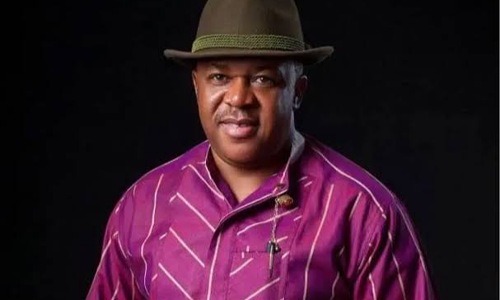
The Nigerian film industry has been thrown into mourning following the death of veteran Nollywood actor Francis Duru, who died at the age of 57 after a brief illness.
Duru’s family announced his death on Friday in a statement shared on the actor’s official Instagram page. The National President of the Actors Guild of Nigeria (AGN), Abubakar Yakubu, also confirmed the development.
Born on July 27, 1969, Duru rose to prominence for his portrayal of Ahanna in Amaka Igwe’s 1995 film Rattlesnake, a role that helped establish him as a recognisable face in Nollywood.
SEE ALSO: JUST IN: Ex-Delta Governor Emmanuel Uduaghan Is Dead
The actor featured in several other productions throughout his career, including Blood Money and Merry Men, earning recognition for his contributions to Nigerian film and television.
Over the years, Duru established himself as a veteran performer whose work contributed to the growth and development of the Nigerian entertainment industry.
His death comes months after he dismissed speculation about his health following the circulation of a video in June that raised concerns among fans.
Duru’s passing marks a loss for Nollywood, with colleagues, fans and other entertainment industry stakeholders expected to pay tribute to the actor and celebrate his contributions to Nigerian cinema.

Nigerian ceramic sculptor and artist, Chris Onaivi Ekuafeh, has opened Unity Forged in Clay, a solo exhibition that draws on clay, culture and personal experience to explore one of humanity’s enduring questions, “How can people remain different and still belong together?”
The exhibition opened on Saturday, September 26, at Quintessence Gallery, Victoria Island, Lagos, and continues until October 10, 2026.
Featuring 13 ceramic works, Unity Forged in Clay is Ekuafeh’s first solo exhibition on Nigerian soil and follows his first solo show in China in 2025, after a residency at the Taoxichuan Arts Centre in Jingdezhen, one of the world’s historic centres of ceramic art. At the heart of the exhibition are two deceptively simple questions: What is unity? And are we united as a people?
Ekuafeh, however, thinks unity does not necessarily have to demand uniformity. “Unity, for me, is not sameness,” he said. The idea is reflected throughout a body of work in which distinct forms, patterns, faces and cultural references coexist while retaining their individual character. “Unity unveils to me bits and pieces of different entities coming together to achieve a thing,” he said.
READ ALSO: NNPC Flaunts $800m Ima FID, as Affirmation of Upstream Viability
Works in the exhibition include Identity, Where We Connect, What the Fire Kept and Kin, with titles across English, Yoruba and Ekuafeh’s native Igarra language. The choice of language, like the forms themselves, is driven by the story and meaning of each piece rather than by a single cultural frame.
The works reflect a creative journey formed across several Nigerian environments and traditions. Born in Kano and trained at Ahmadu Bello University, Zaria, where he studied Industrial Design with a specialisation in ceramics, Ekuafeh says his exposure to northern Nigerian architecture and material culture first awakened his fascination with clay.
The geometric patterns associated with northern architecture continue to appear in his work, while the distinctive faces he carves into some of his pieces draw from his Edo heritage. Lagos, where he now lives and works, has added another layer to the practice, exposing him to contemporary artistic influences and encouraging an increasingly research-driven approach. The result is an artistic vocabulary in which culture, identity, spirituality, emotion, community and human connection repeatedly intersect.
Ekuafeh said clay is more than a convenient artistic medium. His relationship with the material begins from sourcing from the earth, digging, preparing and processing the clay before shaping it into finished work. That physical process has become part of his understanding of both creativity and human experience.
The work captures that connection through scenes of the artist working directly with clay – pressing, shaping, carving and building – alongside reflections on diversity, fracture, belonging and the continuous work required to sustain unity. Rather than provide predetermined answers, Unity Forged in Clay invites viewers to arrive at their own.
Individual works combine sculptural forms with recurring markings, human features and patterns that encourage closer looking. Some begin with sketches and carefully developed ideas; others evolve more organically as Ekuafeh works with the material, allowing the form to develop alongside the thought that inspired it.
This tension between intention and discovery is central to his practice. Clay becomes both material and collaborator. And the exhibition is a visible expression of the process. Unity Forged in Clay is an opportunity to bring years of experimentation, cultural inquiry and technical practice into a focused solo presentation before returning to the studio to develop the next body of work, Ekuafeh said.
Beyond that, however, Unity Forged in Clay leaves its larger question with the audience. “If different particles of earth can be worked, fired and brought together without losing the marks that make each form distinctive, what might that suggest about people, communities and society?”
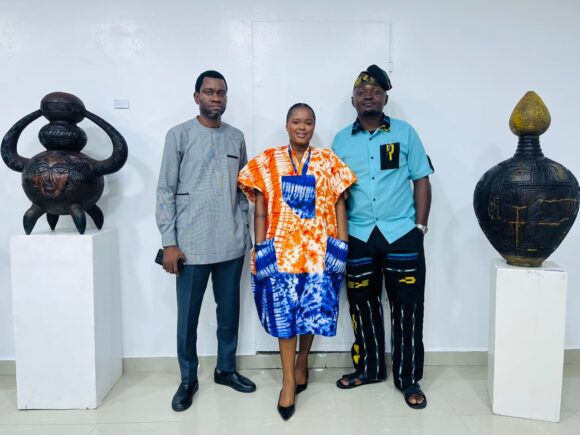
Photo Caption: From Left, Ofuma Agali, Business Lead, The Candella & Company; Saheedat Lawal, Gallery Supervisor, Quintessence Gallery; and Chris Ekuafeh; at Ekuafeh’s ‘Unity Forged in Clay’ exhibition, held at Quintessence Gallery, Victoria Island, Lagos, Saturday, 26 September 2026
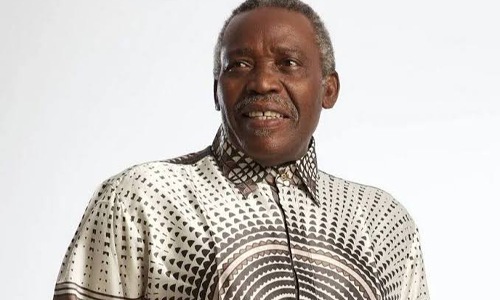
Veteran Nigerian actor and film executive, Oludotun Baiyewu Jacobs, popularly known as Olu Jacobs, has died at the age of 84.
His death was announced by his son, Olusoji Jacobs, in a statement shared on Instagram on Wednesday, September 16, 2026.
The family described the late actor as “The Lion of Lufodo” and appealed to bloggers and social media influencers to respect their privacy as they mourned his passing.
SEE ALSO: Shock as Eagle Online Publisher Dotun Oladipo Dies Suddenly at 56
“It is with gratitude to God for a life well lived and fought, that we announce the passing of our dear husband, father, grandfather and uncle. The Lion of Lufodo,” the statement read.
The family identified him as Oludotun Baiyewun Jacobs, MFR, and gave his dates as July 11, 1942, to September 16, 2026.
Jacobs was one of Nigeria’s most recognised veteran actors, with a career spanning theatre, television and film.






Nigeria Gets More 1,000 5G Sites, Courtesy Airtel

INEC Chairman Assures on 2027 Elections

Tinubu Hails EFCC as FBI Commends Nigeria Over International Child Sextortion Crackdown

Atiku Raises Alarm Over Attacks on Sowore, ADC Governorship Candidate, Accuses APC of Intimidation

ADC Accuses Tinubu of Using N50,000 Cash Relief to Woo Voters Ahead of 2027
FRSC Begins Five-Day Nationwide Crackdown on Fake, Obsolete Number Plates

Trump’s Family Unveils New Cryptocurrency Platform

Senate Denies Receiving Petitions Against Tinubu’s Ambassadorial Nominees

Dangote Cement Lights Up Benue Host Communities With CSR Initiatives

Reps Recommend 3-year Jail Term For Aviation minister

Tems Sets New Record On Billboard Hot 100 Chart
