
Business
World Bank Report Shows High Income Gains For Low-Skilled Nigerian Migrants In The US

According to The World Development Report 2023, Migrants, Refugees, and Societies released by the World Bank highlights the potential gains from migration for low-skilled Nigerians who move to high-income countries.
The report indicates that low-skilled Nigerians who migrated to the United States of America experienced an increase in earnings by almost 1,500 per cent.
The report also notes that the potential gains from migration are highest for people who move from low- to high-income countries. While high-skilled workers experience larger absolute gains, low-skilled workers also experience a multifold increase in their income.
However, the financial costs of moving can offset some of the income gains, especially for low-skilled workers. These costs tend to be borne by the workers themselves, contravening the principles of fair recruitment.
The costs can include job information and job matching fees, regulatory compliance or documentation fees (such as visa/sponsorship, medical tests, and security clearance), transportation costs, and pre-departure training costs.
For low-skilled migration, these costs tend to increase with the duration of contracts, which limits the ability of many low-skilled workers to benefit from migration opportunities.
The report reads “The potential gains are highest for people who move from low- to high-income countries. The labour demand at the destination also shapes outcomes. Gains depend on migrants’ skills, gender, age, and language ability. Although the absolute gains are larger for high-skilled workers than for low-skilled workers, low-skilled workers experience a multifold increase in their income as well.
“For example, low-skilled Yemenis and Nigerians moving to the United States increase their earnings by about 15 times. The gains achieved by low-skilled workers are higher when they move from a society with high socioeconomic inequalities to a country with fewer inequalities and where the difference in wages between low- and high-skilled workers is lower.
“Migrants incur a range of expenses before their departure, from the job information and job matching fees they pay to intermediary agents to the regulatory compliance or documentation fees (for a visa/ sponsorship, medical tests, and security clearance), transportation costs, and pre-departure training costs they must pay.
The report also notes that Nigeria is a major origin and destination for migrants stating that Nigeria is home to almost 1.3 million immigrants and is the origin of 1.7 million emigrants.
Additionally, in Nigeria, households that receive remittances invest more in agrochemicals and planting materials, leading to larger yields on farms.
Despite this, remittance inflows in Nigeria jumped by almost 10 times in one year and then declined, even though economic fundamentals suggest they should have increased steadily.
Furthermore, Nigeria and nine other countries account for more than two-thirds of the 59.1 million internally displaced persons, with about 3.2 million internally displaced persons in Nigeria.
Finally, the report notes that Nigeria is expected to become the second most populous country in the world by the end of the century from 213 million to 791 million, despite a decline in fertility rates.








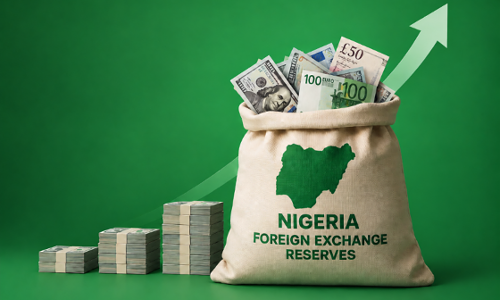
Nigeria’s gross foreign exchange reserves have risen to $54.61 billion in 2026, representing a $12.76 billion increase from the $41.84 billion recorded a year earlier.
The latest figure, recorded as of September, represents a 30.5 per cent year-on-year increase and continues a steady accumulation of Nigeria’s external reserves that became more pronounced from the middle of the year.
But how did Nigeria build up such a substantial reserve position within months?
Available data and analysis point to a combination of stronger oil-sector earnings, increased foreign capital inflows, diaspora remittances, non-oil export proceeds and changes in foreign exchange and monetary management.
Oil production and earnings
One of the factors supporting the improvement has been stronger crude oil production.
SEE ALSO: Nigeria Beats 2026 Foreign Reserves Target, Hits $53.1b
Analysis of Central Bank of Nigeria (CBN) data by Nairametrics showed that reserves stood at $49.80 billion on June 1 before crossing the $50 billion mark on June 4. By July 3, the balance had risen to $51.53 billion and subsequently moved above $52 billion in August.
Earlier CBN data analysis also showed that crude oil and condensate production averaged about 1.68 million barrels per day in April, 1.73 million barrels per day in May and 1.72 million barrels per day in June, before standing at about 1.68 million barrels per day in July.
The stronger production has coincided with higher oil-sector revenues. Nairametrics reported that NNPC revenue rose from N2.57 trillion in January to N2.68 trillion in February and N2.77 trillion in March, before jumping to N4.97 trillion in April. It subsequently stood at N4.34 trillion in May, N4.39 trillion in June and N3.09 trillion in July.
Aminu Gwambe, President of the Association of Bureaux De Change Operators of Nigeria, also attributed part of the reserve improvement to higher crude oil prices and increased production.
According to Gwambe, reduced volatility in the Niger Delta and lower crude oil theft have helped improve production and, consequently, foreign exchange receipts.
Foreign capital inflows surge
Another major development has been the increase in foreign capital entering Nigeria.
Nigeria attracted $10.37 billion in foreign capital in the first quarter of 2026, representing an 83.8 per cent increase from the $5.64 billion recorded in the corresponding period of 2025, according to National Bureau of Statistics data.
Portfolio investment accounted for the overwhelming majority of the inflows, reaching $9.86 billion, or 95.09 per cent of total capital imported during the quarter.
The banking sector attracted $7.55 billion, representing 72.79 per cent of total capital imported, while the financing sector received $2.43 billion.
The United Kingdom was the largest source of the foreign capital, contributing $5.08 billion, followed by the United States with $3.18 billion and South Africa with $983.83 million.
The increase in portfolio inflows has been linked by analysts to improved conditions in Nigeria’s foreign exchange market and the attractiveness of Nigerian financial assets and yields.
However, the composition of the inflows is significant because portfolio investments can be more easily reversed than longer-term foreign direct investment.
Remittances and non-oil exports
The reserve buildup has also been linked to stronger diaspora remittances passing through official channels.
Gwambe pointed to increased remittance flows following Nigeria’s foreign exchange reforms, as well as growing dollar liquidity through licensed fintech channels.
Higher non-oil export proceeds have also contributed to the country’s foreign exchange earnings, while improvements in fiscal and monetary management have supported the broader accumulation.
These sources are important because they provide foreign exchange beyond crude oil, although their contribution must be viewed alongside the much larger role still played by oil and financial-market inflows.
Foreign investors show greater interest
Chief Executive Officer of the Centre for the Promotion of Private Enterprise, Dr Muda Yusuf, linked part of the improvement to stronger foreign investor confidence and increased portfolio inflows.
Yusuf said, “It takes a lot of confidence in an economy for foreign inflows to come in,” while also pointing to improving export performance.
A source at the CBN disclosed that interest from foreign investors in Nigerian government securities had increased, with the apex bank receiving enquiries from foreign investors seeking information about Nigeria’s long-term bonds.
The development suggests that some investors are showing greater interest in holding Nigerian financial assets, although the extent to which such inflows remain in the country over the longer term remains uncertain.
FX and monetary reforms
Changes in Nigeria’s foreign exchange management have also played a role in the changing external position.
Analysts have linked stronger inflows partly to reforms aimed at improving liquidity and reducing distortions in the foreign exchange market.
The improvement in reserves has occurred alongside a period of relative stability in the naira.
The currency closed at N1,329.50/$ on September 15, compared with N1,328/$ on September 10, with the naira remaining within a narrow range over four consecutive trading sessions.
The stronger reserve position gives the CBN a larger external buffer with which to respond to temporary foreign exchange pressures and manage excessive volatility.
The numbers show how quickly reserves have accumulated
The pace of accumulation has accelerated during 2026.
Reserves stood at $50.03 billion in March and reached $49.80 billion on June 1. They crossed $50 billion on June 4 and reached $51.53 billion by July 3.
By August 14, reserves had risen to $52.32 billion.
They then climbed to $53.90 billion on September 1, $54.08 billion on September 3 and finally $54.61 billion on September 14.
That means Nigeria added about $707.75 million to its reserves during the first 14 days of September alone, while the balance increased by about $2.28 billion between August 14 and September 14.
The current position is also above the approximately $51.04 billion reserve level projected by the CBN for the whole of 2026.
Sustainability remains a concern
Despite the sharp increase, analysts have cautioned that the composition of the reserves matters as much as the headline figure.
A former Access Bank Treasury official noted that it is difficult to attribute the buildup to one particular source because several channels contribute to reserve accumulation.
Portfolio inflows can strengthen Nigeria’s foreign exchange liquidity, but they can also leave quickly when global interest rates, exchange-rate expectations or investor sentiment change.
Similarly, oil remains vulnerable to fluctuations in international crude prices and disruptions to domestic production.
Olu Olajemgbese of the University of Abuja therefore argued that a more sustainable improvement would require a broader mix of foreign exchange sources, including non-oil exports, remittances and productive foreign direct investment.
Gwambe has also raised concerns about the continuing gap between the official and parallel foreign exchange markets.
“My worry is on the inherent gaps between the official market and the parallel market rates,” he said.
He called for greater integration of Bureau de Change operators into the formal foreign exchange system and increased participation in the market.


The persistent war between the United States and Iran, and the recent attacks on Saudi Arabia’s oil infrastructure continue to mount pressure on the global crude oil market, pushing prices northwards.
While the hostilities have disrupted crude shipments, the attacks on Saudi Arabia’s oil infrastructure by Iran-backed Houthis have added a new vent to an already longsuffering global energy market.
With the escalation resulting in higher crude prices, Nigeria would see herself earning more from her crude exports, while the citizens would bear the brunt, as she imports refined products and sells at commercial rates, owing to the deregulation of the market.
Already, petrol prices have climbed to N1,500/litre in some parts of Nigeria, with Lagos being the cheapest at N1,395/litre.
Cries from businesses and households crescendoed this week when pump prices of petrol were jacked up with no hope of an imminent fall.
For consumers around the world, the consequences are already becoming visible.
Higher crude prices feed into the cost of petrol, diesel, aviation fuel, transportation and industrial production.
Diesel is particularly important because it powers trucks, generators, agricultural machinery and other equipment across many economies.
Brent crude, the international benchmark, climbed above $108 a barrel yesterday after Saudi Arabia suspended operations on its strategic East-West Pipeline following attacks in the Riyadh and Madinah regions.
The pipeline is a critical alternative route for Saudi crude, particularly at a time when shipments through the Strait of Hormuz have been severely disrupted by the conflict. Although prices eased slightly on Tuesday, after new data showed an unexpected rise in United States crude inventories, the retreat did little to remove the underlying supply concerns. Brent, which Nigeria’s crude is benchmarked on, gained more than $3 in the previous session.
According to experts, Nigeria, as a major crude oil producer, stands to receive higher export earnings when international oil prices rise, provided production and export volumes are maintained.
Higher prices could strengthen government oil revenues and foreign-exchange inflows. But the benefits, experts note, are not automatic.
READ ALSO: Gas Industry Must Commercialise Methane – NLNG
The country also imports refined petroleum products and remains exposed to international energy prices through the wider economy.
Higher crude prices can, therefore, improve government revenue while simultaneously increasing costs for businesses and households.
The impact will also depend on domestic crude production, refinery output, exchange-rate movements and the volume of oil Nigeria actually exports.
Reuters reported that Saudi Arabia had been rerouting roughly four million barrels per day through the pipeline, equivalent to about four per cent of global oil supply. The closure therefore immediately raised concerns among traders about how much crude could continue reaching international markets if the disruption persists.
The crisis has also affected Saudi Arabia’s Yanbu export hub.
Oil loadings at Yanbu were suspended following the attack, while Saudi Arabia reduced shipments to Europe. The development sent physical crude prices sharply higher as refiners competed for alternative supplies.
That is where the current oil crisis differs from an ordinary price rally.
The market is not reacting to one isolated disruption. Several important links in the global oil supply chain are being threatened at the same time.
The Strait of Hormuz, one of the world’s most important oil chokepoints, has experienced a dramatic reduction in traffic since the war began.
Before the conflict, more than 20 million barrels of oil and petroleum products passed through the strait each day, representing more than one-fifth of global oil consumption.
With shipping through the waterway heavily disrupted, Saudi Arabia had increasingly turned to its East-West Pipeline as a way of keeping exports moving.
That alternative has now been hit.
The Red Sea route is also under pressure. Iran-aligned Houthi forces in Yemen have intensified attacks around the Red Sea and the Bab el-Mandeb, another strategic maritime passage connecting the Red Sea to the Gulf of Aden.
The result is a complicated squeeze on global energy supplies: the traditional route through the Strait of Hormuz is severely disrupted, while an important Saudi alternative through the Red Sea is also facing attacks.
The longer this situation continues, the greater the pressure on oil inventories and alternative suppliers.
The International Energy Agency has previously warned that prolonged disruption to Middle Eastern supplies could create a significant global shortfall. The present crisis has, therefore, raised questions about how long strategic stockpiles and alternative routes can cushion the market.
For countries that import large quantities of petroleum products, a prolonged period of crude prices above $100 could therefore translate into renewed inflationary pressure.
For the global economy, the biggest danger is not simply that Brent has crossed $100.
It is that a prolonged conflict could remove more barrels from the market at a time when alternative supply routes are themselves becoming vulnerable.
Yesterday’s fall in crude prices following the unexpected 7.1 million-barrel increase in US crude inventories provided temporary relief. Saudi Arabia has also begun offering additional crude shipments through Oman’s Sohar port, helping to ease immediate fears of a complete supply squeeze. But the fundamental risk remains.
If attacks continue to hit Saudi infrastructure, shipping through the Strait of Hormuz remains restricted and Red Sea routes become increasingly unsafe, the world’s oil market could face a prolonged supply squeeze.
That would make the Middle East conflict not just a geopolitical crisis, but a global economic problem with the price of every barrel increasingly determined by the safety of the roads, pipelines and seas through which it must travel.

Veteran journalist and strategic communication professional, Paul Nwabuikwu, has reflected on Nigeria’s troubled history, present realities and enduring possibilities in his latest book, “The Pain and the Promise”: Insights and Fragments on Nigeria and People, Public and Personal (1990–2025).
Nwabuikwu spoke on Tuesday in Yenagoa, Bayelsa State, during the fifth edition of the Nigerian Content Development and Monitoring Board (NCDMB), Book Reading Programme, held at the Conference Centre of the Nigerian Content Tower.
In his opening remarks, the NCDMB Executive Secretary, Engr. Felix Ogbe, represented by the General Manager, Corporate Communications Division, Dr. Obinna Ezeobi, said the Book Reading Programme reflected the Board’s mandate of capacity building, creating opportunities and enhancing the intellectual capacity of Nigerians to enable them contribute to national development.
READ ALSO: Gas Industry Must Commercialise Methane – NLNG
His word: “This book reading event reflects our belief and value in reading, in learning, and in continuous exchange of ideas. Knowledge, you know, plays an important role in personal growth, in professional development, and national progress.
“Books give us the opportunity to learn from the experience of others, question familiar ideas, and engage issues from different perspectives. Over the years, and of course last year and even the year before, we have organized this book reading event to enhance meaningful conversations with authors and thought leaders.
“At the NCDMB, our mandate, is not only about oil and gas, not only about developing capacity, not only about trying to increase Nigeria being a more oil and gas industry, but also we also support businesses. We develop institutions.
“We also create opportunities for Nigerians to participate meaningfully in the energy sector. And we also enable literature. We enable thought processes. We enable people to also enhance their intellectual capacities, which is why we are organizing this book reading program.
“For this reason, our commitment to human capacity development extends beyond technical and professional skills. We must continue to encourage a culture of learning. We must read widely, think critically, and engage with ideas.
“We are proud and pleased that this initiative provides a platform to celebrate Nigerian authors and intellectuals whose work contribute to national conversation, because Nigerians we have important stories to tell.”
Nwabuikwu, while discussing the book, said his experience as a newspaper columnist had shaped his humanist approach to writing, particularly his determination to provide context and depth to issues.
He said much of the writing contained in the book was his response to events that occurred during the period covered by the publication, from 1990 to 2025.
Explaining the title, “The Pain and the Promise,” Nwabuikwu said the “pain” reflected the difficulties Nigerians encounter in their daily lives, while the “promise” represented the possibilities that still exist within the country
He said: “Everybody is a story, everything you see in this world is a story, we are all stories. So the kind of writing I do is the one that captures different types of stories. And what I try to do throughout my career is not to forget the human story.”
The event was attended by members of the Association of Nigerian Authors (ANA), Bayelsa State chapter, the Nigerian Institute of Public Relations (NIPR), and the Nigeria Union of Journalists (NUJ), alongside academics and university undergraduates.
Excerpts from topical chapters of the book were read at the event and followed by question-and-answer sessions with the author and signing of autographs by the author.






Mambilla: ICC Orders Sunrise Power to Pay Nigeria $11.8m After 9-Year Battle

How Nigeria’s Foreign Reserves Rose to $54.61bn in 2026

Terror Threats: Osun Establishes Joint Security Task Force

Shettima Arrives Yola to Condole With Bamanga Tukur’s Family

Middle East Crises Pump Fuel Prices Upwards with Attacks on Iran, Saudi Arabia
NCDMB Book Reading Features Nwabuikwu

Trump’s Family Unveils New Cryptocurrency Platform

Senate Denies Receiving Petitions Against Tinubu’s Ambassadorial Nominees

Dangote Cement Lights Up Benue Host Communities With CSR Initiatives

Reps Recommend 3-year Jail Term For Aviation minister

Tems Sets New Record On Billboard Hot 100 Chart