
Other News
73.9% Nigerians Satisfied, 91.4% In Good Health, Says Report

The Institute for Health Metrics and Evaluation, Ludwig-Maximilians-Universität in Munich, University of Maryland, and Meta conducted the Pandemic Recovery Survey, revealing that 73.9% of Nigerians are happy with their lives, and 91.4% reported good, very good, or excellent health.
This global survey, spanning 20 countries, utilized geographic distribution and the Facebook Active User Base for its findings.
Participating nations included Argentina, Brazil, Chile, Colombia, Egypt, Germany, India, Indonesia, Italy, Japan, Mexico, Peru, the Philippines, Poland, South Africa, Spain, Türkiye, the United Kingdom, the United States, and Vietnam.
Utilizing a stratified random sampling technique on Facebook, information was collected via the Qualtrics platform. The survey, available in 15 languages, was disseminated to users across 21 countries.
To enhance representativeness, Meta and the University of Maryland computed survey weights, aiding in addressing sampling bias. Conducted between March and May 2023, the survey involved over 621,000 individuals aged 18 and above. Notably, 27,358 respondents participated in Nigeria.
Regarding food insecurity, 50.9% of respondents in Nigeria sometimes or often lack sufficient food due to financial constraints.
Additionally, 57.6% of individuals with health conditions in Nigeria couldn’t access care in the past six months, primarily due to financial limitations. Notably, the survey highlighted a predominant barrier to receiving care as the inability to pay.
Furthermore, vaccine confidence in Nigeria lagged behind the global average, with only 22.4% of adults expressing belief in the safety, effectiveness, importance for children and adults, and compatibility with personal beliefs of vaccines.
In Nigeria, the primary obstacle to vaccine uptake was a shortage of vaccines. For parents unwilling to vaccinate their children, the most prevalent concern, expressed by 47.8%, was apprehension about potential side effects.
Moreover, the survey revealed that among individuals aged 5–25 who attended school before the COVID-19 pandemic, 17.7% were no longer in school at the time of the survey. Reasons for discontinuing school included having already graduated (43.2%) and financial constraints preventing school attendance (24.7%).
In Nigeria, economic security posed a substantial concern, as 47.5% reported a current household income lower than pre-COVID-19 levels. Trust in international health organizations was notably high, with 72.6% of respondents expressing confidence in them.
Conversely, the police were regarded as the least trustworthy organization, with 34.8% stating they were not trustworthy according to survey respondents.
The institution stated “These findings provide a valuable snapshot of the challenges faced by Nigeria in terms of public health, economic security, and trust in institutions.
“Policymakers can use this information to address these issues, such as improving access to health care, increasing vaccine confidence through better information dissemination, supporting education, and tackling economic and food insecurity.”








Leading economists, financial experts and industry stakeholders have described the Dangote Group’s investments as major drivers of industrialisation and economic transformation across Nigeria and Africa.
The experts cited the Group’s impact on job creation, import substitution, foreign exchange conservation and economic competitiveness.
They voiced their thoughts at the Lagos Economic Summit themed “The Real Deal: Africa’s Greatest Investment Opportunity,” where they urged governments to implement policies that strengthen local industries and accelerate economic diversification.
President and Chief Executive Officer of the Africa Finance Corporation (AFC), Samaila Zubairu, commended the Dangote Group’s sustained investments across Africa, describing them as critical to unlocking the continent’s economic potential.
He noted that while recent economic reforms have improved foreign exchange stability, strengthened reserves and eased inflationary pressures, the focus must now shift to growth in industry, productivity and employment.
READ ALSO: NMDPRA Shares July Domestic Cooking Gas Supply Details
Also speaking, Chief Executive Officer of the Centre for the Promotion of Private Enterprise (CPPE), Muda Yusuf, said industrialisation remains the most effective path to sustainable economic development.
He called for better alignment of trade and industrial policies, stressing that local manufacturers require strategic support to compete effectively and drive broader economic benefits.
Founder and CEO of Nairametrics, Ugodre Obi-Chukwu, said Africa’s growing population presents a significant industrial opportunity, noting that investments such as the Dangote Refinery are helping to retain capital within the continent while strengthening local production capacity.
In his keynote address, Managing Director of Financial Derivatives Company Limited, Bismarck Rewane, said Nigeria is gradually transitioning from a consumption-led economy to one driven by investment and production.
He added that sustained investments in productive sectors will continue to stimulate growth, create jobs and improve living standards.
Participants at the summit also advocated stronger credit infrastructure, improved national identification systems and increased investment in skills development to enhance the productivity and global competitiveness of Africa’s growing youth population.
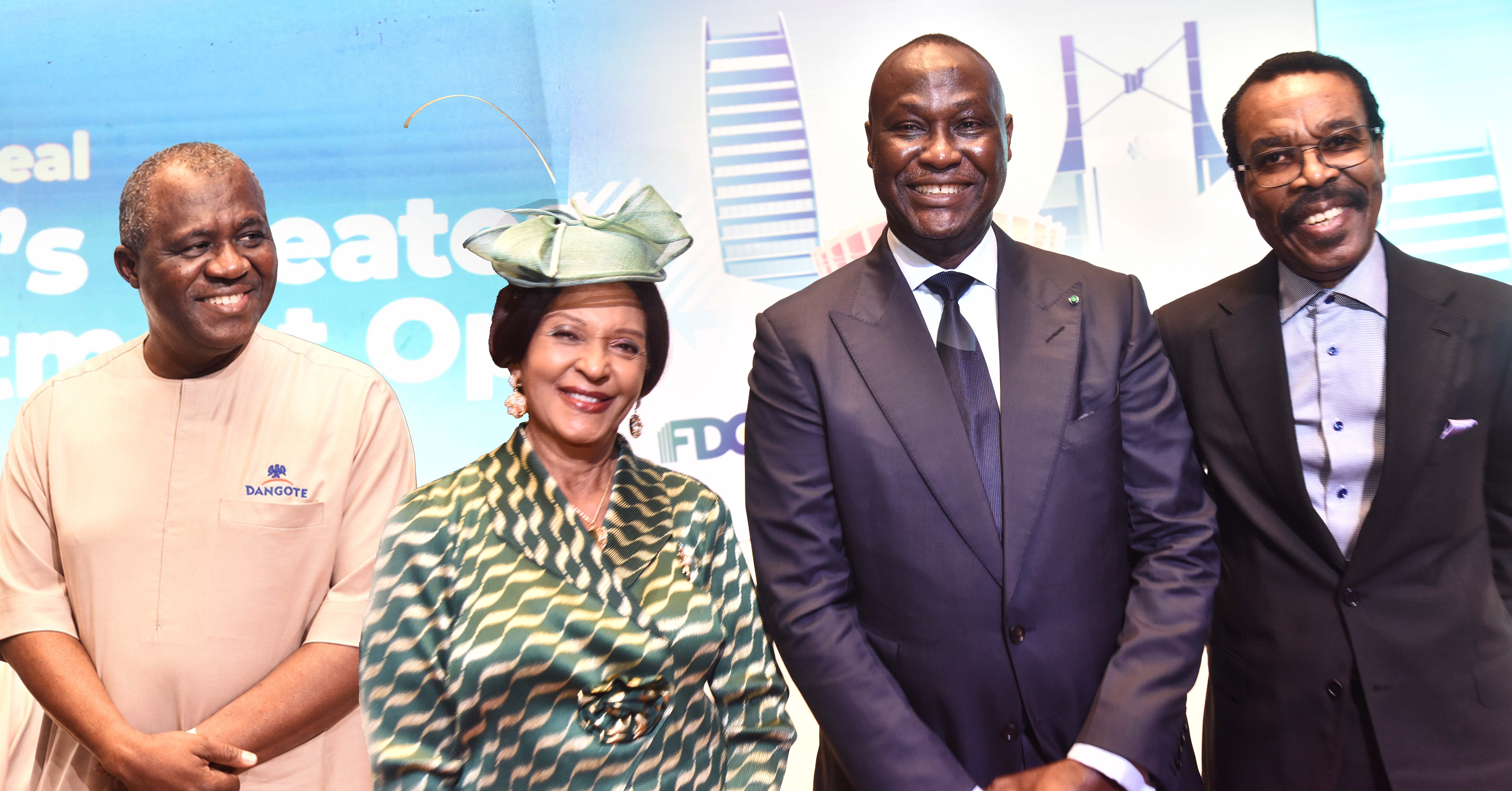
Photo Caption: From Left – Chief Economist, Dangote Industries Limited, Dr. Hassan Mahmud; Lady Maiden Alex-Ibru; Chairman of Occasion/Special Guest of Honour, Samaila Zubairu; Key Note Speaker Session 1, Bismarck Rewane; during the Real Deal: Africa’s Greatest Investment Opportunity, Sponsored by Dangote Industry Limited in Lagos on Thursday 3, September 2026.

Social media critic Martins Vincent Otse, popularly known as VeryDarkMan (VDM), has released what he described as his first piece of evidence after the Nigeria Police Force challenged him to substantiate his allegations that some police officers allegedly collaborate with kidnappers.
VDM released a video on his Instagram handle on Thursday, August 27, 2026, shortly after the police invited him to provide evidence supporting the claims he made at the 66th Annual General Conference of the Nigerian Bar Association (NBA) in Port Harcourt.
SEE MORE: ‘Provide Evidence’ — Police React to VDM’s Explosive Kidnap Allegation
The activist captioned the video: “My evidence number 1.”
Recalled that VDM, who was a panellist at the NBA conference on Tuesday, had alleged that some police officers manning checkpoints along major highways provide kidnappers and bandits with information about travellers.
According to him, the officers allegedly relay details about the identities and movements of travellers to criminal groups, thereby facilitating abductions for ransom.
The allegation triggered a response from the Nigeria Police Force, which denied the claim and challenged VDM to substantiate his allegations.
The police invitation came as the force sought evidence to support the serious claims made by the social media critic.
In response, VDM released the video, describing it as his “evidence number 1”, signalling that he may provide further material to support his allegations.
The development has continued to attract attention, with the controversy placing renewed focus on allegations of possible collaboration between security personnel and criminal groups involved in kidnapping and banditry.
A former Permanent Secretary of the Federal Civil Service Commission, Goke Adeboroye, has questioned how an alleged fake presidential agency was able to gain access to government facilities, budgetary provisions and office space without being detected.
Adeboroye spoke on Channels Television’s Inside Sources following the discovery of the alleged Presidential Foreign Intervention Promotion Council by the Independent Corrupt Practices and Other Related Offences Commission.
SEE MORE: $1m Extortion Scheme: Fake EFCC Officials Arrested In Plot Against Former NPA MD
The ICPC had said the purported agency had no legal basis and operated with forged appointment letters and other official documents.
The commission also said its alleged Director-General, Adeniyi Matthew, was never appointed by the Federal Government.
The anti-corruption agency further disclosed that its investigation into the PFIPC led to the discovery of the National Brands Development and Made in Nigeria Special Project Office, which it alleged was operating within the Office of the Secretary to the Government of the Federation without proper authorisation.
Reacting to the development, Adeboroye described the situation as a major failure of the government’s bureaucratic system.
“The exposure of that fake presidential agency is a major lapse to say that somebody can actually come into the system, get in on the budget, get offices, and all of that,” he said.
The former permanent secretary identified weaknesses in the bureaucratic structures supporting key offices in the Presidency, including the Office of the Secretary to the Government of the Federation, the Office of the Chief of Staff to the President and the Office of the Head of the Civil Service.
According to him, the bureaucracy in these offices should be strong enough to support the President’s policies while also ensuring that fraudulent or unlawful directives do not gain effect.
“The bureaucracy in those offices are not strong enough to be able to help the President drive the vision at the speed and with the efficiency that he wants,” Adeboroye said.
He also stressed the importance of having professional and experienced civil servants who can scrutinise directives issued by political office holders.
Adeboroye said civil servants should be able to recognise suspicious communications purportedly coming from the Presidency because they are familiar with the official channels through which presidential approvals are transmitted.
“Whether the person brings fake or whatever, you as the civil servant should be trained to be able to detect what should be a genuine communication from the State House. You work in that system,” he said.
He explained that presidential approvals usually pass through established channels involving senior government officials.
“When the President approves anything, he always minutes to about three people. He goes to the Chief of Staff, he goes to SGF, and if he has something to do with civil service, the Head of Service will have it.”
Adeboroye recalled an incident from his time as Permanent Secretary in the Ministry of Interior involving a former governor who claimed to have presidential approval for a diplomatic passport.
He said the then Comptroller-General of the Nigeria Immigration Service, Ude, cross-checked the purported approval before taking action and subsequently sought clarification on whether the former governor, who was no longer in office, should receive the diplomatic passport.
“That’s somebody using the experience of the system to ensure that you are not outplayed,” he said.
The former permanent secretary said similar verification could have been carried out in the alleged fake agency case through a simple phone call to the relevant government offices.
“So we would have expected that on a simple phone call, when I was working in the office of Ekaite, Secretary of Government, I could pick a phone, call any minister, call this, it’s just a phone call from the office of whoever to say, Chief of Staff, is this true? And that would have actually corrected it,” he said.
Meanwhile, the controversy surrounding the National Brands Development and Made in Nigeria Special Project Office has continued.
The chairman of the project office, Musa Aliyu, had alleged that the office was allocated space within the OSGF premises without presidential authorisation.
However, the National Coordinator and Executive Director of the project office, George Nwabueze, denied the allegation, insisting that the office is a project office under the OSGF and has existed for 16 years.
Nwabueze also produced an appointment letter purportedly issued by the OSGF, conveying approval of his appointment as National Coordinator/Executive Director of the Made in Nigeria Project Office.
The conflicting claims have continued to raise questions about the authorisation and status of the project office and the alleged involvement of public officials in its operations.






Dangote to Support Two Million Women with Refinery IPO Share Ownership

NGX Invest Expands Primary Market Access with WhatsApp Subscription Channel

Kainji–Birnin Kebbi Power Line: TCN Begins Final Phase of Restoration

2027 Polls: ‘Poor Funding Could Undermine Election Security, Logistics’ — INEC Chairman Warns

N4bn Compensation Dispute Threatens Ikot Abasi Power Project

Organised Labour Supports Workers’ Demand for N500 PMS Price, N500,000 Minimum Wage

Trump’s Family Unveils New Cryptocurrency Platform

Senate Denies Receiving Petitions Against Tinubu’s Ambassadorial Nominees

Dangote Cement Lights Up Benue Host Communities With CSR Initiatives

Reps Recommend 3-year Jail Term For Aviation minister

Tems Sets New Record On Billboard Hot 100 Chart
