
Energy
African Energy Bank Unveils $10bn Project for Nigeria, Angola, Libya

Africa is poised for a significant leap in oil and gas investment, as $10 billion in funding will be mobilised through the newly established African Energy Bank to support strategic energy projects across the continent.
This announcement was made by the Secretary General of the African Petroleum Producers’ Organisation, Farid Ghezali on Tuesday in Abuja, during the opening ceremony of the 9th Nigeria International Energy Summit 2026, which convened stakeholders from governments, regional petroleum organisations, and the private sector to chart a path for sustainable energy-led industrialisation.
He said the initial phase of this pan-African initiative will focus on Nigeria, Angola, and Libya, targeting key upstream, midstream, and downstream developments.
Ghezali highlighted the urgent need to mobilise capital and deepen regional cooperation, adding that the funding is expected to unlock stalled projects, attract global investors, and enhance regional energy self-sufficiency, providing a long-awaited solution to the continent’s chronic underinvestment in critical energy infrastructure
The fund, aimed at accelerating upstream, midstream, and downstream developments across the three countries, is expected to unlock stalled projects, enhance regional energy security, and create thousands of jobs.
He further called on investors, both local and international, to prepare for immediate opportunities, stressing that this initiative will provide structured financing, access to global capital markets, and support for projects with strong environmental, social, and governance frameworks.
“Allow me to present to you our phased growth. Phase 1 is the African Energy Bank platform with a $10 billion project involving Nigeria, Angola, and Libya, supported by APPO certification and major international oil companies such as Shell and Eni,” Ghezali said.
He added that Phase 2, set for 2027, will introduce a regional gas hub trading system, integrating the Congo Brassaville Declaration and promoting 50 per cent local content in projects. Phase 3, projected for 2030, will see the African Energy Bank mature into a $212 billion financial hub, supporting gas transition and energy transformation across the continent.
The APPO official said the fund is expected to begin rewriting the wrongs of decades of resource underutilisation, as the continent still exports about 70 per cent of its crude oil and 45 per cent of its natural gas, losing an estimated $15 billion annually in value that could be generated locally, particularly in midstream and downstream activities.
Ghezali explained that financing remains a major bottleneck, with borrowing costs in Africa ranging from 15–20 per cent, compared to just 4–6 per cent in Asia.
“Energy is, without a doubt, the engine of peace and prosperity. It lights our homes, powers our industries, creates jobs, and propels us into a brighter future. For Africa, which is rich in energy resources, the challenge is not only to extract, but to transform these resources into real shared wealth for our population.”
“Ladies and gentlemen, despite our immense potential, Africa is facing a paradoxical and frustrating reality. We are still exporting about 70 per cent of our crude oil and 45 per cent of our natural gas, losing $15bn per year in added value that we could generate locally, especially in the midstream and downstream segments. Financing remains the main bottleneck hindering the development of our strategic projects.
“More than 150 essential projects, from refineries to pipelines, such as the AKK pipeline, to gas infrastructure remain blocked. What for? Because the cost of financing in Africa is 15-20 per cent compared to only 4-6 per cent in Asia. This disparity is unacceptable and slows down our progress,” he added.
He stressed that fragmented energy financial ecosystems and isolated national oil companies have hindered progress, limiting the continent’s ability to attract large-scale capital.
“The African Energy Bank is our pragmatic solution,” Ghezali said. “It is not just a financial institution, it is a pan-African platform for equipment exchange, energy services, and innovative financing to support structured projects. It will unlock $200 billion for midstream and downstream initiatives by 2030, standardise regional pricing, generate 500,000 direct jobs, and connect certified projects to global sovereign wealth funds.”
Ghezali explained that the African Energy Bank, scheduled to launch in Abuja in the first half of 2026, is designed to address Africa’s long-standing energy financing challenges, including fragmented national oil company operations and the lack of a unified regional capital platform.
He highlighted the tangible benefits of the initiative, noting that the program will provide project financing, achieve regional savings of up to 30 per cent on import costs, create 500,000 direct jobs, and attract sovereign wealth from global investors.
“The African Energy Bank is much more than a financial institution. It is a pan-African platform for the exchange of equipment, energy services, and a catalyst for innovative financing to support structured energy projects,” he said. “It is time for Africa to produce what we consume and consume what we produce.”
Ghezali further explained that the bank will unlock immediate liquidity by listing shares of national energy companies and aims to raise $15 billion within three years.
The platform will also standardise regional pricing for oil and gas, giving member countries potential savings of $1.4 billion annually, and provide direct access to global capital markets, including sovereign wealth funds such as IDAA and BIA, alongside structured public-private partnerships.
“This initiative will help Africa capture value from midstream and downstream projects, strengthen regional cooperation, and position our continent as a hub for sustainable energy development,” he concluded.
On his part, Executive Secretary of the African Refiners & Distributors Association, Anibor Kragha, stressed the importance of building a resilient intra-African oil and gas industry to meet future energy demands.
“Africa must seize this opportunity to build a robust domestic industry that champions energy security. By refining more crude locally and processing natural gas within the continent, we strengthen regional trade, protect local currencies, and insulate our economies from global shocks,” Kragha said.
He cited Nigeria’s leadership in local refining and petrochemical initiatives, highlighting companies like the Dangote Petrochemical refinery and other modular refineries, which are driving innovation, regional trade, and industrial development.
Kragha also welcomed the African Energy Bank headquarters in Abuja and the bank’s financing distribution plan, noting it would catalyse investments in refineries, pipelines, LPG infrastructure, and downstream manufacturing.
“Our projects must meet critical success factors: effective regulatory frameworks, robust project preparation, clear ESG objectives, and strategic human capital development,” he said.
“As Muhammad Ali once said, ‘If your dreams don’t scare you, they aren’t big enough.’ Africa must aggressively pursue its goal of becoming a West African refinery hub, embracing emerging solutions like green hydrogen and second-generation biofuels.”
The African Energy Bank was conceived to overcome long-standing challenges in project financing, regulatory coordination, and regional energy integration.
By pooling capital, aligning policy frameworks, and providing direct access to investors, the bank aims to reduce import dependency, strengthen energy security, and stimulate industrialisation across member countries.
The launch of the bank aligns with Africa’s projected energy demand growth, particularly in Nigeria, which will become the world’s third-largest population by 2050. Regional energy infrastructure such as the AKK pipeline, OB3, and other gas networks will serve as the backbone for industrial development, creating economic multipliers through refining, petrochemicals, and domestic energy access.
The APPO and ARDA emphasised that the African Energy Bank will also support energy transition projects, including low-carbon fuels for shipping and aviation, helping Africa align with global emission reduction targets by 2050.
PUNCH







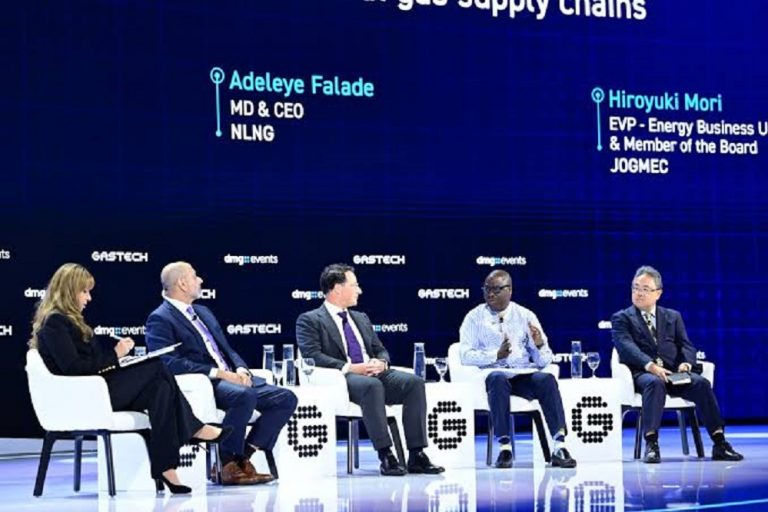
Gas producers must stop treating methane reduction as an environmental cost, because methane released into the atmosphere represents lost gas, lost revenue and lost energy that could otherwise be recovered and sold.
The Managing Director and Chief Executive Officer of Nigeria LNG Limited (NLNG) Adeleye Falade, made the declaration during a panel titled “Capturing the Lost Opportunity: Driving Global Alignment on Methane Abatement Across Natural Gas Supply Chains,” at the Gastech 2026 Exhibition and Conference in Bangkok, Thailand.
READ ALSO: Spike in Petrol Price Moves NLC to Demands Emergency Palliatives
Taking from the company’s experience, he highlighted that investments in methane abatement could pay for themselves while improving plant efficiency and asset reliability.
The NLNG CEO said the commercial value of recovering lost gas should become a central part of the global industry’s approach to methane management.
“Every tonne emitted is lost product, lost revenue and lost energy; gas we could have sold. Every molecule of methane avoided is both an emissions reduction and a recovered energy resource.”
According to him, the NLNG’s new boil-off gas compressor and start-up gas recovery project demonstrate the business case for methane reduction, with each project expected to deliver methane reductions of about 10–15 percent while also recording positive projected net present values. “The most compelling business case is the simplest one: the projects that cut our methane also pay for themselves.
“The same discipline that reduces methane also improves asset reliability and plant efficiency. The returns show up in more places than the emissions ledger,” Falade said.
He added that the starting point for methane abatement was credible measurement of gas losses, which enables companies to identify where methane is being lost, channel investment towards the right interventions and independently verify the results.
According to Falade, the NLNG had demonstrated that producers in developing economies could meet globally recognised standards for emissions measurement and reporting, despite infrastructure and other constraints.
He disclosed that the NLNG had achieved Gold Standard recognition under the Oil and Gas Methane Partnership (OGMP) 2.0 and became the first company in Africa to attain Level 5 methane emissions reporting.
Its measurement, reporting and verification system is independently assured by DNV in line with ISO 14064.
The NLNG’s methane-management programme includes site-wide optical gas imaging, a structured Leak Detection and Repair programme, as well as phased deployment of continuous monitoring and real-time emissions dashboards across its plant and vessels.
Falade said methane reduction was also being incorporated into the design of Train 7, which is expected to raise the NLNG’s LNG production capacity from 22 million tonnes per annum to 30 million tonnes.
The commercial case for emissions abatement was not new to Nigeria, he added, pointing to the NLNG’s longstanding role in converting gas that would otherwise have been flared into a marketable product.
According to him, the company’s activities have contributed to reducing Nigeria’s gas-flaring rate from above 65 percent to below 20 percent.
Beyond its own operations, Falade revealed that the NLNG was extending methane-management requirements across its supply chain through its Scope 3 Advocacy Plan.
The company engages feed-gas suppliers and contractors to measure, disclose and reduce emissions, while verified upstream emissions data and emissions-related criteria are incorporated into supplier selection and evaluation.
Falade also called for greater consistency in methane measurement and reporting requirements across jurisdictions, arguing that divergent standards make enforcement uneven and complicate meaningful comparisons between producers.
“The industry does not need weaker standards; it needs stronger, shared ones backed by real measurement,” he said.
On the tension between emissions reduction, energy access and affordability, Falade said developing economies should not be forced to choose between economic development and climate action.
“Developing economies cannot be asked to choose between economic development and emissions reduction. Both must progress together,” he said.
Other panellists were Zubin Bamji of the World Bank, Niels Dijksman of Brunei LNG and Hiroyuki Mori of JOGMEC.
The session was moderated by energy economist Dr Carole Nakhle of Crystol Energy.
Expectations are high that the $10 billion Train 7 project of the Nigeria Liquefied Natural Gas Limited (NLNG) would go into operation by the end of 2027.
Managing Director of NLNG, Adeleye Falade, made the disclosure on the side-lines of the Gastech conference, yesterday, in Bangkok, Reuters reported.
This is part of a grand strategy by the company to raise production and address persistent gas supply constraints.
READ ALSO: Banks Caution Against Scammers over Dangote IPO
Train 7 project, located on Bonny Island, Rivers State, is expected to increase NLNG’s production capacity to 30 million metric tonnes per annum (mtpa), from the current 22 mtpa.
The project has suffered repeated delays, including disruptions associated with the COVID-19 pandemic and the Russia-Ukraine war.
Falade also disclosed that NLNG remained under a force majeure declared in 2022 following widespread flooding that disrupted gas supplies to the company.
According to him, the company would lift the force majeure when it reaches a 90 per cent utilisation rate, with the plant currently operating at between 82 per cent and 83 per cent.
“We still have a delta of about 15 per cent that we need to close,” Falade said. “Operationally, we are able to do that, but our biggest constraint is gas supply, and we’re working with all the relevant people, including the government, to be able to get more gas to flow into the plant,” he added.
He said NLNG was focused on meeting its existing contractual obligations to buyers while the company worked to increase production.
Falade added that interest in additional LNG volumes and spot cargoes had increased after exports through the Strait of Hormuz were curtailed by the Iran war.
“People are looking at more diversified, reliable sources of supply,” he said.
“Our priority currently is to continue to make sure that we fulfil our obligations to our existing customers and maximize as much production opportunity as possible that we have,” he added.
The NLNG is majority-owned by the Nigerian National Petroleum Company Limited (NNPC Ltd), while Shell, TotalEnergies and Eni are its international partners.
Public concerns that the introduction of smart and self-service filling stations would lead to job losses in the downstream petroleum sector have been dismissed by the Nigerian National Petroleum Company Limited (NNPC Ltd).
According to the state oil major, the deployment of automated stations was part of efforts to improve efficiency and customer experience. It added that the technology would create new opportunities rather than simply eliminate existing jobs.
The NNPC Ltd also disclosed plans to transform about 900 of its existing retail outlets across the country into modern energy hubs, as it adapts its retail business to changing consumer needs and developments in the downstream sector.
READ ALSO: FHC Hands 10 Years Sentence to Nine Oil Thieves in Akwa Ibom
The disclosures were made in Abuja, during the commissioning of a 24-hour smart, self-service filling station at the headquarters of the Nigeria Immigration Service (NIS).
The Executive Director, Retail Operations and Mobility, NNPC Retail Limited, Shettima Kukawa, said the new model was designed to provide customers with faster, more convenient and technology-driven services.
Kukawa added that the transformation of the company’s retail outlets was not about simply replacing workers with machines, but about creating a modern retail environment capable of providing more services to customers.
He explained that the smart station allows motorists to purchase fuel through the NNPC fuel app, fund their digital wallets and dispense the exact quantity of fuel they have paid for using a self-service code.
The station has a storage capacity of 180,000 litres of Premium Motor Spirit (PMS) and 45,000 litres of Automotive Gas Oil (AGO), with 16 PMS pumps and two AGO pumps.
It also has a six-point electric vehicle (EV) charging facility and is primarily powered by a solar system with more than 200kWh capacity.
Managing Director, NNPC Retail Limited, Hubb Stokman, said the downstream industry was undergoing significant changes following fuel deregulation and the commencement of operations at the Dangote Refinery.
Stokman said consumers were also demanding more services at filling stations, pointing out that the traditional fuel-only model was no longer sufficient to meet their expectations.
“Today shows that the downstream industry is changing after the fuel deregulation and also the start-up of the Dangote Refinery. Our industry is rapidly changing, and I think that more than ever, we need to meet the needs of the Nigerian consumer and their wishes.
“They want to see more services, like a fast food restaurant, convenience shop, maybe a coffee shop, banks. They would like to have a lounge or car wash. All these things that you will see here,” he said.
Also speaking, the Executive Vice President, Downstream, NNPC Limited, Dr Mumuni Dagazau, said the company was moving beyond the traditional concept of a filling station by integrating technology and alternative energy solutions into its retail network.
He said the development represented the type of modern retail infrastructure that should be replicated across the country, stressing that Nigerians deserved improved quality and service.
“Our objective at NNPC is not simply to provide fuel, it is to provide reliable energy solutions and a better retail experience supported by technology and innovation.
“We deserve these sort of stations throughout this country. We need to move away from where we have been and deliver this sort of quality and the service to our people in the community,” Dagazau said.
On his part, the Comptroller-General of Nigeria Immigration Service, Kemi Nandap, commended NNPC Limited for integrating EV charging with conventional fuelling.
Represented by Saidu Daura, the Deputy Comptroller-General, Nandap said the development aligned with global trends in energy transition, climate action and smart mobility, describing it as a practical step towards a cleaner, more sustainable and technology-driven economy.
She said the shift to technologies such as electric mobility could create opportunities for investment, employment, skills transfer and industrial growth.
“Today’s commissioning goes beyond the opening of a service station. It is a statement of confidence in Nigeria’s future and a contribution to building a resilient, green, and technologically advanced nation,” she said.
Nandap called for stronger collaboration between government institutions, the private sector and other stakeholders to promote sustainable development and national progress.
The station operates round-the-clock and includes automated services designed to reduce waiting time and give motorists greater control over their transactions.






Terror Threats: Osun Establishes Joint Security Task Force

Shettima Arrives Yola to Condole With Bamanga Tukur’s Family

Middle East Crises Pump Fuel Prices Upwards with Attacks on Iran, Saudi Arabia
NCDMB Book Reading Features Nwabuikwu

Gas Industry Must Commercialise Methane – NLNG

2027: South Should Complete 8 Years Before North Takes Over — Shehu Sani

Trump’s Family Unveils New Cryptocurrency Platform

Senate Denies Receiving Petitions Against Tinubu’s Ambassadorial Nominees

Dangote Cement Lights Up Benue Host Communities With CSR Initiatives

Reps Recommend 3-year Jail Term For Aviation minister

Tems Sets New Record On Billboard Hot 100 Chart