
NEWS
BREAKING: Presidency Accuses The Guardian Of Clamouring For Coup D’etat

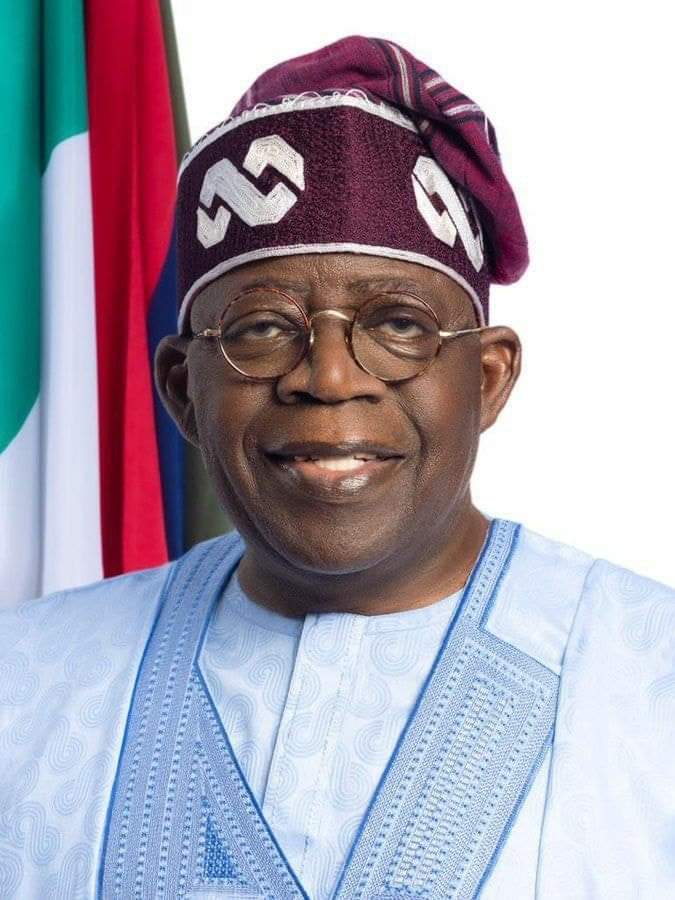
The President has accused The Guardian of deviating from ‘responsible reporting’ and openly advocating for a ‘regime change under the guise of journalism’.
This was contained in a statehouse statement issued in Abuja on Saturday by the Special Adviser to the President, (Information and Strategy), Bayo Onanuga.
Under the subject, RE: “MISERY, HARSH POLICIES DRIVING NIGERIANS TO DESPERATE CHOICES” – OPEN LETTER TO THE GUARDIAN, he asserted that newspaper had delved into inciting public ‘unrest against President Bola Tinubu’s administration’ in the lead story published in its Friday October 25, 2024 edition.
ALSO READ: Ghana’s Foreign Minister Named Commonwealth Secretary-General Amid Heated Reparations Debate
Onanuga wrote, “The Guardian newspaper’s lead story of Friday, October 25, 2024 with the title: “Calls for military intervention: misery, harsh policies driving Nigerians to desperate choices,” openly incites unrest against President Bola Tinubu’s administration and advocates regime change under the guise of journalism. The inflammatory headline and content deviate from responsible reporting.
“The Guardian’s agenda is unmistakable from the cover illustration to the article. In attempting to create a balanced veneer, the author condemns military rule while fanning the flames of military intervention.
“This is evident in the introduction to the article where the newspaper wrote: “Nigerians were exhilarated with the return of democracy in 1999, but 25 years on, the buccaneering nature of politicians, their penchant for poor service delivery, morbid hatred for probity, accountability, and credible/transparent elections, among others, are forcing some flustered citizens to make extreme choices, including calling for military intervention in governance. .. Deep despondency permeates every facet of the polity consequent upon soaring cost of living. And while the political elite splurge on fine wines and exotic automobiles amid poor service delivery, calls for regime change could become more strident in the days ahead even though military insurrection holds no solution to the country’s woes.”
“We must question how The Guardian can present an argument for military intervention while superficially denouncing it unless it harbours a deliberate agenda.
“This latest editorial reflects a troubling trend in which the publication has persistently propagated inflammatory and negative narratives, stepping dangerously close to undermining the very fabric of responsible journalism.
“Moreover, the lead story relies heavily upon emotive language and imagery—such as an illustration of military armoured tank—to bolster its argument while neglecting to present a balanced view.
“It indulges in lampooning the current administration while ignoring positive developments in Nigeria’s economic landscape. The report lacks empirical data and fails to exhibit the journalistic rigour that the situation demands.
“It appears lost on The Guardian that such narratives could embolden anarchists intent on disrupting our democratic process.
Military rule is an anachronism in modern civilisations, irrespective of its framing, due to the oppressive nature typically associated with its practice. Guided by its experience in 1984, when two of its journalists were jailed by the military regime for reporting the truth, The Guardian acknowledges that military rule is terrible.
“Yet, it attempts to provoke public ire against President Tinubu by suggesting he governs with less regard for citizens than military dictators once did.
“This narrative neglects the hard-fought battle that birthed our democracy and serves only to undermine the hard-won freedoms that Nigerians now enjoy.
“Good journalism is characterised by restraint and a commitment to national interest. Media outlets must propagate responsible reporting that contributes to an informed citizenry.
“During times of political and economic crises, the media, as a force for good, should rally the public around their leaders, fostering unity and patience as reforms are introduced.
“President Tinubu has consistently called for understanding and patience amid our nation’s challenges. This plea is not a sign of weakness but an affirmation of his dedication to a brighter future for Nigeria.
“Moreover, recent policy changes have initiated a turnaround, yielding positive economic indicators.
“According to the Minister of Finance and Coordinating Minister of the Economy, Wale Edun, the revenue-to-debt service ratio has notably declined from 97% in 2023 to 68% in 2024.
“Nigeria’s foreign reserves rose to $39.1 billion on October 22, with GDP growth achieving 2.98% in Q1 2024—an increase from 2.31% in Q1 2023.
“This growth was driven by sectors beyond oil, including the financial services sector, mining, and quarrying, marking a significant shift in our economic structure.
“We are now exporting more than we are importing, with trade surpluses recorded in two consecutive quarters.
“In the light of the positive developments, it is unacceptable for any publication, including The Guardian, to incite calls for military intervention based on transient difficulties.
“A more cautious and responsible approach would have better served its readers and the nation.
“Journalism—like our democracy—thrives on fairness and objectivity, and all media outlets must uphold these standards.
“We encourage The Guardian and similar platforms to prioritise balanced reporting that fosters dialogue and understanding rather than division and unrest.
“At this time, we need our people and the media to rally around the government as the Tinubu-led administration steers our country through this challenging period to a better future.”





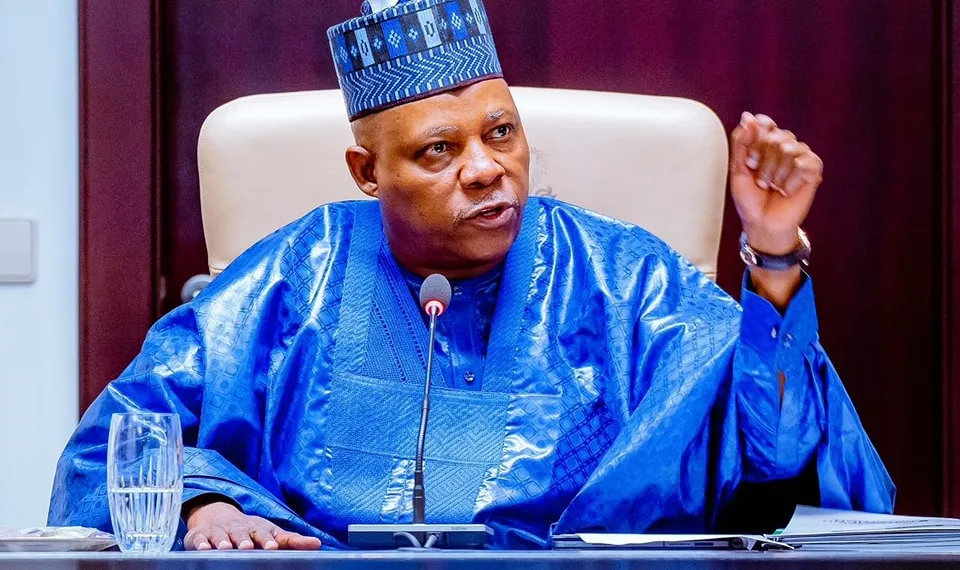
Vice President Kashim Shettima has urged Nigerians to celebrate President Bola Tinubu, saying his leadership saved the country from a potential implosion.
Shettima said Nigeria’s economy had been teetering on the edge of collapse before Tinubu’s intervention, adding that the country could have faced a different situation.
“The economy was teetering on the edge of collapse, we were on a cliff edge,” the Vice President said.
ALSO READ: Subsidy Removal, FX Reforms Driving Fresh Oil Sector Investment – Shettima
“So he literally saved the nation from an implosion. That could have been the scenario. So, instead of demonizing him, Nigerians ought to celebrate this poor man.”
Shettima also called for a return to the drawing board, expressing confidence in the leadership’s commitment and the prospects for the 2027 elections.
“I believe on the bottom of my heart that with this presentation I have seen, and with the commitment of our leadership, by the grace of God, we are going to win,” he said.
Speaking about the 2027 elections, the Vice President reminded his audience that social media platforms should not be mistaken for actual polling stations.
“There are no polling stations on Facebook or Instagram,” he said.
Shettima also expressed gratitude for the efforts made towards promoting the cause of the 2027 elections.

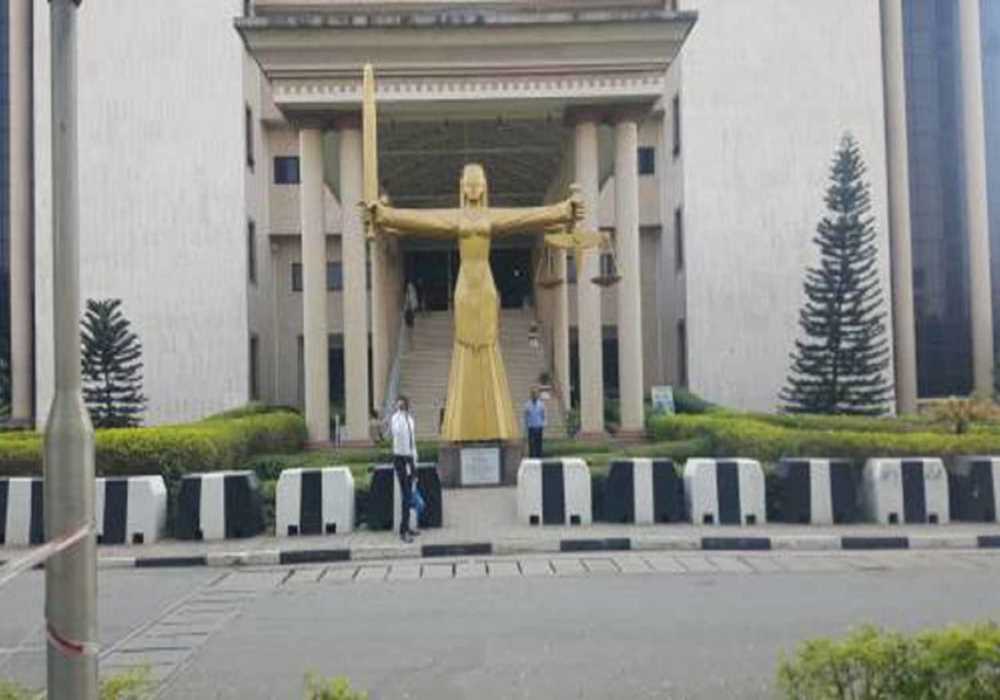
Following observed mis-steps, the Federal Government of Nigeria has withdrawn the eight-count criminal charge brought against the alleged fake Director General (DG) of the Presidential Foreign Intervention Promotion Council (PFIPC), Adeniyi Adeyemi.
Biztellers reports that the matter, in accordance with the counsel of the Attorney General of the Federation (AGF) and Minister of Justice, Prince Lateef Olasunkanmi Fagbemi, (SAN), the matter will be filed at the High Court of the Federal Capital Territory (FCT), instead of the Federal High Court (FHC).
Consequently, upon an unopposed application for termination by the prosecution counsel and Director of the Public Prosecution of the Federation (DPPF), Rotimi Oyedepo (SAN), on Monday, Justice Mohammed Umar of a Federal High Court, Abuja on Monday, struck out the matter.
READ ALSO: Shell Identifies Keys to Nigeria’s Energy Future
In a motion for the termination of the charges, Oyedepo informed the court that the Attorney General of the Federation (AGF) and Minister of Justice has carried out a review of the case file of Adeyemi and the charge filed by the Inspector General of Police (IGP) and found some loopholes.
The DPPF added that the documents allegedly forged by Adeyemi during his operations of the fake agency are those that can be prosecuted by the High Court of the Federal Capital Territory (FCT).
He also informed the court that a new charge has been filed at the High Court of the FCT and that Adeyemi would be expeditiously arraigned afresh.
He therefore urged the judge to strike out the charge as required by law.
Following no objections from Ibrahim Angulu (SAN), who stood in for Adeyemi, Justice Umar subsequently terminated the charge.
Adeniyi, 38, was being tried alongside two others whose whereabouts are unknown, on charges bordering on conspiracy and forgery.
The two others said to be at large were identified as Femi (surname unknown) and Anu (surname unknown).
The charge marked: FHC/ABJ/CR/25/2025, was entered against the defendant by the DPPF.

To secure a bright energy for her teeming population, Nigeria must sustain the momentum of reform, accelerate investment, and deepen partnerships.
This view was expressed by Managing Director, Shell Nigeria Exploration and Production Company of Nigeria Limited (SNEPCo) Ronald Adams in Lagos at the weekend.
Delivering a keynote address at the Africa Energy Conference (AEC) of the Lagos Business School (LBS), Adams called for regulatory certainty through efficient execution of reforms, sustained investment appeal to enable projects to move more swiftly from opportunity to production and partnership by operators, regulators, NNPC Limited and communities to unlock the full value of Nigeria’s resources.
Adams cited Nigeria’s huge oil and gas resources as an advantage but pointed out: “Resources alone do not guarantee prosperity. Prosperity comes when resources are matched with investment, technology, sound policy and disciplined execution. Success will be determined not by the size of our resources, but by our ability to convert them into investment and economic growth.”
Adams pledged the support of Shell towards a bright energy future of Nigerians. He said: “For more than six decades, Shell has been part of Nigeria’s energy journey. Together with our partners, we have helped develop major energy infrastructure, supported Nigerian businesses, invested in talent, and contributed to economic development. Bonga remains a powerful example of what technology, partnership and Nigerian capability can achieve in deepwater operations. Today, that story continues through Bonga North.”
READ ALSO: ADF Targets 5 Million Students, 2 Million Vulnerable Women
Issuing a clarion call for action by all stakeholders, he added: “The world is not standing still. Capital is moving, technology is advancing and competition is intensifying. The countries that attract investment tomorrow are those that improve competitiveness today. Nigeria has begun that journey. Our task is to sustain the momentum and translate reform into projects, projects into growth, and growth into shared prosperity.”
The conference, the 4th in the series had at its theme; “Securing Nigeria’s Energy Future: Policy Reform, Capital Mobilisation, and Pathways to a Sustainable Power and Energy Market” and was attended by top government officials, industry captains, energy professionals, and students.
Lagos State Deputy Governor Obafemi Hamzat represented Lagos State Governor Babajide Sanwo-Olu as the guest of honour. SNEPCo was a principal sponsor of the Africa Energy Conference (AEC) and mounted a well-received exhibition on its deepwater operations and social investments across Nigeria.






Small Investors Take Centre Stage as Dangote IPO Nears Close
Sahara Champions Global Shipping Collaboration for $20m Mercy Ships Healthcare Impact

30 Nigerians Bag Postgraduate Scholarship from NNPC Ltd, Eni

2027: ‘Algorithms Will Not Decide Election Results’, INEC Chairman Declares

Navy Recovers 98,000 Litres of Suspected Stolen Crude in Rivers

DPRP’s Appeal Against Fuel Import Licence Ruling Earns Stakeholder Backing

Trump’s Family Unveils New Cryptocurrency Platform

Senate Denies Receiving Petitions Against Tinubu’s Ambassadorial Nominees

Dangote Cement Lights Up Benue Host Communities With CSR Initiatives

Reps Recommend 3-year Jail Term For Aviation minister

Tems Sets New Record On Billboard Hot 100 Chart
