
Business
Dangote to Deliver $16bn East Africa Refinery in 40 Months

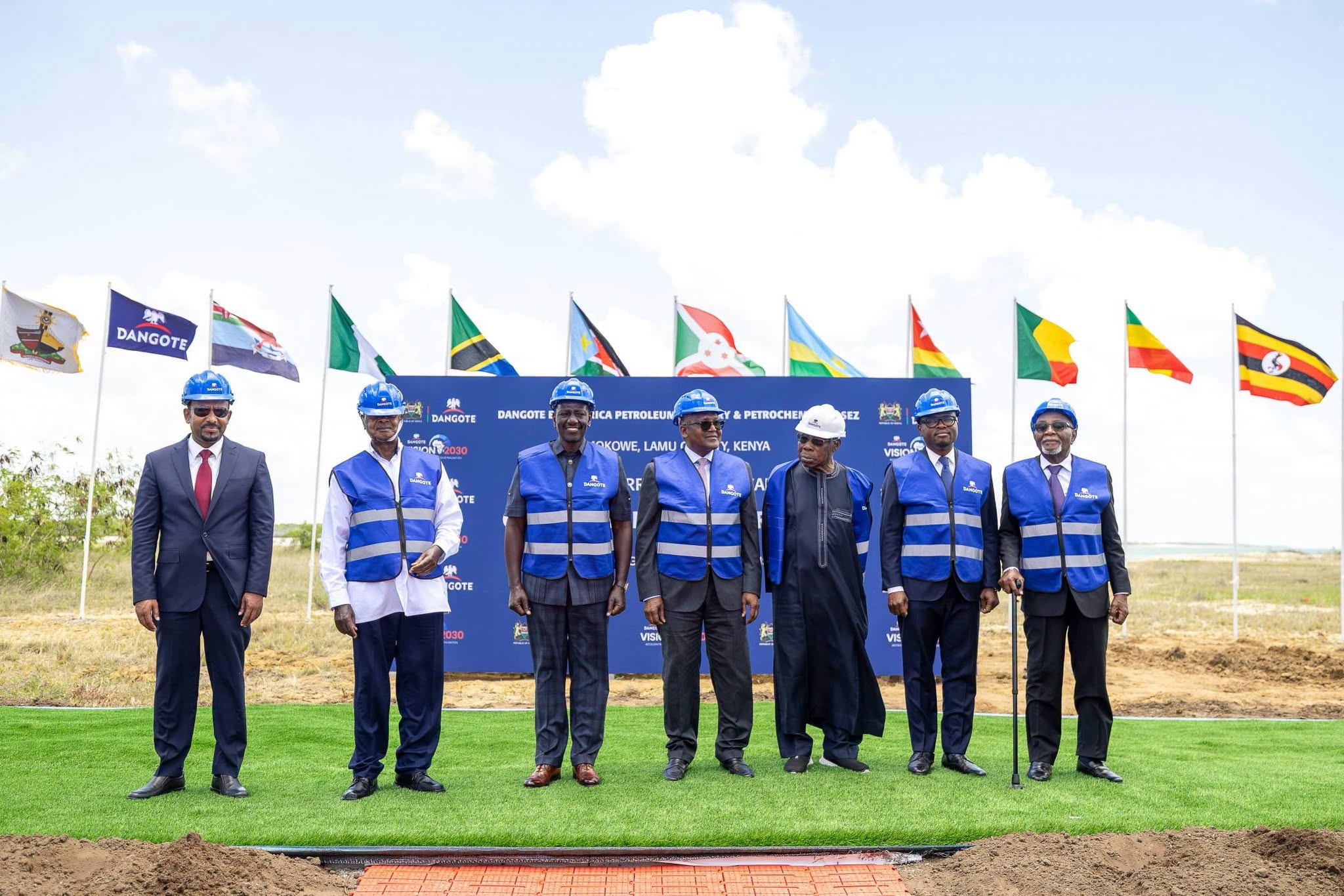
Africa’s drive for industrial self reliance received a major boost on Wednesday as Kenya President William Ruto and President/Chief Executive, Dangote Industries Limited, Aliko Dangote, joined African leaders to break ground on a $16 billion petroleum refinery and petrochemicals complex in Lamu, Kenya.
Biztellers reports that the industrial complex is designed to process 700,000 barrels of crude oil per day and serve markets across Eastern Africa.
Dangote announced that the $16 billion Dangote East Africa Petroleum Refinery & Petrochemicals in Lamu, Kenya, will be delivered within 40 months, with an ambitious local content programme that will provide jobs for qualified Lamu graduates and train more than 1,000 young people from the county. Dangote also disclosed that 30 per cent equity in the 700,000 barrels per day refinery is being offered to East African countries, opening the landmark project to regional ownership as part of a broader strategy to strengthen energy security and retain more of Africa’s wealth within the continent.
READ ALSO: Nigeria @ 66: Chevron Reaffirms Commitment to Partnership with Nigeria
Dangote said the project would be executed at speed, assuring the gathering that the refinery would be completed within 40 months. He said the company had already begun mobilising equipment and technical resources for the project and would draw extensively from lessons learnt in delivering the Dangote Petroleum Refinery in Lagos. According to him, the Kenyan refinery would be one of the fastest major projects undertaken by the Group, as the company seeks to demonstrate that African businesses can execute complex industrial projects at globally competitive scale and speed.
Dangote placed local participation at the heart of the project, announcing that qualified graduates from Lamu would be offered opportunities to work on the development, while more than 1,000 young people from the host communities would receive technical and vocational training to prepare them for jobs within the refinery and its emerging industrial ecosystem. The Group will establish a training school to develop the technical skills required by the refinery, with emphasis on equipping local young people to participate directly in construction and subsequent operations. Dangote said the objective was to ensure that the economic footprint of the investment extended well beyond the refinery.
“We want young Kenyans and East Africans with skills here. We want local businesses to become suppliers. We want entrepreneurs around this project,” he said. “For me, the true measure of this project will not be the height of these towers or the number of barrels it processes.”
Instead, he said its success would also be measured by young Kenyans acquiring engineering and technical skills, local entrepreneurs building businesses around the investment and communities enjoying improved livelihoods. “Industrialisation must have a human face. It must create dignity. It must create jobs. It must create opportunities. It must create hope,” Dangote said.
President Ruto put the cost of the development at $16 billion, or about KSh2 trillion, describing it as a “generational undertaking” designed to serve not only Kenya but the wider Eastern African region. The project is designed to process about 700,000 barrels of crude oil daily and generate up to 1,000 megawatts of electricity. It will also include polypropylene and base oil production as part of an integrated refining and petrochemicals complex.
Ruto reinforced the employment commitment, saying current projections envisage about 60,000 direct and indirect jobs from the development. The President directed technical and vocational institutions and universities to prepare welders, technicians, engineers and managers for the opportunities, insisting that young people from Lamu and neighbouring communities must be given a fair opportunity to compete for the jobs. Ruto said the construction phase alone was expected to inject more than KSh2 billion monthly in wages into the economy, with the money circulating through shops, hotels, restaurants, transport, housing and other businesses.
In another significant move towards regional economic integration, Dangote disclosed that 30 per cent of the refinery’s equity would be made available to East African countries, allowing governments in the region to participate in the ownership and future value created by the project. He said Kenya and Rwanda had already moved quickly to take advantage of the opportunity. The ownership model fits into Dangote’s broader argument that African countries and investors should not merely host major industrial projects but should increasingly participate in their ownership and prosperity. Dangote said the refinery had been designed as a regional asset serving Kenya, Uganda, Rwanda, Tanzania, Ethiopia, South Sudan, the Democratic Republic of Congo and other markets.
“This refinery is therefore not simply about one country. It is about a region,” he said.
The industrialist said Africa could no longer afford an economic model under which crude oil, minerals and agricultural commodities were exported while the continent imported the finished products derived from them.
“Africa cannot build lasting prosperity by exporting what it has and importing what it needs,” he said. “We must refine more of what we produce. We must process more of what we produce. We must retain more value here at home in Africa.”
The Governor of Lamu County, Issa Timamy also used the groundbreaking to condemn attempts to stop the project through litigation, describing those behind the move as working against an investment capable of transforming the economic fortunes of the county. Addressing residents partly in Swahili, the Governor said those who had gone to court against the development did not represent the aspirations of the people of Lamu.
He argued that opponents of the project were seeking to frustrate an investment that could provide opportunities for thousands of young people and insisted that residents would not allow the county’s development prospects to be undermined.
The Governor maintained that the project would go ahead and be completed, while calling on young people and businesses in the county to prepare themselves for the opportunities that would accompany the investment. He said Lamu had for too long been rich in history, culture and natural resources but left behind in the march of development, adding that the refinery offered the county an opportunity to become a major investment and industrial destination.
He nevertheless stressed the importance of protecting Lamu’s mangroves, fishing grounds, coastline and cultural heritage, calling for responsible development that would allow industrialisation and environmental protection to coexist.
Former Nigerian President Olusegun Obasanjo led other African leaders in celebrating Dangote’s emergence as one of the continent’s leading champions of industrialisation, recalling his evolution from trading and importation into large scale manufacturing. Obasanjo said the transformation demonstrated the importance of African governments creating the right environment for indigenous entrepreneurs to invest, manufacture and compete at scale. For the former President, the Lamu investment represented a further expansion of that industrialisation philosophy from West Africa into East Africa.
Obasanjo said he was particularly pleased to witness the project because of its potential to deepen economic integration between the two regions and demonstrate what African entrepreneurship, supported by purposeful political leadership, could accomplish.
Ugandan President Yoweri Museveni said Africa could not continue exporting raw materials while surrendering the jobs and wealth associated with processing them elsewhere. He backed the regional ownership proposal, describing the opportunity for East African countries to acquire equity in the refinery as a smart approach to ensuring that the region participated not merely as a market but also as an owner.
Prime Minister of Ethiopia, Abiy Ahmed, said the refinery would strengthen East Africa’s energy security and reduce its vulnerability to disruptions in global petroleum markets. He said Dangote’s record in cement, fertiliser and petroleum refining had demonstrated that African industrial enterprises could operate at global scale. “East Africa is not only a market. It is a place to produce, to build and to create value,” Abiy said.
Photo Caption: From Left – Prime Minister of Ethiopia, Abiy Ahmed; President of Uganda, Yoweri Museveni; President of Kenya, William Ruto; President/Chief Executive, Dangote Industries Limited, Aliko Dangote; former President of Nigeria, Olusegun Obasanjo; President of Benin Republic, Romuald Wadagni; and President of Togo, Jean Lucien Savi de Tové, during the groundbreaking ceremony of the Dangote East Africa Petroleum Refinery & Petrochemicals SEZ in Mokowe, Lamu County, Kenya, on Wednesday, September 30, 2026





Chevron Nigeria won the second-best exhibitor award at the just-concluded 2026 Nigerian Association of Petroleum Explorationists (NAPE) conference and exhibition at Eko Hotels and Suites, Victoria Island, Lagos.
Biztellers reports that Olajumoke Cecilia Ajayi, FNAPE, NAPE President (2025–2026) and Managing Director/CEO of Ingentia Energies Limited, presented the award to Chevron, during the awards dinner on November 12, 2026.
The award is in recognition of Chevron’s outstanding exhibition, where visitors to its booth, particularly students, took part in Geology/Geophysics presentations and quizzes, word games, and Human Resources/Nigerian Content presentations and quizzes, with gifts for winners and participants.
Commenting on the award, the leader of the Chevron’s exhibition team, Dr. Victor Anyaegbudike, Manager Communications, Chevron companies in Nigeria and the Mid Africa Region, commended NAPE for its commitment to hosting the annual conference and exhibition. He noted that Chevron has operated in Nigeria for over 60 years, contributing to the country’s growth and development and making human investments that yield long-term, transformative returns.
READ ALSO: Tinubu, Shettima Head to Jos for APC Presidential Campaign Rally
“At Chevron Nigeria, we drive innovation and investment to open up opportunities for growth, jobs, productivity and lasting value. Forums like the NAPE conference and exhibition matter because they bring government, academia, students and industry together around shared goals and a better understanding of one another,” he remarked.
Victor noted that Chevron is committed to building productive, collaborative and mutually beneficial relationships, grounded in trust, with governments, partners, customers, communities and employees. “We believe that affordable, reliable and ever-cleaner energy is vital to a more prosperous and sustainable world,” he said.
Attendees at the NAPE conference and exhibition included representatives of the Federal Government of Nigeria, industry regulators, industry leaders, academics, and students from tertiary institutions across the country.

The Nigerian Exchange Limited (NGX) recorded a 1.36 per cent weekly gain as its market capitalisation increased to ₦163.80 trillion at the close of trading on Friday, November 13, 2026.
The NGX All-Share Index (ASI) rose to 252,269.16 points, pushing the market’s year-to-date return to 62.11 per cent.
The performance reflected a positive trading week for the equities market, with 43 listed companies recording price appreciation, compared with 29 in the previous week.
SEE MORE:NGX Market Cap Falls to ₦163.65trn As All-Share Index Drops
According to the Exchange’s weekly market report, investors traded 8.03 billion shares valued at ₦185.36 billion in 160,836 deals during the week.
This represented a significant increase in trading volume from the 2.83 billion shares exchanged in 192,158 deals in the preceding week, although the total value of transactions declined from ₦208.41 billion.
The Financial Services Industry dominated trading activities, accounting for 4.85 billion shares worth ₦95.79 billion. This represented 60.45 per cent of the total equity turnover volume and 51.68 per cent of turnover value.
The Agriculture Industry followed with 2.24 billion shares valued at ₦22.78 billion, while the Consumer Goods Industry recorded 260.99 million shares worth ₦11.89 billion.
Further details of the market performance showed that 39 equities declined during the week, compared with 57 in the previous week, while 64 equities closed unchanged against 60 recorded in the preceding period.
On the gainers’ chart, Champion Breweries Plc emerged as the best-performing stock, appreciating by 27.27 per cent, while LivingTrust Mortgage Bank Plc recorded the biggest loss, declining by 18.53 per cent.
Meanwhile, trading in Exchange-Traded Products (ETPs) stood at 1.21 million units valued at ₦278.97 million in 3,351 deals, compared with 1.46 million units worth ₦381.82 million in 4,085 deals in the previous week.
The fixed-income segment recorded 156,612 units valued at ₦177.88 million in 41 deals, against 21.99 million units worth ₦20.60 billion in 48 deals recorded in the preceding week.
The Exchange also recorded the listing of two commercial paper instruments issued by Thrive Agric Limited.
The instruments comprised ₦3.17 billion Series 1 (Tranche A) and ₦2.09 billion Series 1 (Tranche B) Commercial Papers, with a combined value of approximately ₦5.26 billion.
Nigeria produced a daily average of 1.687 barrels of crude oil and condensate in October 2026, and met its OPEC quota for the sixth consecutive month.
Data from the Nigerian Upstream Petroleum Regulatory Commission (NUPRC) showed that in strict crude oil terms (excluding condensate), the country produced an average of 1.51mbpd in October.
This is 101 percent of the 1.5mbpd quota set by OPEC.
READ ALSO: NLNG, NCDMB Endow Research Chairs in Six Nigerian Varsities with $9m
The data, released on Wednesday, also shows that single-day production hit a peak of 1.79 million barrels, while the lowest for the month under review stood at 1.60 million bpd.
The crude oil data (excluding condensate) shows that Nigeria has met its assigned OPEC quota for six straight months, producing 1.53mobpd in May; 1.55mobpd in June; 1.51mobpd in July; 1.5mobpd in August, 1.53mobpd in September and 1.51mobpd in October.
On a month of month basis, however, production dipped by 1.7 percent.
The NUPRC attributed the stable performance in recent months to an enhanced operational stability, supported improved production uptime and crude evacuation efficiency.
The sustained growth recorded in October reflects the continued commitment of operators and industry stakeholders towards improving operational efficiency, maintaining asset integrity, and enhancing production reliability across the Nigerian upstream petroleum sector.
A breakdown of the daily average crude oil and condensate production by terminals/streams during the review month shows that Forcados Terminal accounted for 318.49kbpd while Bonny comes second with 311.02kbpd.
Qua Iboe Terminal recorded an average production of 173.97kbpd of crude oil and condensates while Escravos Oil Terminal posted a daily average of 134.67kbpd.
Bonga ranked as the fifth highest producing terminal, recording an average of 106.65kbpd of crude oil and condensate.






40% of Breadmakers Shut Down as Atiku Accuses Tinubu of Economic Failure

ADC Fires Back at NBA Over Kalu, Says ‘No Respectful Way to Address Evil’

INEC Debunks Amupitan Resignation Rumour After London Protest, Voter Register Controversy

Chevron Nigeria Emerges Second-best Exhibitor at NAPE 2026
NGX Gains 1.36% as Market Capitalisation Climbs to ₦163.80trn

Shettima, Wife Depart Abuja for Jos as Tinubu–Shettima Campaign Takes Rally to Plateau

Trump’s Family Unveils New Cryptocurrency Platform

Senate Denies Receiving Petitions Against Tinubu’s Ambassadorial Nominees

Dangote Cement Lights Up Benue Host Communities With CSR Initiatives

Reps Recommend 3-year Jail Term For Aviation minister

Tems Sets New Record On Billboard Hot 100 Chart
