
Business
EU to grant Niger Republic €542 million over seven years


BRUSSELS – Food security, the social sectors, road infrastructure and domestic security and stability will be the four sectors on which EU development aid to Niger will focus for the period 2014-2020.
The announcement was made by Andris Piebalgs, the EU Commissioner for Development, during his visit today (6 November) to Niamey (Niger). €542 million will be granted to the country over the next seven years, subject to final approval by the Council and the European Parliament.
This visit to Niger is part of the joint regional mission to Mali, Burkina Faso, Niger and Chad made by the Commissioner from 5 to 7 November 2013 with UN Secretary-General Ban Ki-Moon, the Chairperson of the African Union Commission, Dlamini Zuma, the President of the World Bank, Jim Yong Kim, the President of the African Development Bank, Donald Kaberuka, and the European Union Special Representative for the Sahel, Michel Reveyrand de Menthon.
 European Commissioner Andris Piebalgs said: ‘The European Union’s actions in Niger reflect Niger’s priorities in the fields of governance, improving transport infrastructure between the different regions of the country, and support for the security of goods and persons, food security and sustainable and equitable growth.’
Commissioner Piebalgs’ visit will demonstrate the European Union’s commitment to the principles of coherence and coordination of aid in the framework of the strategies for the Sahel drawn up by the EU, the United Nations and the World Bank which underscore the importance of the link between security and development in the region.
During this visit, Commissioner Piebalgs will meet the President of Niger, Mahamadou Issoufou, who has confirmed that he will take part in the European Development Days on 26-27 November in Brussels. Mr Piebalgs will also sign four financing agreements and an addendum to an existing project totalling €181 million. These programmes directly address Niger’s multiple challenges, namely security, development and food security (more information in ‘Background’).
Niger faces multiple challenges affecting the whole of the Sahel-Saharan region: the continuing instability in Libya, Mali and Nigeria, the terrorist threat, and also the movement of weapons and trafficking of all kinds. To reinforce the EU’s commitment in the area of security, a civilian mission under the Common Security and Defence Policy (EUCAP SAHEL Niger) was launched in August 2012. This mission will help to strengthen the capacities of the Nigerien security forces and assist the country in addressing organised crime and terrorism more effectively.
In Niger, over €100 million of budgetary support have been granted since 2008 to enhance the authorities’ capacity to provide social services. Between 2008 and 2012, primary school completion rates increased from 48% to 55.8%, and infant mortality was halved to 63 per 1000 in 2010. 600 km of roads have been or are being renovated, opening up certain regions for the delivery of healthcare and education as well as boosting trade.
EU support has contributed to overall improvements in health and education. For example, the halving of infant mortality to 63 per 1000 in 2010 places Niger on track to achieving the target of a two-thirds reduction in infant mortality by 2015 under the Millennium Development Goals (MDGs).
New agreements signed during the Commissioner’s visit
The agreements concern financing of €181 million for the following projects:
For the Zinder-Magaria-Nigerian border road, €19.5 million to upgrade a dilapidated 111 km stretch of this route, which is important for trade in the region;
For rehabilitation of roads and tracks in the Agadez, Tahoua and Tillabéry regions, €44.5 million to upgrade 145 km of asphalted roads and 260 km of rural roads in these three Saharan regions of Niger;
For the Northern Niger Local Development Project, €25.6 million for stabilisation and local development. This goal will be achieved by strengthening the capacities of public and private players, improving food security through income from agricultural and pastoral activities, increasing the provision of social services delivering healthcare and, finally, offering guidance and support to young people who have received vocational and technical training in order to help them find employment or self-employment;
€85 million for budgetary support to increase health, education and vocational training indicators;
An addendum of €6.5 million to the Support Programme for Justice and the Rule of Law (PAJED-2) will contribute to security by strengthening the capacities to fight organised crime and modernising the intervention frameworks for priority policies.


In a move perceived as an important milestone in the company’s journey to accelerate its Beyond XXX vision and drive the next phase of growth, innovation, and impact, Sahara has announced the appointment of Chidilim Menakaya as Managing Director.
Menakaya is a seasoned transformation and strategy executive, bringing more than two decades of leadership experience spanning Africa, Asia, Europe, and the Middle East.
Prior to her appointment, Menakaya served as Director of the Sahara Foundation, where she led the company’s sustainability and social impact agenda.
READ ALSO: Olaniwun Ajayi Weighs In on Dangote Refinery IPO
Under her leadership, the Foundation expanded the reach of Sahara’s EXTRApreneurship model, strengthened strategic partnerships, and deepened socio-economic impact across communities in the company’s locations.
Widely respected for her collaborative leadership style, strategic insight, and ability to build high-performing teams, she has consistently demonstrated a commitment to developing people, driving innovation, and delivering measurable outcomes.
Commenting on the appointment, Executive Director, Sahara, Ade Odunsi, said the decision reflects Sahara’s confidence in purposeful leadership and its commitment to building the future from within.
“For over three decades now we have remained committed to our vision of bringing energy to life responsibly. Beyond XXX represents our commitment to shaping the future through bold thinking, innovation, sustainability, and shared value creation. Chidilim’s appointment reflects these aspirations. We are confident that under her leadership, Sahara will continue to expand the frontiers of impact and create sustainable value for stakeholders across our markets.”
Odunsi noted that the appointment signals Sahara’s determination to build a resilient, future-focused enterprise capable of thriving in an increasingly dynamic global environment.
As Managing Director, Menakaya will provide strategic leadership for steering Sahara’s Beyond XXX agenda, enhancing stakeholder value, and positioning Sahara for continued growth and global relevance.
Menakaya holds executive and professional qualifications from leading global institutions, including London Business School, INSEAD, and Manchester Business School. She is also a certified Human Resources Business Partner, Transformation and Reputation Manager, and Prosci-certified Change Management Practitioner.
The Dangote Petroleum Refinery and Petrochemicals FZE (DPRP) Initial Public Offering (IPO), has been described as an important precedent in the Nigerian capital market.
Sharing the view in a statement on Monday, Olaniwun Ajayi LP also expressed its pleasure at having advised on the IPO while acting as Joint Solicitor to the transaction.
According to a Forbes report on Monday, Africa’s richest man, Aliko Dangote, saw his fortune rise to $51.3 billion following the launch of the refinery’s highly anticipated IPO on the Nigerian Exchange (NGX), amid strong investor demand on the opening day.
READ ALSO: DPRP IPO: Dangote Rings Opening Bell at NGX
The transaction was brought to the market by a consortium of professional advisers, including Olaniwun Ajayi LP, which acted as the Joint Solicitors to the issue.
In that capacity, the firm advised Dangote Refinery on the legal aspects of the offer, from transaction structuring and regulatory engagement through to launch
According to the law firm, the transaction is expected to be the largest IPO in both Nigeria and Africa, marking the first public offer of shares by a Nigerian Free Zone Enterprise (NFZE) in Nigeria.
The law firm stated that the transaction matters beyond the deal as it “establishes an important precedent for capital raising by Free Zone Enterprises”, while contributing to the continued development of the Nigerian capital market.
It added that the proceeds are intended to support DPRP’s long-term growth strategy, including the expansion of its refining and petrochemicals capacity.
The law firm stressed that the offer broadens public participation in one of Africa’s most significant industrial assets.
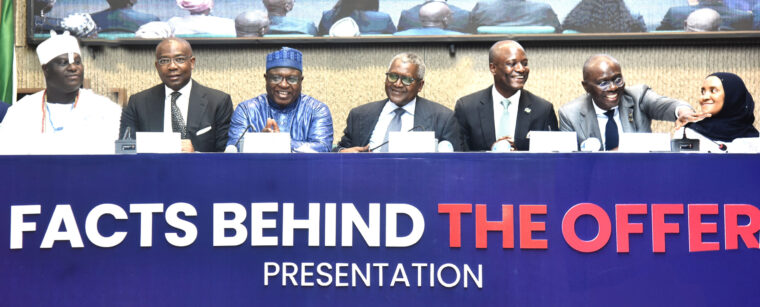
President and Chief Executive of Dangote Industries Limited, Aliko Dangote, has assured investors that the Initial Public Offering (IPO) of Dangote Petroleum Refinery & Petrochemicals FZE presents a compelling opportunity for strong returns and sustainable wealth creation, positioning the offer as a chance for Nigerians and Africans to participate in one of the continent’s most significant industrial achievements.
Speaking during the “Facts Behind the Offer” presentation at the Nigerian Exchange (NGX) in Lagos, Dangote described the $1.6 billion offer as the largest IPO ever undertaken in Africa, underscoring the company’s commitment to broadening ownership and enabling millions of individuals to benefit from the value generated by a world-class industrial enterprise.
According to him, the refinery IPO is more than a capital raising exercise; it is an opportunity for investors to become part owners of a strategic asset that is already delivering strong operational and financial results.
“The Dangote Refinery IPO is more than an investment opportunity; it is an opportunity for millions of Nigerians and Africans to build lasting wealth through ownership of a world-class industrial asset. We have built a refinery that is already delivering strong revenues, solid profitability and significant value to the economy. By investing today, shareholders are not only positioning themselves to enjoy attractive returns and dividend prospects, but they are also laying the foundation for generational wealth that can benefit their children and grandchildren. This offer is designed to allow ordinary people to participate in an extraordinary success story and share in the long-term value that Dangote Refinery will continue to create for decades to come.”
READ ALSO: Saudi Pipeline Disruption Pushes Nigeria’s Crude Beyond $115/barrel
He emphasised that the offer reflects the Group’s long-standing philosophy of creating prosperity through broad ownership, enabling ordinary citizens to share in the success of transformational businesses
Dangote noted that the refinery has already fulfilled its core vision of transforming Nigeria from a major importer of refined petroleum products into a significant refining and export hub, supplying domestic demand while serving markets across Africa and beyond.
“We are not merely offering shares; we are offering Nigerians an opportunity to participate in a transformational chapter of our economic history. This is a strategic investment in an asset that is creating jobs, conserving foreign exchange, enhancing energy security and strengthening Africa’s industrial capacity,” he stated
The IPO has been structured to encourage broad participation, with 4.1 billion ordinary shares offered at N525 per share and a minimum subscription of just 10 shares valued at N5,250. The offer is expected to attract a diverse range of investors, including civil servants, teachers, artisans, students, institutional investors, pension funds and members of the Nigerian diaspora.
Highlighting the refinery’s financial strength, Dangote disclosed that the company generated approximately N19.47 trillion in revenue during the first half of 2026, while profit after tax reached N2.55 trillion, demonstrating its capacity to create sustainable value for shareholders.
At the offer price, Dangote Petroleum Refinery is expected to achieve an implied market capitalisation of approximately N65.22 trillion. Together with the market capitalisations of Dangote Cement Plc and Dangote Sugar Refinery Plc, the listing is projected to create an equity cluster valued at about N83.5 trillion, making the Dangote Group the largest equity cluster on the Nigerian Exchange.
Commenting on the significance of the transaction, NGX Group Chairman, Umaru Kwairanga, described the offer as a defining milestone for Africa’s capital markets and a demonstration of the capacity of African capital to finance large-scale projects capable of accelerating economic growth and development across the continent.
Similarly, Lagos State Governor, Babajide Sanwo-Olu, hailed the IPO as a watershed moment for Africa’s financial markets, noting that it reinforces confidence in the continent’s ability to mobilize capital and invest in its own future.
“This transaction is changing perceptions about what is possible in Africa. It is creating opportunities for a broad spectrum of investors, from small business owners and market traders to institutional investors and technology entrepreneurs,” he said.
Also speaking, Chief Executive Officer of the Botswana Stock Exchange, Kesegofetse Molatlhegi, commended Dangote for demonstrating that African ambition can deliver globally significant industrial projects, while encouraging greater continental participation in the refinery’s growth story.
For his part, Chief Executive Officer of Dangote Petroleum Refinery, Davide Bird, highlighted the refinery’s operational achievements, noting that it has become the largest single supplier of refined petroleum products into Europe and continues to maintain safe, reliable and efficient operations. He added that the company remains focused on delivering its Vision 2030 objective of becoming the world’s largest integrated refinery and petrochemical complex.
Reaffirming the significance of the offer, Dangote said the IPO represents an opportunity for investors to move from consumers to owners and participate in the long-term growth of one of Africa’s most strategic industrial enterprises.
“This is a defining investment opportunity. We want millions of Nigerians and Africans to become owners of a business that has been built to create value for generations. Those who invest today are positioning themselves to benefit from the growth, resilience and enduring legacy of a truly transformational enterprise,” he said.
Photo Caption: L-R: Ooni of Ife, Adeyeye Enitan Ogunwusi; Managing Director, Coronation Asset Management Limited, Aigbovbioise Aig-Imoukhuede; Group Chairman, NGX Group, Dr Umaru Kwairanga; President/CE, Dangote Industries Limited, Aliko Dangote; Group Managing Director/Chief Executive Officer, NGX Group, Temi Popoola; Lagos Governor, Babajide Sawo-Olu; Group Executive Director, Commercial Operations, Oil & Gas, Fertiliser and WAEP, Fatima Aliko-Dangote, at the Dangote Petroleum Refinery & Petrochemicals Initial Public Offering (IPO) Facts Behind the Figure presentation at the Nigerian Exchange (NGX), Lagos on Monday, September 14, 2026.






DPRP to Favour Small Investors in Event of IPO Oversubscription

Sahara Appoints Menakaya as Managing Director

Olaniwun Ajayi Weighs In on Dangote Refinery IPO

Isa Chairs World Energy Council Nigeria

Dangote Refinery IPO: Why Nigerians Are Being Urged to Own a Stake in Oil Business — Madaki Ameh

2027: ‘Let Tinubu Finish the Good Work’ — Oba of Benin Backs President

Trump’s Family Unveils New Cryptocurrency Platform

Senate Denies Receiving Petitions Against Tinubu’s Ambassadorial Nominees

Dangote Cement Lights Up Benue Host Communities With CSR Initiatives

Reps Recommend 3-year Jail Term For Aviation minister

Tems Sets New Record On Billboard Hot 100 Chart
