
Crime
FG Approves New Whistle-blower Bill


The Federal Government, on Wednesday, approved a new Whistle Blower draft bill.
It also lamented that the existing Whistle-blowing policy launched on December 21, 2016, is “losing momentum.”
The Minister of Finance, Budget and National Planning, Dr Zainab Ahmed, disclosed this to State House Correspondents after this week’s Council meeting, chaired by Vice President Yemi Osinbajo, at the Aso Rock Villa, Abuja.
Launched in December 2016 by the Buhari-led Government, the Whistleblower Protection Act, facilitated through the Federal Ministry of Finance, provides legal cover for individuals who voluntarily expose acts of fraud, bribery, looted government funds and assets, financial misconduct and other forms of corruption.
The policy also rewards a whistleblower who provides information about any financial mismanagement or tipoff about stolen funds to the ministry’s portal with 2.5 – 5 per cent of the funds recovered by the Nigerian government.
Speaking after this week’s FEC meeting, Ahmed said the Council approved the draft bill to strengthen the fight against corruption and protect whistleblowers that provide helpful information to the FG.
She said: “The Ministry of Finance, Budget and National Planning presented several memos today. The first is the draft whistleblower bill for 2022. This memo has been reviewed by the Council and approved with a provision to ensure alignment with the Evidence Act.
“The purpose of operationalising and putting in place a whistleblower bill is to strengthen the fight against corruption and to enable protection for whistleblowers that provide information for use by the government.
“As you know, since 2016, the Council has approved the setting up the Presidential Initiative of Continuous Audit. PICA has been working in partnership with EFCC, ICPC, DSS, and NFIU and the Office of the Attorney-General of the Federation.
“We noticed that the whistleblower policy response has lost momentum. We embarked on engagement in the six geo-political zones, and one of the main outcomes we found is that people are concerned about their safety due to providing information. So, this bill is critical to ensure the effectiveness of the retention of the whistle policy.”
Ahmed also revealed that the Council approved N9.24bn for 2022/2023 Group Life Insurance Cover for civil servants.
This includes government officials in all ministries departments and agencies, paramilitary and intelligence agencies.
According to her, the Head of the Civil Service of the Federation, Dr Folashade Yemi-Esan, presented the memo to the Council.
She said, “The Head of Service of the Federation presented a memo to Council on Group Life Insurance Cover for 2022 to 2023. This insurance coverage covers all government officials in all government agencies, paramilitary and intelligence agencies.
“Council approved the total sum of N9.24bn naira for the insurance cover for 2022 to 2023.
“As you know, the insurance will take effect from the date of payment and in Nigeria, by our laws, the insurance cover is 30 per cent of the annual emolument of any staff of government that is deceased and the insurance company pays this cover to the beneficiaries of the deceased staff”, she said.
The Council also approved the 2022 Finance Bill designed to support the implementation of the 2023 appropriation bill.
Ahmed said: “If you recall, at the public presentation of the budget to the National The minister said the bill has five focus areas: tax equity reforms, climate change and green growth provisions, job creation and economic growth reforms, reforming tax incentives as well as generating revenue-enhancing tax administration.
She explained, “The purpose of the tax equity reforms is to combat tax evasion and aggressive tax planning practices that some companies operating in Nigeria are involved in but also enabling the utilisation of ICT tools and using international best practice to assess taxpayers tax on a fair, reasonable basis.
“The climate change green growth focus will complement non-fiscal reforms designed to reduce greenhouse emissions and facilitate domestic and international investment in climate adaptation, mitigation, and enhance green growth and create jobs.
“The third focus area, job creation and economic growth, is also designed to complement the ease of doing business and other reforms to support capital formation by the private sector as well as to foster enabling business environment for micro, small and medium enterprises for youth as well as women in businesses. It will also help to enhance the performance of businesses in the FinTech, the ICT, entertainment, fashion, sports and the art space.”
Ahmed explained that the fourth tax incentive is to phase out an antiquated pioneer and other tax incentives for mature industries and move a revised set of incentives to real infant industries through economic governance reforms.
She said the FG has also made proposals to reduce tax expenditure equivalent to foregone revenue to support the fiscal space and based on statistics, to gradually transition away from expensive and redundant tax incentives to incentives that reward performance.
The fifth Focus Area of revenue generation and tax administration is to complement the ease of doing business and other reforms that enhance tax administration.
She added that the Finance Bill is amending several fiscal laws, including the capital gains tax, company income tax, customs excise tariff act, Federal Inland Revenue Service act, personal income tax, stamp duties act, tertiary education tax, VAT act, Insurance Act, Nigerian police Trust Fund Act, as well as the National Agency for Engineering Act.
“So with this approval from Council, His Excellency Mr President will convey to the National Assembly a request for the consideration of this bill,” Ahmed said.
According to her, the Council also approved the memo for the design, construction and supply of nine Ballistic Riverine assault boats, as well as nine patrol boats with all associated accessories in favour of Messrs Sewa West African limited in the sum of N689,722,681.30 inclusive of 7.5 per cent VAT for the Nigerian customs service.
Meanwhile, the Minister of State for Budget and National Planning, Clem Agba, said the Council also approved the revised National Social Protection Policy (2021 – 2025) presented by the Minister of Finance and Budget and National Planning.
He said: “This revised national social protection policy is an offshoot of a previous policy that was implemented from 2017 to 2020. The review was carried out in collaboration with all relevant ministries, departments and agencies at the federal and state levels and other key stakeholders, including development partners.
“Recall that when the first policy was in place, there was no ministry like humanitarian affairs, and now we have that ministry. And since it’s part of the review process to do this every four years, the review had to be done.
Agba said the National Social Protection Council would be set up and chaired by the Vice President, with the Secretariat domiciled in the Ministry of Finance, Budget and National Planning.
Its membership will include the ministers of Labour And Employment and Humanitarian Affairs, Disaster Management and Social Development, who will serve as Vice Chair of that Council. The ministers will also co-chair a technical working group.
On his part, the Minister of Power, Abubakar Aliyu, said Council approved the contract for procurement of 20 transformer turns ratio analysers awarded to Segulu Stembek Global Services Ltd, at the sum of N564,231,854.08 with 7.5 per cent VAT with a completion period of four months.
He said, “So, this new technology is more reliable. So, it will be used by the TCN in testing the transformers across the country to know their reliability and detect any faults.”









The Nigeria Police Force has commenced steps to investigate alleged financial crimes involving more than ₦178 million against the National Chairman of the Police Community Relations Committee (PCRC), Alhaji Mogaji Ibrahim Olaniyan, and other national executive officers of the organisation.
The allegations were contained in a petition submitted to the Inspector-General of Police on July 13, 2026, by the law firm of A.F. Obainoke & Co. on behalf of some elected national officers of the PCRC.
According to the petition, Olaniyan and some other national executive officers were accused of financial crimes involving more than ₦178 million.
SEE ALSO: IGP Disu Proposes New Police Desk for Nigeria’s Creative Economy, Intellectual Property
The petitioners said they were elected into various national positions in the PCRC in 2022, including the position of National Auditor, while Olaniyan was elected National Chairman and subsequently sworn into office.
In a letter dated July 20, 2026, the office of the Inspector-General of Police forwarded the petition to the Director of Legal Services of the Nigeria Police Force for appropriate action.
The letter, signed by CP Lateef Ahmed, Principal Staff Officer, conveyed the directive of the Inspector-General for the matter to be handled by the legal services department.
The document, according to the report, was received by the Directorate of Legal Services on July 28, 2026.
The latest development comes amid ongoing allegations and internal disputes surrounding the leadership of the PCRC under Olaniyan.
Previous Allegations
The development follows earlier allegations of financial mismanagement and accountability concerns within the organisation.
In March, some PCRC members reportedly accused Olaniyan of failing to account for more than ₦20 million allegedly generated from registration fees for the organisation’s 2026 national leadership workshop.
Sources cited in the report claimed that more than 2,000 PCRC members registered for the workshop at ₦12,000 each in January and February 2026.
The report also alleged that the organisation had not conducted a comprehensive audit of its national accounts for more than three years.
Another PCRC controversy emerged in 2023 when an eight-member committee was reportedly constituted to investigate allegations involving ₦60.3 million allegedly embezzled by the chairman.
A document cited in the report indicated that the committee confirmed that ₦60.3 million had been realised by the PCRC and reviewed expenditure records, with an alleged balance of approximately ₦1.4 million.
The committee reportedly recommended measures including greater financial discipline, limiting the chairman’s powers and ensuring compliance with the organisation’s constitution.
PCRC Election Controversy
The latest allegations also come amid disputes over internal elections within the PCRC.
In July, the Assistant Inspector-General of Police in charge of Zone 13, AIG Godwin Iguh Eze, reportedly postponed a PCRC Zone 13 election over alleged procedural issues.
The police said nomination forms had not been made available to the AIG or the Zonal Police Public Relations Officer, while contestants had also not been screened by the AIG or members of the Zonal Management Team.
Sources further alleged that Olaniyan had sought to influence the electoral process, although he reportedly did not respond to attempts to obtain his reaction.
Meanwhile, sources within the PCRC reportedly claimed that Olaniyan is seeking another tenure as National Chairman ahead of the November 29 election.
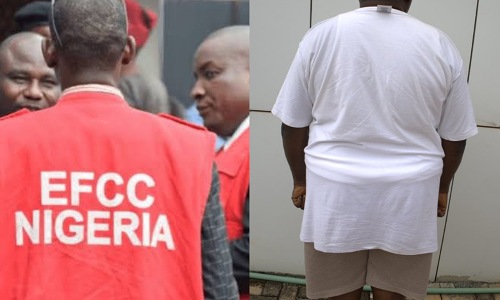
Operatives of the Enugu Zonal Directorate of the Economic and Financial Crimes Commission (EFCC) have arrested Basil Iwoba Ochili, Managing Director of Debasilio Construction and Estate Development Limited, over alleged fraudulent activities involving N128 million.
The EFCC disclosed this in a statement posted on its official X account on Wednesday.
According to the commission, Ochili was arrested for allegedly using his company for fraudulent activities, including “obtaining by false pretence to the tune of N128,000,000.00 (One Hundred and Twenty-eight Million Naira).”
SEE ALSO: EFCC Warns Lawyers Against Charging Clients in Foreign Currencies
The EFCC said Ochili was arrested based on a claim by a petitioner who alleged that sometime in September 2022, the suspect falsely presented himself as the owner of five plots of land situated beside Anambra State Secretariat by Stamford Hotel, Aroma Junction, Awka, Anambra State, and falsely offered the property for sale.
“Relying on the suspect’s representation, the petitioner purchased the said plots in the sum of N128,000,000.00 (One Hundred and Twenty-Eight Million Naira), which was paid into the suspect’s company account,” the EFCC said.
However, the commission said the petitioner was unable to take possession of the land.
Preliminary investigations, according to the EFCC, showed that the suspect knew that the land “encroached on Anambra State Government Secretariat’s land” but allegedly went ahead to sell it to the petitioner.
The commission further said that instead of refunding the petitioner’s money, Ochili “offered him two dud cheques.”
“Further preliminary investigations showed that the suspect used part of the money to settle his debts,” the EFCC said.
The commission also stated that Ochili’s company, Debasilio Construction and Estate Development Limited, “has never been tax compliant.”
The EFCC said the suspect will be charged to court after investigations are concluded.
“The suspect will be charged to court as soon as investigations are concluded,” the commission stated.

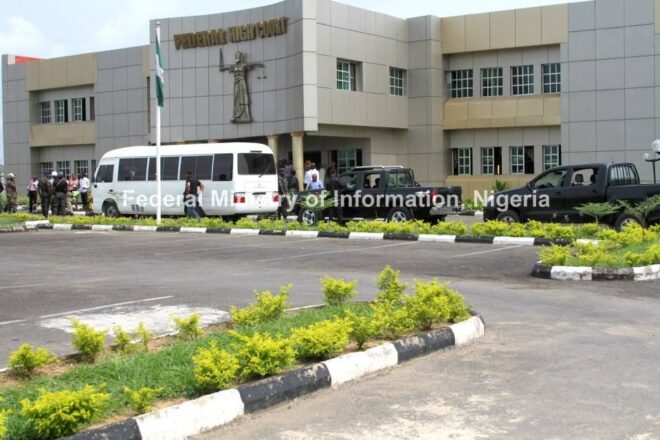
The Federal High Court (FHC) sitting in Uyo, Akwa Ibom State, has sentenced nine convicted crude oil thieves to 10 years in prison without an option of fine following a joint intelligence-led operation by the Department of State Services (DSS) and the Nigerian Navy (NN).
The convicts were among 19 suspects arrested earlier this year after security operatives caught them allegedly stealing crude oil from an oil well head identified as Asabo-D in Ibeno Local Council of the state.
READ ALSO: DPRP to Favour Small Investors in Event of IPO Oversubscription
Delivering judgment on Monday, Justice Joy Ikpeme found the nine men guilty on a two-count charge of conspiracy and tampering with an oil pipeline, contrary to Section 1(7) of the Miscellaneous Offences Act.
The judge sentenced each of them to five years’ imprisonment on the first count and 10 years on the second count, with no option of fine. The sentences are to run concurrently.
The remaining 10 suspects arrested during the operation are expected to face further legal proceedings.
The arrests followed an intelligence-led operation conducted by the DSS in collaboration with the NN as part of efforts to disrupt crude oil theft and illegal bunkering activities in the oil-producing communities of Akwa Ibom.
The conviction was described by a security source as another significant step in the sustained campaign against oil theft, particularly along Nigeria’s maritime and riverine areas.
According to the source, crude oil theft and illegal bunkering have continued to deprive the country of vital oil revenue while inflicting serious environmental damage on host communities.
The source said the latest conviction underscored the determination of security agencies to ensure that those involved in the theft of the nation’s crude resources are brought to justice.






‘Obi Has Nowhere to Hide’ — APC Campaign Council Tackles Peter Obi Over Anambra Record

‘A Nation Cannot Escape the Bill’ — Atiku Questions Tinubu’s Third UNGA Absence

Tinubu Reacts as Former Kogi Governor Ibrahim Idris Dies at 77

Why Ondo is Buying Dangote Shares for 500 Citizens

NMDPRA Points to PIA for Price Control Lapses

Indonesia’s Pertamina Leads Foreign Interest in Nigeria’s 2026 Oil Licensing Round

Trump’s Family Unveils New Cryptocurrency Platform

Senate Denies Receiving Petitions Against Tinubu’s Ambassadorial Nominees

Dangote Cement Lights Up Benue Host Communities With CSR Initiatives

Reps Recommend 3-year Jail Term For Aviation minister

Tems Sets New Record On Billboard Hot 100 Chart
