
Business
Financial Inclusion: 9PSB CEO Calls for Targeted Content in Nigeria

By EdozieObasi-Eze
The Chief Executive Officer, 9PSB, BrankaMracajac has emphasized the need to pay close attention to content creation as an important factor in driving and accelerating financial inclusion in the country, stating that it is capable of enhancing the future of digital banking in the long term.
Mracajac made this assertion while presenting a keynote address, themed “Content Creation and Financial Inclusion; The Future of Digital Banking” at the Tech Summit Ogun 2022, on Thursday, at the Olusegun Obasanjo Presidential Library Abeokuta, Ogun State.
According to her, while there are ongoing efforts to support the country’s financial inclusion drive, a lot more rest on formulating tailored strategies that address specific needs.
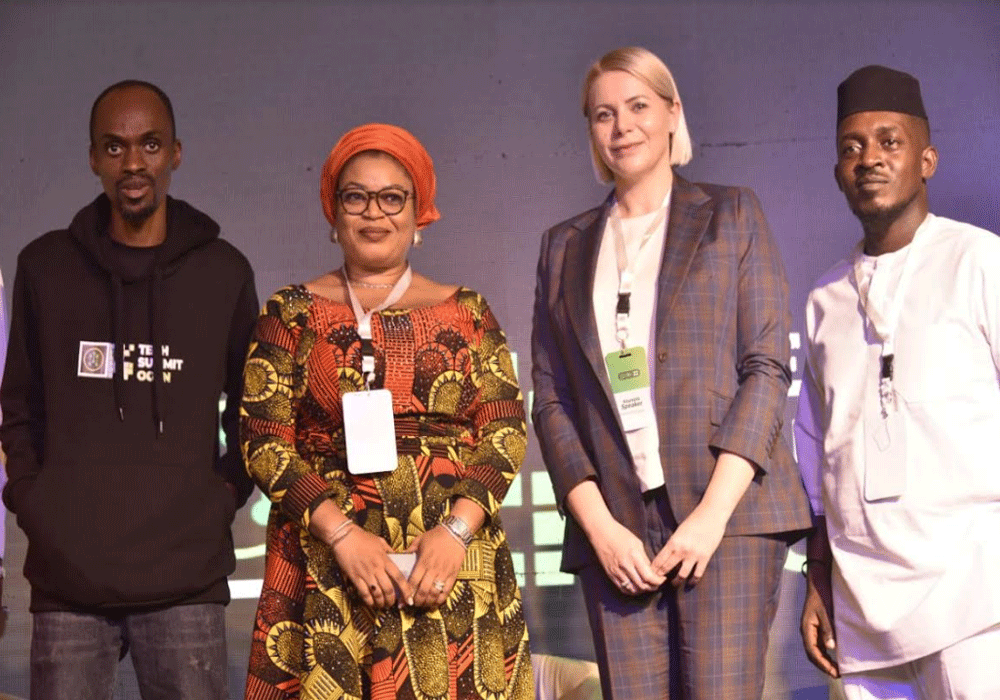
L-R: Olaniyi Ayoola, Team Lead and Convener, Tech Summit, Ogun, 2022; Abimbola Alale, Chief Executive Officer, Nigerian Communication Satellite Limited (NIGCOMSAT)/representing the Minister of Communications and Digital Economy; Branka Mracajac, Chief Executive Officer, 9 Payment Service Bank (9PSB)/Keynote Speaker, and Jude Abaga, Nigerian music producer, at the Tech Summit Ogun, 2022 which held recently at the Olusegun Obasanjo Presidential Library, Abeokuta, Ogun State.
“Providing access to the banking agents and touchpoints, across the country is happening as we speak; payment service banks, microfinance banks, and FinTech companies are all working on this.
But will this be enough? Will the access to digital banks change the mindset of Nigerians in rural areas of the country and be enough to drive the transition from cash to a cashless society?” she questioned.
Proffering the way forward, Mracajac stressed the need to provide financial literacy through content that speaks to an average Nigerian in unserved rural areas of the country, stating that financial inclusion is a process, not just a point in time and space that we want to reach.
Read Also >> NCDMB To Launch US$50m Fund For Oil Industry Manufacturing
She added that developing content that speaks only to the already banked and mirroring the digital financial habits of those who are fully included and heavily banked, will not help to keep the newly onboarded in the system long-term. She stated: “While creating and delivering the content for financial inclusion, we need to have in mind the needs of its beneficiaries, the targeted end-users of the financial services who are currently underserved and the only sustainable way is that we join our forces and create the content – apps and services that will address the specific needs of a farmer in Benue, market women in Onitsha, a trader in Kano, a fisherman in Delta, and the woman selling ofada rice in Ogun State”.
Speaking further, she noted that, to drive the offline individuals and MSMEs from cash to cashless, from analogue to digital and from informal to formal, content creators need to focus on two major goals; one, to deliver relevant and on-point digital financial literacy content, educating people about the principles, ways, modules, and benefits of banking.
The second one, she stated, is needed for sustainable Financial inclusion: delivery of digital banking services that are a reflection of the lifestyle of the currently unbanked and underserved population.
She called on all stakeholders within the financial ecosystem, including content creators to work collectively to develop and implement a digital content strategy for the unbanked to move the financial inclusion needle and ultimately advance the economy, society and improve the life of every Nigerian.
In his own keynote address, titled “Disruptive Innovation: Production and Distribution of Creative Content, the Honourable Minister of Communications and Digital Economy, Professor Isa Ali Ibrahim Pantami, who was represented by the Chief Executive Officer, Nigerian Communications Satellite Limited (NIGCOMSAT), Dr Abimbola Alale remarked that the quality of creatives and start-ups that Nigeria has produced is a testament to the potential of the ecosystem, and as such the ministry will continue to support the tech and creative entrepreneurs to play their part in developing Nigeria’s digital economy.
The Tech Summit Ogun is an annual convergence of Tech disruptors, innovators, startups, organizations and technology enthusiasts in Ogun State, aimed at spurring technological innovation towards the digital transformation and technological advancement of Ogun State.
This year, the summit attracted over 2000 participants, mainly the youths and start-ups.











Tesla has set a 2028 commercial production date for its new Roadster sports car that can briefly rise into the air using rocket technology.
According to CNN, the date was revealed when the manufacturers demonstrated its functionality on Thursday at a SpaceX testing facility in Texas, United States, where the two-seater vehicle performed a series of manoeuvres, including driving upside down before making a short airborne movement.
The prototype was operated without a driver during the test, with Musk saying the decision was taken “to make sure we don’t kill anyone.”
“Success is not guaranteed. I mean that. It’ll probably work, but if it doesn’t work, we’re at a safe distance,” he said.
READ ALSO: 2027 Election: ‘Your Future Is More Valuable’ — IGP Warn Youths Against Political Violence
CNN reported that the vehicle uses 10 nozzles and high-pressure air tanks to generate thrust, with Musk claiming it could accelerate from zero to 60 miles per hour in less than a second.
The Tesla boss attributed the development to cooperation between the electric vehicle manufacturer and SpaceX, the rocket company he also leads.
He described the project as “the results of what happens when you have a collaboration with the world’s best car company and the world’s best rocket company.”
Musk also sought to assure spectators that the demonstration was genuine, saying, “We need an audience to prove that it’s not AI or SI. So you guys can tell people you saw it with your eyes, because what you see with your eyes, you will not believe.”
Despite the display, questions remain about whether the vehicle can achieve sustained flight and how practical it would be for everyday transportation.
Roger Conner, curator for vertical flight at the Smithsonian’s National Air and Space Museum, told CNN that combining the requirements of road vehicles and aircraft presented significant engineering challenges.
“Aircraft are extremely sensitive to weight, whereas with ground vehicles you want them to have bumpers and crumple zones and all that,” he said.
“Inevitably, something that is a hybrid between the two is going to be a poor performing aircraft and a poor performing vehicle, and also quite expensive,” he added.
Conner questioned whether the demonstration amounted to flying in the conventional sense.
“We’re not talking about sustained flight. We are literally talking about hopping,” he said.
However, Jim Dukhovny, chief executive of flying car startup Alef, said the technology was achievable, while pointing to the difficulties involved in making such vehicles transition safely from vertical take-off to forward flight.
“It absolutely is 100% feasible,” he told CNN.
“That being said, the hardest part on all eVTOLs, and for us, it’s a transition from (rising) vertical to (moving) forward. It needs to be extremely careful, making sure you do not lose lift, and making sure it’s very stable,” he added.
CNN also reported that Alef’s prototype weighs about 254 pounds, uses eight propellers and is designed to carry one person.
Musk said Tesla intended to begin production of the new Roadster in 2028.
CNN reported that the latest display adds to Musk’s ambitions to push Tesla’s vehicle technology beyond conventional electric cars, although the prototype’s ability to operate as a practical flying vehicle has yet to be established.
The Petroleum Products Retail Outlets Owners Association of Nigeria (PETROAN) has urged the Federal Government to add its member-stations to the petrol discount programme.
It cautioned that the current arrangement could limit the reach and deny vast consumers in underserved communities the benefits of the 30-day discount window.
The PETROAN also urged the FG to allocate at least 30 percent of the discounted petrol volume to outlets operated by its members.
READ ALSO: Tanzania Nears Completion of $42bn Equinor, Shell-Led LNG Project
The calls followed last week’s announcement by the Minister of Finance and Coordinating Minister of the Economy, Taiwo Oyedele, of a petrol discount at Nigerian National Petroleum Company Limited (NNPC Ltd) retail outlets, with priority given to public transport operators nationwide.
According to the National Publicity Secretary, Independent Petroleum Marketers Association of Nigeria (IPMAN), Chinedu Ukadike, the exclusion of independent marketers could undermine the programme’s effectiveness, particularly in communities where NNPC retail outlets have limited presence.
He argued that independent marketers, with their extensive nationwide distribution networks, were better positioned to extend the benefits of the intervention to consumers in remote and underserved areas.
“Independent oil marketers have over 90 percent coverage and presence in the nooks and crannies of this country. You are giving NNPC that is situated only in the town. So how do the poor masses, whom you intend to ensure that this petroleum product will alleviate their sufferings, how would they now get it?” Ukadike asked.
He said the association was not opposed to the government’s policy but insisted that independent marketers should be included to ensure wider access to the discounted product.
“But it’s government policies; we are not against government policies, but let it be all-inclusive; let independent marketers be part of it,” he said.
Ukadike also urged the government to extend the discount period to 60 days, citing logistical challenges that could delay the movement of petrol from coastal depots to other parts of the country.
“And the 30 days should be extended to 60 days. Because of the circulation of petroleum products, most times it takes two weeks for a truck to leave Apapa and get to Gombe, Maiduguri, because of the bad road and all the rest of them and loading process,” he added.
Similarly, PETROAN National President, Billy Gillis-Harry, urged the Federal Government to allocate 30 per cent of the discounted petrol volume to the association’s retail outlets to facilitate broader national distribution.

In the bid to transform Tanzania into the East African regional energy hub, the country is on the verge of concluding an agreement with a consortium of energy companies, including a $42 billion LNG project.
It was gathered that the project is designed to tap the 47.13 tcf of gas discovered in Tanzania’s deep offshore fields, part of the country’s estimated 57.54 tcf in total discovered reserves, the sixth-largest in Africa, behind Nigeria, Algeria, Senegal, Mozambique and Egypt.
READ ALSO: Shell Identifies Keys to Nigeria’s Energy Future
Equinor and Shell would be the lead operators, alongside involvement from ExxonMobil Pavilion Energy and Medco Energi, while state oil major, the Tanzania Petroleum Development Corporation (TPDC), would also hold an equity stake in the project.
“It’s almost there,” Khamis Mussa Omar, Tanzania’s finance minister, told Reuters.






Tesla Aims for 2028 Commercial Production of Flying Car

Corruption Trials: EFCC, NJI Push Specialised Judges, Digital Evidence Reforms

‘It Is Morally Wrong’ — PDP Chieftain Questions North’s Bid for Another Eight Years

2027 Election: ‘Your Future Is More Valuable’ — IGP Warn Youths Against Political Violence

Tinubu Charges PCC Members to Deliver Wards

Marketers Eye Portion of FG’s Petrol Discount

Trump’s Family Unveils New Cryptocurrency Platform

Senate Denies Receiving Petitions Against Tinubu’s Ambassadorial Nominees

Dangote Cement Lights Up Benue Host Communities With CSR Initiatives

Reps Recommend 3-year Jail Term For Aviation minister

Tems Sets New Record On Billboard Hot 100 Chart
