
International News
French PM Set To Resign Amid Political Turmoil


French Prime Minister, Gabriel Attal is expected to resign soon, continuing to lead a caretaker government amidst ongoing political uncertainty and internal strife.
President Emmanuel Macron is likely to accept Attal’s resignation following a crucial cabinet meeting scheduled for Tuesday.
This decision comes in the wake of a significant defeat suffered by Macron’s allies in a recent snap National Assembly election aimed at clarifying the country’s political landscape.
READ MORE: Elon Musk Pledges Millions To Boost Trump’s Presidential Bid
Attal had previously signaled his intention to resign on July 8, 2024, but initially faced resistance from President Macron.
Attal and his team are expected to maintain their roles with reduced authority until after the Paris Olympics, slated to commence on July 26.
This extension is intended to provide political parties additional time to form a governing coalition following the inconclusive July 7 election runoff, which left the parliament without a clear majority.
The New Popular Front (NFP), comprising Socialists, Communists, Greens, and the hard-left France Unbowed (LFI), secured the largest share of seats with 193 out of 577. Macron’s allies garnered 164 seats, while the far-right National Rally (RN) secured 143 seats.
The NFP alliance has faced challenges in agreeing on a consensus candidate for prime minister, primarily due to internal disputes, especially between the hard-left France Unbowed (LFI) and the more moderate Socialists.
Over the weekend, the Socialists opposed Huguette Bello’s candidacy, despite support from other left-wing factions.
Bello, a former communist MP and regional council president in La Reunion, was seen as a potential unifying figure.
Meanwhile, Laurence Tubiana, an economist and climate specialist endorsed by the Socialists, Communists, and Greens, was rejected by the LFI.
Internal discord within the alliance has drawn criticism, with leftist deputy François Ruffin condemning the situation as “shameful,” and Green deputy Sandrine Rousseau expressing strong frustration with the disagreements.
Attal, recently elected leader of his party’s National Assembly contingent, has expressed his intention to influence the formation of a new majority around specific projects and principles.
Observers note that both Macron and Attal are striving to establish a center-right majority in parliament, excluding the hard-left France Unbowed (LFI) and the far-right National Rally (RN) from potential coalitions.
Following Attal’s anticipated resignation, he and other cabinet members are expected to return to parliament to participate in efforts to build a coalition.
Parliament is scheduled to reconvene on Thursday to elect the National Assembly speaker and other key positions.
Tensions have surfaced between Attal and Macron, with Attal seemingly attributing the electoral setback to Macron.
Attal’s defeat follows his historic appointment as France’s youngest-ever head of government at the age of 34, just six months ago.
Looking ahead, Macron, who has nearly three years remaining in his presidential term, anticipates a potential challenge from Marine Le Pen, the far-right leader expected to contest the 2027 elections.

Federal agents raided the Washington, D.C., home of Democratic Congresswoman Ilhan Omar early Monday morning as part of an ongoing federal criminal investigation, the United States Department of Justice (DOJ) has confirmed.
Homeland Security Investigations agents arrived at the Minnesota congresswoman’s residence at about 6:00 a.m. Eastern Time, according to a report by Fox News.
SEE MORE: Trump Sparks Outrage With Shock Proposal to Rename New Mexico
The report said both the Department of Homeland Security (DHS) and the DOJ are involved in the investigation.
A DOJ spokesperson confirmed the operation, stating: “Today in the Washington, D.C. area, Homeland Security Investigations executed a judicially authorized search warrant secured by the Department of Justice.”
The spokesperson added: “This enforcement action is part of an ongoing federal criminal investigation.”
Details later……….
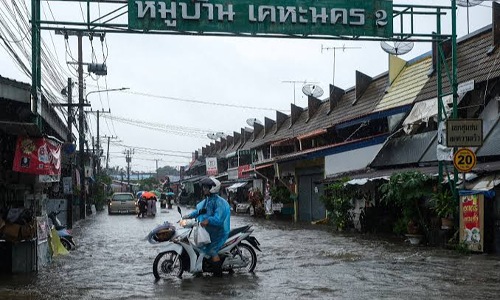
Heavy rains have triggered severe flooding across parts of Bangkok, Thailand, forcing nearly 4,900 residents to evacuate to shelters as floodwaters swept through roads and residential areas.
The flooding has disrupted movement across parts of the Thai capital, with motorists and pedestrians forced to navigate submerged roads and seek alternative routes.
SEE ALSO: NAFDAC Warns Nigerians As Fake Cowbell Milk Floods Market
According to the Bangkok Metropolitan Administration, about 52,000 households have been affected by the flooding, prompting authorities to declare a flood disaster and intensify emergency response efforts.
Emergency teams have been deployed to assist affected communities and move residents from vulnerable areas to safer locations as water levels rise.
Bangkok is accustomed to seasonal heavy rainfall, but intense downpours can overwhelm drainage systems, particularly in low-lying areas, resulting in widespread flooding and disruption.
Authorities are continuing to monitor affected locations while coordinating evacuations and other emergency measures.
For thousands of residents, the immediate priority remains securing safe shelter and protecting homes and livelihoods as authorities work to manage the situation and restore normal activities once the floodwaters recede.
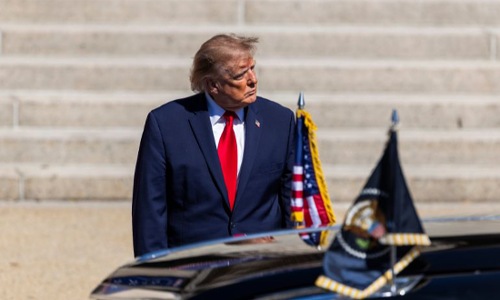
US President Donald Trump has explained his decision to reject Iran’s latest proposal to reopen the Strait of Hormuz, saying Tehran was seeking an agreement because it was losing revenue.
Speaking to reporters at the White House, Trump said Iran wanted to immediately reopen the strategically important waterway but argued that the proposal was not acceptable to his administration.
“They want to make a deal, and I think that’s fine. I like making a deal, too, but that deal would not be acceptable,” Trump said.
SEE ALSO: How the Strait of Hormuz Attack Could Trigger a Fresh Global Oil Shock
According to the US president, Iran’s push to reopen the strait was driven by the economic pressure it was facing.
“What they want to do is immediately open the Hormuz Strait. Do you know why? Because they are dying,” Trump said.
“You know why they’re dying? Because they have no money coming in, because they get their money from the Hormuz Strait.”
Trump also claimed that the US had established an unprecedented naval blockade against Iran, describing it as “a wall of steel.”
“So they outsmarted themselves. We put up the greatest blockade ever in military history. It’s a wall of steel,” he said.
“And guess what? They don’t have any money now because they wanted to close the strait.”
The Strait of Hormuz is a major global energy shipping route, and disruption to traffic through the waterway has significant implications for international oil markets and countries that depend on energy imports.
Trump’s remarks came amid continued tensions between Washington and Tehran over the reopening of the strategic waterway and negotiations involving Iran.






2027 Election: ‘Your Future Is More Valuable’ — IGP Warn Youths Against Political Violence

Tinubu Charges PCC Members to Deliver Wards

Marketers Eye Portion of FG’s Petrol Discount

Tanzania Nears Completion of $42bn Equinor, Shell-Led LNG Project

IEA Puts UAE’s Oil Output at 5.3mbpd for September

Africa’s Energy Security Conversations Pull Industry Executives Together

Trump’s Family Unveils New Cryptocurrency Platform

Senate Denies Receiving Petitions Against Tinubu’s Ambassadorial Nominees

Dangote Cement Lights Up Benue Host Communities With CSR Initiatives

Reps Recommend 3-year Jail Term For Aviation minister

Tems Sets New Record On Billboard Hot 100 Chart
