
NEWS
Hundeyin Leaks America’s, Europe’s Masterplan Against Dangote Refinery, African Economy


The unending efforts of neo-colonists to tie Nigeria and Africa down with the chains of poverty and underdevelopment have come to the fore over the challenges being encountered by the Dangote Petrochemical and Petroleum Refinery.
One of Nigeria’s foremost investigative journalists, David Hundeyin, on Saturday revealed via a strong narrative on his page on micro-blogging site, X, that paid American and European interests were working to stifle the 650,000bpd refinery situated in Nigeria.
Hundeyin revealed how “an international NGO called Dialogue Earth (formerly known as China Dialogue Trust)” has being throwing huge sums at journalists to push the narrative that the “Dangote Refinery is terrible for the environment”.
He maintained that the objective was to give a dog a bad name in order to hang it. That is, give the Nigerian government sufficient evidence to ‘kill the Dangote Refinery’.
ALSO READ: Atiku Urges Resolute Actions To Support Dangote Refinery
In an apparent wake up call to the Nigerian government and the entire African continent, Hundeyin pointed out that India had taken drastic action against their underground agent, by blacklisting him.
He stated, “Basically, this London-based NGO is headed by Sam Geall, an Oxford professor and is funded by several American intelligence fronts such as Ford Foundation and ClimateWorks (which is blacklisted in India for funding organisations working against India’s national interest).”
He wondered why “Africa’s largest oil producer having no functioning oil refinery to beneficiate its own oil was not a problem for Dialogue Earth and the American CIA fronts who fund it.”
Hundeyin wrote, “I debated long and hard whether to do this publicly, but I think a message needs to be sent to a group of external interests working in tandem with the internal interests described in the quoted tweet to counteract the interests of half a billion West Africans. A message that at whatever level we exist, we take our destiny seriously and we are not to be trifled with.
“Last week, I received an N800,000 offer from an international NGO called Dialogue Earth (formerly known as China Dialogue Trust) to write an article essentially saying that Dangote Refinery is terrible for the environment because something, something. “Environmental Concerns,” something, something “Climate Change,” something, something “Energy Transition Policy,” something, something “COP 28.”
“The (unstated but clearly implied) thrust of the brief was for a prominent local voice to put their name on an article that is an argument or a premise for the Nigerian government to kill the refinery based on its “energy transition commitments” and “environmental policy.” This conclusion wasn’t immediately apparent when they reached out to me, but I suspected where it was heading, and I quickly accepted the offer so that I could see the brief and obtain hard evidence. I’ve attached screenshots from the brief below.
“Basically, this London-based NGO is headed by Sam Geall, an Oxford professor and is funded by several American intelligence fronts such as Ford Foundation and ClimateWorks (which is blacklisted in India for funding organisations working against India’s national interest). For whatever reason, it is now quietly mobilising a resistance campaign against what it describes as “Nigeria’s first refinery.” Apparently, the status quo of Africa’s largest oil producer having no functioning oil refinery to beneficiate its own oil was not a problem for Dialogue Earth and the American CIA fronts who fund it.
“The human poverty caused by exporting this raw material and importing refined fuel was not bad for the environment. Also, the fact of European refiners regularly blending West African fuel cargoes with toxic waste and sulphur content 200 times the European legal limit (leading to asthma, bronchitis and eye infections in West Africa) was also not bad for the environment. But Nigeria having a refinery that will wean West Africa off import dependency on those European refiners (and allow West Africa control the sulphur content of its own fuels) is where Dialogue Earth and its funders draw the line. That one is bad for the environment, and David Hundeyin should write an article calling for the refinery to be shut down or limited.
“I’m putting this out there publicly so that nobody will henceforth use the term “conspiracy theory” when it is pointed out for the umpteenth time, that there are American and European state and private interests that are heavily invested in keeping Africa exactly as poor as it is, and that they regularly push levers most of us do not even know exist, to make sure that this status quo is protected. These people believe that Africans should not exist or have nice things in this world. Apparently, the sole purpose of our existence is to enhance their experience of the planet and all that it has to offer.
“It is because of them that I have to make a public spectacle out of this, even though I know that doing this is probably going to cost someone their job. The message needs to be passed that as poor as we are, you cannot convince us to campaign for the elongation of our own poverty by commissioning $500 hack jobs in the hope that we will be greedy enough to only see the money and ignore the bigger picture of what we can clearly see you trying to do.
“I will reiterate something I have said multiple times – I am not a believer in the religious faith called Climate Change/Saving The Environment. I care exactly as much about the environment as do the rich white men who destroyed it to begin with. I firmly believe that if what it takes for Africa to industrialise is for it to burn so much fossil fuel that snow stops falling in Wisconsin and it starts raining concentrated sulphuric acid in Doncaster, it is not too big a price for Europe and North America to pay – it is certainly not bigger than the price Africa had to pay for Europe and North America to develop.
“It is and will continue to be 100% OUR prerogative to determine what to do with our hydrocarbons. It is not the rich white men hiding behind these “Climate Advocacy NGOs” who will tell us what to do with our energy reserves, and by what means we are allowed to escape the poverty that they engineered for us.
“I might not be a fan of Aliko Dangote or his monopolistic business practices – as is well known – but I’m also smart enough to know when rich white men in DC, Houston, Rotterdam and London and trying to use me as a marionette in their 400 year-old coloniser games. If you are reading this and you are one of the rich white men whose economic interests are threatened by Nigeria refining its own oil, you should come out and fight Aliko Dangote by yourself.
“Or at least go find a much stupider African to do your dirty job – there’s plenty of those.
“It will never be me.”






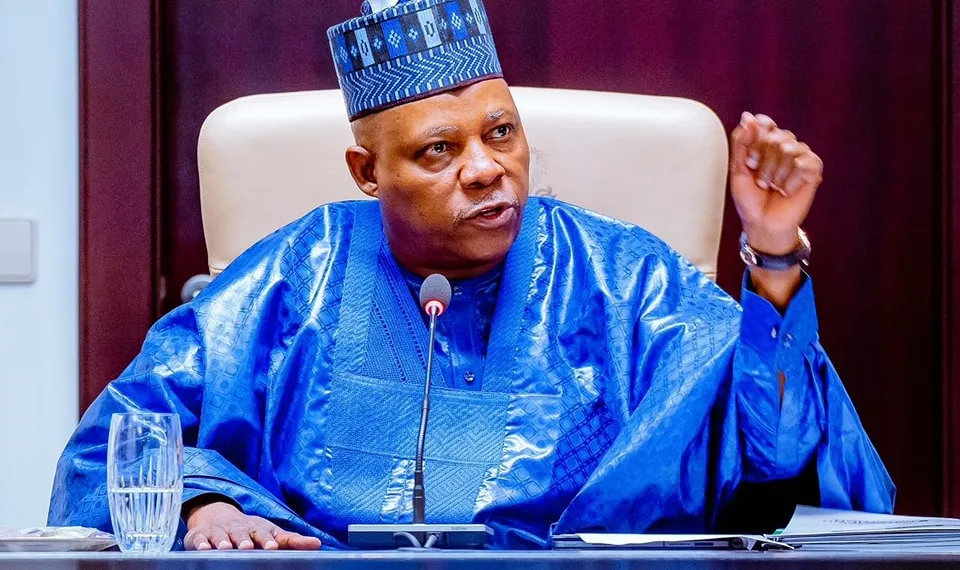
Vice President Kashim Shettima has urged Nigerians to celebrate President Bola Tinubu, saying his leadership saved the country from a potential implosion.
Shettima said Nigeria’s economy had been teetering on the edge of collapse before Tinubu’s intervention, adding that the country could have faced a different situation.
“The economy was teetering on the edge of collapse, we were on a cliff edge,” the Vice President said.
ALSO READ: Subsidy Removal, FX Reforms Driving Fresh Oil Sector Investment – Shettima
“So he literally saved the nation from an implosion. That could have been the scenario. So, instead of demonizing him, Nigerians ought to celebrate this poor man.”
Shettima also called for a return to the drawing board, expressing confidence in the leadership’s commitment and the prospects for the 2027 elections.
“I believe on the bottom of my heart that with this presentation I have seen, and with the commitment of our leadership, by the grace of God, we are going to win,” he said.
Speaking about the 2027 elections, the Vice President reminded his audience that social media platforms should not be mistaken for actual polling stations.
“There are no polling stations on Facebook or Instagram,” he said.
Shettima also expressed gratitude for the efforts made towards promoting the cause of the 2027 elections.

Following observed mis-steps, the Federal Government of Nigeria has withdrawn the eight-count criminal charge brought against the alleged fake Director General (DG) of the Presidential Foreign Intervention Promotion Council (PFIPC), Adeniyi Adeyemi.
Biztellers reports that the matter, in accordance with the counsel of the Attorney General of the Federation (AGF) and Minister of Justice, Prince Lateef Olasunkanmi Fagbemi, (SAN), the matter will be filed at the High Court of the Federal Capital Territory (FCT), instead of the Federal High Court (FHC).
Consequently, upon an unopposed application for termination by the prosecution counsel and Director of the Public Prosecution of the Federation (DPPF), Rotimi Oyedepo (SAN), on Monday, Justice Mohammed Umar of a Federal High Court, Abuja on Monday, struck out the matter.
READ ALSO: Shell Identifies Keys to Nigeria’s Energy Future
In a motion for the termination of the charges, Oyedepo informed the court that the Attorney General of the Federation (AGF) and Minister of Justice has carried out a review of the case file of Adeyemi and the charge filed by the Inspector General of Police (IGP) and found some loopholes.
The DPPF added that the documents allegedly forged by Adeyemi during his operations of the fake agency are those that can be prosecuted by the High Court of the Federal Capital Territory (FCT).
He also informed the court that a new charge has been filed at the High Court of the FCT and that Adeyemi would be expeditiously arraigned afresh.
He therefore urged the judge to strike out the charge as required by law.
Following no objections from Ibrahim Angulu (SAN), who stood in for Adeyemi, Justice Umar subsequently terminated the charge.
Adeniyi, 38, was being tried alongside two others whose whereabouts are unknown, on charges bordering on conspiracy and forgery.
The two others said to be at large were identified as Femi (surname unknown) and Anu (surname unknown).
The charge marked: FHC/ABJ/CR/25/2025, was entered against the defendant by the DPPF.
To secure a bright energy for her teeming population, Nigeria must sustain the momentum of reform, accelerate investment, and deepen partnerships.
This view was expressed by Managing Director, Shell Nigeria Exploration and Production Company of Nigeria Limited (SNEPCo) Ronald Adams in Lagos at the weekend.
Delivering a keynote address at the Africa Energy Conference (AEC) of the Lagos Business School (LBS), Adams called for regulatory certainty through efficient execution of reforms, sustained investment appeal to enable projects to move more swiftly from opportunity to production and partnership by operators, regulators, NNPC Limited and communities to unlock the full value of Nigeria’s resources.
Adams cited Nigeria’s huge oil and gas resources as an advantage but pointed out: “Resources alone do not guarantee prosperity. Prosperity comes when resources are matched with investment, technology, sound policy and disciplined execution. Success will be determined not by the size of our resources, but by our ability to convert them into investment and economic growth.”
Adams pledged the support of Shell towards a bright energy future of Nigerians. He said: “For more than six decades, Shell has been part of Nigeria’s energy journey. Together with our partners, we have helped develop major energy infrastructure, supported Nigerian businesses, invested in talent, and contributed to economic development. Bonga remains a powerful example of what technology, partnership and Nigerian capability can achieve in deepwater operations. Today, that story continues through Bonga North.”
READ ALSO: ADF Targets 5 Million Students, 2 Million Vulnerable Women
Issuing a clarion call for action by all stakeholders, he added: “The world is not standing still. Capital is moving, technology is advancing and competition is intensifying. The countries that attract investment tomorrow are those that improve competitiveness today. Nigeria has begun that journey. Our task is to sustain the momentum and translate reform into projects, projects into growth, and growth into shared prosperity.”
The conference, the 4th in the series had at its theme; “Securing Nigeria’s Energy Future: Policy Reform, Capital Mobilisation, and Pathways to a Sustainable Power and Energy Market” and was attended by top government officials, industry captains, energy professionals, and students.
Lagos State Deputy Governor Obafemi Hamzat represented Lagos State Governor Babajide Sanwo-Olu as the guest of honour. SNEPCo was a principal sponsor of the Africa Energy Conference (AEC) and mounted a well-received exhibition on its deepwater operations and social investments across Nigeria.






Ebonyi 2027: Gov Nwifuru Jittery Over My Candidacy, Violating Constitution — Odii

Small Investors Take Centre Stage as Dangote IPO Nears Close
Sahara Champions Global Shipping Collaboration for $20m Mercy Ships Healthcare Impact

30 Nigerians Bag Postgraduate Scholarship from NNPC Ltd, Eni

2027: ‘Algorithms Will Not Decide Election Results’, INEC Chairman Declares

Navy Recovers 98,000 Litres of Suspected Stolen Crude in Rivers

Trump’s Family Unveils New Cryptocurrency Platform

Senate Denies Receiving Petitions Against Tinubu’s Ambassadorial Nominees

Dangote Cement Lights Up Benue Host Communities With CSR Initiatives

Reps Recommend 3-year Jail Term For Aviation minister

Tems Sets New Record On Billboard Hot 100 Chart
