
NEWS
JUST IN: NELFUND Receives ₦50bn Recovered Proceeds Of Crime


The Management of the Nigerian Education Loan Fund (NELFUND), has received an additional N50 billion from the Economic and Financial Crimes Commission (EFCC).
This was disclosed in a statement in Abuja, on Friday by the Director, Corporate Communications, NELFUND, Oseyemi Oluwatuyi.
ALSO READ: Applicants Rush NELFUND With Highest Single-Day Student Loan Application
According to Oluwatuyi, the release follows the directive of President Bola Tinubu in his speech on 4th August, 2024, directing the EFCC to transfer the funds to NELFUND to further boost the student loan program.
This significant injection of funds represents a major milestone in the Administration’s commitment to bolstering access to education by providing financial support to students across Nigeria.
The fund extends its deepest appreciation to President Bola Ahmed Tinubu for his unwavering dedication to the education sector and his continued efforts to support the most vulnerable segments of the population.
By deciding to allocate these funds to the student loan scheme, President Tinubu has once again demonstrated his visionary leadership and commitment to fostering a brighter future for Nigerian students and to the socioeconomic advancement of Nigeria.
She added that the NELFUND wishes to acknowledge and thank the EFCC under the leadership of its Executive Chairman, Ola Olukayode for their swift action ensuring the release of the funds.
Their diligent work has ensured that these resources has been promptly made available to benefit the education of our nation’s youth.
She noted that President Tinubu’s decision to direct these funds into NELFUND’s student loan scheme underscores the administration’s broader social intervention policy aimed at uplifting the most populous, yet disadvantaged segment of Nigerian society, the youth.
This infusion of funds will significantly boost the NELFUND’s ability to provide much-needed financial support to students, enabling them to pursue their academic aspirations without financial hindrance.
The NELFUND remains committed to utilizing these funds equitably, responsibly and efficiently, ensuring that they directly benefit those who need them the most and have already sought a partnership with EFCC to oversee the disbursement process.
With the support of the government and the EFCC, NELFUND will continue to drive forward the mission of expanding access to tertiary education for all aspiring Nigerian youth and increasing the employability of well educated graduates in both the academic and vocational sectors, Oluwatuyi stated.






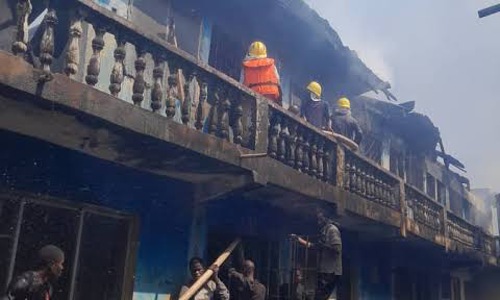
Panic broke out in the Mandate Market area of Ilorin, Kwara State, after a fire engulfed parts of a shopping complex in the early hours of Saturday.
No fewer than 12 shops were affected in the inferno, which occurred opposite Alkad Filling Station at about 1:14am.
The shopping complex, which contains about 40 shops, was already engulfed in flames when firefighters arrived at the scene.
SEE MORE: Firefighters Avert Disaster as Fire Guts Laundry Shop in Kwara
The spokesperson for the Kwara State Fire Service, Hassan Adekunle, disclosed this in a statement on Saturday.
Adekunle said the fire service immediately deployed two fire appliances after receiving the distress call, while personnel of the Federal Fire Service later joined the operation.
According to him, the combined effort of the firefighters prevented the fire from spreading to other shops and nearby properties.
“Despite the prompt intervention of the firefighters, 12 shops were affected, largely due to the late notification of the incident,” Adekunle stated.
He said preliminary findings suggested that a power surge might have triggered the fire.
Adekunle explained that some people sleeping near the shopping complex reportedly heard a loud combustion sound shortly after electricity was restored.
“The exact cause of the incident remains subject to further investigation,” he added.
The Chief Fire Officer, Alabi Muhammed, commended the firefighters and the Federal Fire Service for their response and collaboration.
Muhammed urged business owners to ensure that electrical installations were carried out by qualified professionals and that electrical appliances and power sources were properly monitored.
He also stressed the need for residents and business owners to report fire outbreaks promptly.
“Early notification gives firefighters a better opportunity to contain incidents before they escalate and cause extensive damage,” Muhammed said.
The incident occurred just two days after another fire outbreak affected a residential building behind the Industrial Training Fund in the Asa-Dam area of Ilorin.
The Thursday fire affected three bedrooms in a building comprising three-bedroom flats and a room-and-parlour self-contained apartment.
The Fire Service said the blaze had spread significantly before firefighters arrived but was eventually contained, preventing it from reaching an adjoining block of apartments.
A power surge was also suspected in that incident, although the exact cause had not been conclusively established.
The Kwara State Fire Service consequently urged residents and business owners to regularly inspect and maintain their electrical installations and immediately alert emergency responders whenever a fire outbreak occurs.
NEWS
‘Sambisa Forest Is as Big as Belgium’ — Defence Minister Reveals Why Kidnap Victims Are Hard to Rescue

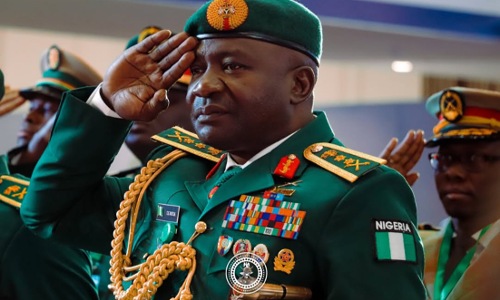
The Minister of Defence, General Christopher Musa (retd.), has revealed that the vast size of the Sambisa Forest is one of the major factors making it difficult for security forces to quickly rescue Nigerians kidnapped by terrorists.
Musa disclosed this during an interview on Channels Television’s Politics Today, where he discussed the Federal Government’s efforts to tackle terrorism and kidnapping in the country.
According to the minister, security agencies have continued to rescue abducted Nigerians, but terrorists often escape into large forest areas before troops can locate them.
SEE ALSO: How Troops Forced Kidnappers to Abandon Abducted Army Lieutenant Colonel in Enugu
“Few ones now, efforts have been made. If you notice, on a daily basis now, we are really getting, rescuing a lot of them,” Musa said.
He explained that the enormous size and difficult terrain of the Sambisa Forest give terrorists an advantage after carrying out attacks.
“So this government is overwhelmed. Sambisa Forest is as big as Belgium, as a country. So when people talk about this, they make it look as if it is one small football field and we are refusing to do anything,” he said.
Musa said kidnappers can disappear into the bush before security agencies receive information about an abduction, making it difficult for troops to determine their exact location.
“These places are massive areas. The forest within Kwara comes in from Burkina Faso to Benin Republic into Nigeria and flows through all these things,” he said.
“So what they do is that once these abductions are done, before the information gets to anybody, these guys are already into the forest.”
The Defence Minister explained that troops sometimes have to cut off terrorists from their usual routes and sources of supplies before they can rescue their victims.
He cited a recent operation in Kwara State, where security forces rescued victims after restricting the movement of their abductors.
“And then the last one that was done in Kwara State, we had to quarantine where they were going, deny them oxygen, and that’s where we were able to get them,” Musa said.
He added that terrorists sometimes abandon their captives when security forces increase pressure on them, providing troops with an opportunity to rescue the victims.
Musa also disclosed that authorities were monitoring financial transactions linked to criminal activities, noting that ransom payments could provide useful information for tracking kidnappers.
He said the Central Bank of Nigeria was also involved in efforts to monitor suspicious funds connected to criminal activities.
The minister further advised state governors to exercise caution when distributing motorcycles as palliatives, warning that some of the vehicles could eventually fall into the hands of terrorists and improve their mobility.
Musa maintained that despite the challenges posed by Nigeria’s vast forests and difficult terrain, security forces were making progress in the fight against terrorism and kidnapping.

The Federal Airports Authority of Nigeria (FAAN) has revealed a series of complaints it received from passengers about their experiences with e-hailing and car-hire drivers at Nigerian airports.
FAAN Managing Director, Olubunmi Kuku, disclosed this on Friday while speaking with journalists at the airport amid controversies surrounding the reported exit of Uber from Nigeria.
Kuku said the complaints were particularly numerous during the December 2025 holiday period, when passengers reported having unpleasant experiences with some e-hailing and car-hire services.
SEE MORE: FAAN Clears Air on Bolt, Uber Suspension, Says Services Will Resume
“We received a lot of complaints, especially around the December holiday period, from passengers who used some of the e-hailing services, as well as car-hire services, and had very unpleasant experiences.”
According to the FAAN boss, the complaints reportedly included intimidation, excessive fares and cases where passengers were allegedly dropped off at unintended locations.
She further alleged that some e-hailing drivers were exploiting the airport transportation system by operating alongside car-hire operators and charging passengers higher fares.
“We also had situations where some Uber and Bolt drivers would get out of their cars under the guise of coming into the airport as e-hailing drivers, and then join the car-hire operators to charge higher fares.”
Her comments come weeks after FAAN temporarily stopped e-hailing drivers from conducting commercial passenger pick-ups at airports under its control, pending the finalisation and execution of licensing agreements.
The move generated criticism, with some observers alleging that the restriction was intended to create room for FAAN’s newly introduced Airport Car Hire and Ride Management System (ACHRAMS).
However, Kuku said FAAN’s decision to regulate airport car-hire services was aimed at protecting passengers and improving their overall experience at Nigerian airports.
She explained that the authority had introduced an application designed to provide passengers with visibility on registered car-hire companies and the identities of drivers taking them from the airport to their destinations.
Kuku also clarified that FAAN does not collect fares on behalf of drivers, noting that the rates displayed on the platform are only indicative.
She added that passengers remain free to choose between pre-booked car-hire services and e-hailing platforms, while FAAN’s responsibility is to ensure visibility, safety and accountability within the airport environment.
On Uber’s reported exit from Nigeria, Kuku said the decision was a business and regulatory matter for the company.
“I work for the Federal Airports Authority of Nigeria, and my first responsibility is to ensure that our passengers are safe, protected, and have a seamless passenger experience.
“Regarding Uber, I can’t speak to their exit from Nigeria. I’m sure they have their own economic and regulatory considerations as to why they chose to exit.”






Panic as Fire Razes 12 Shops in Kwara Shopping Complex

VDM Reacts as Regina Daniels Reportedly Returns to Ned Nwoko (Video)

‘It’s a Lie’ — Wike’s Aide Debunks Peter Obi’s ‘No Shishi’ Claim

‘Sambisa Forest Is as Big as Belgium’ — Defence Minister Reveals Why Kidnap Victims Are Hard to Rescue

Uber Exit: FAAN Reveals Shocking Complaints Against E-Hailing Drivers

Dangote Reveals Date for Much-Awaited Refinery IPO

Trump’s Family Unveils New Cryptocurrency Platform

Senate Denies Receiving Petitions Against Tinubu’s Ambassadorial Nominees

Dangote Cement Lights Up Benue Host Communities With CSR Initiatives

Reps Recommend 3-year Jail Term For Aviation minister

Tems Sets New Record On Billboard Hot 100 Chart
