
Politics
Misuse of Consensus: Senator Abdullahi says Direct primary mode is best for delegates selection

By John Danjuma
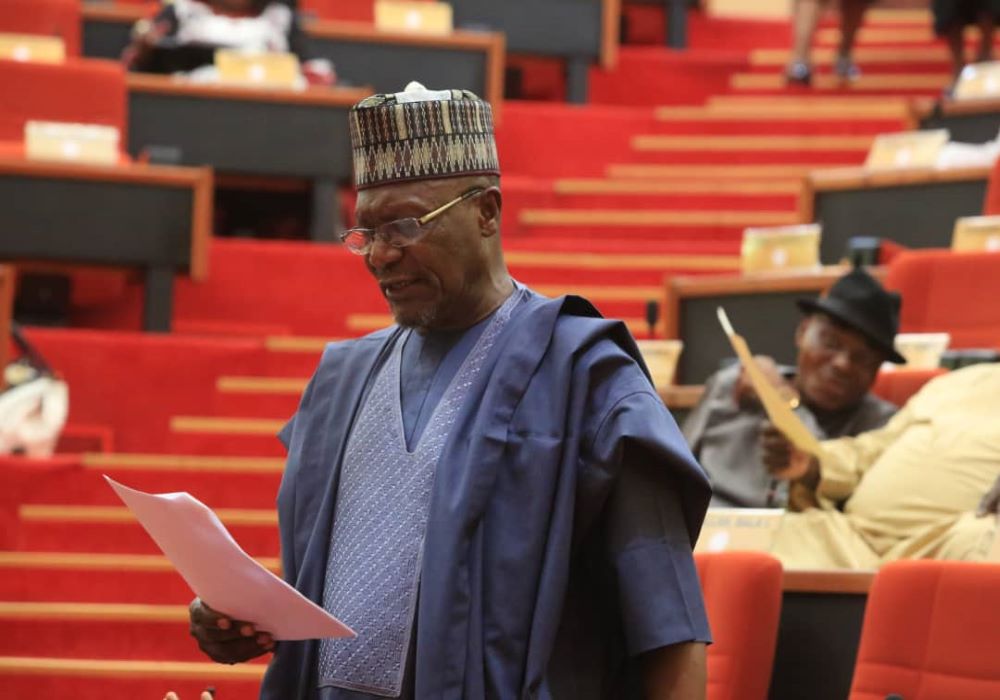
Former Senate leader and Senator representing Kebbi North Yahaya Abdullahi has asked for an amendment in the Electoral Act 2022 to revert to the Direct Primary mode the National assembly earlier adopted going by widely reported misuse of the consensus mode during the recently held primaries
Lawmakers had slammed the mandatory use of direct primaries on all political parties in the electoral bill, however, President Muhammadu Buhari declined to sign the bill until it was amended to include, indirect and consensus modes.
However, during the primary election held recently, the Governors still had the field day as there was alleged misuse of the consensus primary mode for their selfish interests to the detriment of the lawmakers.
Hence more than 70% of the lawmakers lost out to the power play with their governors of which Senator Abdullahi was a victim leading to defections from the ruling APC to opposition political parties.
Coming under order 41 of the senate standing order as amended the former senate leader raised a matter of urgent national importance saying,
“Our recent nasty experience of the misuse of consensus and delegate system has vindicated our earlier position on the merit of direct primaries provided a verifiable membership of the register of political parties is kept simultaneously at the ward level and with INEC with all necessary safeguard against corruption and data manipulation put in place.
Read Also >> Ekweremadu: NDPB Seeks Probe Into Alleged Breach Of Citizens’ Data Privacy
“Secondly, we still as a national assembly have a major outstanding matter that remains, that is we have to after the 2023 election, study the entire implementation process of what had happened so that we might have to revert to our earlier stance on direct primaries.
“We have the responsibility in this 9th assembly that as the political process towards 2023 unfolds the national assembly needs to be observant of the loopholes and weaknesses of the 2022 electoral act so that a comprehensive assessment can be undertaken to provide adequate grounds for making amendments to the act before the end of the 9th National Assembly.”
On the recent judgment by the Supreme Court over section 84(12) of the electoral Act 2022, he said,
“I rise to congratulate the 9th National Assembly for resisting the pressure from the executive arm of government to amend section 82(12) of the electoral act 2022.
“I also want to congratulate the Supreme court for the clarity, decisiveness, and the unanimity of its verdict in upholding the separation of powers principle as enshrined in the 1999 constitution.
“I also want to congratulate Nigerians for this major victory in our match to true democratic governance anchored on the rule of law.
“My view is that the supreme court judgment should be celebrated for two reasons:: the first one is that it restored the power of law-making in the national assembly.
“The second one is that it established a principle that once a President assents to a bill, he or she can not appropriate and reprobate. He or she can not go to court to amend or reject the bill in part or in whole.
“This is a major principle that has emerged from this particular judgment.
President of the Senate, Ahmad Lawan said that efforts will be made by the National Assembly to amend the electoral act to serve as a safeguard against weaknesses identified in the law.
Lawan, in his remark, described the judgment by the Supreme Court on Section 84(12) of the Electoral Act as a “landmark” judgment that vindicates the National Assembly.
According to him, further amendments to the Act would strengthen it ahead of the 2023 general elections.
He said, “Let me say that this is one major landmark judgment by the Supreme Court, that the National Assembly had done their job and the court upheld it
“The idea of what method of primaries should be adopted at the moment is entirely left for the political parties to decide.
“But as we implement the electoral act 2022, we are supposed to be very observant of the strengths and weaknesses of the law.
“This law is supposed to improve the electoral processes and procedures in our country.
“So, it is for us to ensure that where there are weaknesses, we try to come up with measures, and amendments to deal with the issues of weaknesses in the law.
“And, I’m sure it will come full circle when the 2023 elections are held.
“I have no doubt in my mind that all of us in the National Assembly, not only in the Senate but in the House as well, feel that we must do everything and everything possible to make this electoral act serve the purpose for which it was passed and assented to.
“Therefore, I believe that we should work tirelessly to take note of those areas that we feel are not strong enough – that are weak points in the law – with a view to strengthening them before we finally take our exit in 2023.”








The Court of Appeal in Abuja has handed a significant setback to Ondo State Governor Lucky Aiyedatiwa, dismissing his appeal challenging a Federal High Court ruling that questioned his eligibility to contest the upcoming governorship election.
A three-member panel delivered a unanimous judgment on Monday, affirming that the trial court acted correctly when it allowed Dr Akindele Egbuwalo, the plaintiff, to amend his originating summons.
ALSO READ: No Shake-Up in Ondo: Aiyedatiwa Denies Plot To Remove Deputy Gov
Justice Uchechukwu Onyemenam, who read the lead judgment, said the governor failed to show that the High Court’s decision caused any miscarriage of justice or denied him a fair hearing.
The appeal was therefore dismissed for lacking merit, and the court awarded ₦2 million in costs against Aiyedatiwa.
The ruling reinforces the November 24, 2025, Federal High Court decision in Akure, which granted Egbuwalo permission to challenge Aiyedatiwa’s eligibility for re-election.
Earlier, the Court of Appeal also rejected an application by Aiyedatiwa to set aside a January 27, 2026, order staying proceedings in the case before the Federal High Court.
The appellate court clarified that the stay was a lawful exercise of its jurisdiction aimed at protecting the integrity of the proceedings.
The panel further emphasized that attempting to overturn its own order would be akin to sitting on appeal over its own decision.
The governor’s remaining option, the court noted, is to challenge the ruling at the Supreme Court. Another ₦2 million in costs was awarded against Aiyedatiwa.
The crisis rocking the Peoples Democratic Party has deepened following a ruling by the Court of Appeal in Abuja which upheld a ban on the party’s proposed national convention in Ibadan, Oyo State.
A three-man panel of the appellate court on Monday dismissed an appeal filed by a faction of the party led by former Minister of Special Duties, Kabiru Turaki, challenging the jurisdiction of the Federal High Court to hear a suit concerning the controversial convention.
The Turaki-led faction had approached the Court of Appeal after a Federal High Court barred the party from holding its planned national convention scheduled for November 14 and 15, 2025.
SEE MORE: Fubara Moves to Rebuild Cabinet as R/Assembly Screens Nine Commissioner Nominees
The lower court also restrained the Independent National Electoral Commission from recognising or validating the proposed convention.
However, delivering judgment, the appellate court ruled that the Federal High Court had the authority to entertain the case, rejecting the argument that the matter was purely an internal affair of the party.
According to the court, the appellants could not present what it described as a clear violation of the party’s constitution and the Constitution of the Federal Republic of Nigeria as merely an internal party issue.
The panel subsequently dismissed the appeal and awarded a cost of N2 million against the appellants.
The ruling is part of judgments delivered in nine harmonised appeals filed by the Turaki-led faction over the dispute surrounding the convention.
The latest court decision is expected to further intensify the internal wrangling within the opposition party as it continues to grapple with leadership disputes and preparations ahead of the 2027 general elections.

The Rivers State House of Assembly on Monday began the screening of nine commissioner nominees submitted by the Governor of Rivers State, Siminalayi Fubara, as part of efforts to reconstitute the state’s Executive Council.
The nominees arrived at the Assembly complex around 10 a.m. and were ushered into the chamber to undergo the screening exercise conducted by lawmakers.
Those screened include Datonye Alasia, Tonye Bellgam, Temple Nwofor, Peters Nwagor, Mrs. Charity Deemua, Tamuno Williams, Lekue Kenneth, Otonye TKD Amachree, and Amairigha Hart.
SEE ALSO: APC Sweeps Both Rivers Assembly Seats Despite Low Turnout
During the session, each nominee mounted the podium to introduce themselves and respond to questions from members of the Assembly.
The proceedings were broadcast live on Arise TV.
Governor Fubara had earlier forwarded the list of nominees to the Assembly on March 5, 2026, following his dissolution of the State Executive Council in a move aimed at forming a new cabinet to assist in running the affairs of the state.
Prior to the screening, the Assembly directed the nominees to submit 40 copies of their curriculum vitae, photocopies of their academic credentials, and evidence of tax compliance as part of the confirmation process.
The directive was contained in a notice signed by the Clerk of the House, Dr. Emeka Amadi.
The screening exercise comes months after political activities resumed fully in the state following the lifting of a state of emergency by Bola Tinubu, the President of Nigeria.
The emergency rule, which was imposed on March 18, 2025, led to the suspension of Governor Fubara, his deputy, and the state legislature amid a prolonged political crisis linked to a power struggle between the governor and his predecessor, Nyesom Wike, who currently serves as the Minister of the Federal Capital Territory.
However, the six-month emergency rule was lifted on September 17, 2025, paving the way for the restoration of democratic governance and legislative activities in the oil-rich state.






African Club Football Gets Major Financial Boost as CAF Hikes Prize Money

Abramovich Clashes with UK Gov’t Over £2.35bn Chelsea Sale Funds

Global Crisis: Attacks on Schools Skyrocket 166% – UN Sounds Alarm on Children’s Safety

Appeal Court Deals Major Blow to Aiyedatiwa’s Re-election Hopes in Ondo

After Turbulent Elections, Portugal Swears In Seguro as President

JUST IN: Nigerians Reeling as Dangote Sparks Another Spike in Fuel Prices

Trump’s Family Unveils New Cryptocurrency Platform

Reps Recommend 3-year Jail Term For Aviation minister

Senate Denies Receiving Petitions Against Tinubu’s Ambassadorial Nominees

Dangote Cement Lights Up Benue Host Communities With CSR Initiatives

Things To Know About Threads, Zuckerberg’s Twitter-like App
