
NEWS
NASS Committees Back Tantita’s Contract


Nigeria’s National Assembly joint Committees on Petroleum Resources have a vote of confidence on Tantita Security Service (TSS), the security agents and the Nigerian National Petroleum Company (NNPC Ltd) for helping to restore the nation’s oil production.
They took the stance in Abuja, on Wednesday and dismissed three petitions against the TSS’ pipeline surveillance contract.
This is as Nigeria’s oil production stood at about 1.8 million barrels per day as at April, being an increase from the about nine hundred thousand liters per day in 2022 which necessitated the award of the surveillance contract.
The resolution followed a motion moved by the Chairman of the House Committee on Petroleum Resources, Midstream, Henry Okojie at a one day parliamentary roundtable on the state of pipeline security and the battle against crude oil theft
Okojie said that Tantita and the security agencies have recorded lots of achievements in securing the nation’s petroleum assets, thereby increasing oil revenue for the country.
At the roundtable, Speaker of the House of Representatives, Abbas Tajudeen pointed out that despite the ongoing tensions in the Middle East and the protracted conflict involving Russia and Ukraine, the need for valiant efforts at finding alternative energy sources has become necessary.
ALSO READ: How Shell/NNPC Boost Respiratory Care in Nigeria
He added that crude oil still remains the largest source of primary energy in the world, especially the transport sector where it still powers 95 percent of all vehicles, planes and ships.
According to the Speaker, the current crises, particularly with the closure of the Strait of Hormuz, has resulted in price surges and supply shortages, with consequential impact on the nation’s economic survival, saying “as a nation, we must rise to the challenge, and this roundtable is a clear indication that the National Assembly is ready to lead the way.
He said further that in order to understand why the surveillance contract became necessary, “we must remember that Nigeria’s journey as an oil-producing nation has been a very challenging one.
“The discovery of petroleum has both earned us massive foreign exchange and resulted in environmental degradation and despair. As a result, the Niger Delta has witnessed profound agitations over the years which often resulted in pipeline vandalism, crude oil theft, and illegal refining activities.
“Desperate communities and weak enforcement structures created a climate of instability in the oil sector with staggering consequences.
“At some point, Nigeria was losing billions of dollars annually as between 10 to 30 percent of crude oil production was lost to theft, undermining national revenue and questioning our capacity to remain a reliable oil producer.
“It was within this context that the Federal Government introduced the pipeline surveillance contract, including the engagement of private security actors and community-based structures.
“These interventions were designed to provide security to our oil facilities, with the understanding that without the help of the communities where these pipelines and other infrastructure were located, the job of securing them would be impossible.
“In the end, the synergy of private surveillance providers, our security agencies, and community engagement, led to remarkable improvements in our daily production quotas.”
The Speaker said further that there has been clear undeniable and compelling success stories, saying “recent reports indicate that most of the illegal tapping points have been dismantled, production levels have improved significantly and oil receipts are approaching near-total delivery to export terminals, compared to the alarming losses of previous years when production sometimes plummeted to about 700 barrels per day.
“Today, largely due to these surveillance/security efforts, we have been able to ramp up production to about 1.8 million barrel per day. Importantly, the surveillance contract has been able to create direct employment for thousands of Niger Delta youths who were formerly agitators, providing a legitimate alternative to crime, and placing security back in the hands of the people who host the facilities.
“There is no doubt that we can do better. There are still a number of challenges, particularly as they concern accountability, transparency, and the effectiveness of certain surveillance frameworks.
“Recent public discourse suggests that crude oil theft still occurs at concerning levels, sometimes even under existing security arrangements. This underscores the need for continuous oversight and reform”.
He said the National Assembly has remained at the forefront of confronting the challenges in the oil sector and has through legislation, oversight, and appropriation taken deliberate steps to strengthen Nigeria’s response to threats to our oil industry.
He said “we have enacted and reviewed laws such as the Petroleum Production and Distribution (Anti-Sabotage) Act and other relevant statutes aimed at deterring-pipeline vandalism while emplacing stringent penalties.
“We have also worked to strengthen institutions like the National Oil Spill Detection and Response Agency (NOSDRA), recognizing the need for improved monitoring and environmental accountability.
“Both are the fruits of comprehensive and deliberate policy actions that were enabled by the passing of the landmark Petroleum Industry Act (PIA). Some of the provisions of this act, like the Host Community Development Trust, made Corporate Social Responsibility a legal mandate and gave host communities a direct financial stake in the profitability of the oil sector.
“Moreover, by legislating that communities forfeit their entitlement for the year if vandalism occurs in their domain, the law operationalized the concept of “shared responsibility.” Communities now police their own areas, knowing that an attack on a pipeline becomes an attack on their trust fund.
“The 10th National Assembly has continued to take bold legislative steps to institutionalize the gains of the PIA. From maintaining a rigorous oversight of the Act to ensure steady implementation, to our recent investigative hearings on oil theft, we are closing the legal loopholes that once allowed criminals to thrive.
‘Furthermore, this Assembly has exercised its constitutional mandate by probing aspects of the surveillance contract, approving critical funding for pipeline security, and insisting that crude oil theft be treated not just as an economic crime, but as a national security threat requiring coordinated action across agencies.
“In summary, we have consistently emphasized that curbing crude oil theft must be a collective responsibility, involving government, host communities, security agencies, and private operators alike.”
The Speaker said the event was an opportunity to advance the fortunes of the oil industry by consolidating on the gains made so far from the surveillance contract, while addressing existing gaps, while also
Reassessing on the current pipeline surveillance architecture, strengthen transparency and accountability mechanisms, deepen community engagement as critical stakeholders in protecting national assets, and align legislative frameworks with emerging realities in the oil and gas sector, particularly under the circumstances the world has now found itself.
He said “let us remember that the story of Nigeria’s oil industry is not only one of challenges, but also of resilience and possibility. Let us build a system where pipelines are no longer targets, but symbols of shared prosperity; where host communities are not marginalized, but empowered partners; and where Nigeria’s oil wealth translates into sustainable national development.
“The Middle East is in turmoil, Russia is distracted, and global energy maps are being redrawn. The world is looking for energy security, and Nigeria must put itself out there as a credible alternative. We cannot afford the luxury of internal sabotage. Our message to the world is clear: Nigeria is securing its assets, stabilizing its output, and is open for business.”







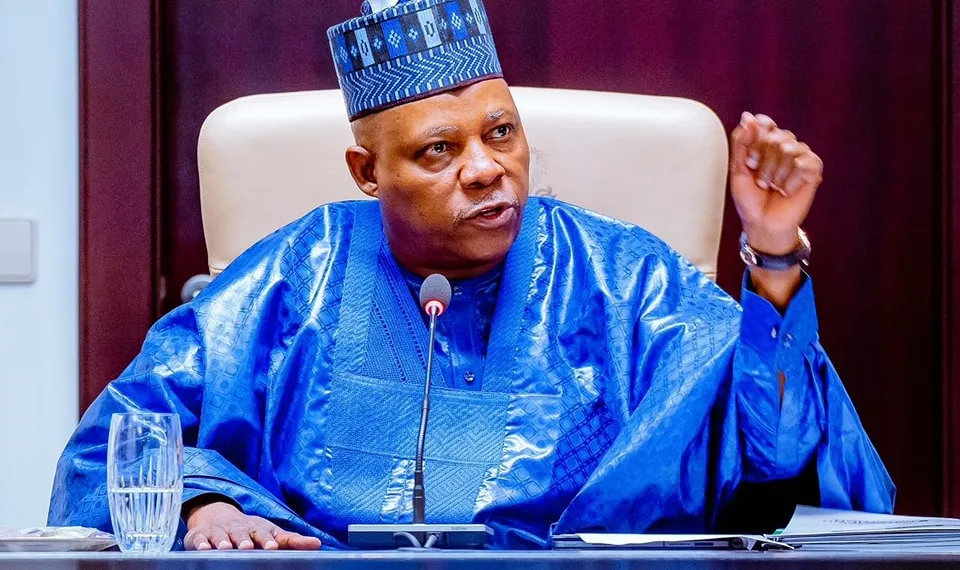
Vice President Kashim Shettima has urged Nigerians to celebrate President Bola Tinubu, saying his leadership saved the country from a potential implosion.
Shettima said Nigeria’s economy had been teetering on the edge of collapse before Tinubu’s intervention, adding that the country could have faced a different situation.
“The economy was teetering on the edge of collapse, we were on a cliff edge,” the Vice President said.
ALSO READ: Subsidy Removal, FX Reforms Driving Fresh Oil Sector Investment – Shettima
“So he literally saved the nation from an implosion. That could have been the scenario. So, instead of demonizing him, Nigerians ought to celebrate this poor man.”
Shettima also called for a return to the drawing board, expressing confidence in the leadership’s commitment and the prospects for the 2027 elections.
“I believe on the bottom of my heart that with this presentation I have seen, and with the commitment of our leadership, by the grace of God, we are going to win,” he said.
Speaking about the 2027 elections, the Vice President reminded his audience that social media platforms should not be mistaken for actual polling stations.
“There are no polling stations on Facebook or Instagram,” he said.
Shettima also expressed gratitude for the efforts made towards promoting the cause of the 2027 elections.
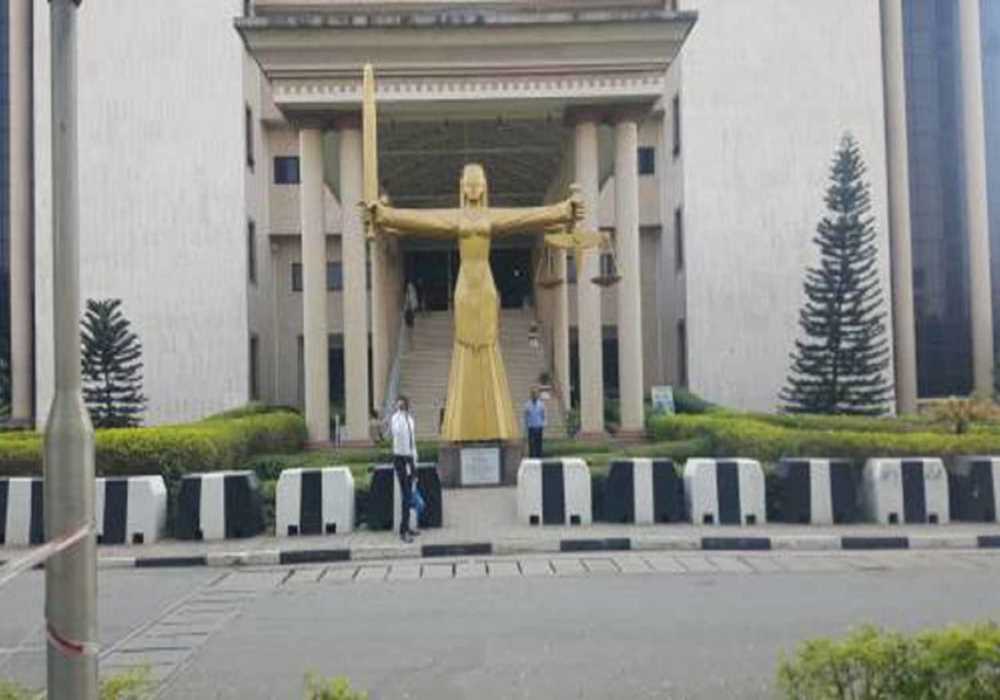
Following observed mis-steps, the Federal Government of Nigeria has withdrawn the eight-count criminal charge brought against the alleged fake Director General (DG) of the Presidential Foreign Intervention Promotion Council (PFIPC), Adeniyi Adeyemi.
Biztellers reports that the matter, in accordance with the counsel of the Attorney General of the Federation (AGF) and Minister of Justice, Prince Lateef Olasunkanmi Fagbemi, (SAN), the matter will be filed at the High Court of the Federal Capital Territory (FCT), instead of the Federal High Court (FHC).
Consequently, upon an unopposed application for termination by the prosecution counsel and Director of the Public Prosecution of the Federation (DPPF), Rotimi Oyedepo (SAN), on Monday, Justice Mohammed Umar of a Federal High Court, Abuja on Monday, struck out the matter.
READ ALSO: Shell Identifies Keys to Nigeria’s Energy Future
In a motion for the termination of the charges, Oyedepo informed the court that the Attorney General of the Federation (AGF) and Minister of Justice has carried out a review of the case file of Adeyemi and the charge filed by the Inspector General of Police (IGP) and found some loopholes.
The DPPF added that the documents allegedly forged by Adeyemi during his operations of the fake agency are those that can be prosecuted by the High Court of the Federal Capital Territory (FCT).
He also informed the court that a new charge has been filed at the High Court of the FCT and that Adeyemi would be expeditiously arraigned afresh.
He therefore urged the judge to strike out the charge as required by law.
Following no objections from Ibrahim Angulu (SAN), who stood in for Adeyemi, Justice Umar subsequently terminated the charge.
Adeniyi, 38, was being tried alongside two others whose whereabouts are unknown, on charges bordering on conspiracy and forgery.
The two others said to be at large were identified as Femi (surname unknown) and Anu (surname unknown).
The charge marked: FHC/ABJ/CR/25/2025, was entered against the defendant by the DPPF.

To secure a bright energy for her teeming population, Nigeria must sustain the momentum of reform, accelerate investment, and deepen partnerships.
This view was expressed by Managing Director, Shell Nigeria Exploration and Production Company of Nigeria Limited (SNEPCo) Ronald Adams in Lagos at the weekend.
Delivering a keynote address at the Africa Energy Conference (AEC) of the Lagos Business School (LBS), Adams called for regulatory certainty through efficient execution of reforms, sustained investment appeal to enable projects to move more swiftly from opportunity to production and partnership by operators, regulators, NNPC Limited and communities to unlock the full value of Nigeria’s resources.
Adams cited Nigeria’s huge oil and gas resources as an advantage but pointed out: “Resources alone do not guarantee prosperity. Prosperity comes when resources are matched with investment, technology, sound policy and disciplined execution. Success will be determined not by the size of our resources, but by our ability to convert them into investment and economic growth.”
Adams pledged the support of Shell towards a bright energy future of Nigerians. He said: “For more than six decades, Shell has been part of Nigeria’s energy journey. Together with our partners, we have helped develop major energy infrastructure, supported Nigerian businesses, invested in talent, and contributed to economic development. Bonga remains a powerful example of what technology, partnership and Nigerian capability can achieve in deepwater operations. Today, that story continues through Bonga North.”
READ ALSO: ADF Targets 5 Million Students, 2 Million Vulnerable Women
Issuing a clarion call for action by all stakeholders, he added: “The world is not standing still. Capital is moving, technology is advancing and competition is intensifying. The countries that attract investment tomorrow are those that improve competitiveness today. Nigeria has begun that journey. Our task is to sustain the momentum and translate reform into projects, projects into growth, and growth into shared prosperity.”
The conference, the 4th in the series had at its theme; “Securing Nigeria’s Energy Future: Policy Reform, Capital Mobilisation, and Pathways to a Sustainable Power and Energy Market” and was attended by top government officials, industry captains, energy professionals, and students.
Lagos State Deputy Governor Obafemi Hamzat represented Lagos State Governor Babajide Sanwo-Olu as the guest of honour. SNEPCo was a principal sponsor of the Africa Energy Conference (AEC) and mounted a well-received exhibition on its deepwater operations and social investments across Nigeria.





Sahara Champions Global Shipping Collaboration for $20m Mercy Ships Healthcare Impact

30 Nigerians Bag Postgraduate Scholarship from NNPC Ltd, Eni

2027: ‘Algorithms Will Not Decide Election Results’, INEC Chairman Declares

Navy Recovers 98,000 Litres of Suspected Stolen Crude in Rivers

DPRP’s Appeal Against Fuel Import Licence Ruling Earns Stakeholder Backing

State Govs, Wike Endorse One-Party State, Join APC Campaign Council

Trump’s Family Unveils New Cryptocurrency Platform

Senate Denies Receiving Petitions Against Tinubu’s Ambassadorial Nominees

Dangote Cement Lights Up Benue Host Communities With CSR Initiatives

Reps Recommend 3-year Jail Term For Aviation minister

Tems Sets New Record On Billboard Hot 100 Chart
