
Energy
New EU support for renewable energy and governance in Cape Verde


BRUSSELS – During his first ever visit to the country EU Development Commissioner, Andris Piebalgs, announced €55 million of new support for Cape Verde during the period 2014 – 2020. The funding will focus specifically on the areas of the fight against poverty, sustainable and inclusive growth and good governance.
The Commissioner will take part in a seminar on renewable energy, during which he will announce the first deployment of the EU’s Technical Assistance Facility for Sustainable Energy for All in Cape Verde; a new instrument on energy cooperation which will cover the whole of Africa. The new facility will support the Cape Verdean authorities in identifying new and innovative project proposals in the energy sector. The European Union will provide the expertise (sharing best practice and providing training, for example) required to achieve Cape Verde’s ambitious energy target of providing 50% renewable energy in the electricity mix by 2020.
Commissioner Piebalgs said: “Renewable energy is something that I am strongly committed to. Energy in Cape Verde is crucial, for education and healthcare, for growth, tourism and even for the supply of water. In short, renewable energy is the country’s main route towards growth and development.
“Electricity prices in Cape Verde are sky high and the country has no fossil fuel resources. That’s why our new Technical Facility is so important – by providing expertise and innovative solutions it will help to utilise abundant renewable resources such as wind and sun to give people on all of Cape Verde’s islands reliable and cost-effective access to electricity and modern energy services through renewable energy.”
The Commissioner will visit the Cabeolica Wind farm project, which was the first large-scale wind project in Africa and has already achieved impressive results; increasing the country’s share of renewable energy to 25 per cent in one go. The project is the first renewable energy public/private partnership in sub-Saharan Africa, and it shows how partnerships with development banks working together with the private sector, present a business model that could be successfully replicated in many other countries.
Commissioner Piebalgs will meet with President Jorge Carlos Fonseca and Prime Minister José Maria Neves during his visit, as well as other high level ministers and representatives from civil society groups.
EU’s ongoing support to the country
The EU provided €51m to Cape Verde between 2008 -2013 through the European Development Fund (EDF). As a result of the mid-term review, additional funds (€10.2 million) were also made available.
As a continuation of the EU’s general budget support to the Cape Verde and the on-going budget support programme (entitled Good Governance and Development Contract or GGDC), new contracts will also be put in place between the EU and Cape Verde. It will continue to support Cape Verde’s development strategy and the EU-Cape Verde Special Partnership. This shows the importance that the EU attaches to its relations with Cape Verde
New support to the EU Cape Verde Special Partnership (which enhances EU cooperation with the country in areas of mutual interest, such as security and stability, as well as the harmonisation of technology and standards, to bring them in line with the EU) is also foreseen.
Cape Verde is on track to achieving nearly all of its Millennium Development Goals (MDGs) by 2015. The country’s main challenge is eradicating poverty (26.6% of population currently live in poverty and promoting economic growth, as well as reducing public deficit and debt.
The EU Cape Verde Special Partnership agreed by the two partners, aims to boost cooperation on areas such as good governance, security and stability, as well as regional integration, and the fight against poverty. The EU is Cape Verde’s main trading partner.
The European Commission has been supporting the goal of Sustainable Energy for All (and the UN’s SE4ALL initiative) from day one and in 2012 committed to help developing countries provide 500 million people with access to sustainable energy services by 2030.

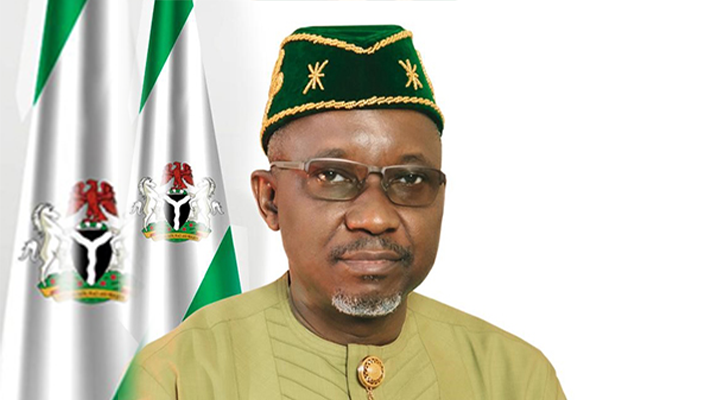
There are indications that the Nigeria-Libya Gas Pipeline would go from the drawing board to reality, as it has emerged as a major option to help Nigeria break into new markets for her gas reserves.
The Minister of State for Petroleum Resources (Gas), Ekperikpe Ekpo, disclosed this at Gastech 2026 in Bangkok, Thailand, during a high-level engagement with global energy companies, investors and governments on expanding Nigeria’s gas production, infrastructure, domestic utilisation and export markets.
The renewed push for the Nigeria-Libya pipeline topped the agenda for the meeting between Ekpo and Libya’s Minister of Oil and Gas, Dr Khalifa Rajab Abdulsadek.
Under the proposed framework, Nigeria and Libya are expected to explore a Memorandum of Understanding (MoU) and establish a joint technical team to assess the feasibility, financing, infrastructure requirements, security considerations and commercial viability of the project.
READ ALSO: ‘Obi Has Nowhere to Hide’ — APC Campaign Council Tackles Peter Obi Over Anambra Record
The NNPC Limited is expected to spearhead Nigeria’s participation in the bilateral initiative. If developed, the pipeline would provide another potential route for transporting Nigerian gas through North Africa to European markets, giving Nigeria an additional platform to monetise its gas resources beyond existing LNG channels.
According to Ekpo, the Federal Government was determined to create an investment environment capable of attracting the capital, technology and strategic partnerships required to convert the country’s gas reserves into economic growth, industrial development and jobs.
“Nigeria is open for business. We have put in place the right fiscal policies and operating environment, and the security of investors and their investments is guaranteed,” he said.
He revealed that the NNPC Limited would play a central role in translating Nigeria’s bilateral energy engagements into commercially viable projects, strategic investments and sustainable development.
The minister’s engagements also revealed plans by major industry players to significantly ramp up domestic gas production and infrastructure.
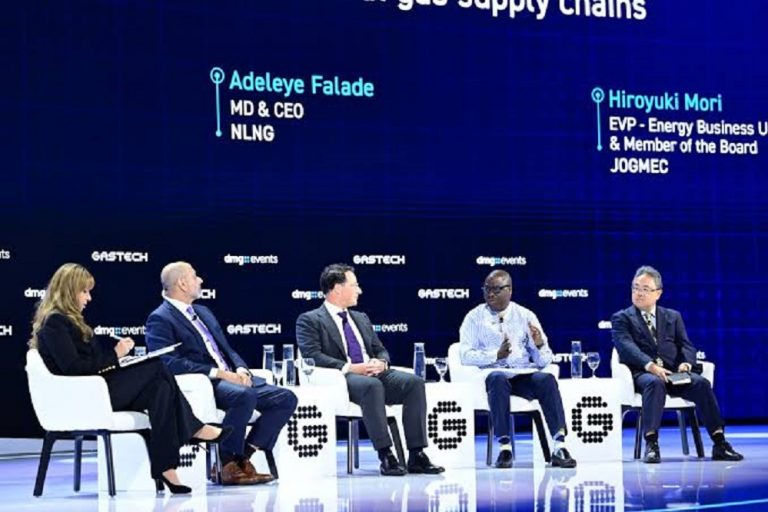
Gas producers must stop treating methane reduction as an environmental cost, because methane released into the atmosphere represents lost gas, lost revenue and lost energy that could otherwise be recovered and sold.
The Managing Director and Chief Executive Officer of Nigeria LNG Limited (NLNG) Adeleye Falade, made the declaration during a panel titled “Capturing the Lost Opportunity: Driving Global Alignment on Methane Abatement Across Natural Gas Supply Chains,” at the Gastech 2026 Exhibition and Conference in Bangkok, Thailand.
READ ALSO: Spike in Petrol Price Moves NLC to Demands Emergency Palliatives
Taking from the company’s experience, he highlighted that investments in methane abatement could pay for themselves while improving plant efficiency and asset reliability.
The NLNG CEO said the commercial value of recovering lost gas should become a central part of the global industry’s approach to methane management.
“Every tonne emitted is lost product, lost revenue and lost energy; gas we could have sold. Every molecule of methane avoided is both an emissions reduction and a recovered energy resource.”
According to him, the NLNG’s new boil-off gas compressor and start-up gas recovery project demonstrate the business case for methane reduction, with each project expected to deliver methane reductions of about 10–15 percent while also recording positive projected net present values. “The most compelling business case is the simplest one: the projects that cut our methane also pay for themselves.
“The same discipline that reduces methane also improves asset reliability and plant efficiency. The returns show up in more places than the emissions ledger,” Falade said.
He added that the starting point for methane abatement was credible measurement of gas losses, which enables companies to identify where methane is being lost, channel investment towards the right interventions and independently verify the results.
According to Falade, the NLNG had demonstrated that producers in developing economies could meet globally recognised standards for emissions measurement and reporting, despite infrastructure and other constraints.
He disclosed that the NLNG had achieved Gold Standard recognition under the Oil and Gas Methane Partnership (OGMP) 2.0 and became the first company in Africa to attain Level 5 methane emissions reporting.
Its measurement, reporting and verification system is independently assured by DNV in line with ISO 14064.
The NLNG’s methane-management programme includes site-wide optical gas imaging, a structured Leak Detection and Repair programme, as well as phased deployment of continuous monitoring and real-time emissions dashboards across its plant and vessels.
Falade said methane reduction was also being incorporated into the design of Train 7, which is expected to raise the NLNG’s LNG production capacity from 22 million tonnes per annum to 30 million tonnes.
The commercial case for emissions abatement was not new to Nigeria, he added, pointing to the NLNG’s longstanding role in converting gas that would otherwise have been flared into a marketable product.
According to him, the company’s activities have contributed to reducing Nigeria’s gas-flaring rate from above 65 percent to below 20 percent.
Beyond its own operations, Falade revealed that the NLNG was extending methane-management requirements across its supply chain through its Scope 3 Advocacy Plan.
The company engages feed-gas suppliers and contractors to measure, disclose and reduce emissions, while verified upstream emissions data and emissions-related criteria are incorporated into supplier selection and evaluation.
Falade also called for greater consistency in methane measurement and reporting requirements across jurisdictions, arguing that divergent standards make enforcement uneven and complicate meaningful comparisons between producers.
“The industry does not need weaker standards; it needs stronger, shared ones backed by real measurement,” he said.
On the tension between emissions reduction, energy access and affordability, Falade said developing economies should not be forced to choose between economic development and climate action.
“Developing economies cannot be asked to choose between economic development and emissions reduction. Both must progress together,” he said.
Other panellists were Zubin Bamji of the World Bank, Niels Dijksman of Brunei LNG and Hiroyuki Mori of JOGMEC.
The session was moderated by energy economist Dr Carole Nakhle of Crystol Energy.
Expectations are high that the $10 billion Train 7 project of the Nigeria Liquefied Natural Gas Limited (NLNG) would go into operation by the end of 2027.
Managing Director of NLNG, Adeleye Falade, made the disclosure on the side-lines of the Gastech conference, yesterday, in Bangkok, Reuters reported.
This is part of a grand strategy by the company to raise production and address persistent gas supply constraints.
READ ALSO: Banks Caution Against Scammers over Dangote IPO
Train 7 project, located on Bonny Island, Rivers State, is expected to increase NLNG’s production capacity to 30 million metric tonnes per annum (mtpa), from the current 22 mtpa.
The project has suffered repeated delays, including disruptions associated with the COVID-19 pandemic and the Russia-Ukraine war.
Falade also disclosed that NLNG remained under a force majeure declared in 2022 following widespread flooding that disrupted gas supplies to the company.
According to him, the company would lift the force majeure when it reaches a 90 per cent utilisation rate, with the plant currently operating at between 82 per cent and 83 per cent.
“We still have a delta of about 15 per cent that we need to close,” Falade said. “Operationally, we are able to do that, but our biggest constraint is gas supply, and we’re working with all the relevant people, including the government, to be able to get more gas to flow into the plant,” he added.
He said NLNG was focused on meeting its existing contractual obligations to buyers while the company worked to increase production.
Falade added that interest in additional LNG volumes and spot cargoes had increased after exports through the Strait of Hormuz were curtailed by the Iran war.
“People are looking at more diversified, reliable sources of supply,” he said.
“Our priority currently is to continue to make sure that we fulfil our obligations to our existing customers and maximize as much production opportunity as possible that we have,” he added.
The NLNG is majority-owned by the Nigerian National Petroleum Company Limited (NNPC Ltd), while Shell, TotalEnergies and Eni are its international partners.






Refineries, Exports Lift Nigeria’s Foreign Reserves over $55bn

Nigeria-Libya Gas Pipeline as FG Eyes New LNG Markets

Who Is Running Nigeria? ADC Demands Answers Over Tinubu, Shettima’s Absence

‘We’ll Bring Back Subsidy in Our Own Way’ — Kwankwaso

Stop Exporting Raw Minerals, Start Building Wealth From Your Resources – Tinubu to Africa

Adeleke Celebrates First Lady Oluremi Tinubu

Trump’s Family Unveils New Cryptocurrency Platform

Senate Denies Receiving Petitions Against Tinubu’s Ambassadorial Nominees

Dangote Cement Lights Up Benue Host Communities With CSR Initiatives

Reps Recommend 3-year Jail Term For Aviation minister

Tems Sets New Record On Billboard Hot 100 Chart
