
NEWS
Nigeria has spent $9 billion, lost 100,000 lives fighting Boko Haram – CDS


By Funmilayo Olusanya
Chief of Defence Staff (CDS) Lucky Irabor has bemoaned the country’s high human and financial consequences of the Boko Haram conflict.

Chief of Defence Staff (CDS) Lucky Irabor
On the final day of the third Ministerial Performance Review Retreat in Abuja yesterday, Irabor made the announcement, that since the insurgency started in 2009, Nigeria has lost 100,000 lives and spent $9 billion (about N3.24 trillion).
However, the General claimed that the insurgency had been contained to a region of the Northeast and estimated that over two million people had been made homeless as a result of the development.
The head of the Defense Department further confirmed that the Armed Forces had received N2.5 trillion in seven years and had been able to “tremendously” expand internal security activities.
According to him, the N2.5 trillion represents less than 0.5 percent of the country’s Gross Domestic Product and just 35% of the needs of the armed forces (GDP).
Regarding the Niger Delta activities, Irabor claimed that militancy had evolved into crude oil theft, a tendency that could be reversed by political leadership, military operations, and the participation of the populace.
Read Also >> Reps Minority Caucus Condemns Attack On PDP Campaign Rally In Kaduna
Boss Mustapha, secretary to the government of the federation (SGF), reiterated the government’s intention to start an aggressive tax mobilization campaign to lower the budgetary risks the economy faces during the retreat.
He emphasized that gasoline subsidies would gradually stop in 2023 and noted that the government had decided to put an end to oil theft.
Reeling out the nine Priorities/Presidential Legacy-Synthesis of Key Recommendations from panel sessions and Next Steps, Mustapha, said: “Our collective efforts will inform our contributions to the legacy of the Buhari administration with high-impact projects.”.
The SGF told the participants that Buhari expects to see these ideas and commitments coming to life on the dates promised.
Mustapha said that the Finance, Budget, and National Planning Ministry would drive aggressive revenue mobilization.
His words: “The government will continue its efforts to broaden the sources of foreign exchange and stimulate a greater supply of foreign exchange through the attraction of foreign direct investment.
”Fuel subsidy will eventually be phased out by next year and use every apparatus available to the government to fight oil theft.
The government will also invest in emerging areas of the oil and gas sector to unlock new investment opportunities.
Read Also >> Put Aside Ethnic, Religious Differences, Vote For Patriotic Nigerian – Obi
”Priority 2: Achieve Agriculture and Food Security: The Ministry of Agriculture and Rural Development has committed to embarking on an aggressive dry season farming immediately after the wet season to sustain increased food production.
”There is a need to address the logistics costs of moving agricultural products from the farm gates to markets to curb the issue of food inflation.
”The Ministry will also expedite action in rehabilitating the existing refineries and ensuring mechanisms are in place to cushion the effects of total removal oil subsidy.
”The Siemens Grid and Distribution Enhancement Project aims to achieve 25,000Megawatts by 2025. Early work orders and financing structure for the deployment of transmission and distribution equipment have been completed. Efforts are on towards the realisation of 11,000Megawatts of installed transmission capacity by 2023:
”Federal Government is to introduce robust mechanisms to track daily PMS consumption with appropriate technologies.
”Key infrastructure to be commissioned before May 2023 include the Lagos-Ibadan Expressway, the 2nd Niger Bridge, and the Kaduna-Kano highway.”


A truck carrying grains fell on its side after crashing into a road median at Itowolo, along the Ikorodu axis of Lagos State, early Thursday, occupying the entire Bus Rapid Transit (BRT) lane.
The incident occurred at about 5 a.m. along the route inward Agric and towards Ogolonto, according to the Lagos State Traffic Management Authority (LASTMA), which disclosed the development on Thursday.
SEE ALSO: Lagos: LASTMA Announces Traffic Restrictions Along Route to Toll Gate
The agency identified the vehicle as a white 10-tyre mini truck and confirmed that no casualties were recorded in the accident.
LASTMA said its officers were at the scene managing the situation, while recovery of the fallen vehicle was expected to commence shortly.
Despite the truck occupying the entire BRT lane, the agency said the incident was not affecting traffic flow at the time of its update.
The authority shared the information to alert motorists to the incident and its ongoing response at the scene.

The Commissioner of Police in Ogun State, Bode Ojajuni, has urged the Police Officers’ Wives Association (POWA) to transform its skills acquisition centre in Abeokuta into an industrial hub to promote job creation, entrepreneurship and women’s empowerment.
According to a statement signed by the Police Public Relations Officer, DSP Oluseyi B. Babas eyi, on Thursday, Ojajuni made the call on Monday when he led members of the Ogun State Police Command’s Management Team on an inspection visit to the POWA Skills Acquisition Centre at the Command Headquarters, Eleweran, Abeokuta.
SEE ALSO: Wife Dies in Ogun House Fire as Police Take 56-Year-Old Husband Into Custody
During the visit, the POWA Acting Chairperson, Bolanle Adeoye, and members of the association’s executive received the commissioner and conducted him around the facility, including its photography and make-up studios.
The centre is designed to equip POWA members and members of the public with practical vocational skills, promote entrepreneurship and create sustainable livelihood opportunities, particularly for women and young people.
Ojajuni charged POWA to leverage partnerships with government agencies, private sector organisations, manufacturers, vocational institutions and development partners to transform the facility into a thriving industrial hub.
He emphasised that the centre’s vision should go beyond skills acquisition to include enterprise development, productive ventures and employment generation.
According to the statement, the commissioner stressed the need for the initiative to create opportunities for beneficiaries to become self-reliant and contribute meaningfully to economic growth.
Ojajuni also highlighted the relationship between economic empowerment and crime prevention, noting that sustainable livelihoods could help address socio-economic factors associated with criminal activity.
He stressed that the centre could contribute to public safety through crime-prevention awareness, constructive community engagement and opportunities that encourage women and young people to pursue legitimate and productive ventures.
Commending Adeoye and the POWA Ogun State executive for their commitment to human capital development, the commissioner pledged the command’s support for the centre.
He reaffirmed the command’s readiness to encourage strategic collaboration and partnerships that would advance the facility’s development, expand its reach and strengthen its contribution to empowerment and community safety.
The Ogun State Police Command reiterated its commitment to supporting initiatives that promote productive engagement, strengthen community resilience and advance public safety across the state.

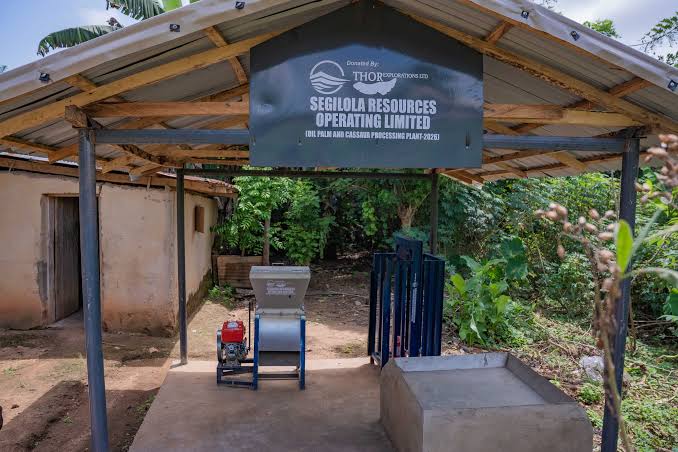
Thor Explorations Limited, through its Nigerian subsidiary, Segilola Resources Operating Limited (SROL), has provided 10 cassava and oil palm processing plants to host communities in Osun State to boost agricultural businesses, improve local livelihoods and create economic opportunities.
The initiative, which covers Imogbara, Odo-Ijesha and Iperindo communities, combines a 50 per cent equipment subsidy with a hire-purchase arrangement to help local processors acquire modern equipment and expand their businesses.
The project comprises six oil palm processing plants and four cassava processing plants allocated to selected beneficiaries across the three communities.
READ ALSO: FG Puts Daily Gas Output at 8bcf
Under the allocation, Iperindo received two oil palm plants and two cassava plants, while Imogbara and Odo-Ijesha each received two oil palm plants and one cassava plant.
Thor said the initiative was designed to address the challenges faced by local processors who rely on labour-intensive methods that limit production, increase processing time and reduce potential earnings.
Each oil palm processing plant comprises a vertical palm fruit debuncher and a diesel-powered automatic presser. The debunchers can process between 800 and 1,000 kilogrammes of palm fruit per hour, reducing the manual effort required to separate the fruits from their bunches.
The cassava processing plants are equipped with graters, manual pressers fitted with 32-tonne jacks and fryers for garri production.
Each grater can process up to 500 kilogrammes of cassava per hour, while the pressers remove excess water from grated cassava before further processing.
The company said the equipment would reduce strenuous manual work, improve processing efficiency and consistency, and enable beneficiaries to handle larger volumes of agricultural produce.
The subsidy and hire-purchase arrangement is also intended to make the equipment more affordable while encouraging business ownership, accountability and long-term maintenance.
Thor said agriculture remained an important source of livelihood in its host communities, adding that improved processing capacity would help local entrepreneurs build stronger businesses and participate more effectively in agricultural value chains.
Beyond the direct benefits to processors, the company expects the project to stimulate economic activities in transportation, trading and distribution, while improving product quality and creating opportunities for related local services.
The initiative forms part of Thor’s wider community investment programme implemented through SROL, which also covers women’s enterprise, education and livelihood restoration.
The company said the intervention reflected its commitment to strengthening local economies and creating sustainable livelihood opportunities in communities surrounding its Segilola Gold Mine.






Grains-Laden Truck Falls on BRT Lane in Lagos

Ogun Police Chief Urges POWA to Turn Skills Centre into Industrial Hub

Thor Empowers Host Communities with 10 Cassava, Palm Oil Processing Plants

FG Puts Daily Gas Output at 8bcf

With Crude at $111, IEA Sees Prolonged Crisis
NCDMB Joins Hand with Manufacturers to Boost Local Oil, Gas Components Production

Trump’s Family Unveils New Cryptocurrency Platform

Senate Denies Receiving Petitions Against Tinubu’s Ambassadorial Nominees

Dangote Cement Lights Up Benue Host Communities With CSR Initiatives

Reps Recommend 3-year Jail Term For Aviation minister

Tems Sets New Record On Billboard Hot 100 Chart
