Connect with us

NEWS

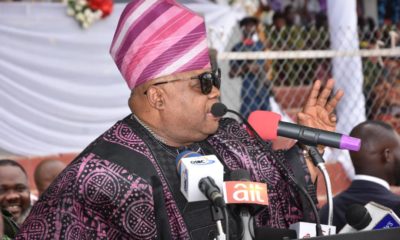
Osun Denies Taking N10bn Loan

Published

on

Four gang-killed two in Osun, destroy N8M properties

The Osun State Government has denied that it obtained a N10 billion facility in 2023.

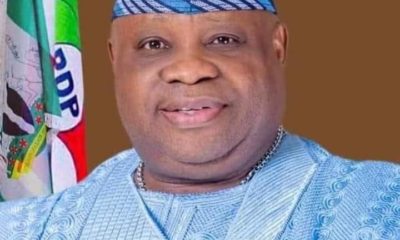
A government statement which conveyed this on Wednesday added that Osun State Governor, Senator Ademola Adeleke did not take any loan and was not planning to take any.

The Commissioner for Information, Kolapo Alimi said all current indebtedness of the state were contracted by previous governments of the All Progressive Congress (APC).

According to the Commissioner, since inception in November 2022, the current government has been servicing inherited debt and ensuring project implementation where the loan is tied to any project like the Ilesa Water Project.

Hon Alimi posited that as a responsible government with a focus on legacy attainments, Gov Adeleke adopted a no-loan policy which he has maintained since assuming office.

In his words, “What the opposition mischievously calculated as loans are World Bank and other multilateral institutions projects like NCares, Ramp and Ilesa Water Project.

“Is the opposition asking Osun State to opt out of many beneficial multilateral projects which are inherited from previous governments?

“We affirm that the State government will continue to support the people of the State in alleviating poverty through the Nigeria Covid-19 Action Recovery and Economic Stimulus (NCARES) with reimbursement from the World Bank through the Federal Government.”
NEWS

PwC Recommends Nigeria’s Oil Sector to South African Investors

Published

on

A call has gone to South African investors, banks, and policymakers to take direct stakes in Nigeria’s upstream oil sector to guarantee crude supply for their domestic refineries, adopting the same playbook European and American majors used to build energy security for their countries.

The PricewaterhouseCoopers (PwC) took the stance, even as the Nigerian Upstream Petroleum Regulatory Commission (NUPRC) urged members of the Crude Oil Refinery Owners Association of Nigeria (CORAN) to consider acquiring oil blocks in upcoming licensing rounds as a long-term solution to crude supply challenges.

The appeal by PwC was made by its Partner and Africa Oil and Gas Leader, Pedro Omontuemhen.

Omontuemhen spoke in Lagos during the Fourth South Africa Week, with the theme, “Repositioning and Promoting Energy Investments between South Africa and Nigeria.”

He stated that the two economies had complementary strengths across oil, gas, renewables, and enabling infrastructure that could create scalable, cross-border energy investment opportunities.

“Let me start from South Africa. If I were a South African, I would ask myself, where are the investment opportunities in Nigeria?” Omontuemhen said, referencing the Dangote Refinery’s plan to supply petroleum products across Africa.

ALSO READ: Salvation for All Souls Global Outreach Provides Free Medicals at Osun

He stated that South Africa had little or no oil, despite ongoing exploration in the Orange Basin.

Omontuemhen said nearby Namibia, which had the same sedimentary basin, had found oil, an indication that South Africa should also find but had not been able to do so at the moment.

Omontuemhen urged South African firms to replicate the model of the international oil companies (IOCs) by investing in the oil exploration and production space in Nigeria and securing crude for their home countries’ refineries.

He stated, “If I was South African, I would take the examples of the Americans or the British who came to Nigeria and invested in oil in Nigeria, and they took the oil back home to refine. Because South Africa at the moment is importing a lot of the oil they are refining.

“Why can’t the South African businessman or the South African bank, the DBSA, invest in oil in Nigeria and then take the oil? Because that’s your share of the crude, you take it back to South Africa, so that way, you’re also securing your supply, which is what the British and Americans did.”

He added, “ExxonMobil, Total, the French, they came here, invested in oil, and they took the oil back to their country to refine.”

Omontuemhen encouraged participation by South Africans in Nigeria’s ongoing oil bid round, where 50 oil blocks spanning onshore, swamp, shallow water and deep-water were being auctioned.

He stated, “Look for credible businessmen in the room here who you can invest in the oil. You take the crude oil and take it back to South Africa, that way, you’re actually securing your supply. And I think you should also do the same thing when you come to Namibia.”

Omontuemhen, who further spoke on the opportunities in the upstream oil and gas sectors in Nigeria and South Africa, cited joint exploration, production sharing, and technology transfer.

He stressed that Nigeria’s deep-water assets offered premium opportunities for South Africa technical partners.

For gas, Omontuemhen said there was huge value in monetising Nigeria’s gas flares, supplying South Africa’s energy transition, adding that a combined liquefied natural gas (LNG) value chain creates significant multi-billion-dollar potential.

In renewables, he said “SA’s solar and wind expertise meets Nigeria’s abundance of solar irradiation,” opening room for “utility-scaled projects and distributed energy solutions”.

He made a strong push for dual listings for both countries, highlighting access to multiple capital markets through listings on two exchanges, enhancing liquidity, visibility, and investor participation.

Pointing to Seplat’s Nigeria-London listing, Omontuemhen asked, “Why are we not listed in South Africa? What should we do in South Africa to make the dual listing more attractive to the Nigeria oil and gas fields?”

He recalled Oando’s earlier failed Johannesburg listing, saying other Nigerian firms can try it again and learn from the mistakes of others.

Omontuemhen pointed out that South African technology remained underutilised.

According to him, “Sasol developed a technology that Chevron copied and it’s all over the world. Why are more companies in Nigeria not using the Sasol technology? To take your stranded gas and make it more valuable, so you can have your naphtha and your diesel.”

He described South Africa’s financial sector as a source of cheap capital, explaining that the banks in South Africa have what he called ancient capital that have been there for years and well-established.

He explained, “So we can tap on that resource as Nigerians to produce here in Nigeria. Can you guys come and invest and participate in what we are doing?

“Nigeria has huge resources, huge population. South Africa, good technology, well-structured, and systems that work. So we can collaborate as two giants of Africa to make our country even much better and to make the continent much, much better.”

Omontuemhen stated, “Private investors play a critical role in mobilising capital, accelerating delivery, and improving operational performance across the energy value chain. Working with governments, the private sector can mobilise capital, de-risk investment, enable growth, improve education and efficiency, and ensure both countries benefit.”

Referring to South Africa and Nigeria as the biggest countries in Sub-Saharan Africa, the PwC energy expert said South Africa stood at 19 per cent and Nigeria at 40 per cent in the continental Gross Domestic Product (GDP) but their power profiles differed sharply.

He said South Africa had 55.4 gigawatts of installed power capacity while Nigeria had 14GW for a far larger population.

According to him, “They actually have more power per person than we do in Nigeria. If you’re talking about energy security, which we call energy poverty, there’s more energy poverty in Nigeria than in South Africa.”

Omonfoman stated that recent mergers and acquisitions (M&A) in Nigeria showed momentum, citing the Seplat-ExxonMobil deal, Renaissance acquisition of Shell Petroleum Development Company (SPDC), Oando’s purchase of Eni, and Axxela-Blue Coal.

He stated, “So there are deals going on, so even in the midst of all of these issues we’re talking about, there are still huge opportunities to make money.

“If you look at the acquisition that happened in the oil and gas field, for example, most of those monies have either come from locally or from other African countries. The rest of the world is not as interested in investing in us. So the need for what I call South-South collaboration, Africa collaboration is much stronger.”

He admitted that private sector interest was rising, alongside policy reforms, and tweaking with the policy to ensure a better outcome.

Omontuemhen mentioned the Electricity Act, tariff rebalancing, and other policies that were unlocking potential.

He added, “The market potential is huge. I think that kind of gives me joy that, even though in the midst of darkness, in Nigeria, light will come.

“So Nigeria and South Africa, if it’s going to be, it’s up to us. We have a role to play to ensure that our country gets better. Why, we’re not talking to each other, why, we’re not doing projects jointly, and then this will lead to local capacity development, job creation, and long-term sustainability.”

Meanwhile, amid complaints of crude supply deprivation, NUPRC urged members of CORAN to consider acquiring oil blocks in upcoming licensing rounds as a long-term solution to crude supply challenges.

Chief Executive of NUPRC, Oritsemeyiwa Eyesan, made the call during a courtesy visit by CORAN members to the commission’s headquarters in Abuja, where both parties discussed ways to strengthen domestic refining capacity and ensure sustainable crude supply.

A statement by CORAN spokesperson, Eche Idoko, quoted Eyesan as, “Encouraging indigenous refiners to participate in upstream asset ownership would create more stable and commercially viable crude supply arrangements while also deepening local participation across the petroleum value chain.”

She assured the refiners that Nigeria had adequate crude resources to meet domestic refining needs, and reiterated the commission’s commitment to policies that promoted in-country value addition.

The NUPRC boss also advised refinery operators to adopt long-term crude supply contracts with producers as a practical approach to guaranteeing feedstock availability, improving operational planning, and achieving pricing stability.

However, she stated that infrastructure gaps remained a major hurdle to seamless crude delivery, citing inadequate pipeline networks, evacuation bottlenecks, storage constraints, marine logistics, and other supply chain challenges as areas requiring urgent investment and coordinated efforts.

Members of CORAN commended the commission’s ongoing regulatory reforms and its support for domestic refining, while stressing the need for effective implementation of frameworks that ensure consistent crude supply to local refineries.

Stakeholders had always emphasised that improved access to crude feedstock was critical to reducing Nigeria’s dependence on imported petroleum products, enhancing energy security, conserving foreign exchange, and creating jobs through the growth of local refining capacity.

Idoko said the meeting was part of ongoing engagements between regulators and private refinery operators aimed at unlocking the full potential of Nigeria’s downstream petroleum sector.

Continue Reading

NEWS

Salvation for All Souls Global Outreach Provides Free Medicals at Osun

Published

on

The Salvation for All Souls Global Outreach, SAFAS, a leading evangelical ministry with a focus on delivering free humanitarian and robust healthcare for the less privileged in the society has concluded its one-day free medical outreach in Ifewara, Osun State, where hundreds of residents benefitted from various healthcare services.

The outreach, which was held on Saturday, April 25, 2026, at Akinyemi Memorial Grammar School, offered free medical consultations, health screenings, surgeries, dental care, medications, eye care services including free glasses, as well as health education.

The ministry also provided financial support to widows and widowers in the community.

The initiative, carried out in collaboration with the Christian Medical and Dental Association, Osun State chapter, forms part of SAFAS’ established model of combining medical intervention with a follow-up crusade, a structure the organisation has previously implemented in Lagos, Abeokuta and Ibadan before extending to Ifewara.

Speaking on the development, the President of SAFAS, Apostle BOT Adeyemi, said the outreach reflects the organisation’s commitment to meeting the holistic needs of communities, noting that the model has consistently delivered impact across different locations as it addresses both physical and spiritual concerns.

ALSO READ: Dangote Leads East Africa’s Industrial Revolution

Also, the Media Director of SAFAS, Ayomikun Bamgboye, explained that the approach goes beyond immediate relief, adding that the integration of medical outreach with a crusade ensures sustained engagement and deeper transformation within host communities, as seen in previous outreaches across the country.

One of the participating medical practitioners, who spoke on the exercise, described the outreach as timely and impactful, noting that many beneficiaries accessed quality healthcare services they would otherwise not have been able to afford.

Following the medical outreach, the organisation is set to commence a crusade in Ifewara from April 27 to May 1, 2026, aimed at providing spiritual support and reinforcing the gains recorded during the medical intervention.

SAFAS has continued to expand its outreach footprint across Nigeria through integrated programmes that combine healthcare delivery with social and spiritual support for underserved communities.

Photo Caption
Health officials offering free medicals at the event

Continue Reading

NEWS

Horror in Kogi: Gunmen Abduct 24 Pupils in Orphanage Raid, 15 Rescued

Published

on

Tragedy struck in Kogi State as armed men invaded an orphanage facility and abducted 24 persons, including 23 pupils and the wife of the school proprietor, in a violent night attack that has thrown the community into panic.

The Kogi State Government confirmed the incident on Monday, revealing that security operatives have so far rescued 15 of the victims, while efforts are ongoing to free the remaining abductees.

ALSO READ: Kogi Chamber Honours Dangote Cement over Impactful Social Performance

According to the State Commissioner for Information, Kingsley Fanwo, the attack occurred on Sunday, April 26, 2026, when gunmen stormed the premises of the Dahallukitab Group of Schools, a facility located in a remote and bushy area of the state.

Fanwo explained that the orphanage was not registered with the state government, describing its operation as illegal and noting that it had no formal approval or security clearance from relevant authorities.

He said the attackers whisked away 23 pupils alongside the wife of the proprietor before security agencies swiftly responded to the distress call.

“The swift intervention of security agencies led to the rescue of 15 of the abductees, while efforts are ongoing to secure the release of the remaining victims,” the commissioner stated.

Security operatives, led by the Nigeria Police Force in Kogi State and supported by other agencies, have intensified search-and-rescue operations in surrounding forests and suspected escape routes.

Fanwo commended the professionalism of the security forces, noting that their rapid response helped prevent a worse outcome.

He also raised concerns over the operation of unregistered schools and orphanages in isolated locations, warning that such establishments expose children and staff to serious security risks.

According to him, the government has reiterated its warning to operators of educational and care facilities to ensure proper registration and compliance with safety regulations.

He added that investigations are ongoing, while assuring residents that the government remains committed to rescuing the remaining victims and bringing the perpetrators to justice.

Security has since been reinforced in the affected area as search operations continue.

Continue Reading

Copyright © 2022. Biztellers, powered by Alphaxristi.

0
Would love your thoughts, please comment.x
()
x