
NEWS
Osun Workers Celebrate Adeleke, As ‘Most Humane Governor’

. . . Governor Issues N2.9 Billion Naira Pension Bond
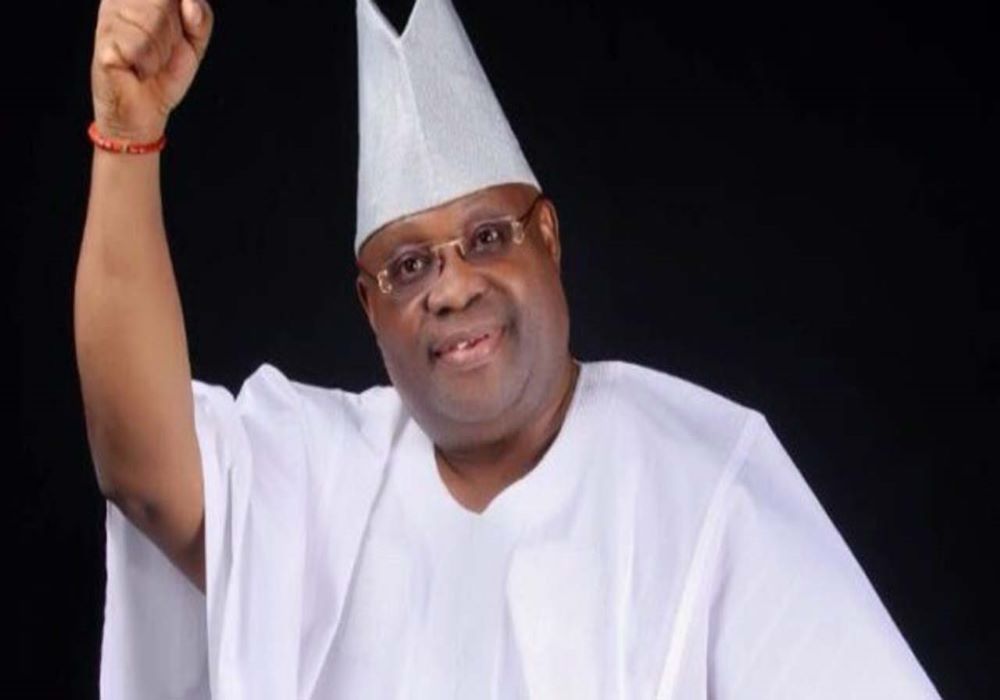
It was a carnival show at the Governor’s office as the entire Osun public workers gathered to confer award of the ‘Most Humane Governor of the Year’ on Governor Ademola Adeleke.
Spokesperson to the State Governor, Olawale Rasheed, communicated this in a statement on Thursday in Osogbo.
He stated that workers in their hundreds led by Comrade Lasun Oladele, the Chairman of the Joint Negotiating Council, presented the award of the “Most Humane Governor of the Year” to the Governor with top ratings and ranking for the Governor across the sectors of the state economy and governance.
Rasheed noted that all public service union leaders took turns to reel out justification for the award.
Head of Service, Elder Ayanleye Aina, highlighted that the event was not just an award but the governor giving out of another Two Billion, Nine Hundred Million naira, pension bond made the gathering a unique one.
“Your Excellency, the entire workforce of Osun State and retirees have a lot to celebrate today as we rejoice with you on the conferment of this well-deserved award by the Labour Leaders in the State on you.
“Experience has shown very clearly that there is a wide gap between campaign promises and the actual delivery of dividends of democracy. The case of our amiable Governor is a radical departure from this position as workers and retirees have continued to benefit from the kindness of the Governor. You indeed displayed great character and integrity by fulfilling your campaign promises to the workers and pensioners in the State in many areas:
“Prior to the advent of your Administration in the State, senior workers were owed several months of unpaid half salaries, a situation that came to the national limelight. Believing that governance is a continuum, your administration has been consistently offsetting these backlog of salary and pension arrears.
“As we speak, four months’ arrears have been paid to date
“Your administration cash-backed arrears of promotions from the previous Administrations which were in millions of naira
“You broke the age long jinx of aberration of Coordinating Directors as career heads of MDAs by appointing qualified civil servants as Permanent Secretaries, an action that brought life back to the entire Civil Service. You have said this is a continuous exercise.
“You have consistently approved release of fund for officers to embark on professional training to enhance their performances at work.
“You have ensured regular and consistent payment of full salaries and pension without hindrance.
“You recently granted approval for conduct of year 2023 promotion for all categories of qualified workers across the entire gamut of the public service. As we speak, the enabling circular has been issued by the Civil Service Commission.
“You increased the monthly release of fund for the payment of gratuities for retirees at the State level by 100%, that is, from N50m to N100m.
“You increased the monthly release of fund for the new pension scheme from N175m to N350m, that is, by 100%. At the local government level, it was increased to N400m.
“Recently, you graciously approved the payment of #15,000 palliative to each worker and #10,000 to each retiree beginning from this month to cushion the effect of petroleum subsidy removal”, the Head of Service noted
Speaking further, Elder Aina, said, “There is no further testimony to your benevolence, sir, as today your Excellency is set to release bonds worth billions of naira to retirees under the new pension scheme to make life more bearable for them.
“All of these have been achieved through prudent fiscal policy that have not in any way affected the capital expenditure of government.
“Given all these, I wish to remind all public servants of the popular adage that ‘to whom much is given, much is expected’. I encourage us to re-dedicate ourselves to the ideals of the Service so as to enhance our productivity, efficiency and capacity in the discharge of our official duties. This is the only way we can really appreciate the kind gestures of our Governor towards us”, he concluded.
Osun will soon Become Singapore of Nigeria– Governor Adeleke
Delivering his speech, Governor Adeleke assured Osun people of sustained pursuit of the progress of the state, saying he will continue to give priority to the welfare of workers in the state.
“Today, I am again deeply overwhelmed by the show of love and support from great Osun workers and retirees. The outpouring of affection for me and my team has further rekindled my faith in our five-point agenda for which workers’ welfare is number one.
“Some months ago, the Nigeria Union of Pensioners conferred on me the award of the most workers’ friendly governor. I was told that was the first time the union would grant such honor to a serving Governor. Here we are today again with the entire workforce of the public service acknowledging our modest contributions to the development of our dear state.
“The positive testimonies from the various unions and labour leaders attested to the correctness of our original thinking when running for the state governorship. We had analyzed the political space and concluded then that the smartest way to grow Osun is workers’ welfare. We accept and adopt the reality that human capital is a strong foundation for integrated development of the state.
“We had also spotted the nexus between formal and informal workers in the state. Easing the challenges of the public service has the tendency to uplift the economic well-being of the informal sector. These analyses were responsible for placing workers’ welfare as number one priority in our governance agenda.
“We are vindicated today as the workforce has validated our approach to governance. This vindication has challenged our team to remain focused and engaged in our relentless drive for new life for our people. I long to expand our capacity to meet the needs of the people, to deploy human development as a tool for societal transformation. We will further innovate as a government to meet workers at the point of their needs.
“I, therefore, humbly accept this award as ‘The Most Humane Governor of the Year’. Dear workers and stakeholders, I cherish this honour done to me and my team. You have further fired our existing strong interest in welfare issues for both serving and retired members of the workforce.
“It is in this direction that I have further approved the release of another tranche of bonds totaling Two Billion, Nine Hundred and Twenty-Five Million, Three Hundred and Thirty-Two Thousand, Eight Hundred and Thirty-Five kobo (N2,925,332,835.75).
“The breakdown is as follows:
“State Retirees – One Billion, Three Hundred Million Naira (N1,300,000,000.00);
“LG/Primary School Retirees- One Billion, Six Hundred and Twenty-Five Million, Eight Hundred and Thirty-Five Thousand Naira (1,625,332,835,75);
“Permit me to list the government commitment on Pension and Gratuities from inception to November, 2023 as follows:
“(A) STATE LEVEL (Civil Servants, Parastatals, Tertiary Institutions, UNIOSUN Teaching Hospital) Retirees;
“Contributory Pension Scheme (Seven Billion, Four Hundred and Forty-Four Million, Eight Hundred and Fifty-One Thousand, Six Hundred and Eighteen Kobo (7,444,851,618.16);
“Gratuities- One Billion, Two Hundred Million Naira Only (1,200.000.000.00);
“Monthly Pension – Five Billion, Nine Hundred and Ninety-Six Million, Thirty-Five Thousand Naira, Seven Hundred and Eleven Kobo (5,996,035,711.00);
“This bring state’s total to Fourteen Billion, Six Hundred and Forty Million, Eight Hundred and Eighty-Seven Thousand, Three Hundred and Thirty Kobo (14,640,887,330.15).
“(B) LOCAL GOVERNMENTS (Local Governments and Primary Schools’ Retirees)
“Contributory Pension Scheme is Seven Billion, Three Hundred and Eighty-Four Million, One Hundred and Seventy-Eight Thousand, Sixteen kobo (7,384,178,016.83);
“Gratuities – One Billion, Nine Hundred and Fifty Million Naira (1,950,000,000.00);
“Pension – Four Billion, One Hundred and Sixty-Six Million, Six Hundred and Nine Thousand, One Hundred and Eighty-Two kobo (4,166,609,182.61);
“Total for Local Government is Thirteen Billion, Five Hundred Million, Seven Hundred and Eighty-Seven Thousand, One Hundred and Ninety Kobo (13,500,787,199.44).
“Permit me to use this opportunity to commend the Head of Service, Elder Ayanleye Aina. You have been a wonderful leader of the civil service with laudable delivery in public service management. I thank you for your great service
“I extend the same commendation to top management of the service as well as middle and lower level officers. I appreciate your commitment to duty and loyalty to our common agenda for societal prosperity.
“We remain strongly pro-people, pro-workers and pro-development. We will continue to combine welfare of the people and workers with state of the art infra upgrades of our dear state. Osun is targeted to be a Singapore of Nigeria, the Governor noted.”







The 15th edition of the Practical Nigerian Content Forum (PNCF) is billed for Yenagoa, Bayelsa State from November 30.
This edition of the initiative of the Nigerian Content Development and Monitoring Board (NCDMB) would hold be in collaboration with the Bayelsa State Government as disclosed on Tuesday when a delegation of the NCDMB and DMG Events met with the Deputy Governor of Bayelsa State, Dr Peter Pereotubo Akpe, at the Government House, Yenagoa.
Leading the delegation, the General Manager, Corporate Communications Division of NCDMB, Dr Obinna Ezeobi, conveyed the appreciation of the Executive Secretary of the board, Felix Omatsola Ogbe, to the state government for its continued support for the forum.
He said, “We appreciate the Bayelsa State Government for its continued partnership and support for the PNC Forum”.
READ ALSO: 40 Oil Blocks up for Grabs as NUPRC Opens 2026 Bid Round
According to him, the Youth PNC was designed to expose young people in the Niger Delta to emerging opportunities in the oil and gas industry and the competencies required to build successful careers in other sectors of the economy.
Ezeobi added, “We have introduced new initiatives into this year’s programme to ensure that the PNC continues to deliver greater value to participants and address emerging issues in the Nigerian content space.”
The Senior Manager, Zonal Coordination, NCDMB, Mr Adebayo Joseph, spoke on plans for the Youth PNC, while the leader of the DMG Events delegation, Ms Olamide Oloko, outlined the major activities planned for the conference.
Oloko said the new initiatives would include a Local Content Roundtable and a two-day programme for Local Community Contractors aimed at helping them scale up their operations.
She added, “The 2026 edition will also feature a breakout session to collate stakeholders’ views on the future direction of Nigerian Content over the next decade.”
Responding, Akpe assured the NCDMB and DMG Events of the state government’s continued support for the PNC Forum.
Akpe said, “The Bayelsa State Government is committed to ensuring that the event is successful and that participants have a conducive and secure environment throughout their stay in the state.”
He said the initiative demonstrated the practical impact of the programme and urged the board to sustain efforts aimed at creating opportunities for young people in the region.


Nigerian women allegedly being held at a deportation facility in India have cried out over their treatment, with a video circulating online showing some of them displaying injuries and alleging that security personnel flogged detainees.
The video began circulating online on Wednesday and shows a group of Nigerian women inside and around what they described as a deportation camp.
Several of the women pointed to marks, bruises and apparent injuries on their legs, feet and bodies while alleging that they were beaten with sticks or canes.
SEE ALSO: Rufai Oseni Row: NiDCOM Breaks Silence on Nigerians Detained in India, Addresses Ekene’s Case
“See my video, see my leg,” one of the women could be heard saying in the footage.
Another woman said, “Mona see wetin dem dey do for deportation camp.”
“Deportation camp, na dem flog person, see,” another woman said while showing what appeared to be an injury.
The women further alleged that female detainees were beaten with sticks.
“Dem dey use stick dey flog women, mona dey see am,” one of them said.
Another woman, while pointing at an injured detainee, said, “Dem carry cane flog o… see her body, dem flog am.”
The women also alleged that police officers carried sticks inside the facility.
“Police carry stick like say dem dey cut firewood,” one of the women said.
The footage shows the women appearing distressed as they moved through the facility and gathered in an outdoor area.
They repeatedly appealed to Nigerians to share the video and draw attention to their situation.
“Make una see… make this video trend/go,” one woman said.
“Make una share am,” another added.
One of the women also expressed frustration over their alleged experience at the facility, saying, “We don suffer, every time, every time.”
The footage comes amid ongoing concerns over Nigerians detained at the Lampur detention centre, also known as Sewa Sadan, in New Delhi.
Recall that in September, reports emerged that more than 200 Nigerians were being held at the facility, with some detainees alleging poor food, inadequate medical care and prolonged detention.
The Nigerians in Diaspora Commission (NiDCOM) subsequently defended its handling of the situation and said the Nigerian High Commission in India was seeking another amnesty period to facilitate the departure of Nigerians without proper immigration documentation.
No official response from the Indian authorities or the Nigerian government specifically addressing the allegations in the latest video had been made available at the time of publication.

Rights activist, public affairs analyst and Chief Executive Officer of The Dialogue, Shehu Muhammad, has questioned the continued occurrence of military aircraft crashes despite the huge budgetary allocations to the country’s defence and security sector.
Muhammad spoke while reacting to the recent Nigerian Navy aircraft crash in Irele Local Government Area of Ondo State during an interview on Channels Television’s The Morning Brief.
Describing the incident as “one incident too many,” he recalled that Nigeria had recorded several military aircraft crashes involving the Nigerian Air Force and Nigerian Army over the years.
RELATED NEWS: Military Gear Found at Ondo Crash Site as Helicopter Burns to Rubble
He said the recurring incidents had raised concerns among members of the public about the condition of military aircraft and the process through which military hardware is procured.
“People have begun to cast aspersions as to the honesty, sincerity, and openness in the purchase of military hardware, including airplanes,” Muhammad said.
According to him, the concerns are heightened by the substantial funds allocated to the military and other security agencies over the years.
“There are insinuations by the public that, after all, the military receive the highest amount of money from the budget year in, year out,” he said.
Muhammad also questioned the transparency of defence procurement, particularly the process of selecting contractors for the supply of military equipment.
He argued that the repeated crashes should prompt authorities to examine military aviation operations, aircraft procurement and the management of defence resources.
The latest crash occurred in Irele, Ondo State, with recovery efforts reportedly complicated by the difficult terrain around the crash site.
Muhammad said the latest incident should not be treated in isolation, but should lead to broader questions about military aviation safety and the management of resources allocated to the defence sector.
He called for greater transparency and accountability in the procurement and management of military hardware to restore public confidence.





World Bank Report: ‘Nigeria Needs 10% Growth for 20 Years to Reduce Poverty’ — Ekpo
Yenagoa Hosts NCDMB 2026 Content Forum

IPO: ADF Opens Wealth Creation Pathway for 2m Vulnerable Nigerian Women

2027: Tinubu Will Beat Atiku, Obi by Wide Margin, Says Bwala

‘Dem Dey Use Stick Dey Flog Women’ — Nigerians in India Camp Cry Out

2027: I’ll Bring Petrol Price Down to ₦300, Says Donald Duke

Trump’s Family Unveils New Cryptocurrency Platform

Senate Denies Receiving Petitions Against Tinubu’s Ambassadorial Nominees

Dangote Cement Lights Up Benue Host Communities With CSR Initiatives

Reps Recommend 3-year Jail Term For Aviation minister

Tems Sets New Record On Billboard Hot 100 Chart
