
Energy
Schneider Electric’s BipBop access to energy program five times recognized at the Africa Forum


…100 innovations for sustainable development
RUEIL-MALMAISON – Schneider Electric announces that five projects in its BipBop (1) access to energy program have been chosen to participate in the “Africa Forum – 100 innovations for sustainable development” taking place in Paris on 4 and 5 December 2013.
This forum was initiated by the French Ministry of Foreign Affairs, prompted by the Deputy Minister responsible for Development, Pascal Canfin, in partnership with the French Development Agency (AFD).
The “Africa Forum – 100 innovations for sustainable development” aims to highlight innovative concrete examples and practical solutions on a national or local scale, in such varied fields as health, the environment, agriculture and food safety, education and new technology. In addition to the entrepreneurial nature and economic viability of these innovations, their contributions to sustainable development and their social and environmental dimensions will be recognized. The event follows on from the Development and international solidarity forums, closed on March 1st 2012 by the French President. It is evidence of France’s support, via the AFD Group, for the promotion of innovative sustainable development in Africa.
Five projects developed by Schneider Electric in the context of BipBop, its access to energy program, were selected from the 100 projects presented:
– “Energy and Microfinance” project in Cameroon – Sponsored by the PAMIGA (Participatory Microfinance Group for Africa) association, in collaboration with Schneider Electric and the MIFED in Cameroon, this project consists of offering micro-credit solutions in rural and urban areas to finance the purchase of solar solutions. Such schemes can boost the economic development of individual tradesmen and small businesses. Schneider Electric provides solutions which meet the needs identified by microfinance institutions (MFIs) and entrusts its local partners Sorepco and Instrumelec to ensure respectively their distribution and installation, thus guaranteeing a qualitative service down to the end of the chain. The customers of these MFIs are offered two types of credit: “light” credits which offer low-energy solar lighting systems; and “energy” credits, designed to provide solar solutions suitable for the needs of an income-generating activity. This project has also been initiated in Tanzania and Ethiopia.
– The decentralized rural electrification project at Abu Monkar in Egypt – This Schneider Electric project, in partnership with Instrumelec, paved the way for development of the first solar power plant built in the Egyptian province of New Valley. The solar power plant at Abu Monkar, built more than 75 miles from the nearest grid, delivers 108 kWh/day, enough to meet all the village’s basic needs (school, mosque, homes, etc.). Schneider Electric also trains the residents of Abu Monkar to ensure optimal operation and maintenance of the power plant.
– « Pay-as-you-go » Solar Energy project in Nigeria – This project developed by TXTlite Nigeria LTD is sponsored by the Schneider Electric Energy Access Fund (SEEA) which provides equity injection or debt financing to local companies, to help them reach viability. Txtlite’s generation assets consist of “home power stations” and centralized management, control and billing infrastructure. Txtlite’s Power Box includes solar panels and a battery with built-in security chip against tampering and theft. It is a small portable kit for self-installation, which is available through the existing cellular sales channels. It provides electricity to off-grid population at the same price as kerosene cost. Regarding the second asset, Txtlite integrates to the MNO’s (Mobile Network Operator) billing systems and can easily integrate to mobile money, USSD (Unstructured Supplementary Service Data) or premium SMS.
– BrightBox project in Kenya –Schneider Electric across it’s Energy Access Fund (SEEA) sponsored One Degree Solar (ODS), which designs and manufactures micro-solar products for low-income households and small businesses across Africa. BrightBox is a micro-solar home system that powers up to 4 light bulbs and radios, phones, and virtually any USB-charged device.
– Decentralized Rural Electrification of Pitti-Gare in Cameroon – Schneider Electric implemented in Pitti-Gare village, Villasol, it’s solar-powered micro off-grid facility solution for decentralized rural electrification. This standardized solution consists in photovoltaic panels, a battery bank and a battery charging station that enable a communal recharge system. The facility supplies domestic, entrepreneurial and community needs such as schools, health centres, water supply, public lightings for around 100 households, without connection to the national grid. This project allows 300 people to access a clean energy.
“The strength of the BipBop program relies on the combination between the R&D capabilities of Schneider Electric and the engagement of our local employees who all know perfectly their own countries’ problematic and ecosystems. Answering the rural energy challenge is key both for the continent’s economical development and for the people who directly benefit from light, from a better agriculture, education or healthcare. It is an exciting challenge and I think all our employees who made these five BipBop projects happen can be very honored and proud to see their efforts recognized by the French government”, states Mohammed Saad, President of Schneider Electric in Africa.
In the context of the Forum, René Pierrot Ekoé, Sustainable Development Engineer at Schneider Electric Cameroon and sponsor of the “Energy and Microfinance” project, was selected with 20 other project sponsors to speak on 5 December 2013 and share the Group’s ideas on best practice.

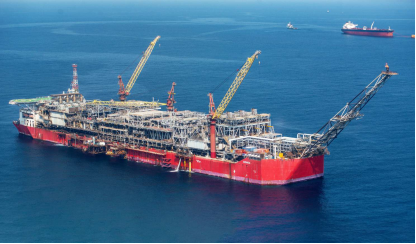
The Shell Nigeria Exploration and Production Company Limited (SNEPCo) has completed the turnaround maintenance on the Bonga Floating Production, Storage and Offloading (FPSO) vessel, leading to resumption of production at Nigeria’s premier deepwater field on March 6, 2026.
Biztellers reports that the project was delivered 11 days ahead of schedule and without any safety incident, reinforcing SNEPCo’s longstanding commitment to operational excellence and asset integrity.
“Completing the turnaround safely and ahead of schedule is a testament to the dedication and professionalism of our Nigerian workforce and the helpful support of our partners,” SNEPCo Managing Director Ronald Adams said. “The achievement not only secures the long‑term integrity of the Bonga FPSO but also positions us strongly for the successful delivery of the Bonga North project, which will leverage the improved reliability of the FPSO.”
The exercise which began on February 1, 2026, highlights SNEPCo’s leading role in advancing deep‑water expertise in Nigeria. Of the 55 companies involved in the execution, 43 were wholly Nigerian. Additionally, eight of the 12 international service providers maintain operational bases in Nigeria, contributing to knowledge transfer and increased local investments.
More than 1,000 personnel worked offshore during the turnaround, with over 95% being Nigerians involved in maintenance, engineering, operations, inspection and construction. Thousands more supported activities from onshore locations, reflecting the depth of Nigerian capability in offshore oil and gas operations.
Adams added: “We acknowledge the support of several stakeholders towards the successful execution of the exercise, including the NNPC Upstream Investment Management Services (NUIMS), the Nigerian Upstream Petroleum Regulatory Commission (NUPRC), the Nigerian Content Development and Monitoring Board (NCDMB) and our partners.”
Modupe Asudo
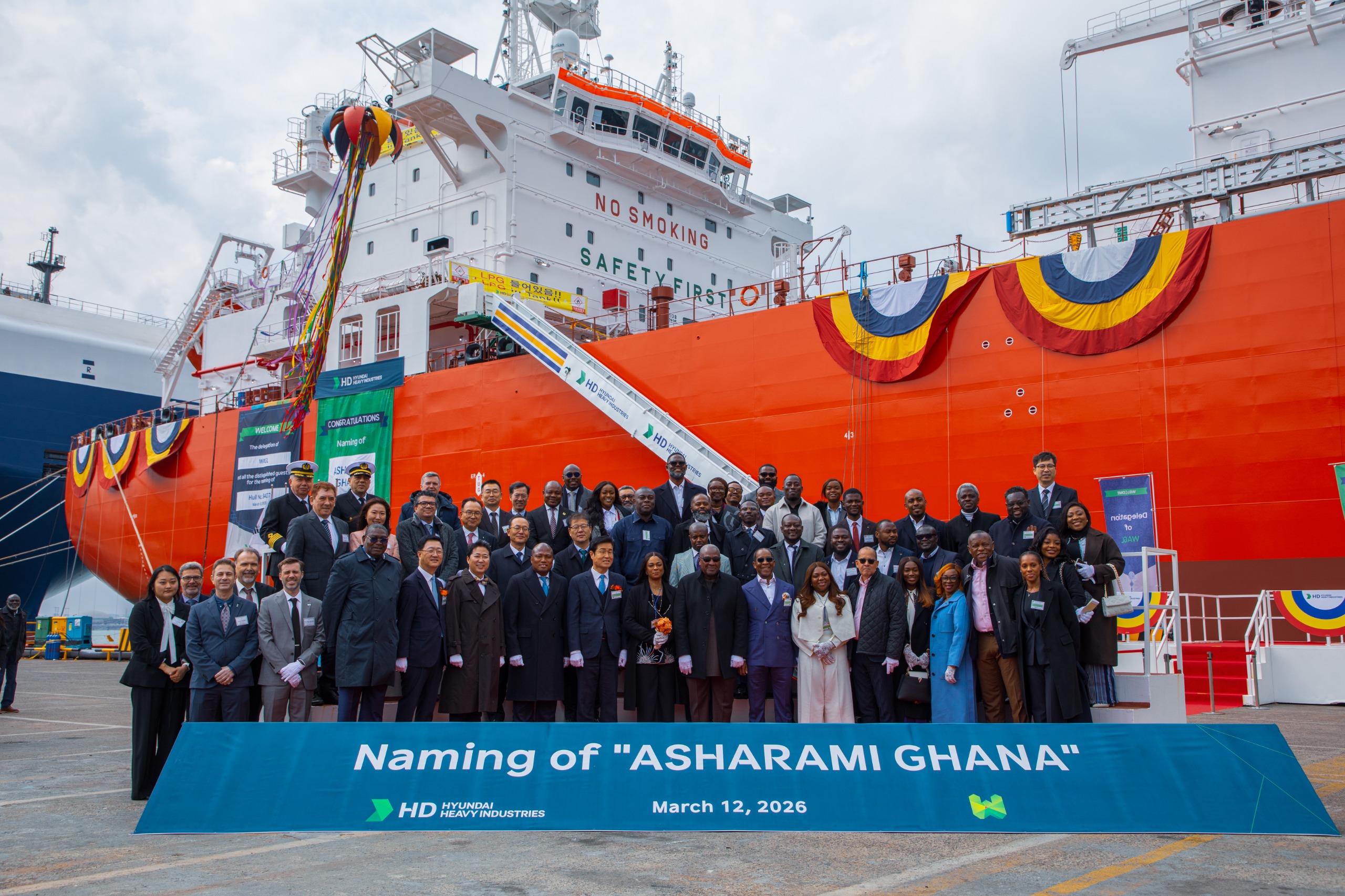
Sahara Group, a leading global energy and infrastructure conglomerate, has commissioned MT Asharami Ghana, a 40,000‑cubic‑metre Liquefied Petroleum Gas (LPG) carrier, expanding its fleet capacity, while strengthening Ghana’s clean energy supply chain and LPG distribution network.
The dual‑fuel vessel improves operational efficiency, enhances supply reliability, and supports lower‑emission LPG logistics as consumption grows across Ghana and the wider sub‑region.
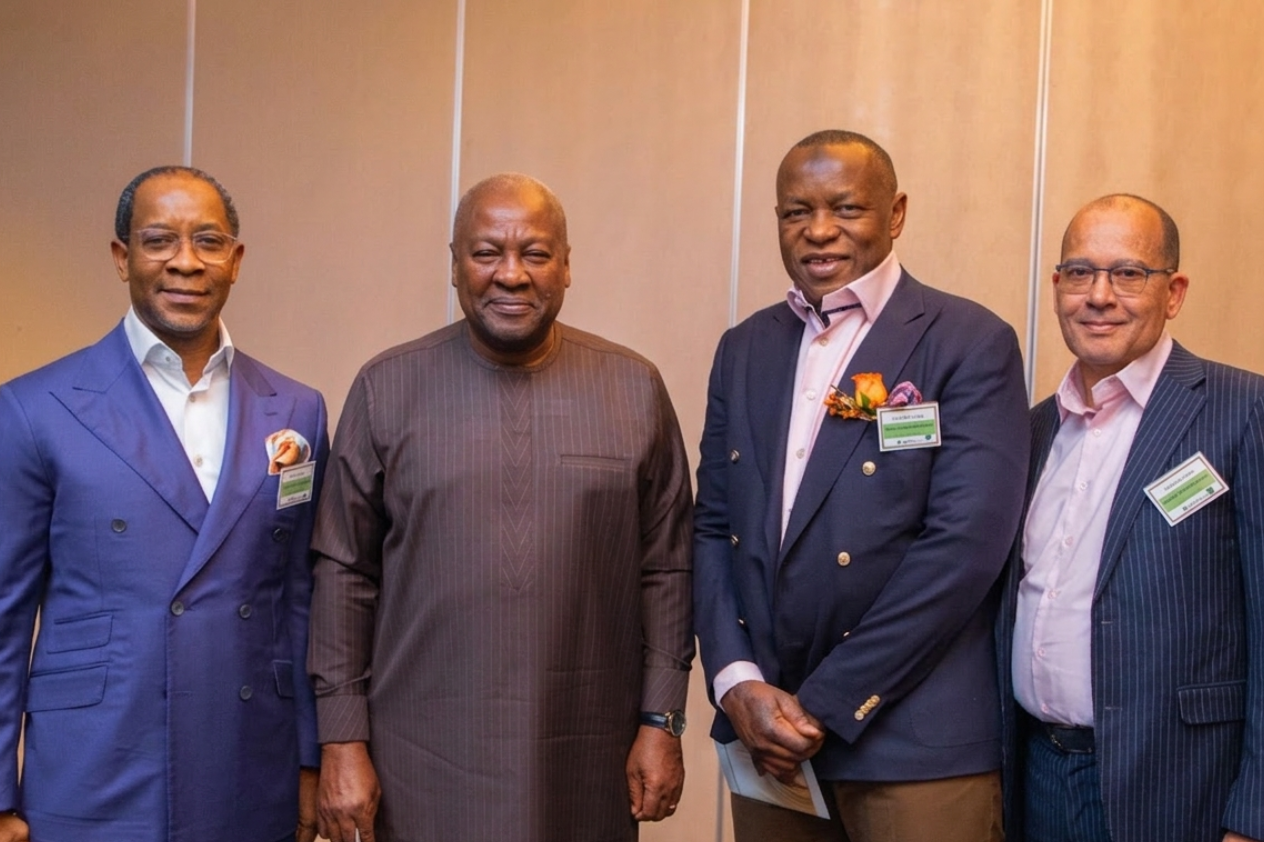
Ghanaian President Mahama and Sahara Executive Directors
Speaking at the commissioning in Ulsan, South Korea, President John Dramani Mahama described the vessel as “a significant milestone in strengthening the infrastructure that underpins the global LPG supply chain,” noting that expanded shipping capacity is critical to improving supply security, reliability and efficiency for countries that rely partly on LPG imports.
He commended Sahara Group, WAGL Energy and all partners involved for their “leadership, technical expertise and strategic foresight,” adding that the project reflects “the power of partnership” in advancing safe, efficient, and responsible energy distribution.
President Mahama wished the MT Asharami Ghana safe sails, expressing confidence that the vessel would inspire further investment and collaboration across Africa’s energy value chain.
According to Wale Ajibade, Executive Director, Sahara Group, the vessel supports Ghana’s clean energy ambitions through integrated infrastructure.
“MT Asharami Ghana is more than a vessel; it is part of a deliberate strategy to strengthen LPG supply security and support Ghana’s clean energy ambitions. It secures an additional 25,000-Metric-tonne stock security for the Ghana economy, alongside the soon to be commissioned 6000-metric-tonee of 12.000-metric-tonne land storage in Tema,” he said.
With the addition of Asharami Ghana, Sahara Group’s LPG carrier fleet now comprises six delivered vessels with a combined capacity of 202,000 cubic metres. Supported by partnerships with WAGL Energy, NNPC Limited and other stakeholders, an additional 270,000 cubic metres of capacity is under construction and due for delivery by September 2028.
Temitope Shonubi, Executive Director, Sahara Group, said Asharami Ghana is part of Sahara’s integrated LPG infrastructure strategy spanning shipping, storage, and downstream distribution globally, including the development of a 12,000‑metric‑tonne land‑based LPG storage terminal in Tema, with a 6,000‑metric‑tonne first phase scheduled for completion in May 2026.
He thanked Yaa Serwaa Alifo, MD of Asharami Ghana, for her resilience and insistence to dedicate a ship of “this magnitude solely to the Ghana Market and its landlocked neighbours.”
Ghana is targeting LPG adoption of 50 per cent of households by 2030, up from about 30 per cent today. Sahara’s investments will support clean energy access for more than 35 million people, while strengthening Ghana’s role in regional LPG trade to neighbouring and landlocked West African markets.
The commissioning comes in Sahara Group’s 30th anniversary year, guided by the Sahara Beyond XXX milestone, underscoring Sahara’s focus on building an enduring enterprise that delivers responsible growth, shared prosperity and long‑term impact across its markets.
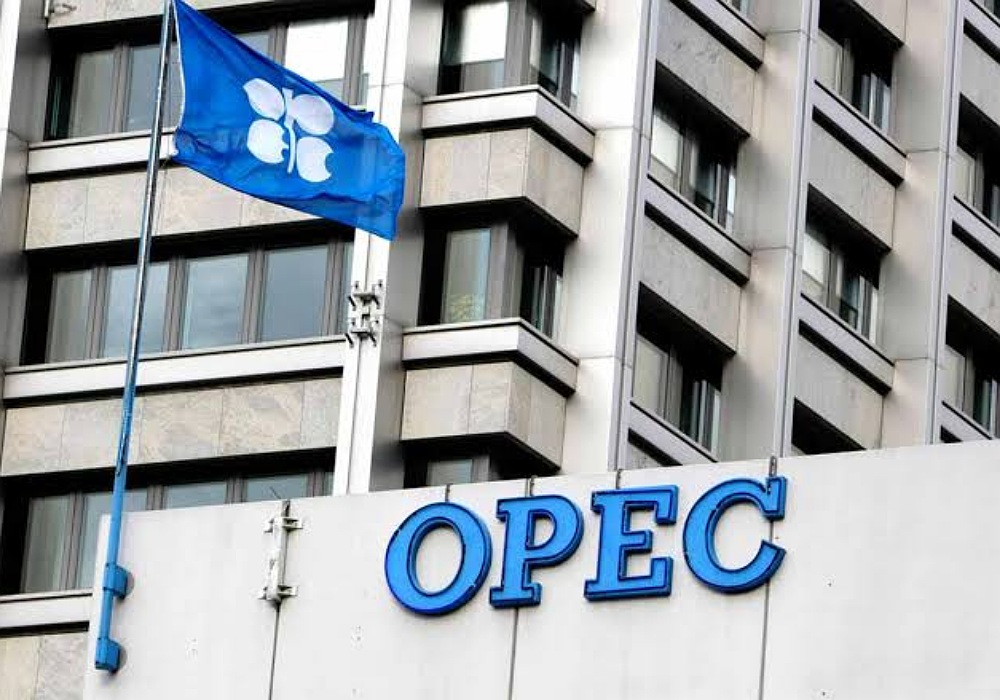
Nigeria’s crude oil production dropped to 1.31 million barrels per day in February, even as local refineries continue to grapple with inadequate domestic crude supply needed to sustain operations.
The development shows that Nigeria again failed to meet its crude oil production quota of 1.5 million barrels per day approved by the Organisation of the Petroleum Exporting Countries (OPEC), as output declined sharply in February 2026.
Data from OPEC’s latest Monthly Oil Market Report, based on direct communication from member countries, showed that Nigeria produced 1.314 million barrels per day in February, down from 1.459 mbpd recorded in January.
ALSO READ: Chevron Reiterates Commitment to Niger Delta Development
The figures indicate a month-on-month decline of 146,000 barrels per day, widening the country’s shortfall from its OPEC production allocation.
Nigeria’s inability to meet its OPEC production quota is not only affecting its oil export earnings but also adversely impacting domestic refineries that are starved of feedstock for their operations.






Airfares Likely to Rise as Aviation Fuel Price Spikes by 80%

Shell Completes Turnaround Maintenance on FPSO, Resumes Production at Bonga

Sahara Group expands fleet with new 40,000 cbm LPG Carrier

NATO Shoots Down Third Iranian Missile in Turkey

Inside Tinubu’s Closed-Door Meeting With Opposition Leaders – SDP, IPAC Reveal Details

Defections Won’t Break PDP in Sokoto, Says Former Senator Gada

Trump’s Family Unveils New Cryptocurrency Platform

Reps Recommend 3-year Jail Term For Aviation minister

Dangote Cement Lights Up Benue Host Communities With CSR Initiatives

Senate Denies Receiving Petitions Against Tinubu’s Ambassadorial Nominees

Things To Know About Threads, Zuckerberg’s Twitter-like App
