
NEWS
SERAP Sues Akpabio, Abbas Over NASS’ Running Costs, Legislators’ Jumbo Pay

The Socio-Economic Rights and Accountability Project (SERAP) has filed a lawsuit against the Senate President, Godswill Akpabio and Speaker of House of Representatives, Tajudeen Abbas over “the failure to end the apparently unlawful practice by the National Assembly of fixing its allowances and running costs, and the failure to account for the monthly running costs paid to members.”
According to a statement on Sunday by the SERAP, Senator Akpabio Mr Abbas are sued for themselves and on behalf of all members of the National Assembly.
ALSO READ: SERAP Urges Govs, Wike To Show Details Of Chinese Loans
Recall that former President Olusegun Obasanjo recently alleged that the lawmakers fix their own salaries and allowances, contrary to the recommendation of the Revenue Mobilisation Fiscal Allocation Commission (RMAFC).
In the suit number FHC/ABJ/CS/1289/2024 filed last Friday at the Federal High Court, Abuja, SERAP is seeking: “an order of mandamus to direct and compel Mr Akpabio and Mr Abbas to end the apparently unlawful practice of the National Assembly fixing its remuneration and allowances termed as ‘running cost’.”
The SERAP is seeking: “an order of mandamus to direct and compel Mr Akpabio and Mr Abbas to disclose the exact amount of the monthly running costs being paid to and received by the lawmakers, and the spending details of any such running costs.”
The SERAP is also seeking: “an order of mandamus to direct and compel Mr Akpabio and Mr Abbas to end the alleged practice of paying remuneration and allowances termed as ‘running costs’ into the personal accounts of lawmakers.”
In the suit, the SERAP is arguing that: “The provisions of paragraph N, section 32(d) of the Third Schedule to the Nigerian Constitution 1999 [as amended] clearly make it unlawful for the National Assembly to fix its salaries, allowances and running costs.”
The SERAP is also arguing that, “the alleged practice of paying running costs into the personal accounts of lawmakers is a fundamental breach of Rule 713 of the Federal Government Financial Regulations, which provides that ‘public money shall not be paid into a private bank account.’”
According to the SERAP, “‘Public function’ means activities in the public interest, not against it. The reports that lawmakers are fixing their own salaries, allowances and running costs amount to private self-interest or self-dealing. It is also detrimental to the public interest.”
According to the SERAP, “The constitutional oath of office of lawmakers requires them to ensure transparency and accountability in the exact amounts of salaries, allowances and running costs they receive.”
Similarly, the SERAP is arguing that, “The allegations that lawmakers are fixing their own salaries, allowances and running costs are entirely inconsistent and incompatible with the constitutional oath of office and the object and purpose of the UN Convention against Corruption to which Nigeria is a state party.”
The suit filed on behalf of SERAP by its lawyers, Kolawole Oluwadare, Andrew Nwankwo, and Ms Blessing Ogwuche, read in part: “Directing and compelling the lawmakers to account for and return any misused or mismanaged running costs they collected would build trust in democratic institutions and strengthen the rule of law.”
“SERAP is seeking: an order of mandamus to direct and compel Mr Akpabio and Mr Abbas to refer the allegations on the misuse of the running costs received by members to appropriate anticorruption agencies for investigation and prosecution where there is relevant admissible evidence.
“The country’s international legal obligations especially under the UN Convention against Corruption impose a legal commitment on public officials including lawmakers to discharge a public duty truthfully and faithfully.
“The convention specifically in paragraph 1 of article 8 requires members to promote integrity, honesty and responsibility in the management of public resources.
“Nigerians have a right to scrutinize how their lawmakers spend their tax money and the commonwealth. Nigerians also have a right to honest and faithful performance by their public officials including lawmakers.
“Ending the reported practice by lawmakers of fixing their salaries, allowances and running costs would improve public confidence in the integrity and honesty of the National Assembly.
“Constitutional oath of office requires public officials including lawmakers to abstain from all improper acts, such as fixing their own salaries, allowances and running costs, that are inconsistent with the public trust.
“It is a travesty and a fundamental breach of their fiduciary duties for members of the National Assembly to fix their own salaries, allowances and running costs.
“Rule 713 of the Federal Government Financial Regulations provides: ‘Personal money shall in no circumstances be paid into a government bank account, nor shall any public money be paid into a private bank account.’
“In the Seventh Schedule to the Nigerian Constitution, lawmakers commit to strive to ‘preserve the Fundamental Objectives and Directive Principles of State Policy contained in the Constitution’, [and to] perform their ‘functions honestly, faithfully’, to act ‘always in the interest of the well-being and prosperity of Nigeria’.
“Lawmakers also commit to ‘preserve, protect and defend the Constitution of Nigeria; and abide by the Code of Conduct contained in the Fifth Schedule to the Constitution.’
“SERAP notes that Section 15(5) of the Nigerian Constitution requires public institutions to abolish all corrupt practices and abuse of power. Section 16(2) of the Nigerian Constitution further provides that, ‘the material resources of the nation are harnessed and distributed as best as possible to serve the common good.’
“According to our information, members of the National Assembly are currently fixing their own salaries, allowances and running costs. The running costs are reportedly paid directly into the personal accounts of members.
“Senator Kawu Sumaila, representing Kano South Senatorial District, recently disclosed in an interview with BBC Hausa that each Nigerian senator earns at least N21 million monthly in running costs, salaries, and allowances.
“Mr Sumaila reportedly said, ‘My monthly salary is less than N1 million. After deductions, the figure comes down to a little over N600,000. Given the increase effected in the Senate, each senator gets N21 million every month as running cost.’”
No date has been fixed for the hearing of the suit.


The Secretary to the Adamawa State Government, Awwal D. Tukur, has identified intelligence gathering, timely information sharing and proactive security strategies as key priorities for tackling Nigeria’s evolving security challenges.
Tukur stated this while delivering a welcome address on behalf of Governor Ahmadu Umaru Fintiri at the opening ceremony of the Federal and State Security Administrators’ Meeting in Yola, Adamawa State on Thursday.
Welcoming delegates to the state, he said, “It is my honor and privilege to welcome you all on behalf of the government and the good people of Adamawa State to the capital city of Yola for this federal and state security administrators’ meeting.”
He described the gathering as an important platform for collaboration between federal intelligence institutions and state and local government administrations.
ALSO READ: ASUU strike: We are losing students to incessant killings — Students union
“As a premier security engagement forum, the FSSAM plays an indispensable role. It provides a unique, highly collaborative platform where federal intelligence frameworks meet the practical day-to-day realities of state and local government administration,” Tukur said.
The Adamawa SSG noted that Nigeria faces evolving security challenges, including insurgency, cross-border criminality and internal civil cleavages.
“No doubt, our nation is facing evolving and fast-moving security challenges, ranging from complex insurgency and cross-border criminality to internal civil cleavages. The mandate of this initiative is therefore, the more pressing,” he said.
Tukur outlined three key tasks for participants during the two-day meeting, stressing the need to identify emerging threats, improve intelligence sharing and develop practical strategies to address security challenges.
“To my mind, the collective task of this forum over the next two days is clear,” he said.
He listed the priorities as identifying and evaluating emerging security indicators; reviewing methods for generating actionable intelligence and sharing it with relevant authorities in a clear, precise and timely manner; and proposing practical strategies to anticipate and contain present and future security threats within communities.
Tukur also highlighted Adamawa State’s efforts to prioritise intelligence gathering under Governor Fintiri’s leadership.
“Under the dynamic and visionary leadership of His Excellency, Governor Ahmadu Umaru Fintiri, Adamawa State has consistently prioritized intelligence in the sector. Community-centered intelligence networks and robust logistical support for our security formation,” he said.
He added that hosting the meeting reflected the state’s commitment to supporting national security efforts.
“Host of this meeting reflects the test part of the commitments on unwavering commitment to contributing meaningfully to the national security architecture,” Tukur said.
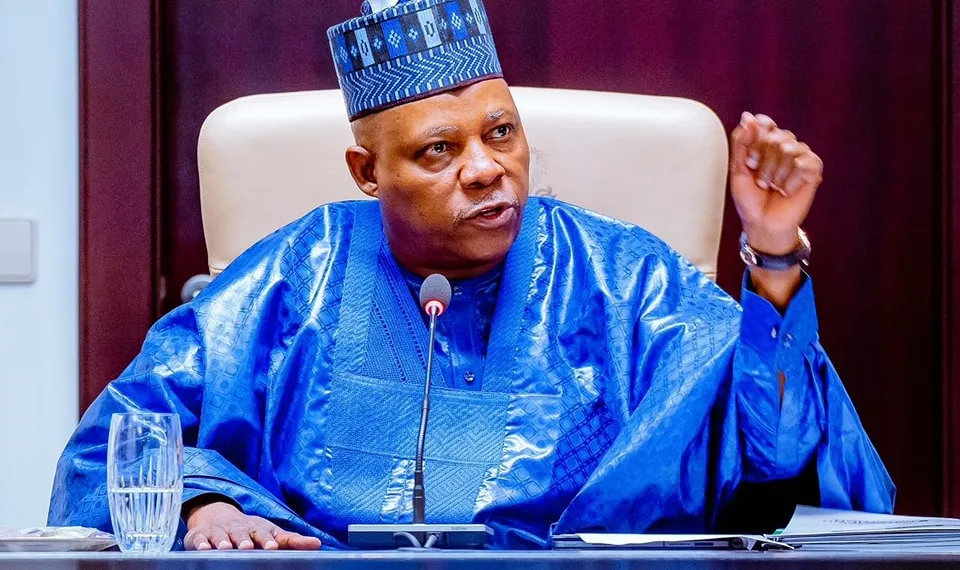
Vice President Kashim Shettima has urged Nigerians to celebrate President Bola Tinubu, saying his leadership saved the country from a potential implosion.
Shettima said Nigeria’s economy had been teetering on the edge of collapse before Tinubu’s intervention, adding that the country could have faced a different situation.
“The economy was teetering on the edge of collapse, we were on a cliff edge,” the Vice President said.
ALSO READ: Subsidy Removal, FX Reforms Driving Fresh Oil Sector Investment – Shettima
“So he literally saved the nation from an implosion. That could have been the scenario. So, instead of demonizing him, Nigerians ought to celebrate this poor man.”
Shettima also called for a return to the drawing board, expressing confidence in the leadership’s commitment and the prospects for the 2027 elections.
“I believe on the bottom of my heart that with this presentation I have seen, and with the commitment of our leadership, by the grace of God, we are going to win,” he said.
Speaking about the 2027 elections, the Vice President reminded his audience that social media platforms should not be mistaken for actual polling stations.
“There are no polling stations on Facebook or Instagram,” he said.
Shettima also expressed gratitude for the efforts made towards promoting the cause of the 2027 elections.

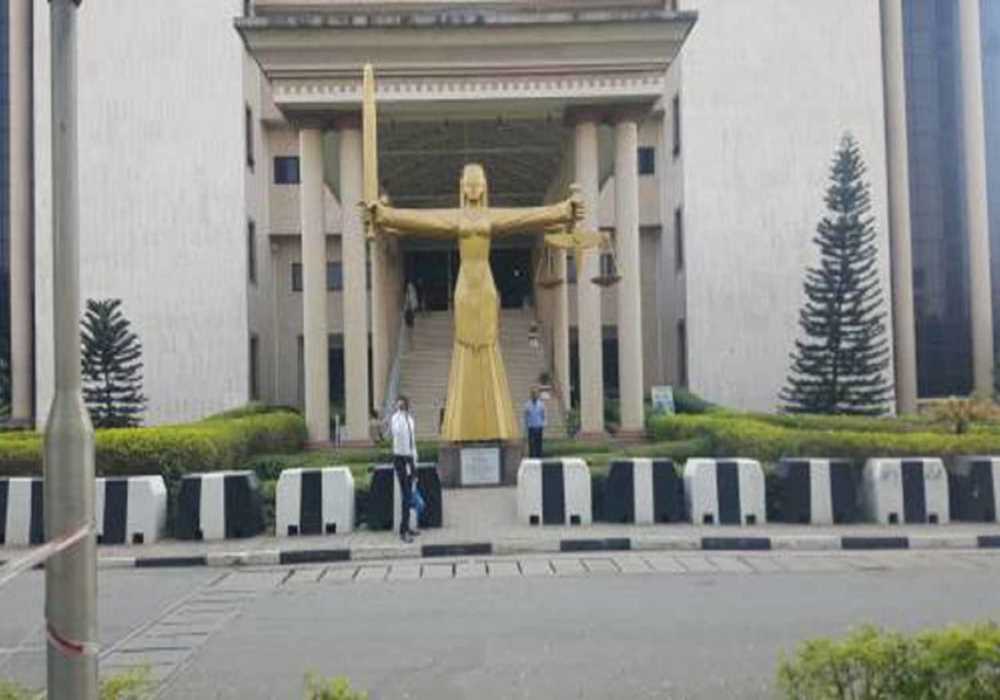
Following observed mis-steps, the Federal Government of Nigeria has withdrawn the eight-count criminal charge brought against the alleged fake Director General (DG) of the Presidential Foreign Intervention Promotion Council (PFIPC), Adeniyi Adeyemi.
Biztellers reports that the matter, in accordance with the counsel of the Attorney General of the Federation (AGF) and Minister of Justice, Prince Lateef Olasunkanmi Fagbemi, (SAN), the matter will be filed at the High Court of the Federal Capital Territory (FCT), instead of the Federal High Court (FHC).
Consequently, upon an unopposed application for termination by the prosecution counsel and Director of the Public Prosecution of the Federation (DPPF), Rotimi Oyedepo (SAN), on Monday, Justice Mohammed Umar of a Federal High Court, Abuja on Monday, struck out the matter.
READ ALSO: Shell Identifies Keys to Nigeria’s Energy Future
In a motion for the termination of the charges, Oyedepo informed the court that the Attorney General of the Federation (AGF) and Minister of Justice has carried out a review of the case file of Adeyemi and the charge filed by the Inspector General of Police (IGP) and found some loopholes.
The DPPF added that the documents allegedly forged by Adeyemi during his operations of the fake agency are those that can be prosecuted by the High Court of the Federal Capital Territory (FCT).
He also informed the court that a new charge has been filed at the High Court of the FCT and that Adeyemi would be expeditiously arraigned afresh.
He therefore urged the judge to strike out the charge as required by law.
Following no objections from Ibrahim Angulu (SAN), who stood in for Adeyemi, Justice Umar subsequently terminated the charge.
Adeniyi, 38, was being tried alongside two others whose whereabouts are unknown, on charges bordering on conspiracy and forgery.
The two others said to be at large were identified as Femi (surname unknown) and Anu (surname unknown).
The charge marked: FHC/ABJ/CR/25/2025, was entered against the defendant by the DPPF.






Atiku Launches ‘Ask AA’ Portal, Invites Nigerians to Question His Record
Adamawa SSG Identifies Three Priorities for Tackling Nigeria’s Security Challenges

Ebonyi 2027: Gov Nwifuru Jittery Over My Candidacy, Violating Constitution — Odii

Small Investors Take Centre Stage as Dangote IPO Nears Close
Sahara Champions Global Shipping Collaboration for $20m Mercy Ships Healthcare Impact

30 Nigerians Bag Postgraduate Scholarship from NNPC Ltd, Eni

Trump’s Family Unveils New Cryptocurrency Platform

Senate Denies Receiving Petitions Against Tinubu’s Ambassadorial Nominees

Dangote Cement Lights Up Benue Host Communities With CSR Initiatives

Reps Recommend 3-year Jail Term For Aviation minister

Tems Sets New Record On Billboard Hot 100 Chart
