
NEWS
SERAP To Tinubu: Emulate Otti, Obey Court Verdict On Ex-Govs’ Pensions

The Socio-Economic Rights and Accountability Project (SERAP) has urged President Bola Tinubu “to emulate the good example of Abia State Governor, Alex Otti by immediately obeying the judgment ordering the Federal Government to recover pensions collected by former governors, and to challenge the legality of states’ pension laws permitting those involved to collect such outrageous pensions.”
The judgment, dated 26 November, 2019 was delivered by Honourable Justice Oluremi Oguntoyinbo following a suit by the SERAP.
Recall that Gov Otti last week signed into law the bill to repeal ‘The Abia State Governors and Deputy Governors Pensions Law No 4 of 2001’, following the passing by the house of assembly. Under the repealed law, former governors and deputy governors in the state were paid lifetime salaries and got houses in Abia and Abuja.
In the letter dated 23 March 2024 and signed by SERAP deputy director Kolawole Oluwadare, the organisation said: “We urge you to emulate the good example of governor Otti by urgently obeying the judgment, something which former president Muhammadu Buhari blatantly failed to do.”
SERAP said, “Unless the judgment is immediately obeyed, former governors and their deputies including those now serving as ministers in your administration and members of the National Assembly who receive pensions would continue to evade justice for their actions.”
The letter, read in part: “SERAP agrees with former president Olusegun Obasanjo’s conclusion that states’ pension laws are ‘acts of daylight robbery’, and his call for such laws to be abolished by other state governors.
“Immediately obeying the judgment would show the sovereignty of the rule of law in Nigeria and go a long way in protecting the integrity of the country’s legal system.
“Obeying the judgment would also show you as a defender of the Nigerian Constitution of 1999 (as amended), the rule of law, and public interest within government.
“Nigeria’s democracy needs courts so that public officials and private actors including former governors and their deputies collecting life pensions, exotic cars and other allowances from their states can be held accountable for any infraction of Nigerian laws.
“Mr Buhari turned a blind eye to the judgment. State governors have failed to provide names of former governors and their deputies who have collected and continue to collect pensions from their states and the amount so far spent on these ex-officials.
“Constitutionalism and the rule of law are not in conflict with democracy; rather, they are essential to it. Justice Oguntoyinbo’s judgment has pointed the way for your government to provide the leadership to ensure the reform of pension laws allowing former governors and their deputies to collect lifetime salaries and allowances. It is now time for your government to restore the rule of law systemically.
“Like pension laws of several states, the repealed Abia state pension law stipulated that former Abia governors and deputies are entitled to 100 percent of the annual basic salaries of the incumbent governor and deputy; their cooks, stewards, drivers, and gardeners are to be paid by the state; and are entitled to three police officers and two operatives of the Department of State Services (DSS).
“Justice Oguntoyinbo in her judgment granted ‘AN ORDER of mandamus compelling and directing the Attorney General to urgently identify former governors and their deputies collecting pensions from their states and to seek full recovery of public funds from those involved.’
“Justice Oguntoyinbo also granted ‘AN ORDER of mandamus compelling and directing the Attorney General to urgently institute appropriate legal actions to challenge the legality of states’ laws permitting former governors, serving as senators and ministers to enjoy governors’ emoluments while drawing normal salaries and allowances in their new political offices.’
“Justice Oguntoyinbo also indicated that double emoluments for former governors are unacceptable, unconstitutional and illegal.
“SERAP also notes that former president Olusegun Obasanjo this week correctly asked state governors to emulate governor Alex Otti in repealing laws supporting the payment of pensions to former governors and deputies in their states. Mr Obasanjo described life pension laws as ‘rascality’ and ‘acts of daylight robbery’
“Over N40 billion have reportedly been collected by former governors serving as ministers and members of the National Assembly.
“Justice Oguntoyinbo who recently retired from the bench expressed ‘regret’ during a valedictory court session held in her honour that the judgment has not been obeyed.
“Justice Oguntoyinbo stated: ‘I remember with pride my landmark judgment in SERAP vs. The Attorney-General. Regrettably, that order is yet to be obeyed. I find it very disappointing that Court orders are often not obeyed. If there’s anything I wish to change, it is the impunity towards judicial decisions and the disrespect for the bench.
“Immediately obeying the judgment would demonstrate your oft-repeated commitment to the rule of law, and respect for the judiciary as the guardian of justice in this country. A democratic state based on the rule of law cannot exist or function, if the government routinely ignores and/or fails to abide by court orders.
“Many of the former governors serving as ministers in your administration and as members of the National Assembly are reportedly enjoying pensions from their states while drawing normal salaries and allowances in their new political offices.
“SERAP is concerned that while many Nigerian workers and pensioners have not been paid by state governors for several months and struggle to make ends meet, former governors continue to collect double emoluments and enjoy opulent lifestyles.
“According to our information, those who are reportedly receiving double emoluments and large severance benefits from their states include: Godswill Akpabio (Akwa Ibom); Rabiu Musa Kwankwaso (Kano); Kabiru Gaya (Kano); Theodore Orji (Abia).
“Others are Abdullahi Adamu (Nasarawa); Sam Egwu (Ebonyi); Shaaba Lafiagi (Kwara); Joshua Dariye (Plateau), and Jonah Jang (Plateau).
“At least 22 states starting from Lagos State have reportedly passed life pensions laws for former governors and other ex-public officials. Other states include Akwa Ibom; Edo; Delta; Ekiti; Kano; Gombe; Yobe; Borno; Bauchi; Abia; Imo; Bayelsa; Oyo; Osun; Kwara; Ondo; Ebonyi; Rivers; Niger; Kogi; and Katsina.
“The 20-page judgment in suit no: FHC/L/CS/1497/2017 signed by Honourable Justice Oluremi Oguntoyinbo reads in part: ‘The Attorney General has argued that the States’ laws duly passed cannot be challenged. With respect, I do not agree with this line of argument by the Attorney General that he cannot challenge the States’ pension laws for former governors.’
“In my humble view, the Attorney General should be interested in the legality or validity of any law in Nigeria and how such laws affect or will affect Nigerians, being the Chief Law Officer of the Federation.
“I have considered SERAP’s arguments that it is concerned about the attendant consequences that are manifesting on the public workers and pensioners of the states who have been refused salaries and pensions running into several months on the excuse of non-availability of state resources to pay them.”





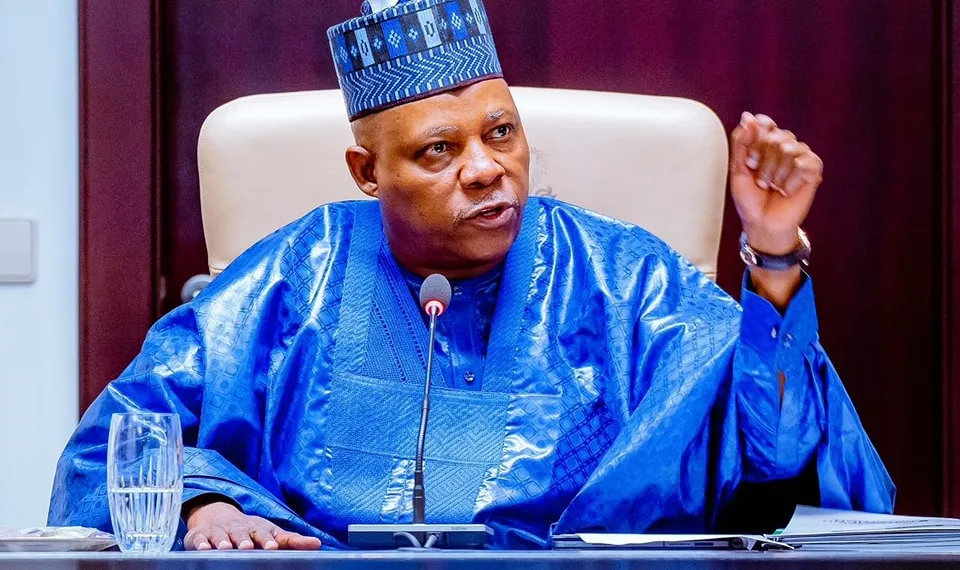
Vice President Kashim Shettima has urged Nigerians to celebrate President Bola Tinubu, saying his leadership saved the country from a potential implosion.
Shettima said Nigeria’s economy had been teetering on the edge of collapse before Tinubu’s intervention, adding that the country could have faced a different situation.
“The economy was teetering on the edge of collapse, we were on a cliff edge,” the Vice President said.
ALSO READ: Subsidy Removal, FX Reforms Driving Fresh Oil Sector Investment – Shettima
“So he literally saved the nation from an implosion. That could have been the scenario. So, instead of demonizing him, Nigerians ought to celebrate this poor man.”
Shettima also called for a return to the drawing board, expressing confidence in the leadership’s commitment and the prospects for the 2027 elections.
“I believe on the bottom of my heart that with this presentation I have seen, and with the commitment of our leadership, by the grace of God, we are going to win,” he said.
Speaking about the 2027 elections, the Vice President reminded his audience that social media platforms should not be mistaken for actual polling stations.
“There are no polling stations on Facebook or Instagram,” he said.
Shettima also expressed gratitude for the efforts made towards promoting the cause of the 2027 elections.

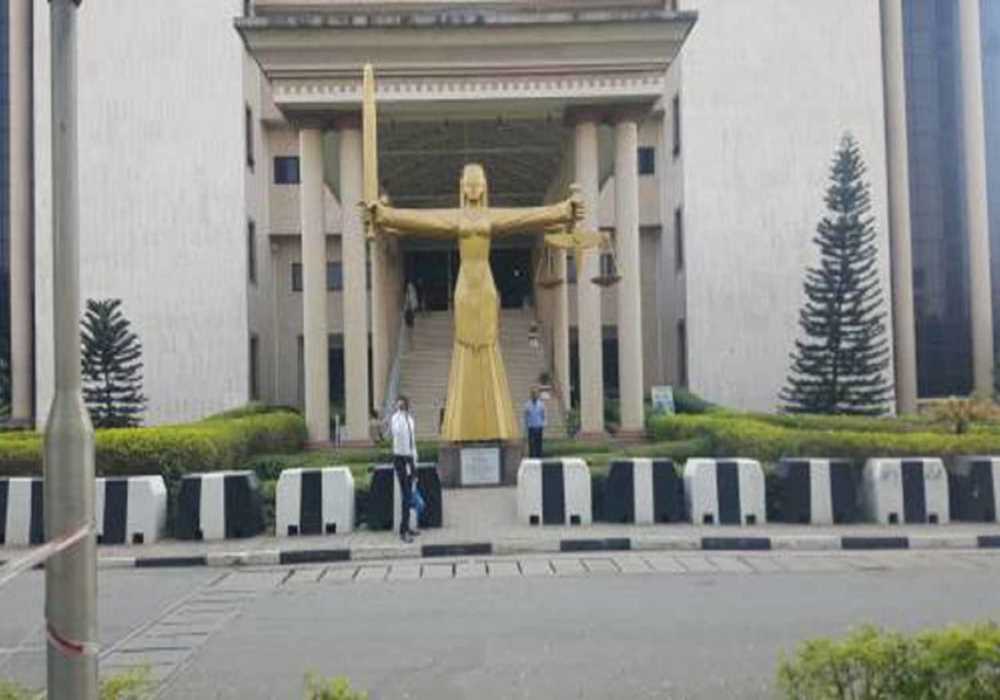
Following observed mis-steps, the Federal Government of Nigeria has withdrawn the eight-count criminal charge brought against the alleged fake Director General (DG) of the Presidential Foreign Intervention Promotion Council (PFIPC), Adeniyi Adeyemi.
Biztellers reports that the matter, in accordance with the counsel of the Attorney General of the Federation (AGF) and Minister of Justice, Prince Lateef Olasunkanmi Fagbemi, (SAN), the matter will be filed at the High Court of the Federal Capital Territory (FCT), instead of the Federal High Court (FHC).
Consequently, upon an unopposed application for termination by the prosecution counsel and Director of the Public Prosecution of the Federation (DPPF), Rotimi Oyedepo (SAN), on Monday, Justice Mohammed Umar of a Federal High Court, Abuja on Monday, struck out the matter.
READ ALSO: Shell Identifies Keys to Nigeria’s Energy Future
In a motion for the termination of the charges, Oyedepo informed the court that the Attorney General of the Federation (AGF) and Minister of Justice has carried out a review of the case file of Adeyemi and the charge filed by the Inspector General of Police (IGP) and found some loopholes.
The DPPF added that the documents allegedly forged by Adeyemi during his operations of the fake agency are those that can be prosecuted by the High Court of the Federal Capital Territory (FCT).
He also informed the court that a new charge has been filed at the High Court of the FCT and that Adeyemi would be expeditiously arraigned afresh.
He therefore urged the judge to strike out the charge as required by law.
Following no objections from Ibrahim Angulu (SAN), who stood in for Adeyemi, Justice Umar subsequently terminated the charge.
Adeniyi, 38, was being tried alongside two others whose whereabouts are unknown, on charges bordering on conspiracy and forgery.
The two others said to be at large were identified as Femi (surname unknown) and Anu (surname unknown).
The charge marked: FHC/ABJ/CR/25/2025, was entered against the defendant by the DPPF.

To secure a bright energy for her teeming population, Nigeria must sustain the momentum of reform, accelerate investment, and deepen partnerships.
This view was expressed by Managing Director, Shell Nigeria Exploration and Production Company of Nigeria Limited (SNEPCo) Ronald Adams in Lagos at the weekend.
Delivering a keynote address at the Africa Energy Conference (AEC) of the Lagos Business School (LBS), Adams called for regulatory certainty through efficient execution of reforms, sustained investment appeal to enable projects to move more swiftly from opportunity to production and partnership by operators, regulators, NNPC Limited and communities to unlock the full value of Nigeria’s resources.
Adams cited Nigeria’s huge oil and gas resources as an advantage but pointed out: “Resources alone do not guarantee prosperity. Prosperity comes when resources are matched with investment, technology, sound policy and disciplined execution. Success will be determined not by the size of our resources, but by our ability to convert them into investment and economic growth.”
Adams pledged the support of Shell towards a bright energy future of Nigerians. He said: “For more than six decades, Shell has been part of Nigeria’s energy journey. Together with our partners, we have helped develop major energy infrastructure, supported Nigerian businesses, invested in talent, and contributed to economic development. Bonga remains a powerful example of what technology, partnership and Nigerian capability can achieve in deepwater operations. Today, that story continues through Bonga North.”
READ ALSO: ADF Targets 5 Million Students, 2 Million Vulnerable Women
Issuing a clarion call for action by all stakeholders, he added: “The world is not standing still. Capital is moving, technology is advancing and competition is intensifying. The countries that attract investment tomorrow are those that improve competitiveness today. Nigeria has begun that journey. Our task is to sustain the momentum and translate reform into projects, projects into growth, and growth into shared prosperity.”
The conference, the 4th in the series had at its theme; “Securing Nigeria’s Energy Future: Policy Reform, Capital Mobilisation, and Pathways to a Sustainable Power and Energy Market” and was attended by top government officials, industry captains, energy professionals, and students.
Lagos State Deputy Governor Obafemi Hamzat represented Lagos State Governor Babajide Sanwo-Olu as the guest of honour. SNEPCo was a principal sponsor of the Africa Energy Conference (AEC) and mounted a well-received exhibition on its deepwater operations and social investments across Nigeria.






Sahara Champions Global Shipping Collaboration for $20m Mercy Ships Healthcare Impact

30 Nigerians Bag Postgraduate Scholarship from NNPC Ltd, Eni

2027: ‘Algorithms Will Not Decide Election Results’, INEC Chairman Declares

Navy Recovers 98,000 Litres of Suspected Stolen Crude in Rivers

DPRP’s Appeal Against Fuel Import Licence Ruling Earns Stakeholder Backing

State Govs, Wike Endorse One-Party State, Join APC Campaign Council

Trump’s Family Unveils New Cryptocurrency Platform

Senate Denies Receiving Petitions Against Tinubu’s Ambassadorial Nominees

Dangote Cement Lights Up Benue Host Communities With CSR Initiatives

Reps Recommend 3-year Jail Term For Aviation minister

Tems Sets New Record On Billboard Hot 100 Chart
