
NEWS
Tinubu’s Charge To New CJN – Full Speech

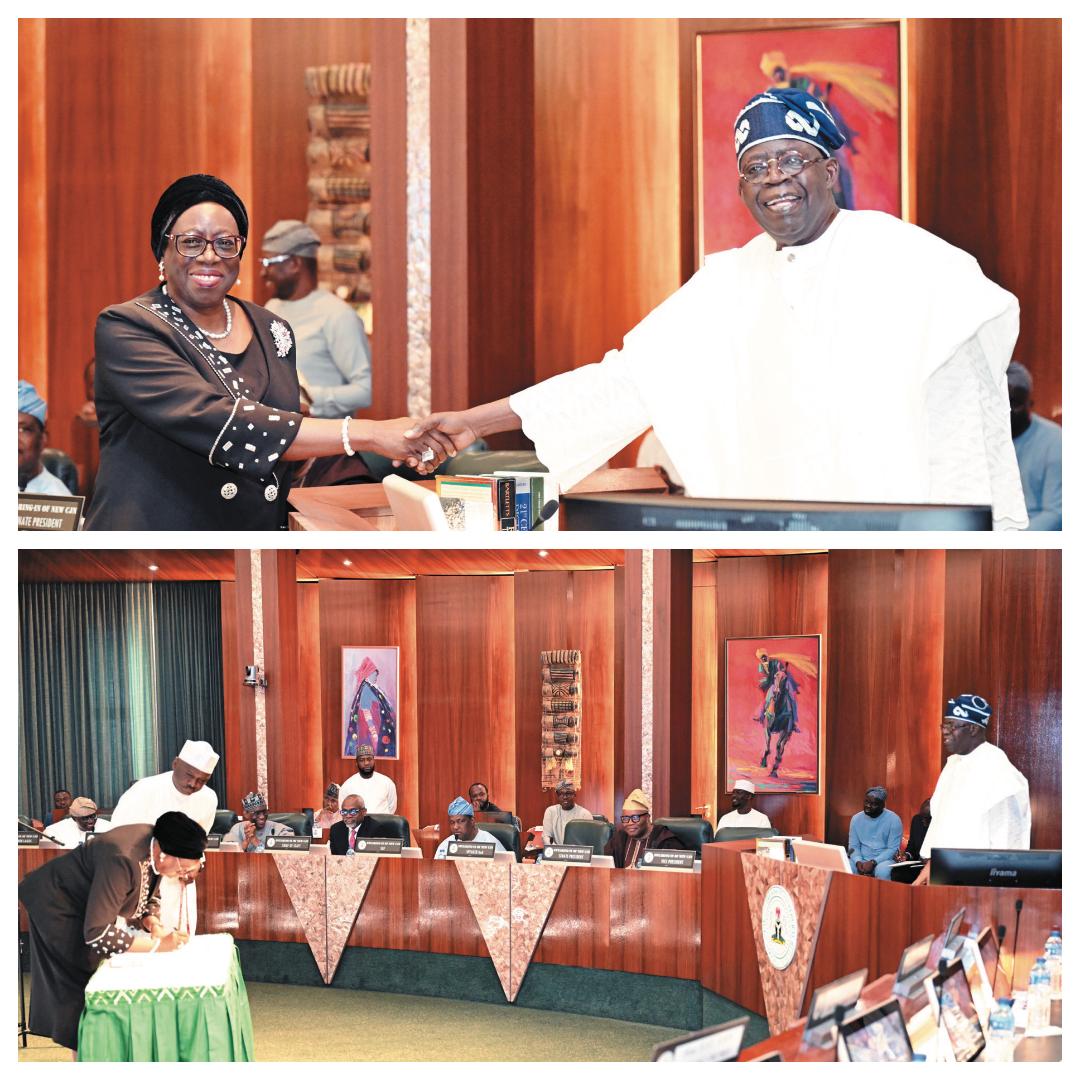
On swearing in the ne Chief Justice of Nigeria (CJN) Kudirat Kekere-Ekun, President Bola Ahmed Tinubu charged her thus, ‘Be faithful and loyal to the constitution’.
ALSO READ: JUST IN: Kekere-Ekun Sworn In As Nigeria’s 23rd CJ
Full Speech
1. I warmly welcome you all to this momentous ceremony to witness a sacred and significant event in the life of our nation: the swearing-in of a distinguished jurist, the Hon. Justice Kudirat Motonmori Olatokunbo Kekere-Ekun, CFR, as acting Chief Justice of Nigeria.
2. She comes in following the retirement of another illustrious jurist, Justice Kayode Ariwoola, who bowed out gracefully after long years of service to our country. Our country owes Honourable Justice Ariwoola a debt of gratitude for his outstanding contributions to the administration of justice.
3. Nigeria’s acting Chief Justice, Kudirat Olatokunbo Kekere-Ekun, comes to this position with an admirable family and professional pedigree. Over the years, she established a respectable and incorruptible reputation within the bar and the bench, which has served the course of justice.
4. Her meteoric rise from the Magistracy to Justice of the Supreme Court is a testament to her exceptional talent, hard work, unblemished record, strong work ethic, and dedication to her calling as a priest in the temple of justice. Her sterling contributions to the growth of the Nigerian judiciary and our legal system have been remarkable. We are inspired by her unwavering commitment to higher ideals of upholding the principles of justice and fairness.
5. Justice Kekere-Ekun is a brilliant lawyer who was called to the bar in 1981. She is now a trailblazer, becoming the second woman to hold this esteemed position after Hon. Justice Aloma Mariam Mukhtar, GCON, who served as the CJN from 16 July 2012 to 20 November 2014. Justice Kekere-Ekun’s ascension to this position is a beacon of hope for young women who aspire to break the glass ceiling and make a meaningful impact on our society.
6. The Nigerian Supreme Court has come a long way since it was empowered by the 1963 Republican Constitution to take over from the then Judicial Committee of the Privy Council as the highest court in our judicial hierarchy.
7. Since then, it has played a critical role in the evolution of our country, resolving complex legal conflicts, even under the military and shaping public policies that impact all segments of Nigerian society.
8. Late Justice Thurgood Marshall, the American civil rights lawyer and first African American justice of the US Supreme Court, once said: “The Constitution is not a static document, but rather a living instrument that must be adapted to the changing needs of society.”
9. Following this entrenched tradition of the apex court, our Supreme Court, under our constitutional democracy, also recently interpreted the 1999 Constitution regarding the financial autonomy of the 774 local councils. To quote Marshall again: “It is, emphatically, the province and duty of the judicial department to say what the law is.”
10. We expect the apex court to continue to play a critical role in the evolution of our constitutional democracy and shape public policies that impact all segments of Nigerian society.
11. I want to assure you that my administration will continue to provide appropriate support to improve the welfare and capacity of the judiciary, ease the administration of justice, and promote the rule of law in Nigeria. This consideration informed the expedited passage by the National Assembly and my consent to the Judicial Office Holders Act, 2024, which approved a 300% increase in the remuneration of judicial officers. This came on the heels of the appointment of 11 Justices of the Supreme Court in December 2023, which enabled the Supreme Court to attain its full complement of 21 Justices for the first time in decades.
12. Let me also reassure you that the judiciary under this administration will continue to receive prompt and adequate attention in recognising its status as a driver of social order, rule of law, peace, security, and economic development.
13. Undoubtedly, the position of the Chief Justice of Nigeria comes with enormous responsibilities. As the head of all judicial institutions in the country, it is a position of considerable influence that demands temperance and sobriety. The occupant of the office must exude the highest level of integrity in the discharge of duties. This is more so because of the finality of the Supreme Court’s judgment.
14. I therefore urge your lordship to be faithful and loyal to the Constitution when discharging your duties as acting Chief Justice of Nigeria. I also encourage you to defend the judiciary’s independence, always promote the course of justice, strengthen mechanisms for integrity, discipline, and transparency in the judicial sector, and pursue other reforms or initiatives to sustain public confidence in the judiciary.
15. Thank you for joining us today as we mark this historic occasion. May this moment inspire us all to strive for excellence in pursuing a prosperous nation where justice will always reign.






Otunba Segun Showunmi, a member of the Tinubu/Shettima Presidential Campaign Council (PCC) for 2027, has urged the South-East to assess President Bola Tinubu’s administration based on verifiable projects and measurable results rather than political propaganda.
Showunmi made the call in a statement posted on X on Saturday, urging Nigerians to evaluate the government’s performance based on infrastructure delivery, funds committed to projects and their impact on communities.
He said federal infrastructure initiatives targeting the South-East under Tinubu’s administration deserved serious scrutiny and factual assessment, adding that unfulfilled promises should continue to be pursued until the expected results were delivered.
SEE ALSO: 2027 Election: ‘Look Beyond the Noise’ – Showunmi Urges Nigerians to Give Tinubu More Time
“Our message is clear: We will not trade facts for propaganda, nor accountability for political loyalty!” he said.
The political figure challenged critics of the administration to provide evidence to support their claims, while urging those defending the government to present the projects and demonstrate their impact.
He also called on government officials to publish relevant figures, disclose project timelines and provide measurable results, insisting that no public official should be exempt from scrutiny.
According to Showunmi, the South-East deserves infrastructure that supports economic growth, including roads that connect markets, investments that create jobs and policies that expand economic opportunities.
He maintained that political representation must translate into tangible benefits for citizens, stressing that public office should deliver value to the people.
As part of his call to action, Showunmi urged Nigerians to scrutinise government records, challenge misinformation with evidence and demand the completion of outstanding projects.
He further called for public commitments to be matched by measurable delivery, arguing that leadership should be assessed by facts and results rather than political rhetoric.
Ending his statement with the slogan, “Asiwaju is a goal,” Showunmi called for accountability and greater inclusion of the South-East in Nigeria’s development.
Showunmi is associated with The Alternative and is a member of the Tinubu/Shettima Presidential Campaign Council for the 2027 elections.

The Lagos State Traffic Management Authority (LASTMA) on Saturday announced a temporary road closure near Apostolic Church, inward Toll Gate, to allow engineers to install a beam on a height-restriction structure.
The agency said the installation was aimed at preventing high-rise trailers from accessing the newly constructed pedestrian bridge.
ALSO READ: LASTMA Alerts Motorists to Traffic Delays on Ogunnusi Road
“Currently, one lane has been occupied to facilitate the ongoing construction work, while the remaining two lanes are available to motorists,” LASTMA stated.
The agency advised road users to approach the affected corridor with caution and follow the directions of its personnel deployed to the area.
“Road users are advised to approach the affected corridor with caution and follow the directions of our personnel who are on ground to ensure the smooth flow of vehicular movement,” the statement added.
LASTMA also urged motorists to remain patient while the installation work continued.
“Motorists are encouraged to exercise patience while the installation work is in progress,” the agency stated.
Nigerian national Ekene Chukwuma has said he returned to Nigeria with assistance linked to Oseni Rufai rather than the Nigerians in Diaspora Commission (NiDCOM), while renewing allegations against the commission’s chairperson, Abike Dabiri-Erewa, over his travel documents.
Chukwuma made the remarks in an interview in which he explained how he returned to Nigeria after spending months at a deportation camp in India.
RELATED NEWS: Rufai Oseni Row: NiDCOM Breaks Silence on Nigerians Detained in India, Addresses Ekene’s Case
“My name is Kenneth Chukwu, from Enugu State,” he said, introducing himself before explaining how he returned to the country.
“I came back here with the assist of Osini Roufai, a good friend of him,” he said.
Chukwuma denied that NiDCOM facilitated his return, alleging that the commission had published false information about his case.
“NiDCOM made a lots of false, uh, news acquisition against me, which is still in Abike Dabiri handle in Twitter,” he said.
He also accused Dabiri-Erewa of sharing his expired international passport and a travel certificate he claimed was issued six months after he entered the detention camp.
“He also, she also posted my international passport that expired. He also, she also posted my TC that issued after 6 months,” he said.
His comments renew questions surrounding the handling of his case and the circumstances under which he obtained the documents needed to return to Nigeria.
Chukwuma’s detention in India previously sparked a public disagreement between ARISE News presenter Oseni Rufai and Dabiri-Erewa over NiDCOM’s response to reports of his situation.
Oseni raised concerns about Chukwuma’s detention and the commission’s handling of the case, while Dabiri-Erewa defended NiDCOM’s position and explained the process for submitting information to the commission.
NiDCOM subsequently issued its account of Chukwuma’s detention, stating that he had been arrested in India over a visa overstay and addressing the circumstances surrounding his travel documents.
The differing accounts prompted public debate about the commission’s response to Nigerians facing immigration difficulties abroad.






Showunmi Urges South-East to Judge Tinubu by Projects, Not Propaganda

2027: ‘North Has No Reason to Break Agreement’ — Gov Yusuf Backs Tinubu

Aircraft Averts Crash, After Losing Door Mid-Air in Abuja

Bandits Kill 70-Year-Old Man in Katsina, 27 Victims Rescued

‘Nigeria Is Doomed Under Tinubu’ — Kenneth Okonkwo Backs Atiku for 2027

Lagos: LASTMA Announces Traffic Restrictions Along Route to Toll Gate

Trump’s Family Unveils New Cryptocurrency Platform

Senate Denies Receiving Petitions Against Tinubu’s Ambassadorial Nominees

Dangote Cement Lights Up Benue Host Communities With CSR Initiatives

Reps Recommend 3-year Jail Term For Aviation minister

Tems Sets New Record On Billboard Hot 100 Chart
