
Energy
Truck Levies: Dangote Accuses NUPENG of Inflating Fuel Prices

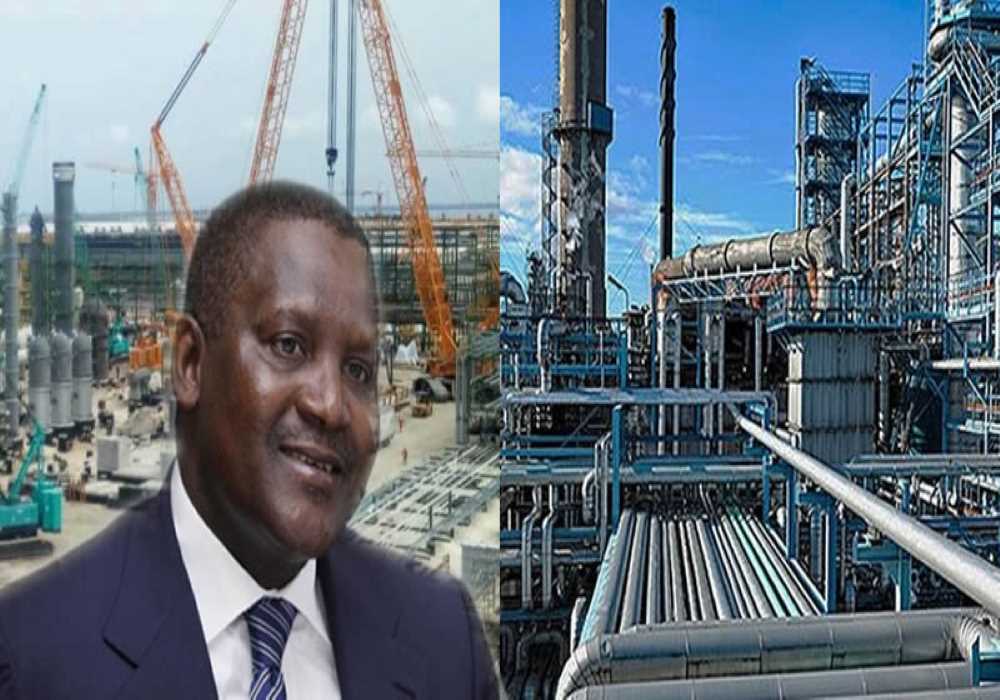
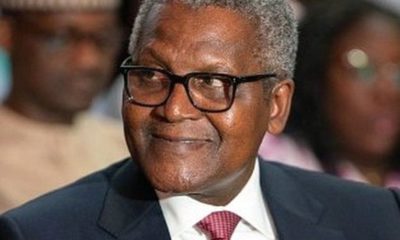
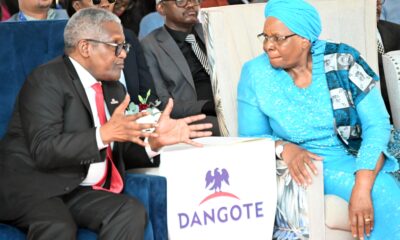
The President of the Dangote Group, Aliko Dangote, has accused the Nigerian Union of Petroleum and Natural Gas Workers (NUPENG) stimulating higher prices of refined products by imposing hefty levies on fuel trucks at his refinery.
Africa’s richest man made the allegations on Sunday in Lagos, while speaking to newsmen.
He alleged that NUPENG collects between N48,000 and N50,000 from every truck that loads fuel, a system he described as exploitative and unsustainable.
“By the time other groups add their charges, the total cost rises to as much as N84,000 per truck. Ultimately, it is the consumer who bears that burden,” the Africa’s richest man stated.
He condemned the charges as rent-seeking behaviour that undermines efficiency in the downstream oil sector.
Dangote recalled how transport unions once “held the company by the neck” when he was still importing fuel.
The situation, according to Dangote, prompted him to establish an in-house fleet under his brother’s management.
He insisted that the company’s newly launched fleet of 4,000 compressed natural gas (CNG)-powered trucks would not be subjected to similar pressures.
The industrialist also rejected claims that the company is preventing drivers from joining unions and insisted that membership must remain voluntary as guaranteed by the Nigerian constitution and labour laws.
ALSO READ: Cultism: Edo Demolishes Four Houses, Arrests 20 Suspects
“Even religion is voluntary, you cannot force anyone to convert. The same applies to unions,” he maintained.
The dispute comes in the wake of NUPENG’s recent blockade of the Dangote refinery and shutdown of depots over disagreements on drivers’ unionisation.
Although the Federal Government intervened to secure a memorandum of understanding, tensions remain high despite a subsisting industrial court order restraining NUPENG from further disruptions.





In pursuit of the Decade of Gas Capability Building Programme, 34 young professionals from Nigeria’s oil and gas industry have visited the Nigeria LNG Limited (NLNG) facility on Bonny Island, Rivers State, to gain first-hand exposure to gas processing, liquefaction, storage and export operations.
The visit, which covered NLNG’s operational Trains 1 to 6 and the ongoing Train 7 expansion project, was designed to bridge the gap between theoretical training and practical industry experience.
Led by the Coordinating Director of the Decade of Gas Secretariat, Ed Ubong, the delegation was received by NLNG’s Managing Director and Chief Executive Officer, Adeleye Falade, and members of the company’s management team.
During the visit, Ubong said the initiative was designed to equip young professionals with the practical knowledge and competence required to drive Nigeria’s ambition of building a gas-powered economy by 2030.
He said classroom training alone was insufficient to prepare the next generation of industry leaders, stressing the importance of exposing participants to world-class gas operations.
“What we are building is not just knowledge, but confidence and competence. You cannot drive a gas-powered economy from theory alone. Our young professionals must see, touch and understand how gas is processed, liquefied, stored and exported to the world,” he said.
Ubong described NLNG as a leading example of Nigeria’s gas development potential, adding that the visit would enable participants to appreciate operational excellence and take valuable lessons back to their respective organisations.
READ ALSO: DPRP Eyes December Listing Date
He said the programme was targeting more than 150 professionals by 2030, including engineers, geoscientists, commercial analysts and policymakers, who would drive the development of gas-based industries, power generation, LPG penetration, CNG adoption and gas-to-chemicals projects.
According to him, capacity building is one of the seven strategic pillars of the Decade of Gas Programme, which seeks to develop the human capital required to translate Nigeria’s vast gas resources into economic growth and industrial development.
In his welcome address, Falade said NLNG was pleased to host the young professionals, noting that developing the human capital required to sustain the gas industry was critical to achieving Nigeria’s energy ambitions.
“At NLNG, we believe that gas is not just a commodity; it is a platform for national transformation. And transformation is driven by people. That is why we are delighted to host this group of bright, young professionals,” he said.
He said NLNG’s operations, from the successful running of Trains 1 to 6 to the ongoing Train 7 expansion, demonstrated the capacity of Nigerians to deliver complex industrial projects through innovation, partnership and commitment to excellence.
Falade urged the participants to see themselves as the next generation of professionals who would consolidate Nigeria’s position in the global gas industry.
“What you have seen today on Bonny Island is what Nigerians can build and sustain when we are committed to excellence and safety. As you go back, I want you to carry this spirit — that Nigeria can lead in gas, not just in Africa, but globally,” he said.
He also charged them to uphold the highest standards of safety, sustainability and local content in their professional careers.
According to him, the decisions they make over the next decade would be critical to determining how effectively Nigeria harnesses its more than 200 trillion cubic feet of gas reserves for power generation, industrial development, job creation and national prosperity.
The programme featured technical sessions on LNG production processes, plant integrity, health, safety and environment, shipping and export logistics, as well as interactive engagements with NLNG engineers and managers.
Some participants described the experience as eye-opening, noting that it was their first opportunity to visit an LNG liquefaction plant and observe the operations involved in producing and exporting liquefied natural gas.
Speaking on behalf of the participants, one of them said the tour had significantly broadened her understanding of the gas value chain.
“Touring Trains 1 to 6, gaining insights into the Train 7 expansion project and appreciating the complexity behind every cargo that leaves Bonny have broadened my perspective. This is more than just a programme; it is a career-defining experience,” she said.
The Decade of Gas Programme seeks to position natural gas as a major driver of Nigeria’s energy transition, economic diversification and industrial growth, in line with President Bola Tinubu’s commitment to leveraging the country’s gas resources for national prosperity.
The Secretariat said the Bonny Island visit was one of several practical learning engagements planned for the cohort, with subsequent exposure to regulators, upstream producers and gas infrastructure companies.
The potential high returns on investment in the gas infrastructure across Africa has been described as very strong, even for short term investors.
The World Energy Council (WEC) in expressing the view, pointed to projects connecting existing reserves to industries, power plants and domestic markets, as areas that should be of particular interest to investors.
The Regional Chair for Africa at WEC, Dr Omar Farouk Ibrahim, maintained that investments in gas gathering, processing, transportation and gas-to-power projects would deliver greater economic benefits than prioritising new exploration.
Speaking to Energy News Network, Ibrahim said Africa should move away from its traditional dependence on exporting energy resources and focus on converting its abundant gas reserves into reliable and affordable energy for industries, businesses and households.
READ ALSO: PLAN Calls for More Investments for Pipeline Infrastructure
He identified Nigeria as a major beneficiary of the strategy, citing progress on two critical pipeline projects: the Obiafu-Obrikom-Oben gas pipeline, which has reached physical completion and is being prepared for first gas, and the Ajaokuta-Kaduna-Kano pipeline, which is about 95 percent complete, according to government figures.
Ibrahim said Africa’s energy investment priorities for 2027 and 2028 should focus on connecting existing reserves and producing fields to processing facilities, power stations and industrial consumers.
He argued that exploring for new gas deposits exposes investors to geological risks, whereas infrastructure investments can unlock substantial reserves already discovered across the continent but yet to be commercially developed.
“Gas processing plants, pipelines and industrial supply projects can generate relatively predictable revenues,” he said.
With Africa’s population of about 1.6 billion expected to reach 2.5 billion in less than 25 years, Ibrahim said expanding domestic energy supply would become increasingly important for economic growth.
He noted that prioritising gas infrastructure over new production was not necessarily about securing the highest percentage returns within two years, but about combining unmet demand, productive use of existing resources, industrial development and long-term revenue generation.
On Nigeria, Ibrahim urged the government to reconsider its approach to gas development, arguing that the resource should serve as a foundation for industrialisation rather than primarily generate foreign exchange for imports.
According to Ibrahim, Nigeria’s challenge is no longer simply discovering more gas but developing an integrated infrastructure network that connects existing resources to domestic markets.
“What it needs more urgently is an integrated system that connects gas resources to gas markets, which must be conscientiously and strategically developed,” he said.
He identified connecting existing producing fields and stranded gas resources to power plants and industries as an immediate priority, alongside developing industrial clusters where gas could generate greater economic value.
To finance the expansion, Ibrahim proposed collaboration among domestic lenders, development partners and the newly established Africa Energy Bank.
He said blended financing could support strategic pipeline and processing projects, while credit guarantees could encourage industrial gas consumers to enter into supply agreements.
Nigerian pension funds could also participate through equity investments, subject to appropriate safeguards.
He identified the Midstream and Downstream Gas Infrastructure Fund (NMDGIF) as an existing financing platform that could be expanded to support the strategy.
Figures released by the fund in September showed that ₦671 billion had been deployed, attracting approximately ₦1.6 trillion in private investment across 31 projects.
Ibrahim recommended building on the financing model, with greater emphasis on projects capable of demonstrating measurable increases in domestic gas deliveries and industrial output.
However, Ibrahim cautioned that the production figures remained targets rather than guaranteed outcomes.
His proposed programme for 2027 and 2028 includes restoring reliable gas supplies to existing power plants, with performance measured by actual electricity generation rather than gas delivery commitments alone.
He also called for improvements in payment security across the power sector to reduce outstanding obligations to gas suppliers.
Other priorities include financing modular gas processing facilities based on confirmed customer demand and expanding the capture of associated gas to reduce routine flaring.
On the two major Nigerian pipeline projects, Ibrahim said the immediate challenge was ensuring that construction progress translated into sustained commercial gas deliveries.
“The critical next step is to translate construction progress into actual, sustained gas deliveries,” he said.
He proposed a coordinated agreement involving the Federal Government, the Nigerian National Petroleum Company Limited (NNPC Ltd), gas producers, power generators, industrial consumers and financiers to address the infrastructure, commercial and financing challenges.
The central objective, he said, should be “to make domestic gas commercialisation commercially profitable, technically feasible and economically transformative.”

For the first time in 20 years, Nigeria has recorded 100 percent availability of its major pipelines.
According to the Nigerian National Petroleum Company Limited (NNPC Ltd) the development is predicated on the implementation of an integrated pipeline security framework involving security agencies, pipeline operators and host communities.
The Group Chief Executive Officer of NNPC Ltd, Bayo Ojulari, disclosed this at the 2026 Nigeria International Pipelines Technology and Security Conference (NIPITECS 2026) in Abuja.
READ ALSO: Shell Commends Oil Industry Reforms as Key to Unlocking More Barrels
The two-day event was organised by the Pipelines Professionals Association of Nigeria (PLAN) under the theme: “Financing the Future: Unlocking Capital for Resilient Pipeline Infrastructure in Nigeria.”
Ojulari, who was represented by the Head of NNPC Gas, Audu Ibrahim, said pipeline availability had remained between 95 and 100 percent over the preceding 18 months, attributing the improvement to the security framework coordinated by the Office of the National Security Adviser, alongside enhanced surveillance and community engagement.
He said the improved security situation had contributed to increased crude oil production, which rose to 1.71 million barrels per day, the highest level recorded in five years.
The NNPC Ltd boss also disclosed that recovery across Nigeria’s five crude oil terminals averaged 98 percent between April 2025 and May 2026, reflecting improved operational efficiency across the country’s oil infrastructure.
According to him, the progress recorded in pipeline security and availability underscores the importance of sustained collaboration among government agencies, industry operators and host communities in protecting critical national energy assets.
On gas infrastructure development, Ojulari said Nigeria’s gas production had reached 7.5 billion standard cubic feet per day, with the government targeting 10 billion standard cubic feet daily by 2027 and 12 billion by 2030.
He said the targets were backed by Nigeria’s estimated 215 trillion cubic feet of gas reserves, the Petroleum Industry Act (PIA), the Decade of Gas Framework and the Gas Master Plan.
Ojulari further disclosed that the NNPC Ltd had signed gas sales and purchase agreements covering 1.29 billion standard cubic feet per day for long-term supply and 750 million standard cubic feet per day for domestic industrial use.
He said the agreements represented more than $20 billion in associated investments, adding that reliable pipeline infrastructure remained critical to translating the country’s gas resources into electricity, industrial development and economic growth.
On major gas transportation projects, he said the 640-kilometre Ajaokuta-Kaduna-Kano (AKK) gas pipeline had reached about 95 per cent completion, with gas delivery to Abuja expected before the end of 2026, followed by Kaduna and Kano.
The 40-inch pipeline, valued at approximately $2.8 billion, is designed to transport up to 2.2 billion standard cubic feet of gas daily to support power generation, fertiliser production and manufacturing.
He also highlighted progress on the 130-kilometre Obiafu-Obrikom-Oben (OB3) gas pipeline, designed to transport up to two billion standard cubic feet of gas daily.
According to him, the NNPC Ltd completed the technically challenging Niger River crossing on April 3, 2026, using horizontal directional drilling technology, while pre-commissioning was completed in August.
Ojulari said the project would strengthen connectivity across Nigeria’s eastern and western gas networks and improve the country’s overall gas transportation capacity.
He stressed that sustained investment in pipeline infrastructure, technology and security would be essential to achieving Nigeria’s energy ambitions.
Meanwhile, the President of PLAN, Engineer Ngozi Adeleke, called for increased investment, stronger collaboration and the deployment of advanced technology to strengthen the country’s pipeline infrastructure.
Adeleke said pipelines remained the backbone of the energy value chain, connecting producing fields to processing facilities, power plants, industrial centres, export terminals and consumers.
She said the association would continue to promote professionalism, operational excellence, safety, integrity and capacity development across the pipeline industry.
According to her, PLAN would also sustain its advocacy for policies and practices that encourage local and international investment in critical pipeline infrastructure.
She urged operators, financiers, regulators, technology companies, service providers, academia and host communities to work together to develop practical solutions to the sector’s financing, security and operational challenges.
Adeleke said the association would use the conference as a platform to foster partnerships, stimulate innovation and encourage knowledge sharing capable of advancing Nigeria’s pipeline ecosystem.


NNPC Ltd Claims $2.04bn Fully Accounted for

Decade of Gas: NLNG Hosts 35 Young Professionals at Bonny Facility

‘Nigeria Has Lost a Giant’ – Tinubu Pays Tribute to Pete Edochie

Veteran Nollywood Actor Pete Edochie Dies at 79

DPRP Eyes December Listing Date
₦7.8m Fraud: Sales Girl Sentenced to Six Months in Prison

Trump’s Family Unveils New Cryptocurrency Platform
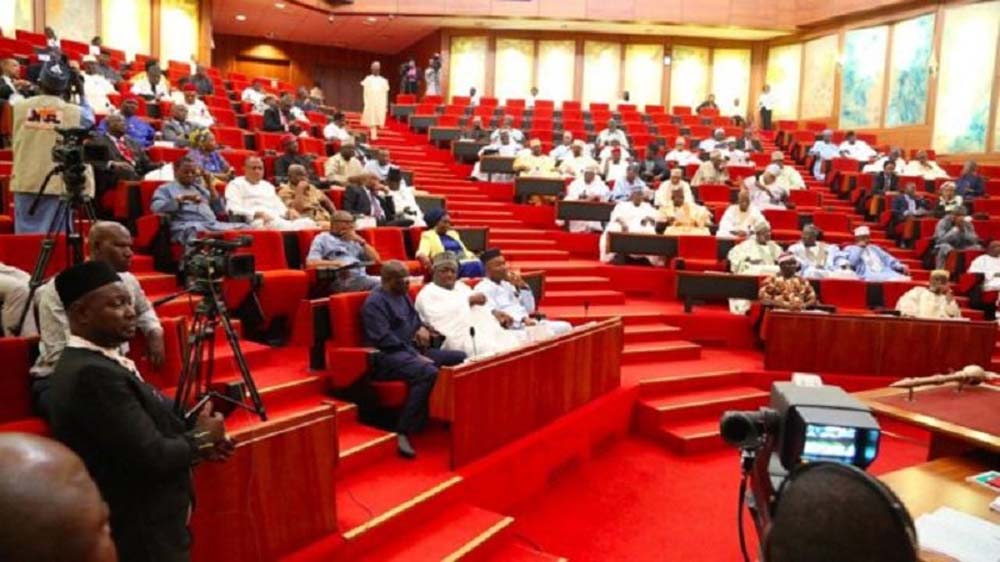
Senate Denies Receiving Petitions Against Tinubu’s Ambassadorial Nominees

Dangote Cement Lights Up Benue Host Communities With CSR Initiatives

Reps Recommend 3-year Jail Term For Aviation minister

Tems Sets New Record On Billboard Hot 100 Chart
https://shorturl.fm/sm9l1
https://shorturl.fm/0Ke8m
d5nmgy
6viu9n
0v3ekb
Hey there, You’ve done an incredible job. I will certainly digg it and personally suggest to my friends. I am sure they will be benefited from this web site.
In the great scheme of things you secure an A for effort and hard work. Exactly where you misplaced everybody ended up being on the facts. As it is said, details make or break the argument.. And that could not be much more correct in this article. Having said that, let me reveal to you precisely what did deliver the results. The authoring can be rather convincing which is possibly the reason why I am taking the effort to comment. I do not make it a regular habit of doing that. Secondly, whilst I can certainly notice a leaps in reason you make, I am not necessarily sure of just how you seem to connect the details that produce the conclusion. For now I will yield to your position but wish in the near future you link your facts much better.
cs4k8t
I really appreciate this post. I?¦ve been looking everywhere for this! Thank goodness I found it on Bing. You have made my day! Thx again
I am continuously looking online for posts that can aid me. Thx!
Wow, amazing weblog format! How lengthy have you been running a blog for? you made blogging look easy. The overall glance of your site is fantastic, as neatly as the content!
Can I simply say what a aid to seek out somebody who actually is aware of what theyre talking about on the internet. You positively know the right way to bring a problem to light and make it important. Extra people have to read this and perceive this side of the story. I cant consider youre not more widespread because you definitely have the gift.
Incredible! This blog looks just like my old one! It’s on a completely different subject but it has pretty much the same page layout and design. Great choice of colors!
Some genuinely wonderful work on behalf of the owner of this site, absolutely great content material.
What’s Happening i’m new to this, I stumbled upon this I’ve found It absolutely helpful and it has aided me out loads. I hope to contribute & assist other users like its aided me. Good job.
Magnificent beat ! I would like to apprentice while you amend your website, how could i subscribe for a blog site? The account helped me a acceptable deal. I had been a little bit acquainted of this your broadcast offered bright clear idea
Howdy just wanted to give you a brief heads up and let you know a few of the images aren’t loading properly. I’m not sure why but I think its a linking issue. I’ve tried it in two different internet browsers and both show the same outcome.
You made some decent points there. I seemed on the web for the problem and found most individuals will go along with along with your website.
Just want to say your article is as astonishing. The clearness in your post is simply great and i can assume you are an expert on this subject. Fine with your permission allow me to grab your feed to keep updated with forthcoming post. Thanks a million and please keep up the rewarding work.
As soon as I observed this internet site I went on reddit to share some of the love with them.