
NEWS
₦100bn Lawsuit: Oil Sector Legal Drama Ends As Dangote Withdraws Case


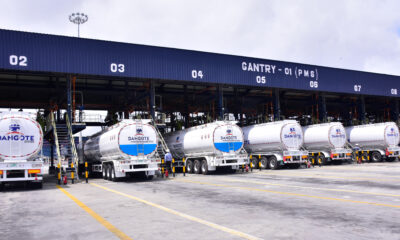
The Dangote Petroleum Refinery and Petrochemicals has decided to discontinue its ₦100 billion legal action against the Nigerian Midstream and Downstream Petroleum Regulatory Authority (NMDPRA), the Nigerian National Petroleum Company Limited (NNPCL), and five other major petroleum marketers.
The suit, which was pending before the Federal High Court in Abuja, was officially withdrawn after Dangote’s legal team filed a notice of discontinuance.
Though the court documents confirm the case has been dropped, they offer no explanation for the refinery’s change of course, nor is it clear whether an out-of-court resolution was reached.
READ MORE: Dangote Describes Tinubu as a Listening President, with Pro-Private Sector Policies
Among the parties previously dragged into the lawsuit were AYM Shafa Limited, A. A. Rano Limited, Matrix Petroleum Services Limited, T. Time Petroleum Limited, and 2015 Petroleum Limited.
At the heart of the dispute was the allegation that the NMDPRA had been breaching the Petroleum Industry Act by issuing import licences to various marketers without proof of domestic supply shortfalls.
Dangote Refinery asked the court to declare this practice unlawful, arguing that “such licenses should only be issued when a petroleum product shortfall exists.”
The refinery further asserted that NMDPRA had failed in its regulatory duty by not promoting and supporting local refining capacity, claiming the agency “violates its statutory responsibilities under the Petroleum Industry Act (PIA) for not encouraging local refineries such as Dangote Refinery.”
In response, the defendants argued that the licensing process complied with legal provisions and was necessary to meet market demand.
They insisted that their operations were legitimate, highlighting that they were “fully qualified to receive an import licence from NMDPRA, under Section 317(9) of the PIA.”
The marketers also accused Dangote Refinery of attempting to corner the petroleum industry, stating that the company “seeks to monopolise the petroleum industry in Nigeria, where it alone would control supply, distribution, and pricing.”
Backing this claim, Idris Musa, a Senior Regulatory Officer at NMDPRA, stated in a counter-affidavit that Dangote’s refining output was insufficient to meet the country’s daily fuel demand.
“In line with Section 317(9) of the Petroleum Industry Act, NMDPRA issued import licences to companies with a track record of international products trading to bridge the supply gap,” he noted.
Musa further emphasized that the regulator’s mandate includes “promoting competition and preventing monopolies in the sector,” firmly denying any coordinated attempt to sabotage Dangote’s operations.
The legal back-and-forth also featured procedural complications.
In December 2024, Dangote Refinery moved to amend the suit to correct a naming error, replacing “Nigeria National Petroleum Corporation Limited” with the correct entity, “Nigerian National Petroleum Company Limited.”
NNPCL responded with a preliminary objection, calling the suit “incompetent” due to the misidentification.
However, Justice Inyang Ekwo dismissed the objection on March 18, 2025, ruling that the error did not invalidate the suit.
He maintained that “the defendants should have responded to the substantive claims before raising procedural objections.”







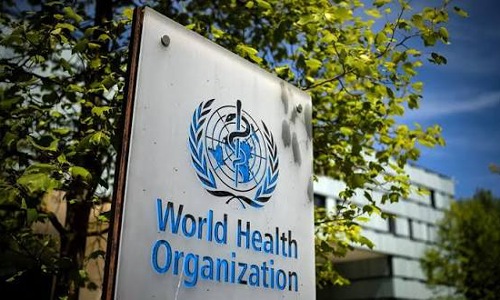
The World Health Organization (WHO) has released a disturbing update on the escalating conflict involving the United States, Israel, and Iran, revealing that thousands of people have been killed or injured in just under two weeks.
WHO Director-General Tedros Adhanom Ghebreyesus warned that health systems across the Middle East are under “immense strain” and are at risk of complete collapse if the crisis continues.
SEE MORE: US-Israel-Iran War: Day Four Updates from the Middle East
According to WHO reports, Iran has suffered over 1,300 deaths and around 9,000 injuries, while Lebanon has recorded at least 570 deaths and approximately 1,400 injuries.
In Israel, at least 15 people have died and more than 2,100 have been injured since hostilities escalated.
The conflict began on February 28, following a massive joint strike by US and Israeli forces that targeted top Iranian officials, including the country’s Supreme Leader.
The violence has since spread across the region, with retaliatory attacks targeting Israeli sites and US military bases in neighboring countries.
The humanitarian impact is severe. Over 100,000 Iranians and up to 700,000 Lebanese citizens have been displaced, many living in overcrowded conditions with limited access to clean water, sanitation, and medical care.
The WHO warns that these conditions put women and children at particular risk of disease outbreaks.
The organization also highlighted a growing trend of attacks on healthcare infrastructure, reporting dozens of strikes on hospitals and medical facilities across Iran and Lebanon.
Such attacks have not only resulted in deaths but also deprived entire communities of critical medical care when they need it most.
Tedros emphasized the urgent need for all parties to respect international law and protect civilians, calling for unimpeded humanitarian access and immediate measures to prevent the collapse of fragile health systems.
With the conflict continuing to escalate, the WHO has stressed that immediate action is required to protect lives, ensure medical support reaches affected populations, and prevent the humanitarian crisis from worsening.

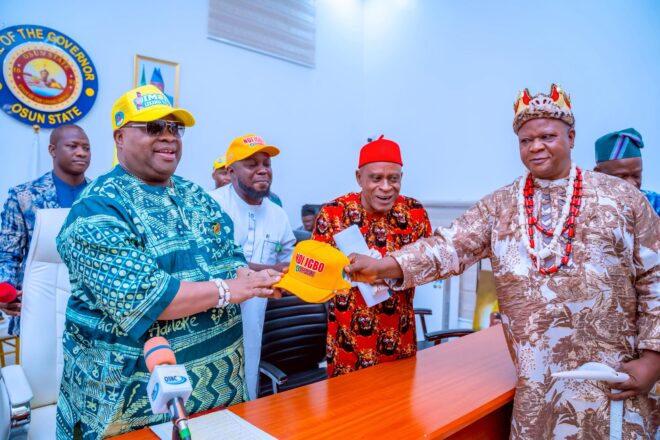
Ahead of the 2026 governorship election, the Ndigbo community across the local government areas of Osun State has declared its support for the second-term bid of Governor Ademola Adeleke.
A government house statement in Osogbo on Wednesday night has it that ndi Igbo cited his administration’s developmental strides across the state for their decision.
The endorsement was made during a courtesy visit by leaders of the Igbo community in Osun to the governor at the Government House in Osogbo, where they commended his leadership and commitment to inclusive governance.
ALSO READ: Adeleke on Why he Deserves Second Term
Speaking on behalf of the association, President-General of the Ndigbo in the state, Chief John Dike, praised the governor for the infrastructural and social development projects being carried out across the state.
He particularly commended the governor for appointing some members of the Igbo community as Senior Special Assistants, describing the gesture as a sign of recognition and inclusion of the community in the affairs of the state.
Chief Dike, however, appealed for further inclusiveness, requesting that more Igbo indigenes be considered for appointments into the state cabinet and other employment opportunities within the government.
He also urged the state government to allocate land for the construction of a modern secretariat for the Igbo community and grant approval for an endorsement rally in support of the governor’s re-election bid.
In addition, the Ndigbo leader sought assistance for Igbo farmers operating within the state, while assuring the governor of the community’s unwavering support for his administration and second-term ambition. Members of the delegation also presented campaign caps to the governor as a symbol of their solidarity.
Responding, Governor Adeleke expressed appreciation for the endorsement, noting that the Igbo community has continued to contribute positively to the social and economic development of the state.
He assured them that his administration would continue to promote their welfare and support their progress, while granting the requests presented during the visit.
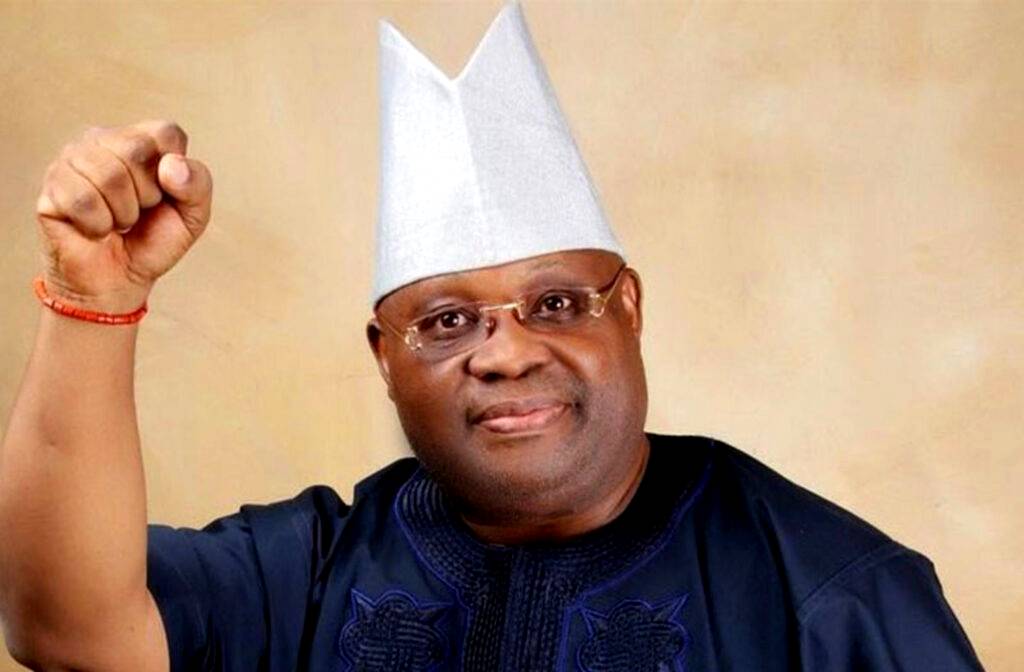
Osun State Governor, Senator Ademola Jackson Nurudeen Adeleke, has declared that his administration’s record of performance and fulfilment of electoral promises justifies a second term in office.
A government house statement in Osogbo on Wednesday has it that the governor made the declaration while hosting a delegation of the Ansar-Ud-Deen Society of Nigeria (ADS), Osun State Council, during a courtesy visit to the Government House, Osogbo.
ALSO READ: CNG: Tinubu Orders Deployment of 100,000 Kits in Three Weeks
It was gathered that the delegation was led by the National Vice President of the society, Asiwaju Justice Adeigbe (Rtd), alongside the Chairman of the Osun State chapter, Chief Daud Oladapo.
Speaking on behalf of the delegation, the State Secretary of the society, Dr Afeez Akande, praised the Governor’s performance and pledged the support of the organisation for the continuity of the administration.
“We have been following what you are doing and your track records. You are wonderful and you are marvelous in our eyes. The monumental works you have been doing in Osun make it look like we have never had a Governor like this before,” Dr Akande said.
He noted that the administration’s projects are known for timely delivery and strategic impact on the lives of residents.
“We have identified that once you embark on projects, they are time-bound. It shows genuine administrative acumen, love for the state and love for the people,” he added.
Dr Akande also cited infrastructural developments, specifically the ongoing dualisation of roads, notably that of Iwo as an example of the Governor’s vision-driven leadership.
“That road project has helped to boost economic activities in the area. Such development can only come from someone with vision who follows through with implementation. We appreciate what you are doing and we are resolved to support the continuity,” he said.
Responding, Governor Adeleke thanked the delegation for the visit and reaffirmed his commitment to people-centred governance.
“Today marks the starting point of campaigning for the August 15, 2026 governorship election. We need your prayers and support for a free and fair election through which the will of the people will prevail,” the Governor said.
Governor Adeleke also unveiled an upgraded Five-Point Agenda that will drive his re-election campaign.
“Our reloaded Five-Point Agenda will focus on integrated youth, women and workers’ welfare and empowerment; infrastructure consolidation for citizens’ social and economic wellbeing; agro-industrial expansion for human development and collective prosperity; affordable and qualitative health and education access; and an improved and secured business environment for job creation,” the Governor stated.
Explaining why he deserves a second term, the Governor pointed to the administration’s record across several sectors.
“When the opposition asked whether I deserve to be re-elected, I told them yes based on my performance in this first term in office,” the Governor said.
“I deserve re-election because of what our administration has delivered for the people of Osun. We have empowered the cooperative movement with almost four billion naira, strengthened community development associations with grassroots health and infrastructure projects, and implemented the Imole Medical Outreach that has benefited almost eighty thousand residents.”
He added that the administration has also revived agriculture and rural development across the state.
“We revived the cocoa revolution through aggressive seedling distribution and new farmers’ initiatives, acquired brand new tractors now serving farmers across the state, and implemented thousands of local projects through integrated rural development under the O-RAMP programme,” he said.
Governor Adeleke further highlighted achievements in governance, infrastructure and economic management.
“We introduced a 45-day window for the acquisition of Certificates of Occupancy, revived the Osun Free Trade Zone with active investors, digitised tax and revenue collection, and implemented the SIFMIS payroll application to ensure transparency in the management of public funds,” he stated.
The Governor also cited major achievements in infrastructure and social services.
“We have constructed over 350 kilometres of roads, developed three major flyover bridges, revived six moribund waterworks, drilled 332 boreholes across wards, rehabilitated schools and health centres, and paid inherited half salaries and almost one hundred billion naira in pension debts,” he added.
Governor Adeleke assured the people of Osun that his administration will continue to deliver inclusive governance and sustainable development if re-elected.
“My promise to the people of Osun is that now and when we are re-elected, we will continue to run an inclusive and forward-looking government that keeps the people at the centre of our programmes and policies,” he said.
Other dignitaries, and political functionaries present included the Deputy Governor of Osun State, Prince Kola Adewusi, and the Head of Service, Elder Ayanleye Aina.






WHO Releases Alarming Casualty Figures From US‑Israel‑Iran Conflict

PDP’s Festering Crisis Chases Tambuwal to ADC

$200/barrel Price Likely as Iran Threatens Oil Ships

2026 Poll: Osun Ndigbo Backs Adeleke’s Second-Term Bid

NGX Group, IFC, CSCS and WIMBIZ Convene Leaders to Advance Gender Equality at 2026 Ring the Bell Ceremony

Adeleke on Why he Deserves Second Term

Trump’s Family Unveils New Cryptocurrency Platform

Reps Recommend 3-year Jail Term For Aviation minister

Dangote Cement Lights Up Benue Host Communities With CSR Initiatives

Senate Denies Receiving Petitions Against Tinubu’s Ambassadorial Nominees

Things To Know About Threads, Zuckerberg’s Twitter-like App
