
Breaking News
133m Nigerians Battling Poverty – NBS

The Federal Government has declared that 133 million people or 63% of Nigeria’s population of over 200 million live in poverty.
Based on a survey conducted by the National Bureau of Statistics (NBS), the National Social Safety-Nets Coordinating Office (NASSCO), the United Nations Development Programme (UNDP), the United Nations Children’s Fund (UNICEF), and the Oxford Poverty and Human Development Initiative, the figure was announced during the Poverty Index (MPI) Survey launch yesterday in Abuja (OPHI).
The poll was carried out between November 2021 and February 2022, sampling more than 56,000 homes across the 36 States of the Federation and the FCT.
It was discovered that 65 per cent of the poor, amounting to 86 million people, live in the North while 35 per cent, nearly 47 million live in the South.
According to the report: “Over half of the population of Nigeria are multidimensionally poor and cook with dung, wood or charcoal, rather than clean energy. High deprivations are also apparent nationally in sanitation, time to healthcare, food insecurity, and housing.”
Putting a further perspective on it, the report said: “In general, the incidence of monetary poverty is lower than the incidence of multidimensional poverty across most states.”
It said the North West has the highest number of people in poverty with 45.49m followed by North East 20.47m, North Central 20.19m, South South 19.66m, South West 16.27m and South East 10.85m.
On state profile, it said Kano has the highest number with 10.51m while the least is Abia with 1.12m people.
The report, which included the Child MPI stated that two-thirds 67.5 per cent of children (0–17) are multidimensionally poor and half, 51 per cent, of all poor people are children.
It added that the highest deprivations are in the indicator of child engagement, where over half of the poor children lack the intellectual stimulation pivotal to early childhood development.
“Child poverty is prevalent in rural areas, with almost 90% of rural children experiencing poverty. Across the geo-political zones, the child MPI shows higher poverty in the North-East and North-West (where 90% of children are poor) and lower poverty in the South-East and South-West (74% and 65.1% respectively). The incidence of Child MPI is above 50% in all States and greater than 95% in Bayelsa, Sokoto, Gombe and Kebbi.
In Nigeria, 40.1% of people are poor according to the 2018/19 national monetary poverty line, and 63% are multidimensionally poor according to the National MPI 2022.”
The Statistician General of the Federation/CEO of NBS, Semiu Adeyemi Adeniran, noted that the MPI, which uses three dimensions (health, education and living standards), was upgraded to include a fourth dimension of work and shocks.
He said other variables such as food security, water reliability, underemployment, security shocks and school lag, were all added to reflect the current realities and priorities in Nigeria.
NBS added that in general, a disparity between north and south is evident in both the incidence and in the intensity of multidimensional poverty, with the North being poorer.
NBS, which said the composition of Multidimensional Poverty Index (MPI) varies across zones, stressed that nutritional deprivations contribute highest in the Northopaedic West but food insecurity contributes more strongly across the South.
Reports further said security shocks have a greater impact on MPI in South-South, North Central, and North East than they do in other zones due to unemployment.
According to NBS, multidimensional poverty is more prevalent in rural areas, where 72% of people live in poverty.
It was emphasized that 80% of the poor in Nigeria reside in rural areas, where about 70% of the population calls home.




Socio-Economic Rights and Accountability Project (SERAP) announced that it has filed a lawsuit against the Central Bank of Nigeria (CBN) “over the failure to account for and explain the whereabouts of the missing or diverted N3 trillion of public funds, including the over N629 billion paid to ‘unknown beneficiaries’ as part of the Anchor Borrowers’ Programme.”
The lawsuit followed the grave allegations contained in the latest annual report by the Auditor-General of the Federation, which was published on 9 September 2025.
In the suit number FHC/ABJ/CS/250/2026 filed last week at the Federal High Court in Abuja, SERAP stated that it is seeking “an order of mandamus to direct and compel the CBN to account for and explain the whereabouts of the missing or diverted N3 trillion of public funds, including detailed reports of how exactly the funds were spent.”
In the suit, SERAP is arguing that, “These grim allegations by the Auditor-General suggest grave violations of the public trust, the provisions of the Nigerian Constitution 1999 [as amended], the CBN Act, and anticorruption standards.”
SERAP is also arguing that, “These grave violations also reflect a failure of CBN accountability more generally and are directly linked to the institution’s persistent failure to comply with its Act and to uphold the principles of transparency and accountability.”
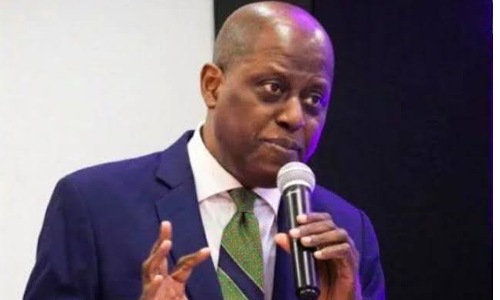
CBN Gov, Olayemi Cardoso
According to SERAP, “These violations have seriously undermined the ability of the CBN to effectively discharge its statutory functions and the public trust and confidence in the bank. The CBN ought to be committed to transparency and accountability in its operations.”
SERAP also stated in its suit that, “Nigerians have the right to know the whereabouts of the missing or diverted public funds. Granting the reliefs sought would advance the right of Nigerians to restitution, compensation and guarantee of non-repetition.”
SERAP said, “Section 15(5) of the Nigerian Constitution requires public institutions to abolish all corrupt practices and abuse of power. Section 13 of the Constitution imposes clear responsibility on the CBN to conform to, observe and apply the provisions of Chapter 2 of the constitution.”
The suit filed on behalf of SERAP by its lawyers Oluwakemi Agunbiade and Valentina Adegoke, read in part: “According to the Auditor-General, the CBN in 2022 failed to remit over N1 trillion [N1,445,593,400,000.00] of ‘the Federal Government’s portion of operating surplus’ into the Consolidated Revenue Fund (CRF) account.”
“The Auditor-General fears that the money may have been ‘diverted.’ He wants the money recovered and remitted to the treasury.”
“The CBN also failed to recover over N629 billion [N629,040,000,000.00] paid to ‘unknown beneficiaries’ as part of the Anchor Borrowers’ Programme, a programme ‘meant to support farmers to ensure sustainable food production in the country.’”
“But ‘the numbers of beneficiaries who collected the money are unknown.’ The CBN has also failed to ‘recover the money.’ The Auditor-General fears ‘the money may have been diverted’, which could have ‘contributed to the difficulty in sustaining food security in the Nation.’”
“He wants the money recovered and remitted to the treasury.”
“The CBN has also failed to recover over N784 billion [N784,410,108,864.47] ‘being 32 unpaid, overdue loans and interventions disbursed by the Bank between 2018 and May 2022.’”
“The Auditor-General said ‘there was no evidence that the Bank was doing enough to recover the loans/interventions, which ought to have been paid.’ He wants the money recovered and remitted to the treasury.”
“The CBN in 2022 also spent over N125 billion [N125,374,000,000.00] ‘on questionable intervention activities.’ The CBN claimed it spent the money ‘on intervention activities in connection with national security, the federal government, state securities, armed forces and to build the capacity of the financial sector’.”
“But the Auditor-General is concerned that the money may have been spent ‘without the approval of the National Assembly.’ There was also no document to ‘support the expenditure.’”
“The ‘expenditure also may not have been in the public interest and consistent with the objectives of the CBN in section 2 of the CBN Act.’ The Auditor-General fears the money may have been ‘diverted.’ He wants the money recovered and remitted to the treasury.”
“The CBN in 2022 also ‘unjustifiably’ spent over N1 billion [N1,792,769,160.00] to buy 43 operational vehicles for the Nigeria Immigration Service (NIS).”
“According to the Auditor-General, ‘the spending is unjustified because there is no connection with buying operational vehicles for the NIS and the objectives of the CBN as stated in section 2 of the CBN Act.’”
“The NIS also ‘failed to provide any evidence to show that the vehicles were actually supplied and delivered.’ There ‘were also no procurement and payment records or documents.’ The Auditor-General fears the money may have been ‘diverted’. He wants the money recovered and remitted to the treasury.”
“The CBN also awarded 43 contracts for over N189 billion [N189,50,066,756.73]. The Auditor-General said that ‘the contractors deliberately delayed completion of these contracts by seeking extension of the completion period.’”
“The contractors then ‘requested for variation of the contracts due to extension of completion period.’ Following the request, the CBN paid the contractors over N9 billion [N9,270,849,691.61] ‘irregular variation of contract price.’”
“There ‘were no relevant procurement documents such as contract files, procurement records, and payment vouchers’ for the payment. The Auditor-General fears ‘the money may have been diverted’ and the projects may have been abandoned.’ He wants the money recovered and remitted to the treasury.”
“The Katsina state branch of the CBN also failed to recover over N90 million [N90,163,610.00] being ‘outstanding loans and interventions disbursed to 33 small and medium enterprises during Covid 19 in 2020.’”
“The Auditor-General fears ‘the money may have been ‘diverted’ or ‘mismanaged’. He wants the money recovered and remitted to the treasury.”
“Paragraph 3112(ii) of the Financial Regulations 2009 provides: ‘Where a public officer fails to account for government revenue, such officer shall be surcharged for the full amount involved and such officer shall be handed over to either the EFCC or the ICPC.’”
“Section 51 of the Fiscal Responsibility Act provides that, ‘A person shall have legal capacity to enforce the provision of this Act by obtaining prerogative orders or other remedies at the Federal High Court, without having to show any special particular interest.’”
“The Nigerian Constitution, Freedom of Information Act, and the country’s anti-corruption and human rights obligations rest on the principle that citizens should have access to information regarding their public institutions’ activities.”
No date has been fixed for the hearing of the suit.
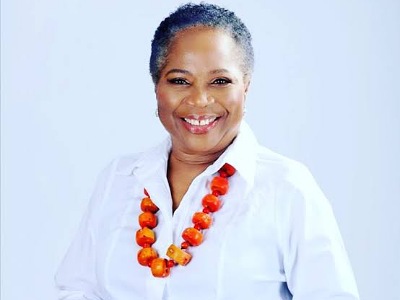
Nigerian singer, songwriter, and actress Onyeka Onwenu passed away on Tuesday, shortly after performing at a birthday party in Lagos.
The celebrated music icon was attending a friend’s private birthday celebration when she took to the stage to perform. After returning to her seat, Onwenu suddenly collapsed, prompting immediate concern among the attendees.
Emergency responders arrived swiftly and transported her to Reddington Hospital on Victoria Island. Despite the medical team’s efforts, Onwenu was pronounced dead shortly after her arrival.
Sources close to the family revealed that she fell ill during the event, leading to her collapse.
READ MORE: Adeleke Appeals To #EndBadGovernance2024 Organisers To Keep Osun Violence Free During Agitations
She said, “It is very sad. Onyeka Onwenu just performed at the birthday of Mrs. Stella Okoli of Emzor Pharmaceuticals tonight. After performing, she slumped. She was taken to Reddington Hospital but couldn’t make it.”
The exact cause of her death is yet to be confirmed.
Born on 31 May 1952, Onwenu was a multifaceted artist whose career spanned over four decades. She was not only a renowned singer and songwriter but also an actress, journalist, and politician.
Onwenu’s music blended genres such as highlife, reggae, and pop, often addressed social and political issues. Some of her most popular songs include “One Love,” “Iyogogo,” and “Ekwe.”
Onwenu was also known for her political activism. She was chairperson of the Imo State Council for Arts and Culture and was appointed Executive Director/Chief Executive Officer of the National Centre for Women Development.
Earlier this year, Onwenu revealed she was producing a movie chronicling her experiences in the music industry spanning several decades. She expressed her excitement to share her personal story and how Nigerian music has evolved over time.
Onyeka Onwenu, known for her contributions to the Nigerian music and film industry, leaves behind a legacy that will be remembered for generations.
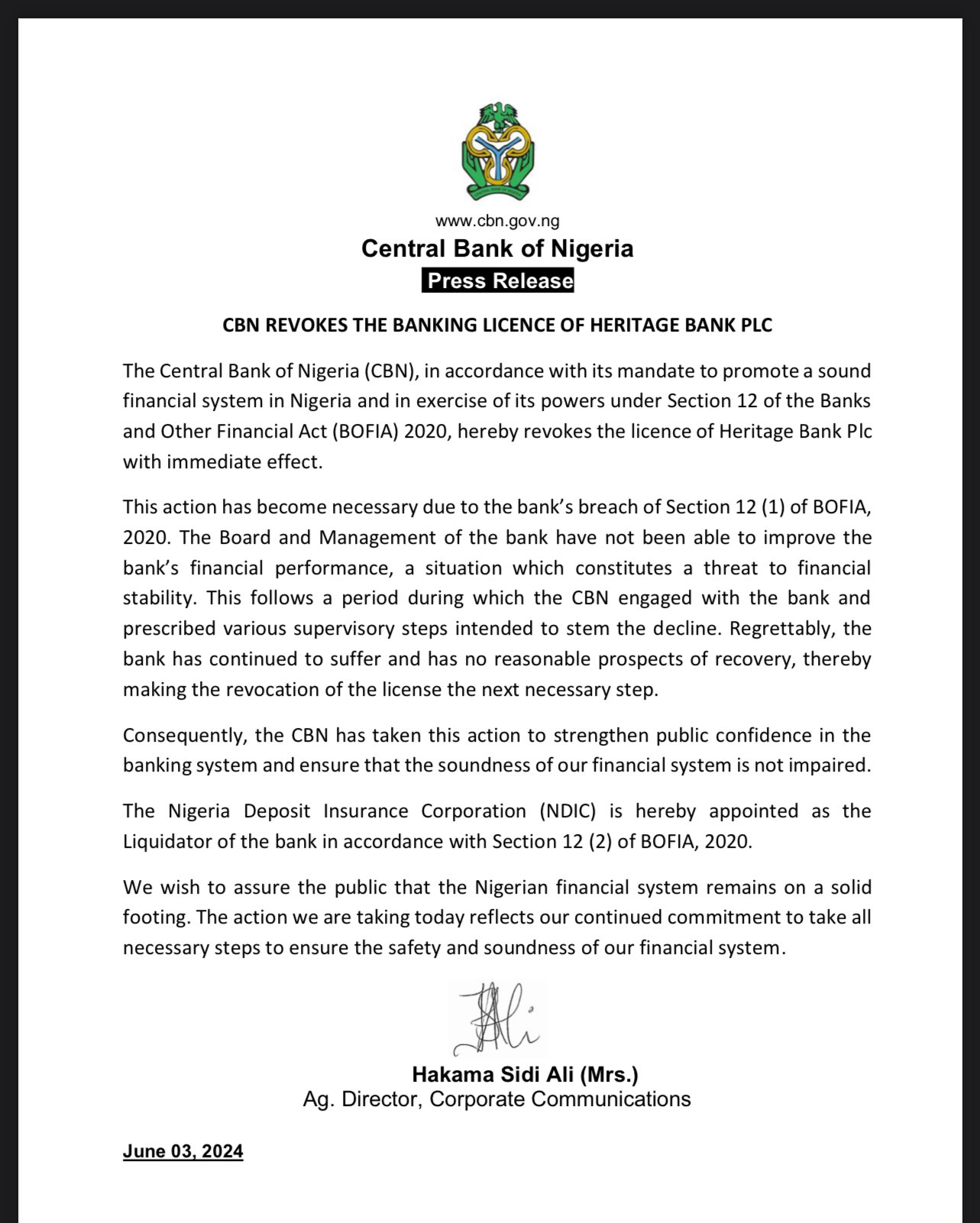
In a significant move to ensure the stability of Nigeria’s financial system, the Central Bank of Nigeria (CBN) has announced the immediate revocation of Heritage Bank Plc’s banking license.
The decision came after the bank breached Section 12 (1) of the Banks and Other Financial Act (BOFIA) 2020, with the bank’s Board and Management unable to improve its financial performance despite various supervisory measures prescribed by the CBN.
Biztellers reports that the CBN found that the bank’s declining financial situation posed a threat to the overall stability of Nigeria’s financial system.
Consequently, the CBN took decisive action to revoke the bank’s license and appointed the Nigeria Deposit Insurance Corporation (NDIC) as the Liquidator.
This step is intended to strengthen public confidence in the banking system and ensure its continued soundness.
In a press release, Mrs. Hakama Sidi Ali, Acting Director of Corporate Communications at the Central Bank, assured the public that Nigeria’s financial system remains robust and stable.
The CBN’s decision to revoke Heritage Bank’s license underscores its unwavering commitment to taking all necessary measures to safeguard the financial system and protect depositors’ interests.
As the situation unfolds, the banking community and the general public are closely monitoring the ongoing developments related to Heritage Bank and the broader implications for Nigeria’s financial sector.






Airfares Likely to Rise as Aviation Fuel Price Spikes by 80%

Shell Completes Turnaround Maintenance on FPSO, Resumes Production at Bonga

Sahara Group expands fleet with new 40,000 cbm LPG Carrier

NATO Shoots Down Third Iranian Missile in Turkey

Inside Tinubu’s Closed-Door Meeting With Opposition Leaders – SDP, IPAC Reveal Details

Defections Won’t Break PDP in Sokoto, Says Former Senator Gada

Trump’s Family Unveils New Cryptocurrency Platform

Reps Recommend 3-year Jail Term For Aviation minister

Dangote Cement Lights Up Benue Host Communities With CSR Initiatives

Senate Denies Receiving Petitions Against Tinubu’s Ambassadorial Nominees

Tems Sets New Record On Billboard Hot 100 Chart
