
Energy
Africans Learn Nigeria’s Local Content Model – NCDMB

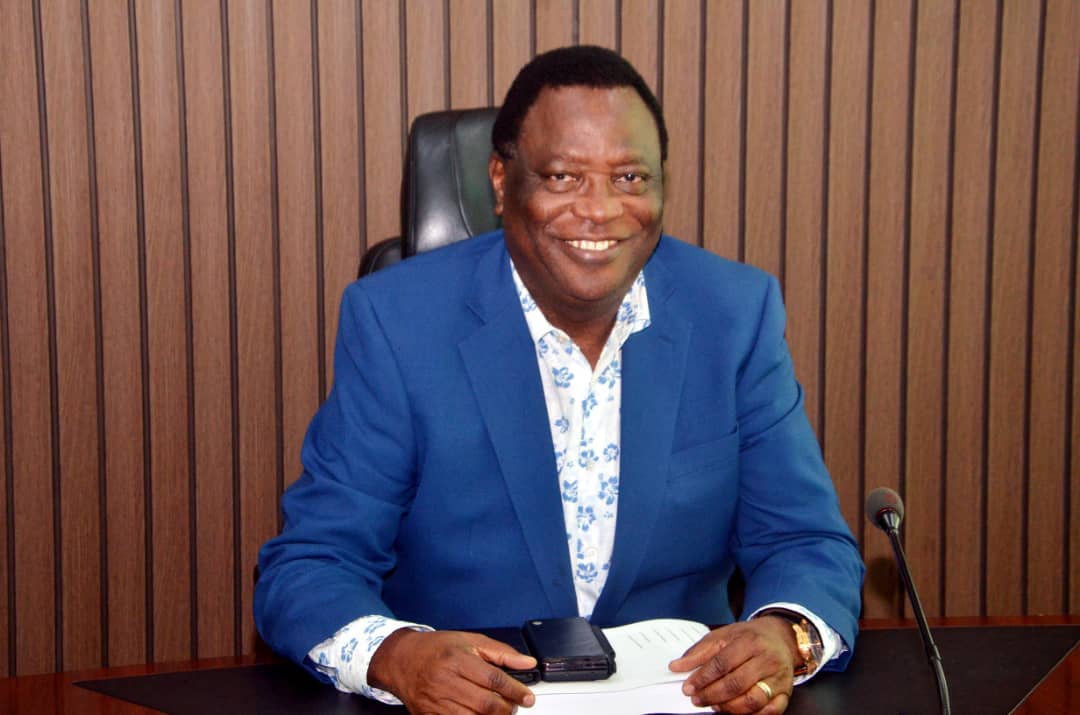
In the bid to set up domestic local content models, several African countries are studying the Nigerian Content Development and Monitoring Board’s (NCDMB) template.
The board stated this recently while hosting a delegation from the Ghana National Petroleum Corporation (GNPC) on a benchmarking and knowledge-sharing visit aimed at deepening Ghana’s understanding of Nigeria’s local content development framework.
The delegation, led by the Director of Corporate Affairs at GNPC, Eric Pwadura, was received at the NCDMB headquarters in Yenagoa, Bayelsa State.
In a media statement, the General Manager, Corporate Communications Division of NCDMB, Dr Obinna Ezeobi, said Nigeria and Ghana had enjoyed long-standing cooperation in the energy sector and that the board had continued to support peer learning across Africa.
Welcoming the team, the Executive Secretary of NCDMB, Felix Ogbe, said Africa’s hydrocarbon endowment places a responsibility on producing countries to prioritise local content development and reduce dependence on foreign technology.
He said, “Africa has evolved over the last three to four decades, growing its hydrocarbon resources to over 120 billion barrels of crude oil reserves and 800 trillion standard cubic feet of gas, which constitute over 10 per cent of hydrocarbon resources globally.”
ALSO READ: NLNG Train 7 Hits 90% Completion, Generates 16,000 Jobs
Ogbe added that it was in the national interest of producing countries to build internal capacity for exploration and production, stressing the need for a shift away from over-reliance on external expertise.
Represented by the Director, Corporate Services of NCDMB, Dr Abdulmalik Halilu, Ogbe said Africa’s youth population remained a key advantage for industrial development if properly equipped with relevant skills.
He maintained that the board had evolved from policy directives under the defunct Nigerian National Petroleum Corporation Local Content Division into a full-fledged institution.
“We have evolved from a policy to an institution,” he enthused, adding, “NCDMB is the sole agency responsible for local content” in Nigeria.
He disclosed that the board’s Nigerian Content 10-Year Strategic Roadmap was structured around five strategic pillars, including technical capability development, compliance and enforcement, enabling business environment, organisational capability, and sectoral and regional markets, alongside key enablers such as funding and regulatory support.
On capacity development, Ogbe highlighted the Nigerian Content Intervention Fund, which is administered through the Bank of Industry and the Nigerian Export-Import Bank, to provide single-digit loans to indigenous service companies.
“What we have done is to create that access to make the local service companies competitive,” he explained, noting that the initiative had enabled indigenous firms to acquire critical assets such as marine vessels.
He further noted that the board promotes utilisation of built capacity through a First Consideration policy for Nigerian companies with proven capability.
He added, “Local content does not compromise standards…it does not mean you have African spec or European spec,” adding, “It’s one global spec.”
Ghana’s Pwadura, in his remarks, expressed appreciation for the opportunity to learn from Nigeria’s experience, noting that Ghana’s current structure remains less developed.
“Even though we have the legislation guiding local content, we have not had the benefit of having a robust local content environment like you have. If we take our organisation (Ghana National Petroleum Corporation), for example, what we have is a local content unit. That’s currently the structure that we have. We want to have a deeper understanding of your local content development programme,” he said.
Earlier in his opening remarks, Ezeobi noted that NCDMB had maintained strong partnerships with several African institutions, including memoranda of understanding with Ghana’s Petroleum Commission and Senegal’s ST-CNSCL, as well as agencies in Mozambique, Angola and Namibia.





Gas producers must stop treating methane reduction as an environmental cost, because methane released into the atmosphere represents lost gas, lost revenue and lost energy that could otherwise be recovered and sold.
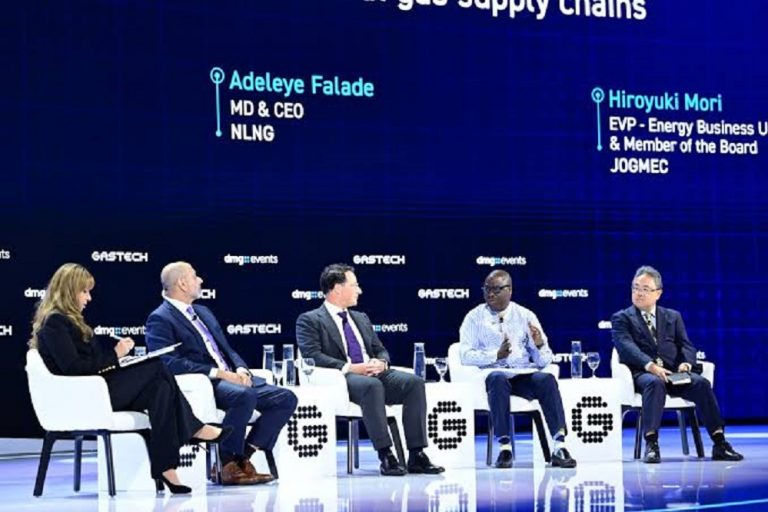
The Managing Director and Chief Executive Officer of Nigeria LNG Limited (NLNG) Adeleye Falade, made the declaration during a panel titled “Capturing the Lost Opportunity: Driving Global Alignment on Methane Abatement Across Natural Gas Supply Chains,” at the Gastech 2026 Exhibition and Conference in Bangkok, Thailand.
READ ALSO: Spike in Petrol Price Moves NLC to Demands Emergency Palliatives
Taking from the company’s experience, he highlighted that investments in methane abatement could pay for themselves while improving plant efficiency and asset reliability.
The NLNG CEO said the commercial value of recovering lost gas should become a central part of the global industry’s approach to methane management.
“Every tonne emitted is lost product, lost revenue and lost energy; gas we could have sold. Every molecule of methane avoided is both an emissions reduction and a recovered energy resource.”
According to him, the NLNG’s new boil-off gas compressor and start-up gas recovery project demonstrate the business case for methane reduction, with each project expected to deliver methane reductions of about 10–15 percent while also recording positive projected net present values. “The most compelling business case is the simplest one: the projects that cut our methane also pay for themselves.
“The same discipline that reduces methane also improves asset reliability and plant efficiency. The returns show up in more places than the emissions ledger,” Falade said.
He added that the starting point for methane abatement was credible measurement of gas losses, which enables companies to identify where methane is being lost, channel investment towards the right interventions and independently verify the results.
According to Falade, the NLNG had demonstrated that producers in developing economies could meet globally recognised standards for emissions measurement and reporting, despite infrastructure and other constraints.
He disclosed that the NLNG had achieved Gold Standard recognition under the Oil and Gas Methane Partnership (OGMP) 2.0 and became the first company in Africa to attain Level 5 methane emissions reporting.
Its measurement, reporting and verification system is independently assured by DNV in line with ISO 14064.
The NLNG’s methane-management programme includes site-wide optical gas imaging, a structured Leak Detection and Repair programme, as well as phased deployment of continuous monitoring and real-time emissions dashboards across its plant and vessels.
Falade said methane reduction was also being incorporated into the design of Train 7, which is expected to raise the NLNG’s LNG production capacity from 22 million tonnes per annum to 30 million tonnes.
The commercial case for emissions abatement was not new to Nigeria, he added, pointing to the NLNG’s longstanding role in converting gas that would otherwise have been flared into a marketable product.
According to him, the company’s activities have contributed to reducing Nigeria’s gas-flaring rate from above 65 percent to below 20 percent.
Beyond its own operations, Falade revealed that the NLNG was extending methane-management requirements across its supply chain through its Scope 3 Advocacy Plan.
The company engages feed-gas suppliers and contractors to measure, disclose and reduce emissions, while verified upstream emissions data and emissions-related criteria are incorporated into supplier selection and evaluation.
Falade also called for greater consistency in methane measurement and reporting requirements across jurisdictions, arguing that divergent standards make enforcement uneven and complicate meaningful comparisons between producers.
“The industry does not need weaker standards; it needs stronger, shared ones backed by real measurement,” he said.
On the tension between emissions reduction, energy access and affordability, Falade said developing economies should not be forced to choose between economic development and climate action.
“Developing economies cannot be asked to choose between economic development and emissions reduction. Both must progress together,” he said.
Other panellists were Zubin Bamji of the World Bank, Niels Dijksman of Brunei LNG and Hiroyuki Mori of JOGMEC.
The session was moderated by energy economist Dr Carole Nakhle of Crystol Energy.
Expectations are high that the $10 billion Train 7 project of the Nigeria Liquefied Natural Gas Limited (NLNG) would go into operation by the end of 2027.
Managing Director of NLNG, Adeleye Falade, made the disclosure on the side-lines of the Gastech conference, yesterday, in Bangkok, Reuters reported.
This is part of a grand strategy by the company to raise production and address persistent gas supply constraints.
READ ALSO: Banks Caution Against Scammers over Dangote IPO
Train 7 project, located on Bonny Island, Rivers State, is expected to increase NLNG’s production capacity to 30 million metric tonnes per annum (mtpa), from the current 22 mtpa.
The project has suffered repeated delays, including disruptions associated with the COVID-19 pandemic and the Russia-Ukraine war.
Falade also disclosed that NLNG remained under a force majeure declared in 2022 following widespread flooding that disrupted gas supplies to the company.
According to him, the company would lift the force majeure when it reaches a 90 per cent utilisation rate, with the plant currently operating at between 82 per cent and 83 per cent.
“We still have a delta of about 15 per cent that we need to close,” Falade said. “Operationally, we are able to do that, but our biggest constraint is gas supply, and we’re working with all the relevant people, including the government, to be able to get more gas to flow into the plant,” he added.
He said NLNG was focused on meeting its existing contractual obligations to buyers while the company worked to increase production.
Falade added that interest in additional LNG volumes and spot cargoes had increased after exports through the Strait of Hormuz were curtailed by the Iran war.
“People are looking at more diversified, reliable sources of supply,” he said.
“Our priority currently is to continue to make sure that we fulfil our obligations to our existing customers and maximize as much production opportunity as possible that we have,” he added.
The NLNG is majority-owned by the Nigerian National Petroleum Company Limited (NNPC Ltd), while Shell, TotalEnergies and Eni are its international partners.
Public concerns that the introduction of smart and self-service filling stations would lead to job losses in the downstream petroleum sector have been dismissed by the Nigerian National Petroleum Company Limited (NNPC Ltd).
According to the state oil major, the deployment of automated stations was part of efforts to improve efficiency and customer experience. It added that the technology would create new opportunities rather than simply eliminate existing jobs.
The NNPC Ltd also disclosed plans to transform about 900 of its existing retail outlets across the country into modern energy hubs, as it adapts its retail business to changing consumer needs and developments in the downstream sector.
READ ALSO: FHC Hands 10 Years Sentence to Nine Oil Thieves in Akwa Ibom
The disclosures were made in Abuja, during the commissioning of a 24-hour smart, self-service filling station at the headquarters of the Nigeria Immigration Service (NIS).
The Executive Director, Retail Operations and Mobility, NNPC Retail Limited, Shettima Kukawa, said the new model was designed to provide customers with faster, more convenient and technology-driven services.
Kukawa added that the transformation of the company’s retail outlets was not about simply replacing workers with machines, but about creating a modern retail environment capable of providing more services to customers.
He explained that the smart station allows motorists to purchase fuel through the NNPC fuel app, fund their digital wallets and dispense the exact quantity of fuel they have paid for using a self-service code.
The station has a storage capacity of 180,000 litres of Premium Motor Spirit (PMS) and 45,000 litres of Automotive Gas Oil (AGO), with 16 PMS pumps and two AGO pumps.
It also has a six-point electric vehicle (EV) charging facility and is primarily powered by a solar system with more than 200kWh capacity.
Managing Director, NNPC Retail Limited, Hubb Stokman, said the downstream industry was undergoing significant changes following fuel deregulation and the commencement of operations at the Dangote Refinery.
Stokman said consumers were also demanding more services at filling stations, pointing out that the traditional fuel-only model was no longer sufficient to meet their expectations.
“Today shows that the downstream industry is changing after the fuel deregulation and also the start-up of the Dangote Refinery. Our industry is rapidly changing, and I think that more than ever, we need to meet the needs of the Nigerian consumer and their wishes.
“They want to see more services, like a fast food restaurant, convenience shop, maybe a coffee shop, banks. They would like to have a lounge or car wash. All these things that you will see here,” he said.
Also speaking, the Executive Vice President, Downstream, NNPC Limited, Dr Mumuni Dagazau, said the company was moving beyond the traditional concept of a filling station by integrating technology and alternative energy solutions into its retail network.
He said the development represented the type of modern retail infrastructure that should be replicated across the country, stressing that Nigerians deserved improved quality and service.
“Our objective at NNPC is not simply to provide fuel, it is to provide reliable energy solutions and a better retail experience supported by technology and innovation.
“We deserve these sort of stations throughout this country. We need to move away from where we have been and deliver this sort of quality and the service to our people in the community,” Dagazau said.
On his part, the Comptroller-General of Nigeria Immigration Service, Kemi Nandap, commended NNPC Limited for integrating EV charging with conventional fuelling.
Represented by Saidu Daura, the Deputy Comptroller-General, Nandap said the development aligned with global trends in energy transition, climate action and smart mobility, describing it as a practical step towards a cleaner, more sustainable and technology-driven economy.
She said the shift to technologies such as electric mobility could create opportunities for investment, employment, skills transfer and industrial growth.
“Today’s commissioning goes beyond the opening of a service station. It is a statement of confidence in Nigeria’s future and a contribution to building a resilient, green, and technologically advanced nation,” she said.
Nandap called for stronger collaboration between government institutions, the private sector and other stakeholders to promote sustainable development and national progress.
The station operates round-the-clock and includes automated services designed to reduce waiting time and give motorists greater control over their transactions.






Indonesia’s Pertamina Leads Foreign Interest in Nigeria’s 2026 Oil Licensing Round

Ingentia Energies Focused on Exponential Growth

‘Another Oil Shock Is Coming’ — Badenoch Calls for North Sea Drilling Amid Middle East Supply Disruptions

Petrol Prices: Arewa Marketers Dispute NMDPRA’s Claim It Has No Pricing Powers

ICAN, Police Move to Finalise MoU on Financial Crime Investigation

Police Probe PCRC Chairman Olaniyan Over Alleged ₦178m Financial Crimes

Trump’s Family Unveils New Cryptocurrency Platform

Senate Denies Receiving Petitions Against Tinubu’s Ambassadorial Nominees

Dangote Cement Lights Up Benue Host Communities With CSR Initiatives

Reps Recommend 3-year Jail Term For Aviation minister

Tems Sets New Record On Billboard Hot 100 Chart
