
International News
Canada’s Wildfires Smoke Deteriorate Air Quality In Northern U.S

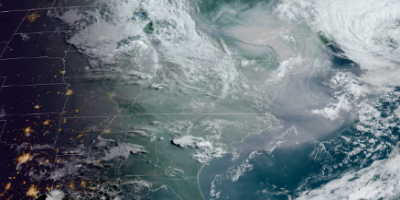
A satellite image of the eastern United States shows swirling clouds of smoke from wildfires and haze enveloping large portions of that region.
Smoke moved into portions of northern New York State and Vermont on Tuesday. In the Upper Midwest, air quality alerts were issued in Minnesota.
Hundreds of wildfires continued to blaze on Tuesday across Canada, exacerbating an already active wildfire season that was only expected to worsen, and sending smoke into portions of the United States, creating poor air quality levels.
In Ontario, a layer of haze enveloped parts of Ottawa and Toronto, where Canadian officials warned residents about the poor air quality, as smoke moved into portions of northern New York State and Vermont. All of New York City was under an air quality alert on Tuesday because of the smoke; by the afternoon, the Manhattan skyline was obscured by hazy skies.
There were more than 400 active wildfires in Canada on Tuesday, according to the Canadian Interagency Forest Fire Centre, with more than 200 deemed to be “out of control.”
In eastern Canada, Quebec was most affected by wildfires as of early afternoon on Tuesday, with more than 150 active blazes across the area, according to the fire agency. Residents in some areas were being encouraged to close their windows and doors, local officials in Quebec said.
Videos and images showed some fires blazing for miles, sending dark smoke plumes billowing into the sky.
Burned-area boundaries and hotspot locations are estimates based on satellite data, and hotspots indicate likely areas of burning detected within the previous two days. By Martín González Gómez and Madison Dong
At a press conference on Monday, Prime Minister Justin Trudeau said he was in contact with local officials across Canada about the fires.
“This is a scary time for a lot of people,” Mr. Trudeau said.
As of Monday, an estimated 26,000 people across Canada had been evacuated from their homes because of wildfires, Bill Blair, Canada’s minister of public safety, said at the press conference.
“The images that we have seen so far this season are some of the most severe ever witnessed in Canada,” Mr. Blair said.
A woman in an orange hoodie walks her dog along a grassy bank of the Ottawa River, and smoke obscures part of the background on the river’s opposite side.
Many Canadians who have had to evacuate in recent days had just a few hours to pack before fleeing their homes, Mr. Trudeau said.
“When people lose their homes, they don’t just lose a roof and their possessions,” Mr. Trudeau said. “They lose a special place where they saw their children grow up, where they built a life for themselves. This is incredibly difficult and heartbreaking.”
Bands of smoke from the numerous wildfires were expected to shift southward across the border on Tuesday, creating hazy skies and prompting the U.S. National Weather Service to issue air quality alerts for parts of the upper Great Lakes and the Northeast.
Large swaths of Minnesota were under air quality alerts through the evening on Tuesday, the Weather Service said. Light winds were expected to push smoke from wildfires in Quebec across Minnesota. Smoke was also predicted to move into the state off Lake Superior.
Weather officials warned that people more sensitive to poor air quality, such as people with lung disease and heart disease, children, and older adults, should limit certain activities outdoors.
Farther east, air quality alerts were also in place for multiple counties in upstate New York and New York City through midnight. Similar alerts were issued for parts of Connecticut, Massachusetts, and Vermont.
Satellite images of North America on Tuesday showed light brown smoke streaming south from the fires. The smoke appeared to be particularly thick over portions of Quebec, Ontario, and New York. Hazy.










Federal agents raided the Washington, D.C., home of Democratic Congresswoman Ilhan Omar early Monday morning as part of an ongoing federal criminal investigation, the United States Department of Justice (DOJ) has confirmed.
Homeland Security Investigations agents arrived at the Minnesota congresswoman’s residence at about 6:00 a.m. Eastern Time, according to a report by Fox News.
SEE MORE: Trump Sparks Outrage With Shock Proposal to Rename New Mexico
The report said both the Department of Homeland Security (DHS) and the DOJ are involved in the investigation.
A DOJ spokesperson confirmed the operation, stating: “Today in the Washington, D.C. area, Homeland Security Investigations executed a judicially authorized search warrant secured by the Department of Justice.”
The spokesperson added: “This enforcement action is part of an ongoing federal criminal investigation.”
Details later……….
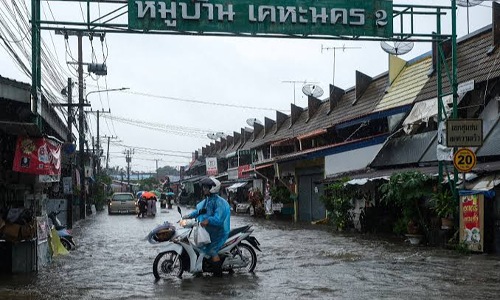
Heavy rains have triggered severe flooding across parts of Bangkok, Thailand, forcing nearly 4,900 residents to evacuate to shelters as floodwaters swept through roads and residential areas.
The flooding has disrupted movement across parts of the Thai capital, with motorists and pedestrians forced to navigate submerged roads and seek alternative routes.
SEE ALSO: NAFDAC Warns Nigerians As Fake Cowbell Milk Floods Market
According to the Bangkok Metropolitan Administration, about 52,000 households have been affected by the flooding, prompting authorities to declare a flood disaster and intensify emergency response efforts.
Emergency teams have been deployed to assist affected communities and move residents from vulnerable areas to safer locations as water levels rise.
Bangkok is accustomed to seasonal heavy rainfall, but intense downpours can overwhelm drainage systems, particularly in low-lying areas, resulting in widespread flooding and disruption.
Authorities are continuing to monitor affected locations while coordinating evacuations and other emergency measures.
For thousands of residents, the immediate priority remains securing safe shelter and protecting homes and livelihoods as authorities work to manage the situation and restore normal activities once the floodwaters recede.

US President Donald Trump has explained his decision to reject Iran’s latest proposal to reopen the Strait of Hormuz, saying Tehran was seeking an agreement because it was losing revenue.
Speaking to reporters at the White House, Trump said Iran wanted to immediately reopen the strategically important waterway but argued that the proposal was not acceptable to his administration.
“They want to make a deal, and I think that’s fine. I like making a deal, too, but that deal would not be acceptable,” Trump said.
SEE ALSO: How the Strait of Hormuz Attack Could Trigger a Fresh Global Oil Shock
According to the US president, Iran’s push to reopen the strait was driven by the economic pressure it was facing.
“What they want to do is immediately open the Hormuz Strait. Do you know why? Because they are dying,” Trump said.
“You know why they’re dying? Because they have no money coming in, because they get their money from the Hormuz Strait.”
Trump also claimed that the US had established an unprecedented naval blockade against Iran, describing it as “a wall of steel.”
“So they outsmarted themselves. We put up the greatest blockade ever in military history. It’s a wall of steel,” he said.
“And guess what? They don’t have any money now because they wanted to close the strait.”
The Strait of Hormuz is a major global energy shipping route, and disruption to traffic through the waterway has significant implications for international oil markets and countries that depend on energy imports.
Trump’s remarks came amid continued tensions between Washington and Tehran over the reopening of the strategic waterway and negotiations involving Iran.





South-South Group Opposes Coastal Road Alignment With East-West Road

Zamfara: Farmer rescued as search for 10 others continues

Showunmi Urges South-East to Judge Tinubu by Projects, Not Propaganda

2027: ‘North Has No Reason to Break Agreement’ — Gov Yusuf Backs Tinubu

Aircraft Averts Crash, After Losing Door Mid-Air in Abuja

Bandits Kill 70-Year-Old Man in Katsina, 27 Victims Rescued

Trump’s Family Unveils New Cryptocurrency Platform

Senate Denies Receiving Petitions Against Tinubu’s Ambassadorial Nominees

Dangote Cement Lights Up Benue Host Communities With CSR Initiatives

Reps Recommend 3-year Jail Term For Aviation minister

Tems Sets New Record On Billboard Hot 100 Chart
