
Energy
Dangote Refinery Backs Gantry Loading, Cautions Against Costly Coastal Evacuation

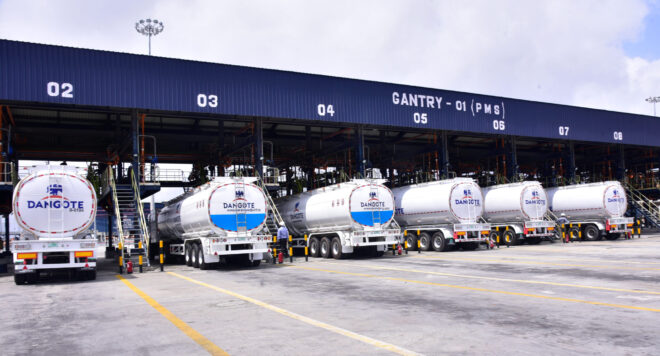
The Dangote Petroleum Refinery has reaffirmed its commitment to supplying high quality petroleum products at competitive and affordable prices, urging marketers and policymakers to prioritise logistics choices that support price stability and consumer welfare.
The refinery said its position is anchored on sustained investments in critical infrastructure, including a world class gantry facility with 91 loading bays capable of loading up to 2,900 tankers daily. Operating on a 24-hour basis, the facility can evacuate over 50 million litres of Premium Motor Spirit PMS, 14 million litres of Automotive Gas Oil (diesel) and other refined products each day.
While the refinery remains open to coastal loading where logistics make it necessary, it maintained that gantry loading remains the most economically efficient and operationally effective option. According to the refinery, direct gantry evacuation eliminates port charges, maritime levies and vessel related costs that do not add value to end users, helping to optimise costs, improve distribution efficiency and support price stability.
ALSO READ: Savannah Energy Shares Unaudited FY 2025 Operational, Financial Updates
Dangote Refinery clarified that marketers are free to choose their preferred mode of evacuation, noting that PMS and other refined products are made available at competitive gantry prices. “However, reliance on coastal delivery, particularly within Lagos, may introduce avoidable costs with material implications for fuel pricing, consumer welfare and overall economic wellbeing. In our opinion, coastal logistics can add approximately N75 per litre to the cost of petrol, which, if passed on to consumers, would push the pump price of PMS close to N1,000 per litre”.
Based on Nigeria’s average daily consumption of about 50 million litres of PMS and 14 million litres of diesel, the refinery estimated that sustained dependence on coastal logistics could impose an additional annual cost of roughly N1.752 trillion. This cost, it said, would ultimately be borne either by producers or Nigerian consumers.
The refinery also renewed calls for coordinated investment in pipeline infrastructure nationwide, arguing that functional pipelines linking refineries to depots would significantly cut distribution costs, improve supply reliability and strengthen national energy security.
Addressing claims that it imports finished petroleum products, Dangote Refinery strongly refuted the allegations, describing them as misleading. It explained that while its Residue Fluid Catalytic Cracking Unit is currently undergoing maintenance, it only imports intermediate feedstock in line with global industry practice. The refinery challenged anyone with credible evidence of finished product importation to present it to the appropriate regulatory authorities, adding that such claims are often driven by interests seeking to justify continued dependence on fuel imports.
Dangote Refinery said domestic refining has already delivered measurable benefits to the Nigerian economy. Since commencement of operations, the price of diesel has fallen from about N1,700 per litre to N1,100 and currently trades between N980 and N990. Similarly, PMS prices have declined from about N1,250 per litre to between N839 and N900.
It added that increased local supply has sharply reduced fuel importation, eased foreign exchange pressures and improved market stability, contributing to a stronger naira, which recently traded at about N1,385 to the dollar.
The refinery reiterated its commitment to efficiency, transparency and price stability in Nigeria’s downstream petroleum sector, urging marketers, regulators and policymakers to support logistics and distribution decisions that align with national economic interests, protect consumers and sustain the long-term benefits of the domestic economy.











Fears of renewed US military strikes on Iran and escalating threats to energy infrastructure across the Middle East heightened concerns about global crude supplies have pushed-up crude oil prices in the global market.
These factors pushed crude oil prices over $117 a barrel in the global market, even as oil theft and pipeline losses in Nigeria fell by 82.9 percent in five years, from 102,900 barrels per day (bpd) in 2021 to 17,600 bpd in the first seven months of 2026, amid fresh concerns about further increases in lost volumes after years of decline.
Nigeria’s oil benchmark, Brent crude, climbed by about 3.5 percent to cross $117 a barrel during trading before easing to just above $116, still up approximately 2.7 percent.
READ ALSO: Navy Uncovers 132,000 Litres of Stolen Crude Oil in Bonny
The latest rally followed reports that Washington was considering fresh military strikes against Iran after the November 3 midterm elections, raising concerns that the conflict, now in its eighth month, could escalate further rather than move towards a diplomatic resolution.
Iran had threatened to attack oil facilities, undersea cables, data centres and artificial intelligence infrastructure across the Gulf if the United States and Israel launched a new offensive against the country.
Recall that Brent crude traded at about $72 a barrel in February, before the war began, but surged to about $126 a barrel by the end of April as the conflict intensified and concerns mounted over supply security.
Tensions rose again during the week following claims by Iran’s Islamic Revolutionary Guards Corps (IRGC) that it struck four commercial vessels in the Strait of Hormuz on Wednesday.
The US ordered some diplomats and family members of American government employees to leave Saudi Arabia, which had faced continued attacks by Houthi rebels operating from Yemen.
From January to September 2026, the domestic refineries in Nigeria received 156.52 million barrels of crude oil.
Of the volume, 125.85million barrels (80.4 percent) were sourced from in-country while 30.66 million barrels (19.6 percent) were imported.
This was contained in the Nigerian Midstream and Downstream Petroleum Regulatory Authority (NMDPRA) Factsheet September 2026 released on Thursday.
The Factsheet specifically revealed that in September 2026, 38.7 million litres of the Premium Motor Spirit PMS (petrol) were received per day, crashing from the 50.5million litres per day received in August by 23 percent.
READ ALSO: Thor Empowers Host Communities with 10 Cassava, Palm Oil Processing Plants
Stock sufficiency in September was 23.9 days, declining below the 30-day threshold.
The NMDPRA stressed that while 28.7million litres were supplied per day from domestic sources, declining by 21 percent from the previous month, 10.2 million litres were imported, reducing imported petrol by 30 percent in the period under review.
According to the Factsheet, “Domestic refining contributed about 65 percent of the national petrol requirement (consumption) in September 2026, and about 74 percent of receipts, supplemented by 26 percent of imports”.
The Dangote Refinery and Petrochemicals Company (DPRP) is the only domestic refinery which currently produces petrol in Nigeria.
The report added that the DPRP produced 47.22 million litres per day of PMS in September, supplying 28.50 million litres per day to the domestic market and exporting (35.2 percent) 15.47 million litres per day.
On capacity utilization, the refinery recorded 105.98 percent of its 650,000 barrels per day capacity in the period under review.
The Factsheet disclosed that 8.7million litres of diesel were consumed in the month under review.
The NMDPRA revealed that modular refineries supplied 4.3 percent of domestic diesel consumption in September.
Aradel and OPAC, said the Factsheet, operated below optimal capacity due to feedstock challenges and maintenance shutdowns.
September diesel receipts, according to the NMDPRA, were the lowest of the 13 months, driven by low imports and low domestic evacuation amid high prices.
The Factsheet said, “Nigeria’s energy-sector transformation is progressing. Domestic refining contributed about 65 percent of the national petrol requirement (consumption) in September 2026, and about 74 percent of receipts, supplemented by 26 percent of imports.
“Priority gas projects have reached significant mileage, with the AKK pipeline at 84 percent completion as of September 2026,” the Factsheet pointed out.

The appetite for improving access to capital for indigenous oil and gas contractors, strengthening the capacity of Nigerian businesses to execute critical energy projects and contribute to the country’s production ambitions, has seen the Renaissance Africa Energy Company Limited (‘Renaissance’) go into a strategic financing partnership with Sterling Bank Limited.
The partnership, formalised through a Memorandum of Understanding (MoU), brings Sterling Bank into the renewed Renaissance Vendor Financing Scheme (RVFS), a structured financing programme designed to address one of the longstanding challenges confronting indigenous service providers in Nigeria’s oil and gas industry: access to timely and affordable funding for contract execution.
READ ALSO: Group Demands Fair Share of NNPC Jobs for Ogoni Oil Exploration
The expanded programme brings together 13 financial institutions with combined financing commitments of $4.1 billion and ₦435 billion, creating a substantial pool of capital to support eligible contractors delivering projects for Renaissance, operator of the former Shell Petroleum Development Company (SPDC) joint venture assets.
Speaking on its participation, Dele Faseemo, Group Executive, Corporate and Investment Banking at Sterling Bank, described the partnership as an important opportunity to connect financial capacity with productive enterprise in one of Nigeria’s most strategically important sectors.
“At Sterling Bank, we believe financing should enable capable businesses to deliver, grow and compete. Our participation in the Renaissance Vendor Financing Scheme reflects that conviction. By providing structured funding to qualified contractors, we are supporting the businesses that keep the energy value chain moving, strengthening Nigerian content participation and contributing to the broader objective of increasing the country’s productive capacity,” Faseemo said.
For many indigenous contractors, securing a major contract represents only the first step towards business growth. The ability to mobilise equipment, procure materials, retain skilled personnel and meet demanding project timelines often depends on access to adequate working capital. Financing constraints can therefore limit the capacity of otherwise qualified businesses to execute contracts, scale their operations and participate more meaningfully in the energy value chain.
Through the RVFS, participating financial institutions will provide structured financing to eligible contractors against confirmed contracts awarded by Renaissance, subject to applicable credit assessment and approval processes. The arrangement is intended to ease funding pressures, improve project execution and strengthen the financial capacity of indigenous service providers.
Tony Attah, Managing Director and Chief Executive Officer of Renaissance Africa Energy Company Limited, highlighted the importance of the financing arrangement to the company’s growth ambitions.
“What we’ve been able to achieve as Renaissance is to go into that partnership with these incredible 13 banks who have come up to support this vendor scheme at over $4 billion and over ₦435 billion funds available for the vendors to be able to support us in our growth agenda,” Attah said.
He further emphasised the financial advantage the scheme offers participating contractors, noting that, “The interest rate that the banks are offering to the contractors is very competitive, and it is certainly better than the vendors going out to the respective banks on their own.”
The Renaissance Vendor Financing Scheme builds on a contractor financing programme established in 2010, which has evolved over the years to support local service providers executing projects across the oil and gas value chain. Its latest expansion comes as Renaissance pursues an ambitious growth strategy, including its aspiration to achieve production of one million barrels of oil equivalent per day by 2030.
Delivering on this ambition will require sustained investment not only in upstream production assets but also in the network of engineering firms, equipment suppliers, logistics providers, technical specialists and other indigenous businesses whose services are essential to operational performance.
With an established presence in corporate banking and energy sector financing, Sterling Bank continues to support businesses operating across critical segments of the Nigerian economy through tailored financial solutions, strategic partnerships and sector-specific expertise.
The collaboration reinforces the Bank’s commitment to supporting indigenous enterprise development, strengthening local capacity and financing productive economic activity, while contributing to efforts to improve Nigeria’s energy security and long-term industrial competitiveness.






Tinubu Promises to Boost Local Production with NNPC Refineries

INEC Opens Online Access to Voters’ Register After Public Outcry

ADC Replies Alake, Says APC’s ‘Falsehood’ Cannot Hide Tinubu’s Failures

‘How Did Tinubu Graduate Before School Existed?’ – ADC Challenges Shettima Over Atiku

Tinubu Congratulates Lula on Re-Election, Seeks Stronger Nigeria-Brazil Ties

Ebola: IGP Warns Nigerians Against Contact With Suspected Patients’ Body Fluids

Trump’s Family Unveils New Cryptocurrency Platform

Senate Denies Receiving Petitions Against Tinubu’s Ambassadorial Nominees

Dangote Cement Lights Up Benue Host Communities With CSR Initiatives

Reps Recommend 3-year Jail Term For Aviation minister

Tems Sets New Record On Billboard Hot 100 Chart
