
Business
Dangote Refinery vs NNPCL: Unfortunately, Nigeria needs both companies to thrive
It is also sad to note that the Dangote refinery has not produced any duly signed and legally enforceable agreement with any domestic crude oil supplier prior to this time and for the purpose of feedstock supply to the refinery, which is very strange for a business of that magnitude, and a highly unusual and unprofessional practice in the oil and gas industry. This is actually the crux of the matter as the oil industry apparently operates differently from the cement and other industries where Mr. Dangote has been an experienced player for decades.

By Yemie ADEOYE
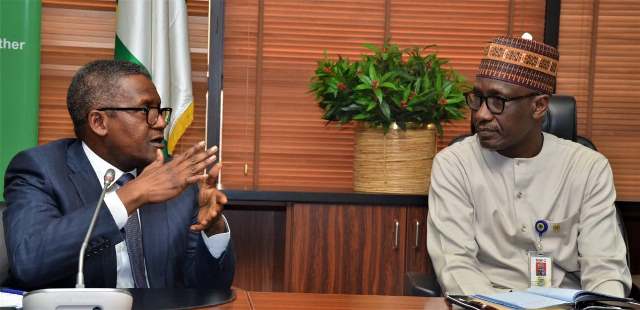
THE saying that when two elephants fight, the grass suffers is being brought to light and affirmed more than any time in recent history by the ongoing tussle nay controversy between the Dangote refinery and the federal government of Nigeria as represented by the state-owned Nigeria National Petroleum Company Limited, NNPCL and the industry regulatory agency, the Nigerian Midstream and Downstream Petroleum Regulatory Authority, NMDPRA.
Gracefully, the minister of petroleum resources, Mr. Bola Tinubu, who also ‘doubles’ as Nigeria’s President has waded in to offer some succor via a directive to the NNPCL to sell a percentage of Nigeria’s crude in Naira to the Dangote refinery. That was a relief according to several industry watchers even if it is seen as a short term solution to a long term situation.
Even as that seem to have calmed frayed nerves for a bit, reports and counter reports continue to hit the news, thereby keeping the issue on the front burner, even after a presidential mediation. Only recently, there has been a back and forth over the facilitation and non-delivery of 29 million barrels of crude oil to the refinery.
It goes without saying that the advent of the Dangote industries in the business of refining at the time it did, and up until this moment was and is still is, a necessity for the Nigerian economy. Even if it’s just for the dignity and pride it brings to the African continent, that alone is enough to fight or die for.
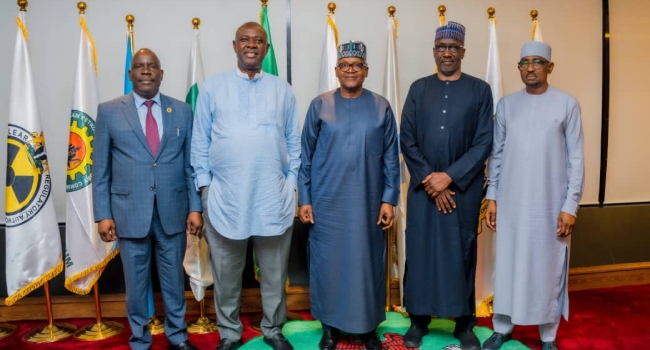
Nigeria’s Minister of State for Petroleum Resources, Heineken Lokpobiri , flanked by Alhaji Aliko Dangote, and heads of NNPCL, NUPRC, NMDPRA
This is outside other immediate economic advantages that accrues to Nigeria as a country, from mass employment to indirect domestic businesses, FDI attraction reduction in forex need and pressure amongst others. The list as they say is endless, only if our business climate is not unduly charged, cumbersome, and difficult for no logical reason.
Almost the same thing applies to the NNPCL, save for the fact that it is a public trust. This company, since inception in 1977 is now almost the single most important company in Nigeria, if only we allow it to work for the country. The issues aren’t so difficult to address, but it seems Nigeria has allowed undue politics and interference to affect the functionality of the NNPCL.
Oil, amongst a few others, is a globally priced commodity, which reacts negatively to undue and non-technical interference. This is the bane of the NNPCL debacle, and until the company, supposedly the largest oil company south of the Sahara is completely free of this interference and obstacles, thereby operating like any other International Oil Company, it will be absolutely impossible for the company to reach its full potentials for the benefit of the global oil and gas industry and the Nigerian economy specifically.
Over the decades, there has been several suggestions on the most beneficial modus operandi for the company, with many experts agreeing that the Nigeria Liquefied Natural Gas, NLNG module will best serve the oil behemoth and better position the company for international plays just like it’s supposed contemporaries, Saudi Aramco, PETROBRAS, PETRONAS, Equinor, SONANGOL and their likes.
Currently, the operational rig count in Nigeria is around 15 rigs. This is abysmally low when compared to other major oil cities or countries. The state of Texas in the USA has 278 operational rigs at work at the time of this report, while Saudi’s Aramco has 300. Algeria has the highest in Africa at 42 rig counts, while even troubled Libya has 20 operational rigs at the moment.
This should serve as a crucial area of focus for the current Nigerian government and indeed, the NNPCL, in order for the country to at least meet the traditional OPEC quota of 2.4 million barrels and enable it meet its contractual obligations, and still feed all domestic refineries starting with the Dangote refinery, with a proviso to produce first for the nations’ local consumption before any export in the interest of national security.
It goes without saying that there would be interests, both foreign and domestic that prefers the status quo and current modus operandi to stay in effect, as they are direct and indirect beneficiaries of the current system, and this is why it is pertinent for the two companies to come together for the common good and national interest.
We live in a world where perception is almost reality, and Nigeria must never lose sight of this fact. Mr. Aliko Dangote is first and foremost a Nigerian, subject to the laws of the country, hence there are several legitimate ways the government can protect its own interest, if any without resorting to a public show.
Again, Inspite of himself and whatever allegations, sentiments or petitions that are leveled against him, Aliko Dangote ought to be properly managed by the regulators and the government for the giant strides he has embarked upon, thereby putting Nigeria on the global map for something positive outside of entertainment.
The nation’s regulator calling out such an investor, said to be the highest single tax payer in the country in such casual manner and on national television is not in the best interest of the nation’s fledgling economy, and image, especially in such a news sensitive industry.
It is also sad to note that the Dangote refinery has not produced any duly signed and legally enforceable agreement with any domestic crude oil supplier prior to this time, and for the purpose of feedstock supply to the refinery, which is very strange for a business of that magnitude, and a highly unusual and unprofessional practice in the oil and gas industry. This is actually the crux of the matter as the oil industry apparently operates differently from the cement and other industries where Mr. Dangote has been an experienced player for decades.
However, the Nigerian people are of any consideration in this equation, then It is in the best interest of Nigeria’s economy that the NNPCL, the NMDPRA, and the owners and management of the Dangote refinery sheath their swords and work together for the common good of the country. If that is the focus, it will be far too difficult to fight so publicly and so dirty. The opportunity of this massive Nigerian establishment must never be blown on the altars of ego and personal interest.
The job of any government is to create a conducive atmosphere for every business interest both local, foreign, public or private to thrive, and for a struggling economy which currently begs for foreign direct investments above all else, no ambassador is better positioned for that message at this moment, than Mr. Aliko Dangote, Inpsite of himself. He has been there, and against all odds, he has done that which others are too concerned, or too cautious to do. The NNPCL has to strategically increase its crude oil production to meet new demands. the company has to be intentional about this, it certainly isn’t a rocket science to achieve that, and that should be the log term focus.
That refinery, should be to the benefit of the NNPCL, the people and government of Nigeria, and of course the owners and management of the company, and this can only happen if national interest is the collective goal.
A sports team does not play or score goals against itself and still appear normal to spectators.








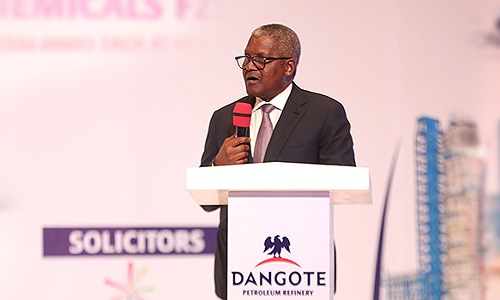
President of Dangote Group, Aliko Dangote, has reaffirmed his commitment to ensuring broad-based participation in the Dangote Refinery’s Initial Public Offering (IPO).
In a statement, the industrialist announced that investors applying with ₦50,000 and below will receive priority consideration as the company seeks to democratize ownership of one of Africa’s most significant industrial assets.
Dangote made the declaration during the final leg of the nationwide IPO roadshow held in Port Harcourt, Rivers State, where investors, financial market experts, business leaders and other stakeholders gathered to discuss the investment opportunity and its implications for Nigeria’s economic transformation.
READ ALSO: Sahara Champions Global Shipping Collaboration for $20m Mercy Ships Healthcare Impact
Speaking at the event, Dangote emphasised that the IPO should be viewed not merely as an investment opportunity, but as a chance for Nigerians to become shareholders in a landmark enterprise that is reshaping the country’s industrial landscape.
“We will prioritise people with ₦50,000 and below,” Dangote stated, underscoring the Group’s determination to make the offering accessible to small and medium-scale investors across the country.
He noted that while international and African investors had already committed substantial capital to the refinery, the IPO now offers Nigerians a rare opportunity to participate directly in the ownership of a world-class industrial project built on Nigerian soil.
According to him, investing in the refinery goes beyond financial returns, representing a vote of confidence in Nigeria’s future, institutional development, corporate governance standards and industrial capacity.
“African investors have invested in this refinery. Now it is time for Nigerians to invest in themselves and participate in a project that is creating value, jobs and opportunities for generations to come,” he said.
Dangote also encouraged prospective shareholders to adopt a long-term investment perspective, noting that participation in the IPO presents a pathway to wealth creation, portfolio diversification and increased public engagement with the capital market.
He added that wider participation in the stock market would deepen financial literacy, promote a savings and investment culture, and enable more Nigerians to better understand how businesses create value and contribute to economic growth.
The roadshow also featured insightful presentations from leading economists and market analysts on the refinery’s economic significance and the broader opportunities associated with the public offering.
Renowned economist Bismarck Rewane highlighted the enormous economic potential of the South-South region and stressed the need to convert the area’s resource endowment into sustainable prosperity, infrastructure development and improved living standards. He also noted that the IPO presents an opportunity to deepen Nigeria’s capital market by encouraging citizens to participate actively in wealth creation.
Similarly, economist Dr. Muda Yusuf outlined the refinery’s far-reaching impact on economic diversification, domestic value addition, energy security, capital formation and employment generation.
According to Yusuf, the refinery represents far more than a petroleum-processing facility, serving as a catalyst for growth across multiple sectors including petrochemicals, packaging, manufacturing, logistics and other downstream industries.
He further emphasized that policy consistency, regulatory stability and sustained stakeholder engagement remain critical to maintaining investor confidence and attracting long-term capital into Nigeria’s industrial sector.
Speaking on the investment outlook, stakeholders urged prospective investors to consider the company’s operational performance, valuation metrics and long-term fundamentals when evaluating the offer.
Yusuf also described the refinery as a major example of domestic value addition, noting that its extensive local content and industrial linkages would significantly amplify its contribution to the Nigerian economy.
Discussions at the event further highlighted the importance of sound monetary policy, affordable financing and a predictable business environment in supporting investment-led growth and industrial expansion.
The Port Harcourt engagement was particularly significant for the South-South region, with legal luminary and business leader Paul Usoro expressing satisfaction at the level of participation from investors across the region.
“My joy is to see the South-South well represented,” Usoro said, stressing the importance of ensuring that investors from the region take advantage of the opportunity presented by the IPO.
The Port Harcourt event marked the final stop of the nationwide IPO roadshow, concluding a series of engagements designed to deepen public awareness and expand participation in what is widely regarded as one of the most significant capital market offerings in Nigeria’s history.
For Dangote Group, the objective remains clear: to provide Nigerians from all backgrounds with an opportunity to participate in the ownership of a transformative industrial enterprise while contributing to economic growth, employment generation and national development.
Sahara Energy Geneva has highlighted the power of business collaboration to deliver lasting impact, with Mercy Ships Cargo Day celebrating more than $20 million raised over the past decade to support healthcare interventions in Africa.
More than 500 guests from over 150 shipping and trading companies gathered in Geneva recently for the 10th anniversary Gala of Mercy Ships Cargo Day, celebrating a decade of industry support for the international charity.
David Walker, Head of Chartering at Sahara Energy Geneva and Chairman of the Cargo Day Geneva Committee, joined industry leaders at the event, where he thanked the global shipping community, sponsors, media partners and Cargo Day committees in Geneva, London, Houston, Dubai and Singapore for supporting the initiative.
Cargo Day brings together charterers, shipowners, shipbrokers, and other shipping professionals who contribute through pledges, cargo commissions, and address commissions to support the work of Mercy Ships.
READ ALSO: 30 Nigerians Bag Postgraduate Scholarship from NNPC Ltd, Eni
Kola Motajo, Director, Sahara Geneva said Sahara’s involvement reflects the company’s belief in the ability of enterprise and partnerships to deliver impact beyond business.
“At Sahara, our focus is always on impact and lives transformed. Cargo Day demonstrates what is possible when businesses and individuals unite around a shared purpose. The $20 million milestone reflects the collective commitment of the global shipping community to improving healthcare in Africa. As Sahara looks Beyond XXX, we remain committed to building connections that create lasting value and possibilities for generations to come,” Motajo said.
Reflecting on Cargo Day’s growth, Walker said: “Ten years ago, we raised $300,000 and there were 70 people at the Gala. Today, we have more than 500 people coming from around the world to support such a great cause.”
Cargo Day 2025 raised more than $2.5 million, with 93 companies participating, including charterers, brokers, shipowners, and other partners.
Mercy Ships operates two hospital ships supporting patients in Africa with free life-changing surgeries, while also providing training and mentoring for local healthcare professionals. Cargo Day funding contributes to expenses associated with operating the hospital ships.
The 2026 Cargo Day campaign begins November 4 and will run through November and December, with companies participating through Mercy Cargoes, address commissions and pledges.

Up to 30 Nigerian graduates have bagged postgraduate scholarships to pursue further studies both locally and in the Diaspora.
According to the Nigerian National Petroleum Company Limited (NNPC Ltd) and Italian energy company, Eni have awarded postgraduate scholarships
The beneficiaries emerged from more than 3,000 applicants following assessments of their academic records and performances in a recently conducted computer-based test (CBT).
The awards are under the 2026/2027 Postgraduate Scholarship Scheme of Nigerian Agip Exploration Limited (NAE), an Eni subsidiary, on behalf of the NNPC-NAE Production Sharing Contract (PSC) partners.
In a statement, NAE’s Vice Chairman and Managing Director, Maurizio Pinna, said the initiative was designed to develop local talent and equip young Nigerians with skills relevant to the oil and gas industry. Pinna congratulated the beneficiaries, noting that the scholarships would enable them to pursue their academic ambitions and achieve their career goals.
According to NAE, the programme reflects its commitment to education, innovation and capacity building in Nigeria.
The company urged the beneficiaries to make good use of the opportunity by acquiring valuable knowledge and skills that would contribute to national development, particularly in the energy sector.
Ten of the awardees will undertake postgraduate studies in universities abroad, including Imperial College London, Robert Gordon University in Aberdeen, Newcastle University, the University of Aberdeen and the University of Hull in the United Kingdom.
READ ALSO: Navy Recovers 98,000 Litres of Suspected Stolen Crude in Rivers
The remaining 20 beneficiaries will study at Nigerian universities in fields including engineering, geosciences, petroleum and environmental technology, energy economics, renewable energy and energy transition.
Established in 2007, the NNPC-NAE PSC postgraduate scholarship scheme is part of the partners’ human capital development programme aimed at promoting specialised knowledge and addressing skills shortages in Nigeria’s deep offshore oil and gas operations.
NAE said 380 Nigerian graduates had benefited from the scheme since its inception, gaining knowledge and skills required by the oil and gas industry.
Beyond education, Eni, through NAE, has implemented sustainability initiatives in Nigeria covering healthcare, access to water, infrastructure and community empowerment.
Eni has operated in Nigeria since 1962 and currently has an equity production of about 55,000 barrels of oil equivalent per day. The company also holds a 10.4 per cent stake in Nigeria LNG.
NAE was incorporated in 1996 to manage Eni’s deep offshore exploration and production assets. It became the first oil and gas company in Nigeria to produce oil from the country’s deep offshore when its Abo floating production, storage and offloading (FPSO) vessel began operations in 2003.
The company has interests in nine offshore blocks in Nigeria, either as operator or co-venturer, including PML 102 and PML 103, where the Zabazaba-Etan fields are being developed.






Ebonyi 2027: Gov Nwifuru Jittery Over My Candidacy, Violating Constitution — Odii

Small Investors Take Centre Stage as Dangote IPO Nears Close
Sahara Champions Global Shipping Collaboration for $20m Mercy Ships Healthcare Impact

30 Nigerians Bag Postgraduate Scholarship from NNPC Ltd, Eni

2027: ‘Algorithms Will Not Decide Election Results’, INEC Chairman Declares

Navy Recovers 98,000 Litres of Suspected Stolen Crude in Rivers

Trump’s Family Unveils New Cryptocurrency Platform

Senate Denies Receiving Petitions Against Tinubu’s Ambassadorial Nominees

Dangote Cement Lights Up Benue Host Communities With CSR Initiatives

Reps Recommend 3-year Jail Term For Aviation minister

Tems Sets New Record On Billboard Hot 100 Chart
