
Energy
Dangote Supplies over 72% of Nigeria’s Petrol as Consumption Falls 17%

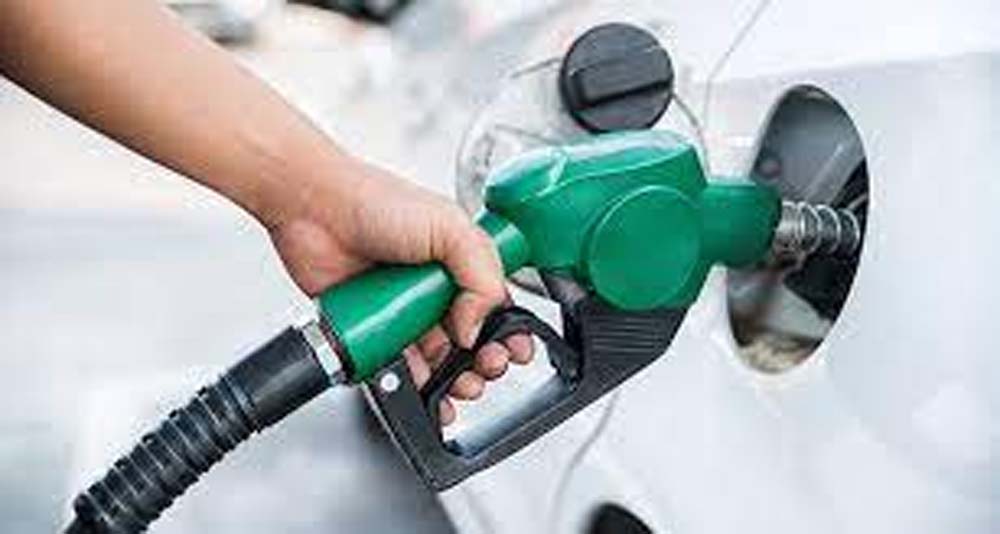
The Dangote Refinery supplied about 72.3 percent of Nigeria’s total domestic demand for petrol in March, while consumption fell by approximately 17 percent during the period under consideration from 56.9 million litres per day in February to 47.3 million litres last month.
Besides, although still modest compared to last year’s massive importation, the share of petrol imports in the supply mix surged by 96.7 percent month-on-month, rising from 3 million litres per day to 5.9 million litres/day during the period.
Data from the March 2026 fact sheet on midstream and downstream petroleum operations provided by the Nigerian Midstream and Downstream Petroleum Regulatory Authority (NMDPRA) yesterday, showed that the 47.3 million litres per day consumption for march fell below the national average of 50 million litres per day.
Overrall, the data indicated that total domestic petrol supply stood at 34.2 million litres per day in March. When measured against total consumption of 47.3 million litres per day, this placed Dangote Refinery’s contribution at approximately 72.3 percent of the domestic market, reaffirming its dominant role in the country’s fuel supply chain.
However, the supply mix also reflected a sharp increase in the role of imports. The fact sheet showed that petrol import contribution rose from 3 million litres per day in February to 5.9 million litres per day in March, equivalent to a 96.7 percent jump in import share.
ALSO READ: Diezani Claims She Was NNPC’s Rubber Stamp Before London Court
However, this increase in imported petrol between February and March was despite the downstream regulator’s insistence that it has halted the issuance of import licenses to oil marketers for months.
For over a year, owner of the 650,000 barrels per day facility in Lagos, Aliko Dangote, has pushed to end petrol imports in order to, according to him, protect local refining and grow the economy. Dangote’s refinery, which began production of petrol in 2024, has argued that Nigeria’s import licensing regime undermines local refining by allowing marketers to continue bringing in petrol even when domestic supply is increasing.
The company has maintained that under the Petroleum Industry Act (PIA), imports should only be permitted when there is a clear supply shortfall, not as a parallel system competing with local production.
On the other hand, oil marketers and a cross section of Nigerians believe that leaving the market solely for Dangote, without any competition from any other refinery, especially from NNPC’s defunct Port Harcourt and Warri refineries will lead to a monopoly and inflated pump prices.
The NMDPRA fact sheet further showed that other domestic refining sources contributed only marginal volumes, specifically diesel refining. The three operational modular refineries: Walter Smith, Edo Refinery, and Aradel collectively supplied about 0.629 million litres per day of diesel during the month.
Walter Smith refinery operated at an average capacity utilisation of 59.56 per cent, supplying 0.241 million litres per day. Edo Refinery recorded 64.69 percent utilisation with 0.051 million litres per day, while Aradel posted 58.84 percent utilisation, delivering 0.337 million litres per day.
Average diesel consumption during the period stood at 14.5 million litres daily, slightly above the 14 million litres per day national benchmark, despite the rising prices as a result of the Middle East crisis, indicating sustained demand from industrial and commercial users.
Similarly, in March, aviation fuel consumption remained lower at 2.1 million litres per day compared to the 3 million litres per day benchmark for the country and against the 2.9 million litres per day supplied in February.
In the whole gas market segment, total supply averaged 4.888 Billion Standard Cubic Feet Per Day (Bscf/d). Of this, 3.033 Bscf/d was supplied to the Nigeria LNG (NLNG), representing approximately 62 percent of total gas supply.
Domestic gas supply stood at 1.855 Bscf/d, with utilisation spread across key sectors. Gas-to-power accounted for 0.485 Bscf/d, commercial consumption stood at 0.430 Bscf/d, and gas-based industries utilised 0.601 Bscf/d.
In the Liquefied Petroleum Gas (LPG) segment, the NMDPRA data indicated that demand outpaced supply during the period. Average daily supply stood at 4,726 metric tonnes, while consumption reached 5,122 metric tonnes per day, leaving a shortfall of 396 metric tonnes daily. Also, retail LPG prices ranged between N980 and N1,450 per kilogramme nationally.
Fuel sufficiency data showed that petrol stock levels stood at 21 days, including pumpable volumes at the Dangote Refinery, diesel sufficiency was 55 days, aviation fuel stood at 109 days, and LPG at 14 days.
In the same vein, the midstream and downstream regulator put the Ajaokuta-Kaduna-Kano (AKK) gas pipeline completion level at 79.23 per cent; OB3 River Crossing at 59.50 per cent and the Odidi-Warri Expansion Project (OWEP) at 67.34 per cent completion rate.







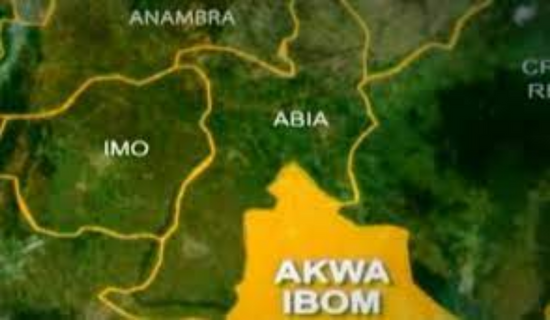
Nearly 20 years after the Federal Government awarded the contract for the 330kV Ikot Abasi Transmission Line, the Niger Delta Power Holding Company Limited (NDPHC) has turned to the Akwa Ibom State Government to break a N4 billion compensation deadlock threatening the completion of the strategic power project.
The transmission project, awarded in 2006 under the National Integrated Power Projects (NIPP), has remained stalled primarily over unresolved community and wayleave compensation issues.
But, to ensure the completion of the project, NDPHC Managing Director/Chief Executive Officer, Jennifer Adighije, is now seeking the intervention of Akwa Ibom State Governor, Pastor Umo Eno, to clear the outstanding issues and enable the contractor, Anit Energy, to return to site.
Adighije made the appeal during a courtesy visit to the Governor in Uyo, Akwa Ibom State.
READ ALSO: Organised Labour Supports Workers’ Demand for N500 PMS Price, N500,000 Minimum Wage
She disclosed that the latest valuation of the outstanding wayleave obligations was slightly below N4 billion.
The NDPHC boss said the prolonged delay was particularly concerning because the contractor had reportedly completed about 90 per cent of the engineering, procurement and construction procurement for the project.
She added that substantial project materials, including conductors and tower members worth millions of dollars, had already been deployed along the project corridor between Adiasim and Ikot Ekpene, but were still lying across communities as the impasse persists.
“We are therefore pleading for your kind intervention as a shareholder and board member of the company,” Adighije told the governor.
According to her, resolving the outstanding community issues would allow the contractor to remobilise to site and bring the long-delayed project to completion.
NDPHC is now targeting May 29, 2027, for commissioning of the transmission line, subject to the successful resolution of the outstanding compensation and community challenges.
Adighije said NDPHC was keen to support the state’s development ambitions through its role as a major interventionist agency in Nigeria’s electricity sector.
“We want to be part of your ARISE Agenda,” she said, referring to the governor’s development programme.
She also welcomed the establishment of the Akwa Ibom State Electricity Regulatory Commission, saying NDPHC had commenced discussions with the commission on the development of appropriate electricity-market frameworks for the state.
According to her, officials of the commission had visited NDPHC and requested information on the company’s projects in Akwa Ibom, while a joint working group was being established to examine how the assets could be better utilised and electricity access extended to underserved communities.
Also speaking, NDPHC Executive Director, Strategy and Commercial, Mr. Patrick Obahiagbon, commended the Governor’s administration for its development initiatives across the state.
Responding, Governor Eno welcomed the NDPHC initiative and pledged to take the Ikot Abasi project before the State Executive Council for consideration. The governor said the state government would examine the outstanding issues and determine how it could intervene to facilitate the completion of the project.
There are indications that the Nigeria-Libya Gas Pipeline would go from the drawing board to reality, as it has emerged as a major option to help Nigeria break into new markets for her gas reserves.
The Minister of State for Petroleum Resources (Gas), Ekperikpe Ekpo, disclosed this at Gastech 2026 in Bangkok, Thailand, during a high-level engagement with global energy companies, investors and governments on expanding Nigeria’s gas production, infrastructure, domestic utilisation and export markets.
The renewed push for the Nigeria-Libya pipeline topped the agenda for the meeting between Ekpo and Libya’s Minister of Oil and Gas, Dr Khalifa Rajab Abdulsadek.
Under the proposed framework, Nigeria and Libya are expected to explore a Memorandum of Understanding (MoU) and establish a joint technical team to assess the feasibility, financing, infrastructure requirements, security considerations and commercial viability of the project.
READ ALSO: ‘Obi Has Nowhere to Hide’ — APC Campaign Council Tackles Peter Obi Over Anambra Record
The NNPC Limited is expected to spearhead Nigeria’s participation in the bilateral initiative. If developed, the pipeline would provide another potential route for transporting Nigerian gas through North Africa to European markets, giving Nigeria an additional platform to monetise its gas resources beyond existing LNG channels.
According to Ekpo, the Federal Government was determined to create an investment environment capable of attracting the capital, technology and strategic partnerships required to convert the country’s gas reserves into economic growth, industrial development and jobs.
“Nigeria is open for business. We have put in place the right fiscal policies and operating environment, and the security of investors and their investments is guaranteed,” he said.
He revealed that the NNPC Limited would play a central role in translating Nigeria’s bilateral energy engagements into commercially viable projects, strategic investments and sustainable development.
The minister’s engagements also revealed plans by major industry players to significantly ramp up domestic gas production and infrastructure.
Gas producers must stop treating methane reduction as an environmental cost, because methane released into the atmosphere represents lost gas, lost revenue and lost energy that could otherwise be recovered and sold.
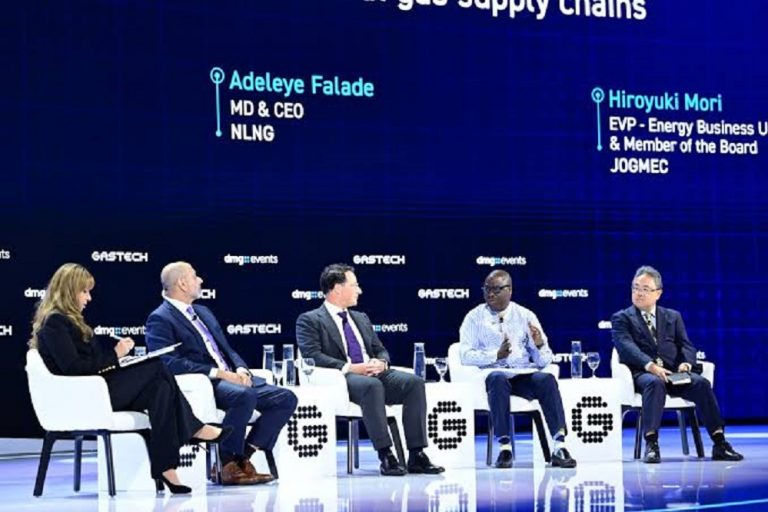
The Managing Director and Chief Executive Officer of Nigeria LNG Limited (NLNG) Adeleye Falade, made the declaration during a panel titled “Capturing the Lost Opportunity: Driving Global Alignment on Methane Abatement Across Natural Gas Supply Chains,” at the Gastech 2026 Exhibition and Conference in Bangkok, Thailand.
READ ALSO: Spike in Petrol Price Moves NLC to Demands Emergency Palliatives
Taking from the company’s experience, he highlighted that investments in methane abatement could pay for themselves while improving plant efficiency and asset reliability.
The NLNG CEO said the commercial value of recovering lost gas should become a central part of the global industry’s approach to methane management.
“Every tonne emitted is lost product, lost revenue and lost energy; gas we could have sold. Every molecule of methane avoided is both an emissions reduction and a recovered energy resource.”
According to him, the NLNG’s new boil-off gas compressor and start-up gas recovery project demonstrate the business case for methane reduction, with each project expected to deliver methane reductions of about 10–15 percent while also recording positive projected net present values. “The most compelling business case is the simplest one: the projects that cut our methane also pay for themselves.
“The same discipline that reduces methane also improves asset reliability and plant efficiency. The returns show up in more places than the emissions ledger,” Falade said.
He added that the starting point for methane abatement was credible measurement of gas losses, which enables companies to identify where methane is being lost, channel investment towards the right interventions and independently verify the results.
According to Falade, the NLNG had demonstrated that producers in developing economies could meet globally recognised standards for emissions measurement and reporting, despite infrastructure and other constraints.
He disclosed that the NLNG had achieved Gold Standard recognition under the Oil and Gas Methane Partnership (OGMP) 2.0 and became the first company in Africa to attain Level 5 methane emissions reporting.
Its measurement, reporting and verification system is independently assured by DNV in line with ISO 14064.
The NLNG’s methane-management programme includes site-wide optical gas imaging, a structured Leak Detection and Repair programme, as well as phased deployment of continuous monitoring and real-time emissions dashboards across its plant and vessels.
Falade said methane reduction was also being incorporated into the design of Train 7, which is expected to raise the NLNG’s LNG production capacity from 22 million tonnes per annum to 30 million tonnes.
The commercial case for emissions abatement was not new to Nigeria, he added, pointing to the NLNG’s longstanding role in converting gas that would otherwise have been flared into a marketable product.
According to him, the company’s activities have contributed to reducing Nigeria’s gas-flaring rate from above 65 percent to below 20 percent.
Beyond its own operations, Falade revealed that the NLNG was extending methane-management requirements across its supply chain through its Scope 3 Advocacy Plan.
The company engages feed-gas suppliers and contractors to measure, disclose and reduce emissions, while verified upstream emissions data and emissions-related criteria are incorporated into supplier selection and evaluation.
Falade also called for greater consistency in methane measurement and reporting requirements across jurisdictions, arguing that divergent standards make enforcement uneven and complicate meaningful comparisons between producers.
“The industry does not need weaker standards; it needs stronger, shared ones backed by real measurement,” he said.
On the tension between emissions reduction, energy access and affordability, Falade said developing economies should not be forced to choose between economic development and climate action.
“Developing economies cannot be asked to choose between economic development and emissions reduction. Both must progress together,” he said.
Other panellists were Zubin Bamji of the World Bank, Niels Dijksman of Brunei LNG and Hiroyuki Mori of JOGMEC.
The session was moderated by energy economist Dr Carole Nakhle of Crystol Energy.






Dangote to Support Two Million Women with Refinery IPO Share Ownership
NGX Invest Expands Primary Market Access with WhatsApp Subscription Channel

Kainji–Birnin Kebbi Power Line: TCN Begins Final Phase of Restoration

2027 Polls: ‘Poor Funding Could Undermine Election Security, Logistics’ — INEC Chairman Warns

N4bn Compensation Dispute Threatens Ikot Abasi Power Project

Organised Labour Supports Workers’ Demand for N500 PMS Price, N500,000 Minimum Wage

Trump’s Family Unveils New Cryptocurrency Platform

Senate Denies Receiving Petitions Against Tinubu’s Ambassadorial Nominees

Dangote Cement Lights Up Benue Host Communities With CSR Initiatives

Reps Recommend 3-year Jail Term For Aviation minister

Tems Sets New Record On Billboard Hot 100 Chart
