
Business
DPRP Decries Rising Fuel Imports, Despite Strong Local Supply Capacity

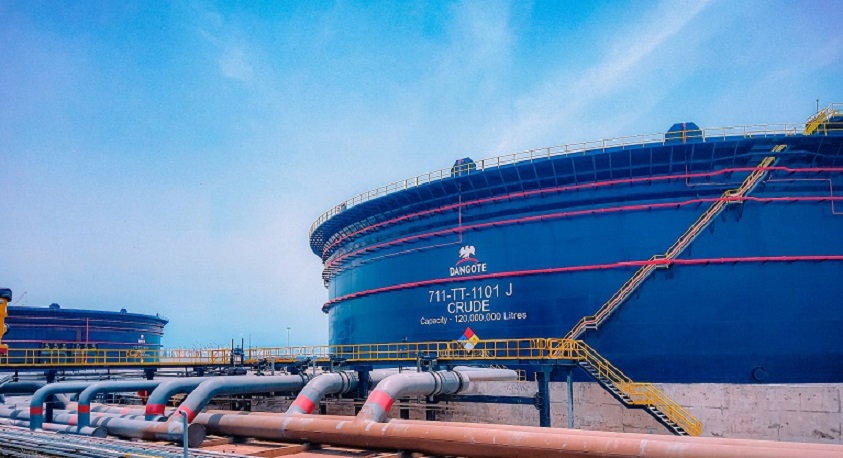
The management of Dangote Petroleum Refinery and Petrochemicals (DPRP) has expressed concern over the continued issuance of petroleum product import licences despite the refinery’s proven capacity to meet and exceed Nigeria’s domestic Premium Motor Spirit (PMS) requirements.
The refinery noted that while it remains fully committed to supporting Nigeria’s energy security and ensuring uninterrupted fuel availability across the country, the volume of imported PMS entering the market has created uncertainty in domestic demand planning and inventory management.
According to market data available to the refinery, imported PMS accounted for approximately 43 percent of the fuel supplied into the Nigerian market in July, a development that raises questions about the necessity of continued large-scale imports when substantial local refining capacity exists.
Since commencing operations, Dangote Refinery has consistently maintained sufficient inventory levels and reserved product volumes to guarantee steady supply to the Nigerian market. This commitment has required significant investment in storage, logistics, and working capital, all aimed at protecting Nigerians from supply disruptions and market volatility.
READ ALSO: US Hails DPRP as Nigeria’s Petroleum Exports Surge Seven Times
However, the refinery stated that the absence of transparency regarding the actual volume of imported products expected into the country makes effective production and inventory planning increasingly challenging. Maintaining large stock positions without clear visibility into import volumes imposes substantial carrying costs on the refinery and ultimately undermines efficient market operations.
“As a responsible energy provider, we have always endeavoured to keep adequate reserves to satisfy local demand at all times. However, in an environment where significant volumes of imported PMS continue to enter the market through licences issued by the regulator, and where there is limited visibility on future import volumes, it becomes commercially unsustainable to continue holding excess inventory indefinitely.”
The refinery explained that, under these circumstances, any surplus products not immediately absorbed by the domestic market must be exported to regional and international markets. Consequently, DPRP’s export volumes have increased in recent months, not because local demand cannot be met, but because excess inventory generated by market uncertainty must be evacuated to avoid unnecessary storage and financing costs.
Dangote Refinery emphasised that its growing exports should not be interpreted as a lack of commitment to the Nigerian market. Rather, exports are a prudent operational response to the realities of a market where imported products continue to compete with locally refined fuel despite the availability of sufficient domestic refining capacity.
The company reiterated that it remains ready, willing, and able to meet and surpass Nigeria’s petroleum product requirements and continues to invest heavily in ensuring reliable supply across the country.
The refinery further stated that should any supply shortfalls arise as a result of market distortions created by excessive importation and the inability of local producers to accurately forecast domestic demand, such shortages should not be attributed to Dangote Refinery, which has consistently demonstrated its capacity and commitment to serving the Nigerian market.
DPRP therefore called for greater transparency, improved market coordination, and policies that support local refining, enhance energy security, conserve foreign exchange, and maximize the economic benefits of Nigeria’s investments in domestic refining capacity.





Talks are ongoing between Aliko Dangote, President of Dangote Group, and the Securities and Exchange Commission (SEC) on a possible sale of part of his personal stake in the Dangote Petroleum Refinery and Petrochemicals (DPRP) to accommodate institutional investors whose demand for shares exceeded the available allocation in the company’s initial public offering (IPO).
The proposed transaction would involve a secondary sale of Dangote’s existing shares to investors who could not secure their desired allocations through the public offer, according to a Bloomberg report.
The discussions have also affected the timing of the IPO allotment, with the SEC reportedly postponing the release of the allocation list, initially expected on Tuesday, November 17, to later this week to allow it to consider the proposed transaction.
READ ALSO: Renaissance Unlocks New Oil, Gas Reserves with Technology
The SEC is processing the allotments and will grant approval once all requirements have been met.
The development follows an overwhelming response to the refinery’s share offer, which attracted applications worth approximately N5.85 trillion ($4.3 billion), almost three times the amount initially targeted. Dangote Refinery had offered 4.1 billion shares at N525 each, seeking to raise between $1.6 billion and $2.1 billion in what is expected to be Africa’s largest initial public offering.
The six-week subscription period, which ended on October 27, attracted nearly four million unique applications from investors in 120 countries, including all 54 African countries.
The proposed secondary sale is expected to address some of the unmet demand from institutional investors, particularly foreign investors, following the strong subscription.
South Africa’s Public Investment Corporation (PIC), which manages almost $220 billion in assets, including pensions for South African government workers, applied for approximately $500 million worth of shares. Nigerian pension fund administrators also sought between $400 million and $500 million worth of shares, bringing institutional demand from the two countries to nearly $1 billion.
Under the reported allocation arrangement, retail investors are expected to receive all the shares they applied for, while Nigerian pension funds are expected to receive allocations close to their requests. Foreign institutional investors are expected to bear most of the reduction in allocations.
Dangote currently owns approximately 87.3 percent of the refinery, which has a processing capacity of 650,000 barrels per day.
The initial public offer covers about 3.3 percent of the refinery, which would reduce his ownership to approximately 84.4 percent. If the full 30 percent overallotment option is exercised, his stake would fall to about 83.6 percent, before any additional sale of his personal shares.
At the IPO price of N525 per share, the refinery is valued at approximately N65.2 trillion ($47.8 billion). The proposed secondary transaction is separate from the refinery’s plan to increase the size of its IPO through the overallotment option.
In a separate report, Reuters reported that the refinery planned to increase its IPO by up to 30 percent, from the initial 4.1 billion shares to as many as 5.33 billion shares, subject to SEC approval. The proposed expansion could increase the fundraising target to approximately $2.1 billion, following investor orders worth nearly N6 trillion. The IPO proceeds are expected to support the refinery’s expansion plans, while a secondary sale of Dangote’s existing shares would generate proceeds for him as the selling shareholder.
Deployment of advanced technology, sustained exploration and local expertise have led to improved hydrocarbon discovery around a local oil player’s operating assets, strengthening prospects for unlocking new oil and gas reserves in Nigeria.
Renaissance Africa Energy Company Limited made the disclosure following its recent JK-004 exploration success in Oil Mining Lease (OML) 74, where it confirmed multiple light-oil-bearing reservoirs close to existing infrastructure.
The company made this known at the 44th Annual International Conference and Exhibition of the Nigerian Association of Petroleum Explorationists (NAPE), held in Lagos, where it also received three awards for its participation.
Renaissance’s Vice President, Exploration, Dr Johnbosco Uche, said the JK-004 discovery demonstrated that mature basins still hold significant opportunities when supported by strong subsurface knowledge, technology, disciplined investment and effective execution.
“The real lesson from JK-004 is that discovery should not be the finish line. We should be thinking about delivery before the exploration well is drilled,” Uche said during a fireside chat titled, “From Discovery to Delivery: Leadership Lessons in Unlocking Nigeria’s Next Billion Barrels.”
READ ALSO: EFCC Arraigns Woman over Alleged N1.1 bn NNPC Ltd Appointment Fraud
He said Nigeria’s oil and gas industry must increasingly integrate exploration decisions with development and commercial considerations to translate the country’s resource potential into additional production.
The NAPE conference was themed, “Unlocking More Barrels: Driving Reserves Growth through Exploration, Local Capabilities and Adaptive Technology.”
Uche said Renaissance’s strategy aligned with the conference theme, highlighting the company’s focus on exploration, technology deployment, talent development and strengthening indigenous technical capabilities.
At the conference exhibition, Renaissance showcased technologies and data-driven approaches deployed to optimise asset performance and identify additional hydrocarbon opportunities.
The company received the Overall Best Exhibitor award and Best Company with Novel Technology award, while emerging First Runner-Up for Best Technical Paper Presentation.
Renaissance said the awards reflected its commitment to technical excellence, innovation and operational performance.

The social impact vehicle of Sahara Group, the Sahara Group Foundation (SGF), has commissioned its 23rd Sahara Go Recycling Hub at the Sam Ethnan Air Force Base in Ikeja, Lagos.
Biztellers reports that this reinforces the group’s commitment to environmental sustainability, community empowerment and inclusive economic growth.
The new hub advances the SGF’s efforts to transform recyclable waste from an environmental liability into an economic asset, creating income opportunities for households through targeted waste-to-wealth programmes.
It also marks another step towards strengthening sustainable waste recovery systems and empowering host communities across Nigeria.
READ ALSO: WEC Points Investors to Gas Infrastructure in Africa
Speaking at the commissioning ceremony, Director of Sahara Group Foundation, Chidilim Menakaya, highlighted the Foundation’s continued investment in practical, community-focused solutions that deliver lasting environmental and socio-economic benefits.
“This initiative aligns with our sustainability and development priorities by transforming waste into valuable resources, reducing environmental impact, supporting climate action and creating livelihood opportunities. It demonstrates how communities can advance environmental responsibility while promoting inclusive economic growth,” she said.
Air Commodore M.A. Imam, Commander of 651 Base Services Group, commended the Foundation’s investment in environmental sustainability and emphasised the importance of collective action in addressing waste management challenges in rapidly growing communities.
Also speaking, Kingsley Okotie, Head of Corporate Communications at Ikeja Electric, said the company was delighted to join forces with the SGF to promote responsible environmental stewardship and sustainability at the Air Force base.
He reaffirmed Ikeja Electric’s commitment to building sustainable relationships, enhancing seamless power supply, and supporting the well-being of customers, institutions, businesses and communities.
Reiterating the Foundation’s broader vision, Menakaya noted that Sahara Go Recycling demonstrates the transformative potential of collective action in building cleaner, more resilient communities.
“Through collaboration, innovation and community participation, we are driving long-term environmental impact while improving livelihoods and strengthening community ownership of sustainable practices,” she added.
The ceremony brought together representatives of Sahara Group and Sahara Group Foundation, the Commandant of 651 Base Services Group, Sam Ethnan Air Force Base, Air Force officials, community leaders, volunteers and residents, reflecting the importance of collaboration in delivering sustainable solutions.
Since its inception, Sahara Go Recycling has facilitated the recycling of more than 1,000 tonnes of recyclable waste and directly and indirectly supported over 2,000 livelihoods across collection, sorting, logistics and community-based enterprise activities.
Through strategic partnerships and community engagement, the initiative continues to promote recycling, unlock economic value from waste and encourage sustainable lifestyles.
It was gathered that the SGF will continue expanding the Sahara Go Recycling in line with its mission of building sustainable communities through EXTRApreneurship.





Dangote, SEC Ponder Secondary Sale to Meet Refinery IPO Demand

Renaissance Unlocks New Oil, Gas Reserves with Technology

Fuel Supply Fears Spike on Renewed Middle East Crisis

EFCC Arraigns Woman over Alleged N1.1 bn NNPC Ltd Appointment Fraud

Adeleke Approves Prince Adewumi Olusola Adeniyi as New Owamiran of Esa-Oke

SGF Commissions Another Go Recycling Hub

Trump’s Family Unveils New Cryptocurrency Platform

Senate Denies Receiving Petitions Against Tinubu’s Ambassadorial Nominees

Dangote Cement Lights Up Benue Host Communities With CSR Initiatives

Reps Recommend 3-year Jail Term For Aviation minister

Tems Sets New Record On Billboard Hot 100 Chart
