
Crime
Dutch Journalist Exposes Heineken’s Corruption In Nigeria, Others

Dutch investigative journalist, Oliver Beerman has once again turned the spotlight on Heineken’s controversial business operations across Africa, alleging a history of corruption, unethical marketing, and exploitation in his 2019 book The Dark Side of Heineken’s African Beer Empire.
During a book reading event in Abuja on Saturday, Beerman shared insights from his six-year investigation into the brewing giant’s activities in 13 African countries, including Nigeria.
The book paints a damning picture of Heineken’s conduct in the region, with Beerman accusing the company of engaging in practices that undermine local brewers, collaborating with authoritarian regimes, and exploiting weak governance to bypass ethical standards.
READ ALSO: American Woman Shares Her Experience With Nigerian Romance Scams
“Unlike in Western markets, where regulations are stricter, Heineken has operated with far more freedom in Africa,” Beerman stated.
He pointed to the company’s use of marketing tactics disguised as Corporate Social Responsibility (CSR), such as funding schools in Nigeria’s Enugu state, where the buildings are emblazoned with the Heineken logo and painted in the company’s colors.
“This should be CSR, but in this case, it is another form of advertisement,” Beerman explained.
Beerman also revealed that many African consumers are unaware that brands they consider local—such as Gulder, Star Radler, and Primus—are actually brewed by Heineken.
He highlighted the company’s strategy of creating the illusion of local identity, such as printing the Congolese flag on bottles sold in the Democratic Republic of Congo, while the profits ultimately flow to Heineken’s shareholders abroad.
“They make the product look national, but in the end, the profits go to Heineken outside the country,” Beerman added.
Nigeria, according to Beerman, is by far Heineken’s most important market in Africa, contributing nearly half of the company’s turnover on the continent.
“Nigeria represents half of Heineken’s total turnover in Africa,” Beerman stated. “Lagos, the economic capital, is the heart of a conurbation that 20 million people call home. Nigeria as a whole is more than 200 million strong.”
But the journalist’s findings also expose a darker side to Heineken’s operations. Beerman uncovered a marketing campaign orchestrated by Heineken Nigeria’s CEO, Festus Odimegwu, that allegedly involved the use of sex workers to promote Heineken products.
“In Nigeria, the upper and middle classes drink in clubs without prostitution, but poor people go to bars where you pay 2,000 naira (around $10 at the time) to sleep with a woman,” Beerman recounted.
“So it came to pass that the company designated 500 well-frequented bars as so-called hot spots, where young women had to promote the beer.
“When I ask if they were also encouraged to sleep with the clients, Odimegwu’s eyes grow large as he looks at me, ‘What kind of question is that? Of course, they are prostitutes.’”
When Beerman reached out to Heineken for comment, executives defended the company’s past actions, stating that ethical concerns were not a priority at the time.
“You are looking at the past with eyes of now. Back then, ethical questions were not as important as the present,” Beerman quoted the executives as saying.
However, Beerman countered, “I show in the book that already in the 1990s, people who were already thinking of business ethics had begun asking Heineken questions about some of its practices.”
Beerman’s findings have sparked renewed calls for greater corporate accountability in Africa, where multinational companies are often able to operate with little oversight.









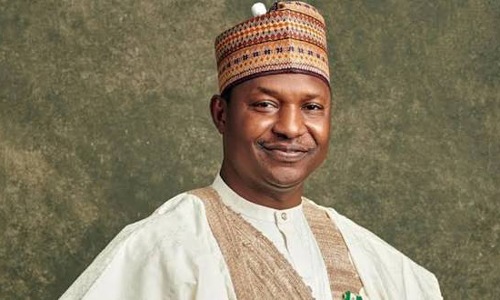
The Federal High Court in Abuja has adjourned the alleged terrorism financing and illegal firearms possession case involving former Attorney-General of the Federation, Abubakar Malami, and his son, Abdulaziz Malami, until April 15 and 16.
Justice Joyce Abdulmalik granted the adjournment on Tuesday after the prosecution requested more time to prepare for the trial.
During the court session, lead prosecuting counsel, Akinlolu Kehinde (SAN), informed the court that he had only recently been assigned to handle the case and needed additional time to consult with witnesses.
SEE ALSO: Malami Speaks Out On Court Ruling, Urges Nigerians To Stay Calm
“I got the instruction to take over the prosecution of the case on Monday and so I need time to interface with the witnesses,” Kehinde told the court while asking for a new hearing date.
Counsel for the defendants, Shuaibu Arua (SAN), did not oppose the request for adjournment.
Following the application, Justice Abdulmalik granted the request and fixed April 15 and 16 for the continuation of the trial.
The Department of State Services (DSS) had earlier arraigned the former justice minister and his son on a five-count charge bordering on alleged terrorism financing and unlawful possession of firearms.
According to the charge marked FHC/ABJ/CR/63/2026, Malami was accused of allegedly aiding terrorism financing by failing to prosecute suspected financiers whose case files were reportedly forwarded to him while he served as Attorney-General of the Federation and Minister of Justice.
The defendants were also accused of illegally storing firearms and ammunition at their residence located in Gesse Phase II Area of Birnin Kebbi Local Government Area of Kebbi State without lawful authority.
Items allegedly recovered include a Sturm Magnum 17-0101 firearm, 16 Redstar AAA 5’20 live cartridges, and 27 expended Redstar AAA 5’20 cartridges.
The alleged offences are said to violate provisions of the Terrorism (Prevention and Prohibition) Act, 2022, as well as the Firearms Act, 2004.
The trial is expected to continue in April when the court begins full hearing of the case.
A routine patrol by the Federal Road Safety Corps (FRSC) has led to the recovery of a stolen vehicle in Lagos and the exposure of a wanted driver, highlighting the importance of proper vehicle documentation and cooperation with authorities.
The incident occurred at the RS2.1114 Isolo Unit Command, where officers stopped an ash-coloured Toyota Sienna bearing registration number LSD438GK for a Vehicle Licence Violation (VLV) on Saturday, February 28, 2026, at about 5:11 p.m.
While the driver initially failed to present valid documents, further checks revealed the vehicle had been reported stolen and the driver was already declared wanted.
SEE ALSO: Fatigue, Over Speeding Led To Road Accident Which Claimed 21 Kano Athletes – FRSC
The suspect was subsequently handed over in handcuffs to the Nigeria Police Force, Ajao Division, for further action.
The FRSC credited the recovery to the National Vehicle Identification Scheme (NVIS), a digital framework that strengthens vehicle verification and tracking.
The scheme has reportedly helped identify, trace, and recover numerous stolen vehicles nationwide, while curbing criminal syndicates involved in vehicle theft and identity manipulation.
In a statement, Assistant Corps Marshal Olusegun Ogungbemide stressed that enforcement is not only about traffic compliance but also crime prevention and public safety, urging motorists to always carry valid documentation and cooperate with patrol officers.
Corps Marshal Shehu Mohammed commended the Isolo team for their vigilance, affirming the FRSC’s commitment to leveraging technology, intelligence, and strategic partnerships to protect lives and property on Nigerian roads.
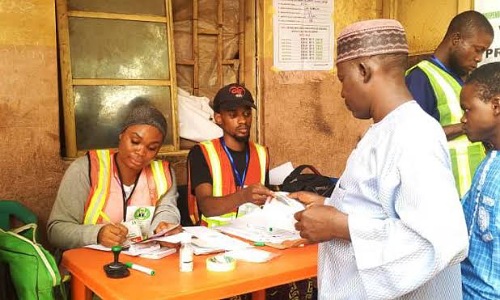
A major election scandal unfolded on Saturday in the Federal Capital Territory (FCT) as security agents apprehended a young woman in the Kabusa area for allegedly possessing 20 voter cards during the ongoing area council elections.
The woman, dressed in a black shirt and red trousers with a white scarf, was intercepted at Polling Unit 001 in Kabusa Primary School.
She was immediately escorted into a police van by security personnel, raising concerns about the integrity of the election process.
SEE ALSO: Chaos At Nyanya Polling Unit As PDP, ADC Accuse APC of ₦1,000 Vote Buying
Meanwhile, the Minister of the FCT, Nyesom Wike, was on the ground monitoring the elections.
He visited several polling units, including the Karu Chief’s Palace, to interact with adhoc staff of the Independent National Electoral Commission (INEC) and assess voter turnout.
Wike reportedly inquired about the progress of the voting and the challenges faced by election officials.
This incident comes amid reports of low voter turnout and other electoral irregularities in parts of Abuja, underscoring ongoing concerns about electoral security and transparency in the FCT area council elections.
Authorities have assured that investigations are ongoing, and the suspect may face legal action pending further verification of her actions.






Airfares Likely to Rise as Aviation Fuel Price Spikes by 80%

Shell Completes Turnaround Maintenance on FPSO, Resumes Production at Bonga

Sahara Group expands fleet with new 40,000 cbm LPG Carrier

NATO Shoots Down Third Iranian Missile in Turkey

Inside Tinubu’s Closed-Door Meeting With Opposition Leaders – SDP, IPAC Reveal Details

Defections Won’t Break PDP in Sokoto, Says Former Senator Gada

Trump’s Family Unveils New Cryptocurrency Platform

Reps Recommend 3-year Jail Term For Aviation minister

Dangote Cement Lights Up Benue Host Communities With CSR Initiatives

Senate Denies Receiving Petitions Against Tinubu’s Ambassadorial Nominees

Tems Sets New Record On Billboard Hot 100 Chart
