
NEWS
Ebonyi Residents Abandon Homes As Herdsmen Kill 16 In Brutal Attack

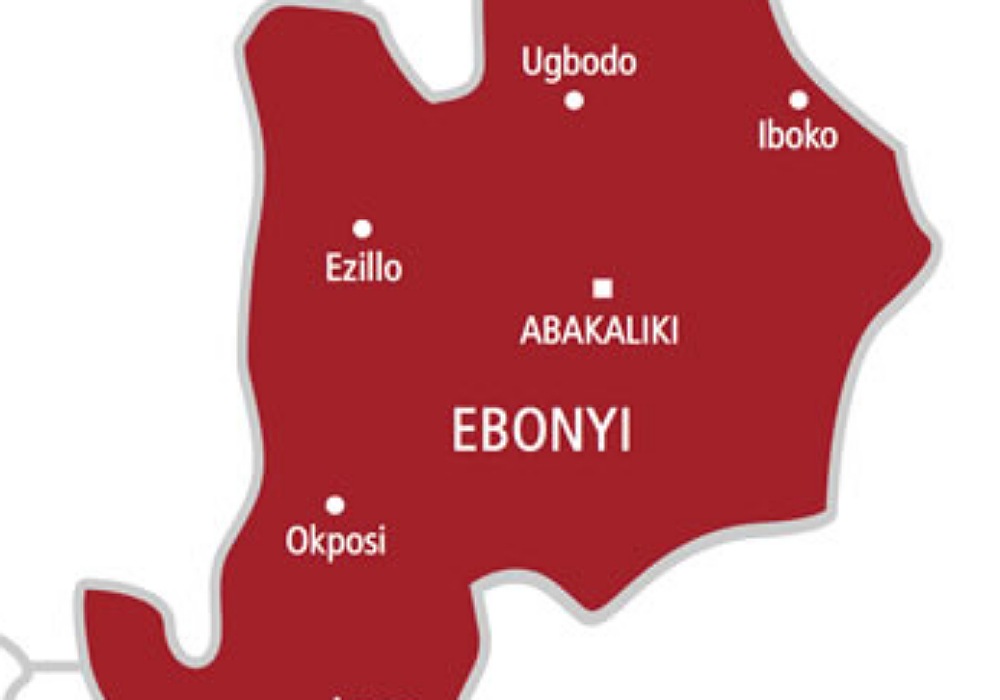
Amegu Nkalaha, a community in Ishielu Local Government Area of Ebonyi State, has been thrown into turmoil following a deadly attack by suspected armed herdsmen on Sunday.
The assault, which began in the morning, has left at least 16 people dead, several others missing, and dozens of homes and properties destroyed.
According to report on Monday, a mass exodus was underway as hundreds of residents, carrying their belongings, fled to neighboring communities.
READ MORE: Ganduje Identifies Four Categories Of Herdsmen Fueling Issues In Nigeria
The atmosphere was one of grief and devastation, with survivors gathering in clusters to mourn their loved ones.
The attack, which lasted for several hours, saw gunmen storming the community, killing residents and setting homes ablaze.
It was observed that at least 25 houses were completely burned, while another five were vandalized. Seven yam barns were also set on fire.
Among the victims were retired police officer James Ogbu, Alloy Nnaji (also known as Eze Nwata), assistant pastor Alfred Igwurube, and his principal pastor, Ibam. Other casualties included Simon Ogbuabor, Nnaji Nwa Omebe, Amos Ogbu, and several others.
Some of the bodies retrieved by families showed signs of gruesome execution.
“Some had their throats slit, while others suffered multiple gunshot wounds,” a resident recounted.
The attack has raised serious concerns about the role of security forces, as residents accused the military and police of failing to intervene despite prior warnings of an imminent attack. Some survivors even alleged that security agencies may have aided the attackers.
“They came on Saturday telling us that nobody should leave the community, only for attackers to strike on Sunday morning, killing 16 people and destroying everything,” a resident lamented.
Another survivor, Edeze, accused soldiers of intimidating residents and confiscating their phones to prevent them from recording evidence of the attack.
“Worse still, when they came, the soldiers seized the phones of our people who were making videos and threatened that if they see the videos of the carnage and pictures of the destruction, they will come back and destroy them,” he said.
“After they carried 10 corpses, including that of a retired policeman, the soldiers returned and handed back the phones they had seized,” Edeze added.
The response of the Ebonyi State government has drawn sharp criticism from residents, particularly the alleged stance of Deputy Governor Patricia Obila.
According to locals, rather than addressing the attack, she called for mass arrests in the community over claims that Fulani herdsmen’s cattle had been killed.
“Even the deputy governor of Ebonyi, Mrs. Patricia Obila, was the one telling the police that they should go for mass arrests in our community, accusing our people of killing cows belonging to the Fulani herdsmen. Till now, she hasn’t visited the community,” Edeze said.
Many residents decried what they see as a double standard in how the government reacts to crises.
“If a cow is reportedly killed in a community, is it not the duty of the security agencies to investigate and fish out the killer? Why would the entire community be collectively punished? After the police extortion for bail and payment for the cow, they will send Fulani militias to invade and slaughter the people who probably knew nothing, and the attackers would raze the community,” one resident lamented.
Mrs. Clementina Ogbu, who lost her home and belongings, described the terror of the invasion.
“On Sunday, we were preparing to go to church when suddenly, we started hearing gunshots. Some had already gone to church, while others were in their farms. The gunshots came from all directions.
“We were in a state of confusion and ran into the bushes to hide. Shortly after, we saw thick smoke rising into the sky—our homes, food barns, and clothing were completely burned,” she recounted.
“We slept in the bushes, and now we have no house, no food, nothing left to live on. My family hasn’t eaten anything since yesterday. We need help from anywhere,” she pleaded.
Elder Simon Idenyi also shared his frustration over the government’s failure to protect them.
“On February 1st, officials from the state government, along with the military and police, visited our community and told us that they had made peace with the Fulani herdsmen. They assured us that we should not leave our homes, that the government and security agencies would protect us,” he said.
“Regrettably, at about 9:30 a.m. on Sunday, strange faces—who we later understood were Fulani herdsmen—wielding AK-47 rifles and machetes surrounded the community and started killing people and burning houses. There was no security agent in sight while the carnage lasted. The attack went on until about 3:30 p.m., and no single security agent came until 5 p.m.,” he revealed.
The Ebonyi State Police Command confirmed the attack, stating that 10 bodies had been recovered so far. The command’s spokesperson, Joshua Ukandu, said investigations were ongoing.
“Several houses were also burned selectively in the area, and other properties destroyed. Upon receipt of the information, we drafted police operatives to the area. We are currently investigating the incident while normalcy has returned to the area,” Ukandu stated.
Despite this assurance, residents remain skeptical, fearing that justice may never be served. For now, Amegu Nkalaha stands as yet another community devastated by the growing wave of violence sweeping across parts of Nigeria.
Displaced residents are calling for immediate government intervention, demanding shelter, food, and security to prevent further bloodshed.





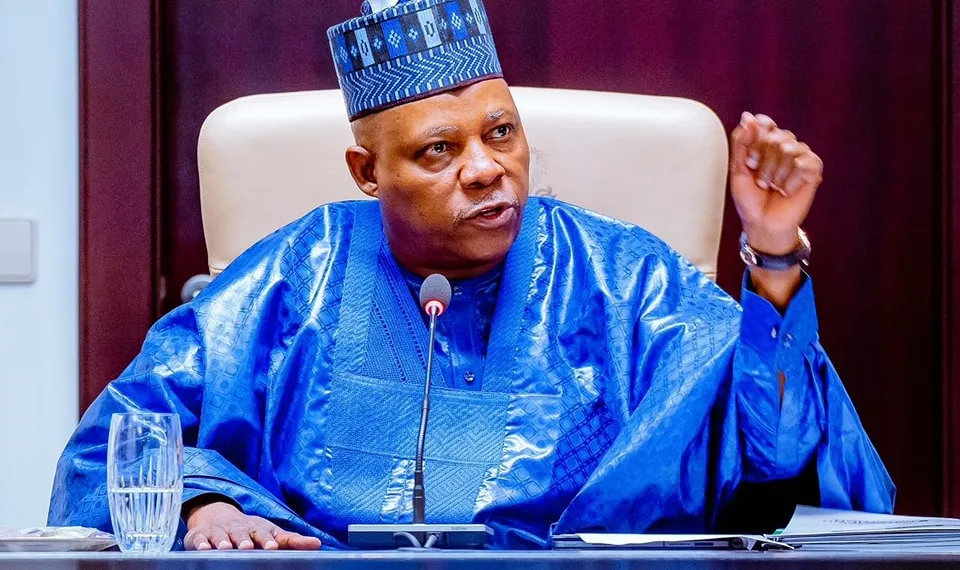
Vice President Kashim Shettima has urged Nigerians to celebrate President Bola Tinubu, saying his leadership saved the country from a potential implosion.
Shettima said Nigeria’s economy had been teetering on the edge of collapse before Tinubu’s intervention, adding that the country could have faced a different situation.
“The economy was teetering on the edge of collapse, we were on a cliff edge,” the Vice President said.
ALSO READ: Subsidy Removal, FX Reforms Driving Fresh Oil Sector Investment – Shettima
“So he literally saved the nation from an implosion. That could have been the scenario. So, instead of demonizing him, Nigerians ought to celebrate this poor man.”
Shettima also called for a return to the drawing board, expressing confidence in the leadership’s commitment and the prospects for the 2027 elections.
“I believe on the bottom of my heart that with this presentation I have seen, and with the commitment of our leadership, by the grace of God, we are going to win,” he said.
Speaking about the 2027 elections, the Vice President reminded his audience that social media platforms should not be mistaken for actual polling stations.
“There are no polling stations on Facebook or Instagram,” he said.
Shettima also expressed gratitude for the efforts made towards promoting the cause of the 2027 elections.

Following observed mis-steps, the Federal Government of Nigeria has withdrawn the eight-count criminal charge brought against the alleged fake Director General (DG) of the Presidential Foreign Intervention Promotion Council (PFIPC), Adeniyi Adeyemi.
Biztellers reports that the matter, in accordance with the counsel of the Attorney General of the Federation (AGF) and Minister of Justice, Prince Lateef Olasunkanmi Fagbemi, (SAN), the matter will be filed at the High Court of the Federal Capital Territory (FCT), instead of the Federal High Court (FHC).
Consequently, upon an unopposed application for termination by the prosecution counsel and Director of the Public Prosecution of the Federation (DPPF), Rotimi Oyedepo (SAN), on Monday, Justice Mohammed Umar of a Federal High Court, Abuja on Monday, struck out the matter.
READ ALSO: Shell Identifies Keys to Nigeria’s Energy Future
In a motion for the termination of the charges, Oyedepo informed the court that the Attorney General of the Federation (AGF) and Minister of Justice has carried out a review of the case file of Adeyemi and the charge filed by the Inspector General of Police (IGP) and found some loopholes.
The DPPF added that the documents allegedly forged by Adeyemi during his operations of the fake agency are those that can be prosecuted by the High Court of the Federal Capital Territory (FCT).
He also informed the court that a new charge has been filed at the High Court of the FCT and that Adeyemi would be expeditiously arraigned afresh.
He therefore urged the judge to strike out the charge as required by law.
Following no objections from Ibrahim Angulu (SAN), who stood in for Adeyemi, Justice Umar subsequently terminated the charge.
Adeniyi, 38, was being tried alongside two others whose whereabouts are unknown, on charges bordering on conspiracy and forgery.
The two others said to be at large were identified as Femi (surname unknown) and Anu (surname unknown).
The charge marked: FHC/ABJ/CR/25/2025, was entered against the defendant by the DPPF.

To secure a bright energy for her teeming population, Nigeria must sustain the momentum of reform, accelerate investment, and deepen partnerships.
This view was expressed by Managing Director, Shell Nigeria Exploration and Production Company of Nigeria Limited (SNEPCo) Ronald Adams in Lagos at the weekend.
Delivering a keynote address at the Africa Energy Conference (AEC) of the Lagos Business School (LBS), Adams called for regulatory certainty through efficient execution of reforms, sustained investment appeal to enable projects to move more swiftly from opportunity to production and partnership by operators, regulators, NNPC Limited and communities to unlock the full value of Nigeria’s resources.
Adams cited Nigeria’s huge oil and gas resources as an advantage but pointed out: “Resources alone do not guarantee prosperity. Prosperity comes when resources are matched with investment, technology, sound policy and disciplined execution. Success will be determined not by the size of our resources, but by our ability to convert them into investment and economic growth.”
Adams pledged the support of Shell towards a bright energy future of Nigerians. He said: “For more than six decades, Shell has been part of Nigeria’s energy journey. Together with our partners, we have helped develop major energy infrastructure, supported Nigerian businesses, invested in talent, and contributed to economic development. Bonga remains a powerful example of what technology, partnership and Nigerian capability can achieve in deepwater operations. Today, that story continues through Bonga North.”
READ ALSO: ADF Targets 5 Million Students, 2 Million Vulnerable Women
Issuing a clarion call for action by all stakeholders, he added: “The world is not standing still. Capital is moving, technology is advancing and competition is intensifying. The countries that attract investment tomorrow are those that improve competitiveness today. Nigeria has begun that journey. Our task is to sustain the momentum and translate reform into projects, projects into growth, and growth into shared prosperity.”
The conference, the 4th in the series had at its theme; “Securing Nigeria’s Energy Future: Policy Reform, Capital Mobilisation, and Pathways to a Sustainable Power and Energy Market” and was attended by top government officials, industry captains, energy professionals, and students.
Lagos State Deputy Governor Obafemi Hamzat represented Lagos State Governor Babajide Sanwo-Olu as the guest of honour. SNEPCo was a principal sponsor of the Africa Energy Conference (AEC) and mounted a well-received exhibition on its deepwater operations and social investments across Nigeria.






State Govs, Wike Endorse One-Party State, Join APC Campaign Council

2027: ‘Tinubu Has Done Well’ – Wike Tells Opposition to Speak the Truth

‘Celebrate This Poor Man’ – Shettima Defends Tinubu Over Economic Crisis
FG Withdraws Charges Against ‘Fake Agency’ DG, Adeniyi Adeyemi

Shell Identifies Keys to Nigeria’s Energy Future

Nigeria Records Biggest Rise in Multidimensional Poverty Among Five Countries – UN

Trump’s Family Unveils New Cryptocurrency Platform

Senate Denies Receiving Petitions Against Tinubu’s Ambassadorial Nominees

Dangote Cement Lights Up Benue Host Communities With CSR Initiatives

Reps Recommend 3-year Jail Term For Aviation minister

Tems Sets New Record On Billboard Hot 100 Chart
